Physio Lab Exam 1 - Skeletal Muscle
 Call Kai
 Learn
Learn Practice Test
 Spaced Repetition
 Match
Match Flashcards
 Knowt Play
1/70

There's no tags or description
Looks like no tags are added yet.
Name | Mastery | Learn | Test | Matching | Spaced | Call with Kai | Chat |
|---|
No analytics yet
Send a link to your students to track their progress
71 Terms

smooth muscle
involuntary and non-striated
in blood vessels and GI tract
uni nucleated

skeletal muscle
voluntary and striated
in the biceps and triceps
multi nucleated

cardiac muscle
involuntary and striated
uni or multinucleatic
how is the diaphragm a special case of skeletal muscle?
its important function of respiration is involuntary primarily but we can also take over if we want o
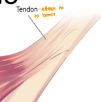
tendon
attaches muscle to bones

ligaments
attaches bone to bone

epimysium
connective tissue layers that surrounds a muscle group
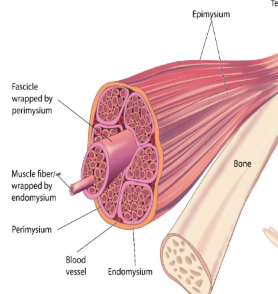
perimysium
connective tissue layer that surrounds a fascicle

endomysium
connective tissue layer that surrounds muscle fiber/cell
organization of skeletal muscle?
muscle → fascicle → fiber/cell → myofibril → sarcomere

longtudinal section of skeletal muscle
multinucleic nuclei sit at the edges of fiber unlike other cells!
alternating light/dark bands
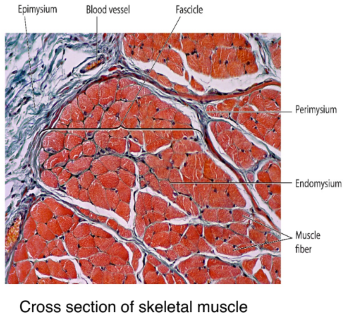
cross section of skeletal muscle

sarcomere
functional repeating segment units or most basic unit of a muscle that ultimately makes muscles move
area from z-line to z-line

myofibrils are in a muscle ___.
they are made of repeating segments aka ___.
they have ____ aka contractile proteins: actin and myosin
cell
sarcomeres
myofilaments
what are the two protein filaments of myofibrils?
thick/myosin
thin/actin

troponin and tropomyosin
two additional proteins on the actin molecule
small portion of muscle that help regulate contraction process
a band
region of myosin filaments and some overlapping actin
dark region of the sarcomere
I band
region that contains only actin filaments
light region of sarcomere
H zone
region in the center of each A band thats a portion of myosin filament w/o overlap of actin
Z line
how sarcomeres are divided from each other
in the center of each I band
M line
in the center of each A band
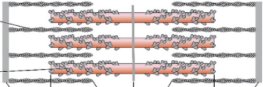
sarcomere relaxation
sarcomere at resting length
all bands are visible

sarcomere contraction
z disc are closer together
I band and H zone disappear
zone of overlap increases
no change in size of A band
as muscle contracts, myosin ___ grab onto ___ → pull it ___ → 2 lines come closer together → sarcomere shorterns
ACTIN AND MYOSIN DON’T SHORTEN; THEIR OVERLAP JUST INCREASES
___ and ___ bands get smaller
heads → actin → inwards
I … H
peripheral nucleias are in sarcolemmas
true
importance of tubules of sarcoplasmic reticulum
where calcium is stored until contraction signal
extends into the interior of muscle fiber → helps depolarization reach every membrane

overall internal structure of skeletal muscle:
skeletal muscle → myofibril → sarcomere → filaments
what are the three parts of excitation-contraction coupling
electrical, chemical, and mechanical
what is excitation-contraction coupling
process that pairs depolarization of a neuron w/ depolarization of a muscle cell
motor neuron - nerve cell that innervated muscle fibers
NMJ - spot where nerve endings meats muscle fibers
electrical excitation contraction coupling:
ach is released at the ___ and binds to receptor site on the ___
___ happens in the muscle membrane
___ of T tubules causes ___ channels to open
NMJ
action potential
depolarization … calcium
chemical excitation contraction coupling
intracellular concentration of calcium ___
calcium binds to ___ on thin filaments
___ moves to let myosin bind to actin
increases
troponin
tropomyosin
mechanical excitation contraction coupling
___ cycling begins and force is ___
calcium is ___ by the ___ → muscle relaxes
cross-bridge … generated
reaccumulated … SR
detailed excitation-contraction coupling:
AP is made in neuron → goes to axon → nerve impulse stimulated AcH release into synaptic cleft (released via exocytosis)
AcH released from synaptic vesicles of axon terminal → diffuses across cleft and attaches to receptors on sarcolemma → impulse made to excite the muscle cells
impulse propagates along sarcolemma and polarizes the T tubulus → calcium channels open → rise in intracellular concentration of calcium
calcium is released from the sarcoplasmic reticulum and into the cytoplasm to bind to troponin for contraction
troponin
regulatory protein on thin filament that binds calcium to initiate contraction
polypeptides w/ 3 subunits
TnI troponin and its significance
inhibitor subunit
elevated lvls in a blood test → physiological indicator of cardiac damage
elevated lvls → sign of heart attack in a patient
TnT troponin
helps bind troponin and tropomyosin
TnC troponin
available calcium is cytoplasm that binds to TnC
what calcium binds to to get tropo myosin to move
when calcium concentration is low what happens?
tropomyosin blocks the myosin binding site on actin → no contraction
when calcium concentration is high what happens?
calcium binds to troponin complex (TnC) → tropomyosin allows myosin to bind to actin → contraction
sliding filament theory
filaments dont shorten, they slide
the sarcomere shortens
the muscle fiber shortens
process results in shortening of muscle and force generation

sliding filament theory process:
cocked: ATP is ___into ___ and ___→ myosin heads ___to ___conformation
cross bridge: myosin head binds to ___ monomer, making a ___bridge
power stroke: ___ P is released → myosin heads ___ ____ (like a bicep curl) → filament slide past each other → myosin drags ____ inward along w/ a zlines → how sarcomere shorterns
attached: ___ released but myosin is still ___ to actin (___state)
release: ___ binds to myosin → ___ of actin-myosin complex
hydrolyzed … ADP … P … returns … resting
actin … cross
P … change formation … actin
ADP … still … contracted
ATP … dissociation
motor unit
comprises a single motor neuron and the muscle fibers it innervates
varies in size
small motor units
motor units involved w/ pecise motor activites
large motor units
units involved with large motor activites
recruitment of motor units
process where motor units are recruited from smallest to largest
our bodies always use the minimum force necessary before recruiting more
a pianist’s finger muscle have motor units of 3-5 → ultra-precise
quadriceps motor unit have 1k+ fibers → built for power not precision
Isometric action
muscle contracts but length stays the same; the force generated is insufficient to overcome the load
contracted but still losing energy
isotonic action
the contraction tension stays constant but the muscle changes in length and moves the load
2 types: concentric and eccentric

concentric action
type of isotonic action where muscle contracts and shortens

eccentric action
type of isotonic action where the muscle contracts and lengthens
agonist
primary mover
i.e bicep
syngergistic
muscles that assist the agonist (primary mover) group
i.e brachioradialis
antagonistic
muscles that oppose the agonist
i.e tricep
structural and histological features determine the type of fibers based on ___
size, diameter, and myoglobin
myoglobin
oxygen binding molecules that facilitates oxygen transport into myocytes
slow twitch (T1)
what endurance athletes use → have smaller cross sectional layer
myoglobin rich
lots of oxidative enzymes
high mitochondrial volume
surrounded by dense capillary networks
fatigue resistant
slower maximal shortening velocity
highly efficient
cells make a lot of energy for aerobic respiration
fast twitch IIX
What rapid-movement athletes use like basketball players
small amount of mitochondria
less resistant to fatigue
rich in glycolytic enzymes
generate the highest power input
power/speed
less efficient
twitch IIA
intermediate fibers
mixture of both Type 1 and Type IIX
i.e 800m runner → fibers are not purely aerobic → fatigue but can stil generate force to sustain pace -
mixture and intermediate power/speed
less efficient
hypertrophy
an increase in muscle fiber diamter due to myfibril size increase
phyiolgoical adapatations because of strength training are result in increase in muscle size not number
muscle soreness
result of microscopic injury/tears to the muscle fibers
DOMS
not result of lactic acid accumulation
delayed onset muscle soreness (doms)
inujury occurs → 24-48 hrs peak soreness → resolution
sex differences
men are stronger regarding absolute strength but relative strength per unit muscle mass is similiar
testosternone directly stimulates muscle growth
is it true that theres research that female m. is more fatigue resistant?
yes bc women recruit more muscle for a given task which distributes work load
according to the journal of applied physio, women have ___ less upper body strength and ___ less lower body strength
40% … 33%
rigor mortis
postmortem muscle stiffness resulting from rigid cross bridges in the absence of ATP
helpful for estimating time of death 12 hrs after
dying cells dont have proper ability to exlude calcium → leaking → calcium floods cytoplasm → calcium binds troponin and tropomyosin moves out the way … locked in contraction state
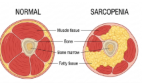
sarcopenia
Age related decline in muscle mass begins around age 25 and occurs across the lifetime.
slow phase sarcopenia
10% of muscle mass is lost from 25 to 50 years
rapid phase sarcopenia
An additional 40% of muscle mass is lost from 50 to 80 years
● Generally, see in a shift in fiber type (heavy loss of fast twitch, increase of slow
twitch).
muscular dystrophy
group of hereditary muscle diseases that weaken skeletal muscle characterized by defects in muscle proteins/lack of dystrophin protein that results in a progressive muscle weakness and a loss of muscle fibers
bad prognosis w/ no cure and short lifespan bc the diaphragm is affect which can cause respiratory failure
why are men more affected by muscular dystrophy compared to women?
bc its a mutated gene expressed on the X chromosome, which men only have one of
thin filaments
filaments made of actin along w/ regulatory proteins troponin and tropomyosin
tropomysosin
regulatory protein that blocks the myosin-binding site on actin when calcium lvls are low