RBTC Safety
 Call Kai
 Learn
Learn Practice Test
 Spaced Repetition
 Match
Match Flashcards
 Knowt Play
1/191

Earn XP
Description and Tags
-Radiation Protection,
Name | Mastery | Learn | Test | Matching | Spaced | Call with Kai | Chat |
|---|
No analytics yet
Send a link to your students to track their progress
192 Terms
The patient (scatter radiation)
Is the primary source of occupational dose
85% to 99%
Lead shielding is very effective at reducing occupation dose from scatter radiation Can reduce it by ____ to __%.
Half
A higher energy beam (tube potential) requires a thicker shield to reduce the dose by _____.
0.50 mm Pb (lead)
Predetermined thickness for a lead apron
0.50 mm Pb
Predetermined thickness for a lead thyroid shield
0.35 mm Pb
Predetermined thickness for a lead glasses
0.25 mm Pb
Predetermined thickness for a lead gloves
0.25 mm Pb
Predetermined thickness for a lead protective curtain and bucky slot cover
Primary beam
The barrier at which the primary beam is directed.
Primary barriers
What type of barrier?
Wall behind the wall bucky
Floor underneath the examination table
secondary
Doors to the x-ray room are considered a (primary/secondary) barrier
Never be larger than the detector or anatomy of interest
The X-ray beam cannot be focused and it radiates in all direction from the anode. As the x-ray beam travels to the x-ray tube, it diverges and becomes much larger than necessary. This is a problem as the x-ray field should never be larger that the _________ or ____________
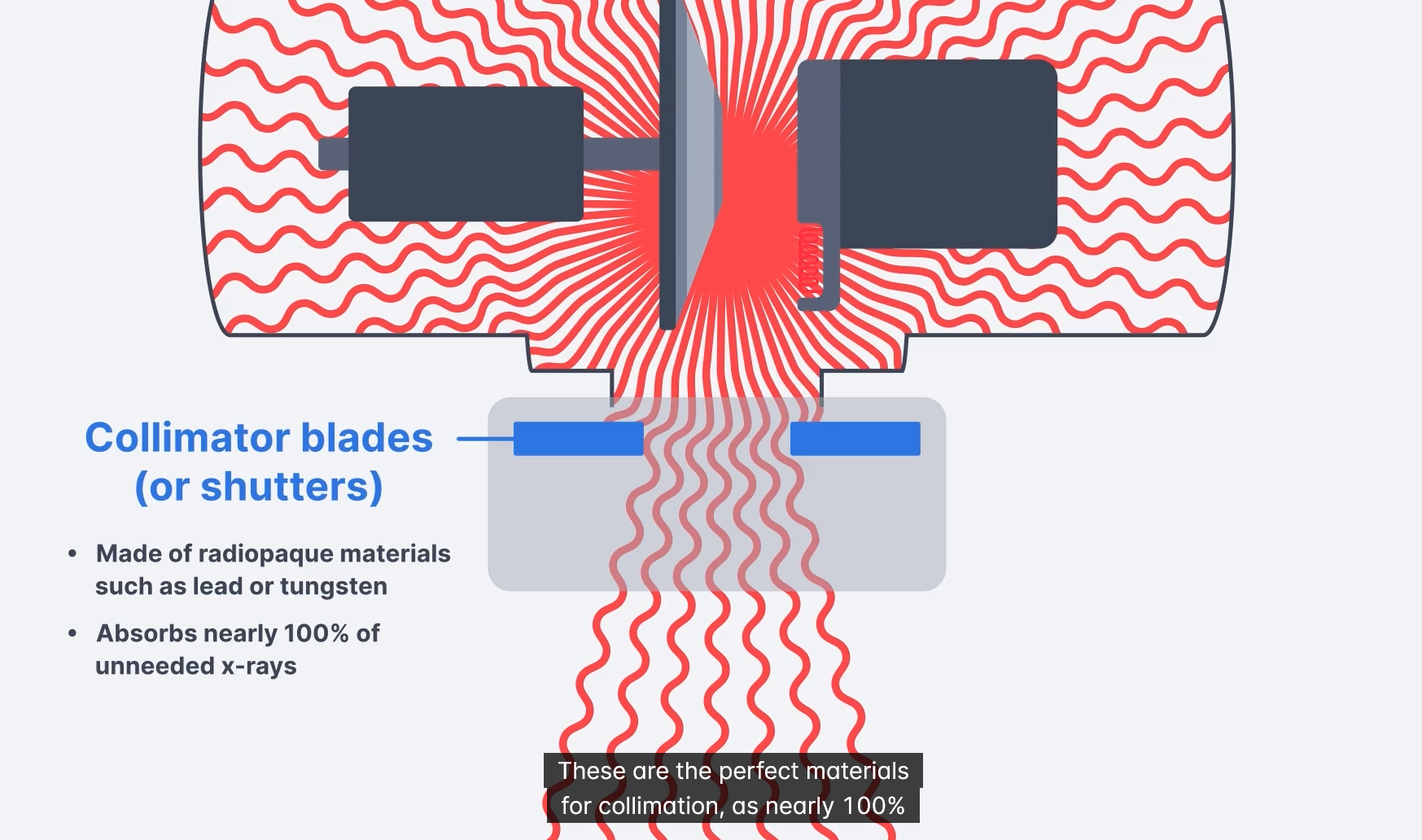
Collimator blades (or shutters)
-Made of radiopaque materials such as lead or tungsten.
-Absorbs 100% of unneeded x-rays
Positive Beam Limitation (PBL)
Automatically adjusts the collimation to match the detector size.
Effective dose (higher effective dose = higher cancer risk)
Measurement that corresponds to the potential cancer risk for the patient from the exposure. Can be reduced with good collimation.
Effective dose
is based partially on the amount of exposed tissue and the sensitivity of exposed tissues
-Large bowel
-Liver
-Kidney
-Breasts
If open collimation is used for an AP Lumbar spine, exposure to these tissues significantly increases the patient’s effective dose
Effective dose to the patient (reduces cancer chance)
Reduces Scatter and improves image contrast
Using accurate and better collimation can reduce these 2 things.
Increased image contrast due to less scatter radiation produced
The use of lead collimation to reduce the exposure field size has what effect on radiographic image quality?
Divergent
What term describes the expansion of the x-ray beam as it travels through space?
Filtration
Process that removes the lower energy photons from the x-ray beam and decreases patient dose.
Entrance Skin Dose (ESD)
Unfiltered x-ray beam has a huge number of low energy photons, these photons don’t have energy to penetrate the patient and is instead absorbed in the patient’s skin and add nothing to the x-ray image. This is called the _________________
By adding filtration
How do you decrease the Entrance Skin Dose?
Aluminum (Al) because of its low atomic number of 13 which is good for absorbing low energy photons and allowing transmission of high energy photons
What is the most common filtration material? and why?
Filtration decreases the quantity of the beam as some photons are absorbed by the filtration.
Filtration decreases the quality of the beam as it increases the average energy as low energy photons are absrobed.
Filtration changes both the quality and quantity of the beam.
-Adding filtration (increases/decreases) the quantity
--Adding filtration (increases/decreases) the quality
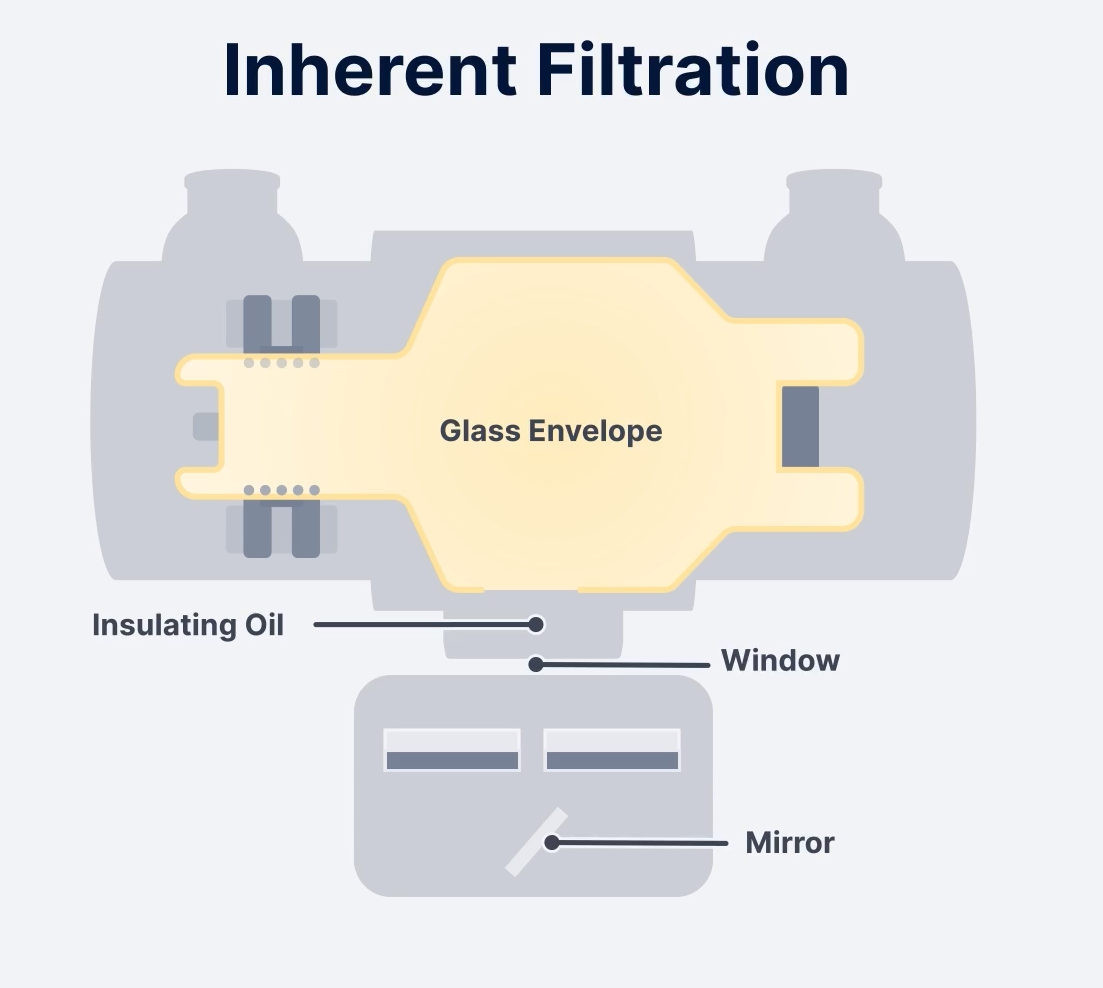
Inherent Filtration (built-in filtration)
Includes the:
-Glass envelope
-Insulating oil
-Glass window of tube housing
Mirror within the collimator housing
Added filtration (can only be added by the physician or doctor)
Refers to the aluminum plates added to the collimator housing that removes most of the remaining low energy photons
Inherent filtration + Added filtration
How do you calculate Total filtration?
Aluminum equivalence (Al eq.)
For inherent filtration and added filtration, what do you try the equivalate of since most of them are not made of this material?
0.5 mm Al eq.
What should be the Aluminum equivalence (Al eq.) for the Inherent Filtration?
Includes:
-Glass envelope
-Insulating oil
-Glass window on the tube housing
About 2.0 mm AL eq.
What should be the Aluminum equivalence (Al eq.) for the Added Filtration?
Includes:
-Aluminum
-Copper
-Tin
2.5 mm Al eq.
In general radiography, all machines can operate above ___ kVp.
0.5 mm Al eq.
What is the NCRCP 102 Recommendations for total filtration for using operating kVp BELOW 50 kVp?
1.5 mm Al eq.
What is the NCRCP 102 Recommendations for total filtration for using operating kVp between 50-70 kVp?
2.5 mm AL eq.
What is the NCRCP 102 Recommendations for total filtration for using operating kVp ABOVE 70 kVp?
Half-value layer
Measures the hardness (average energy) of the x-ray beam
Increase
As an x-ray tube ages, the measured half-value layer (HVL) is expected to (increase/decrease)
Bronzing
Tha accumulation of tungsten on the glass envelope is called?
Image quality and patient dose
Half-value layer of an x-ray affects these 2.
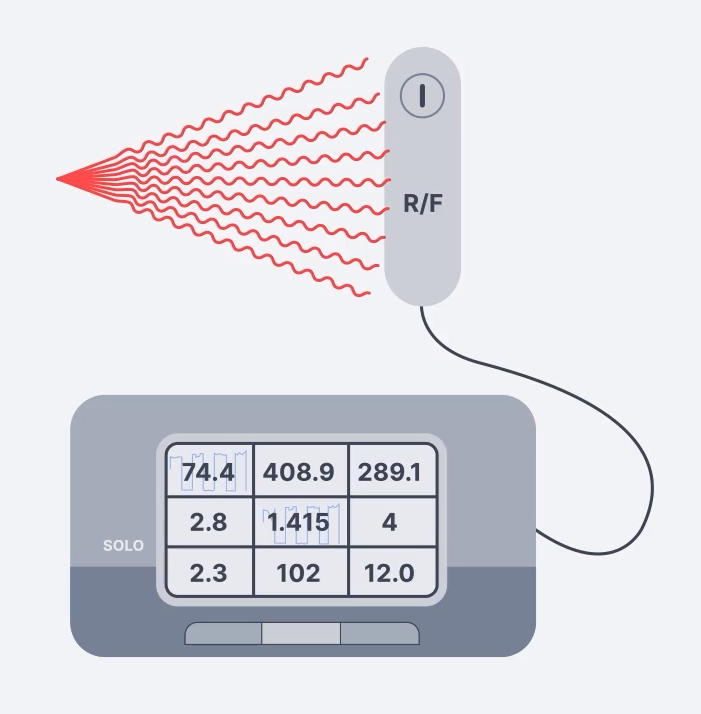
Equipment survey devices
Ensure proper radiation output of X-ray machines.
-used by medical physicists to make sure the mA and kVp assigned are the actual mA and kVp used during exposure.
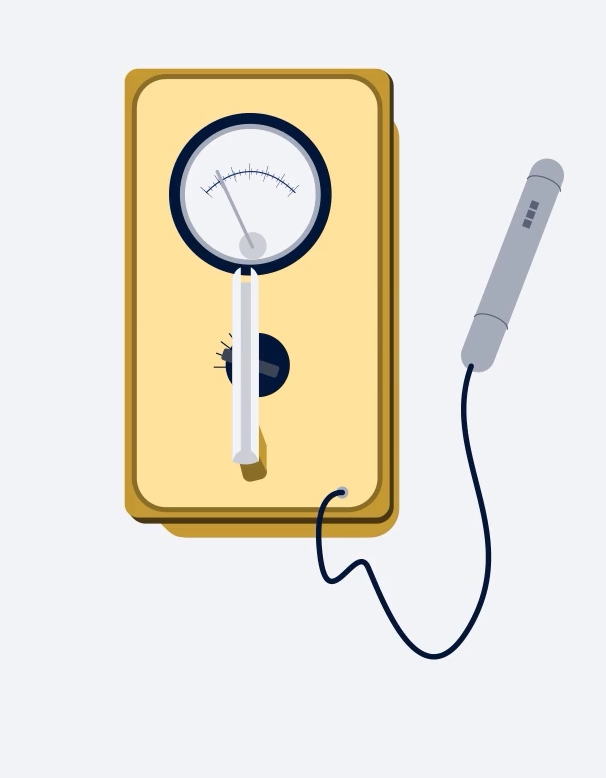
Environmental survey devices
Monitor radioactive contamination and x-ray transmission into occupied areas.
-important for occupation and public safety to protect people.
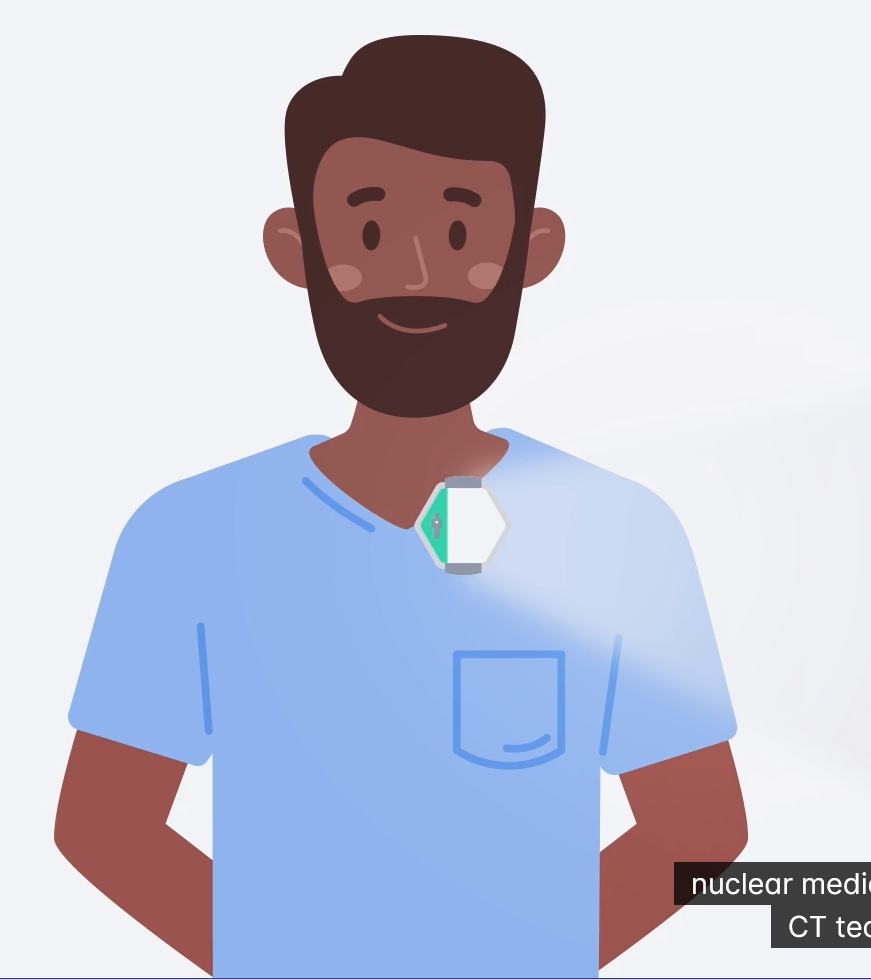
Personal dosimetry device
Track radiation dose to occupation workers
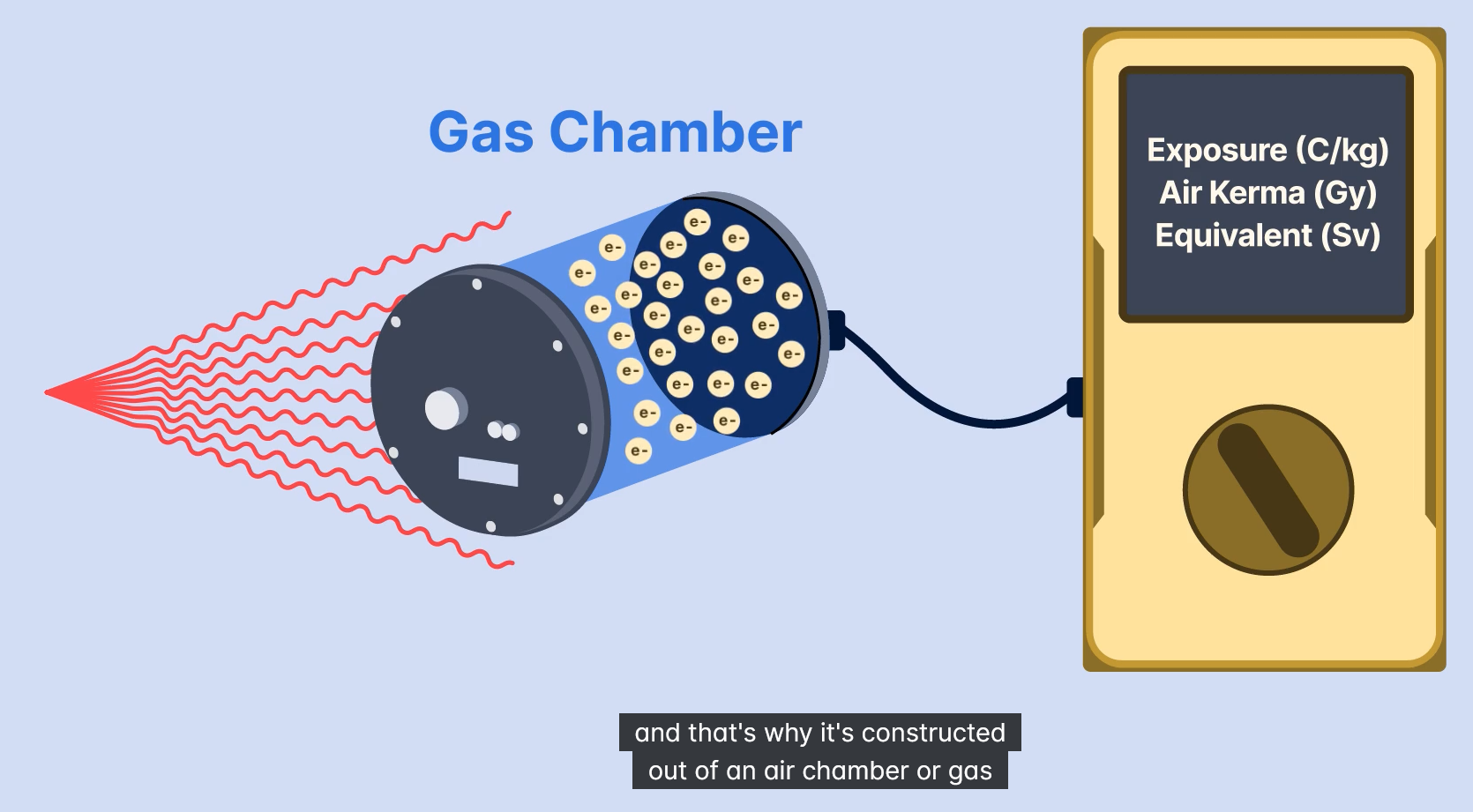
Ionization chambers
-Built around a very simple air chamber or gas chamber.
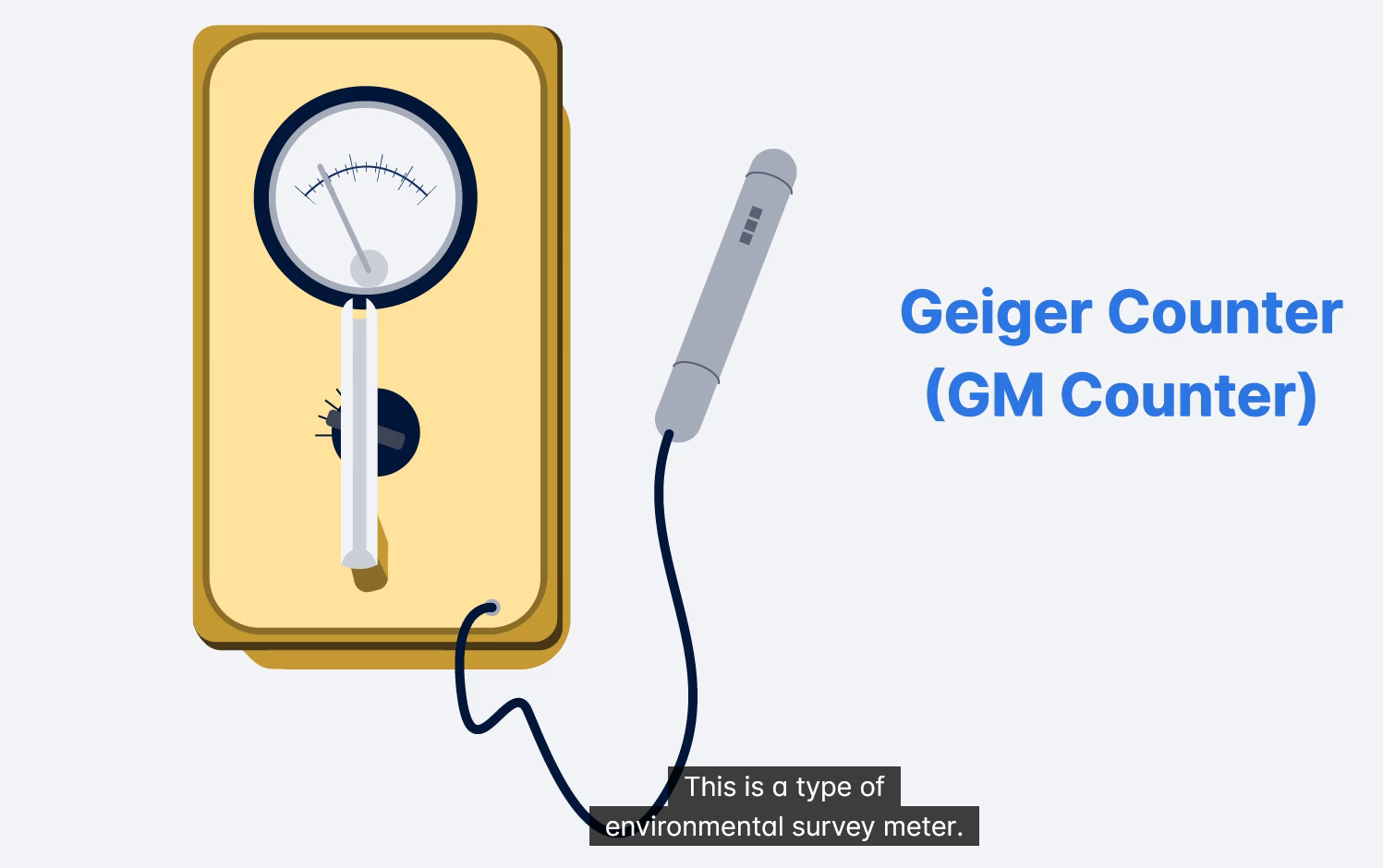
Geiger Counter (GM Counter)
Type of Ionization chamber that is used extensively in nuclear medicine departments to check for radioactive contamination. (type of environmental survey meter)
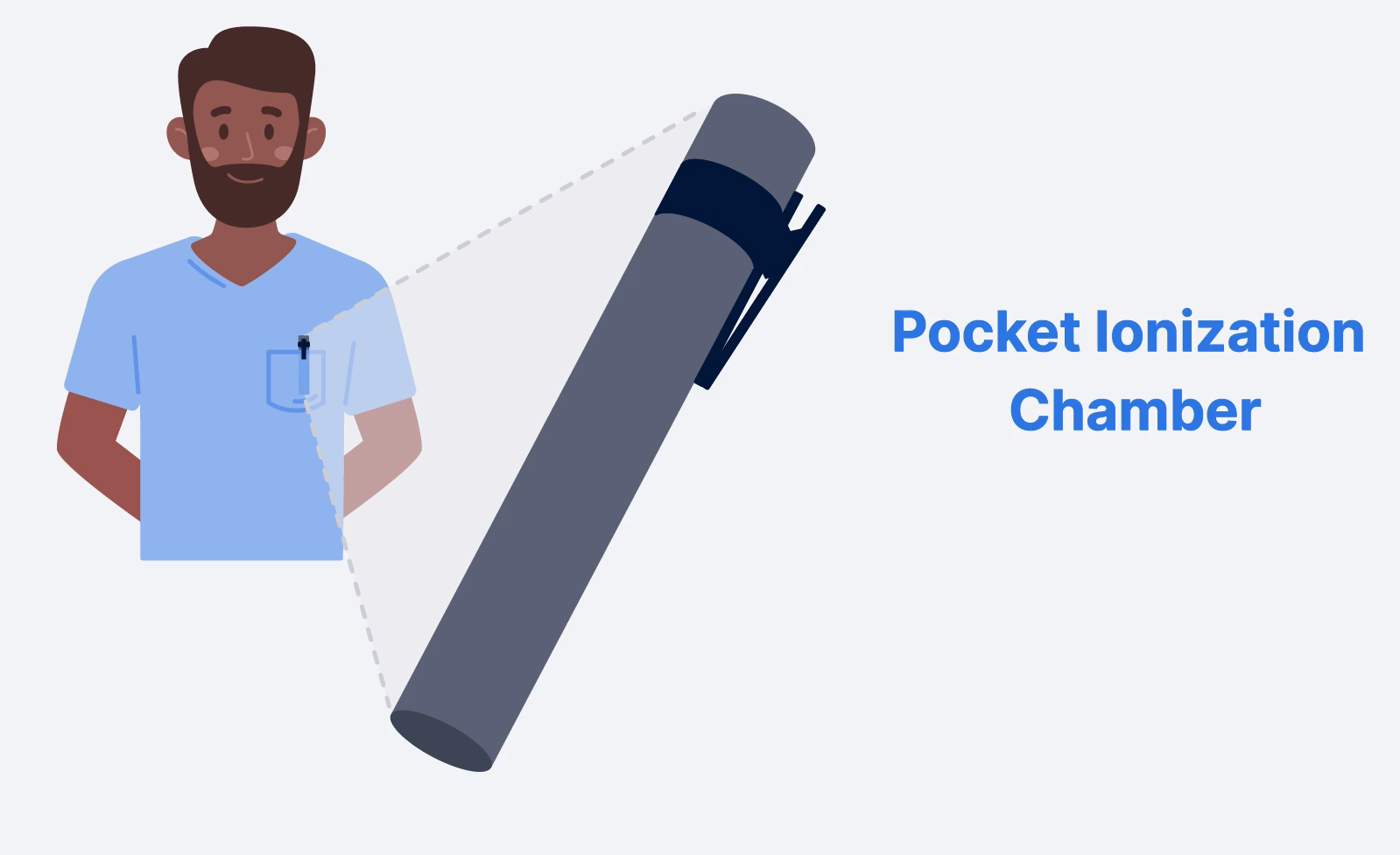
Pocket ionization chamber
Type of ionization chamber that is very valuable because they can be read immediately by looking through the chamber at a dial and is considered an occupation dosimeter.
Air in the chamber
In an ionization chamber, the radiation measurement is provided based on radiation interactions with:
Sievert
Measuring unit for equivalent dose
Gray (Gy)
Measuring unit for air kerma
Coulombs per kilogram (C/kg)
What is the unit of measurement for exposure?
Scintillation detector
-Used for environmental surveys by nuclear medicine technologists, medical physicists,
-Used in indirect capture DR image receptors
-Has a fairly complex design and multiple layers
Scintillation
The creation of visible light.
- the process of emitting a flash or spark of light.
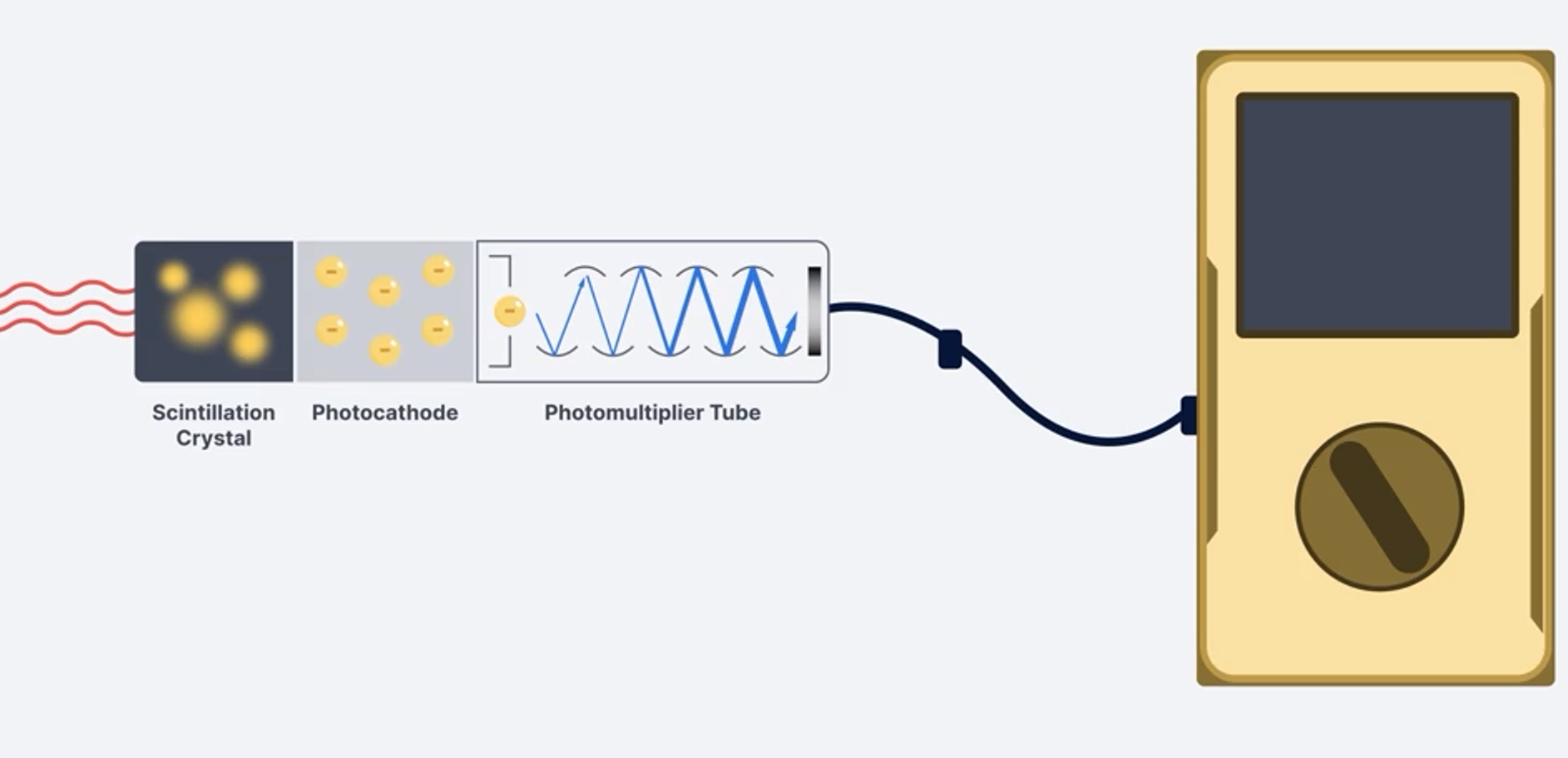
Scintillation crystal → Photocathode → Photomultiplier tube
Components of a scintillation detector in order:
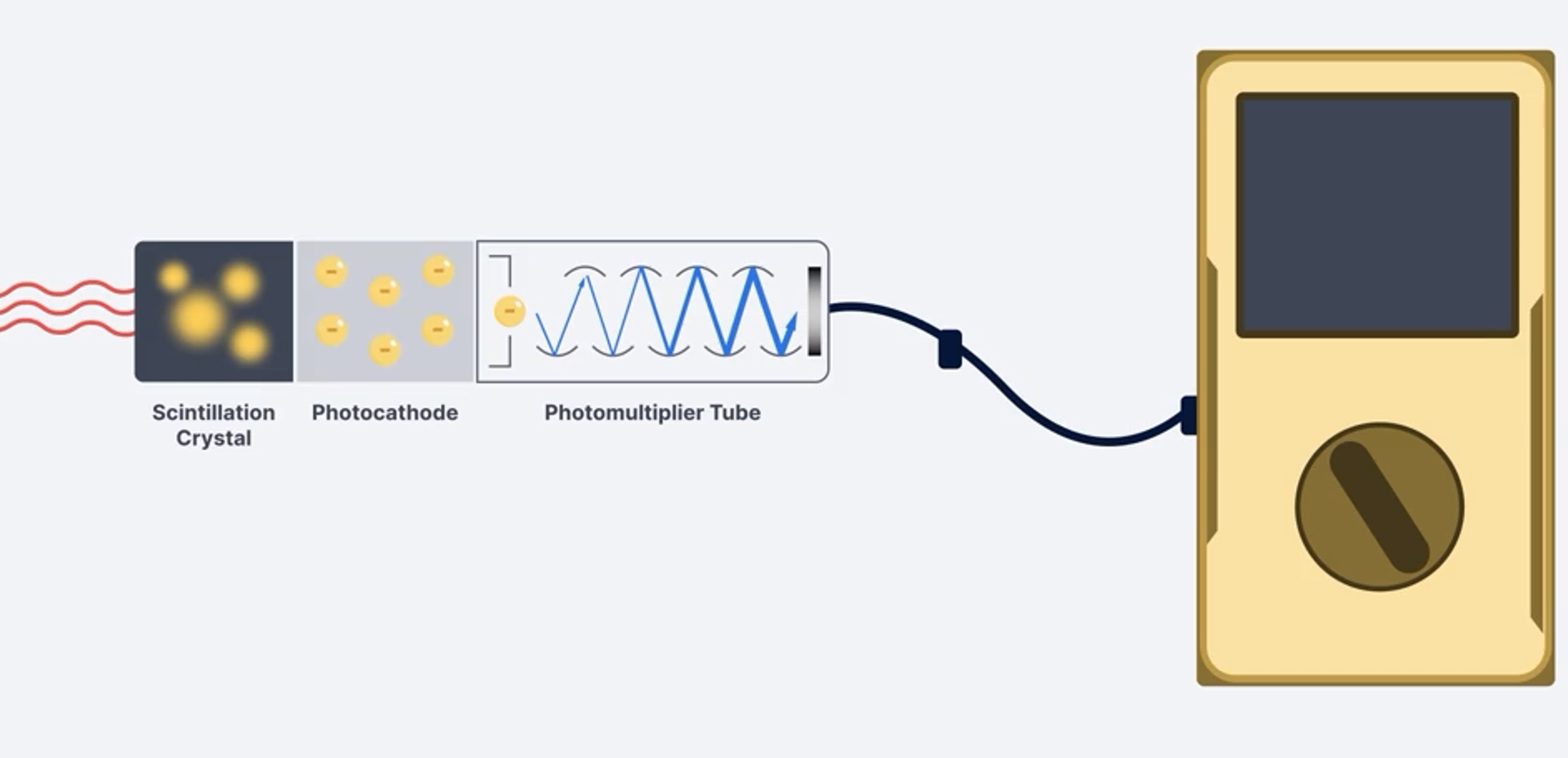
Scintillation crystal
First component of a Scintillation detector.
-Usually a solid material and very effective at absorbing radiation.
-Converts X-rays into light.
-When struck by photons, it creates bursts of light that we call scintillation.
-Scintillations are created by interactions with photons.
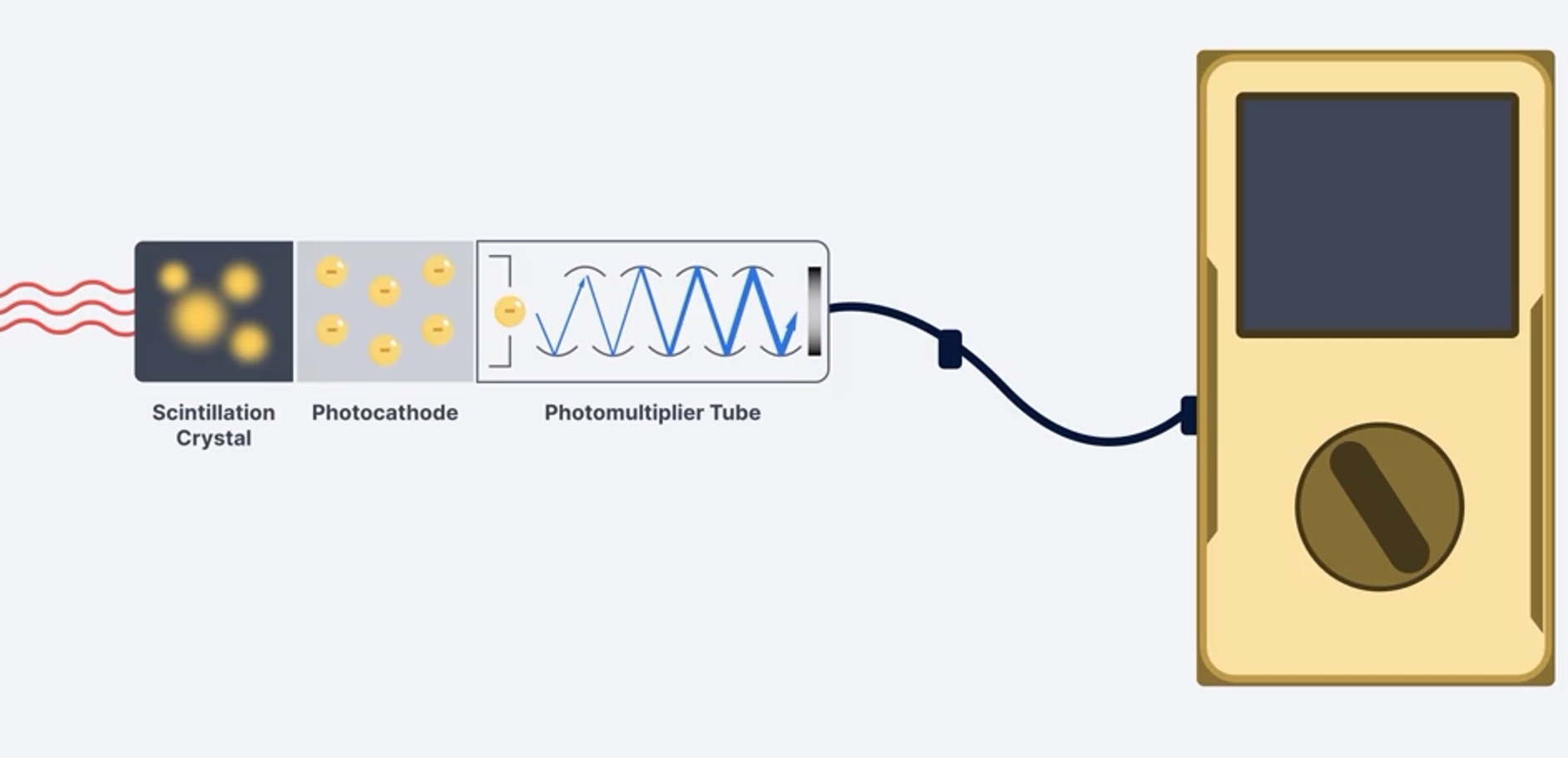
Photocathode layer
Second layer of the Scintillation detector.
-Where it converts light photons into electrons.
-The point at which the radiation signal is first converted into an electrical signal by these electrons.
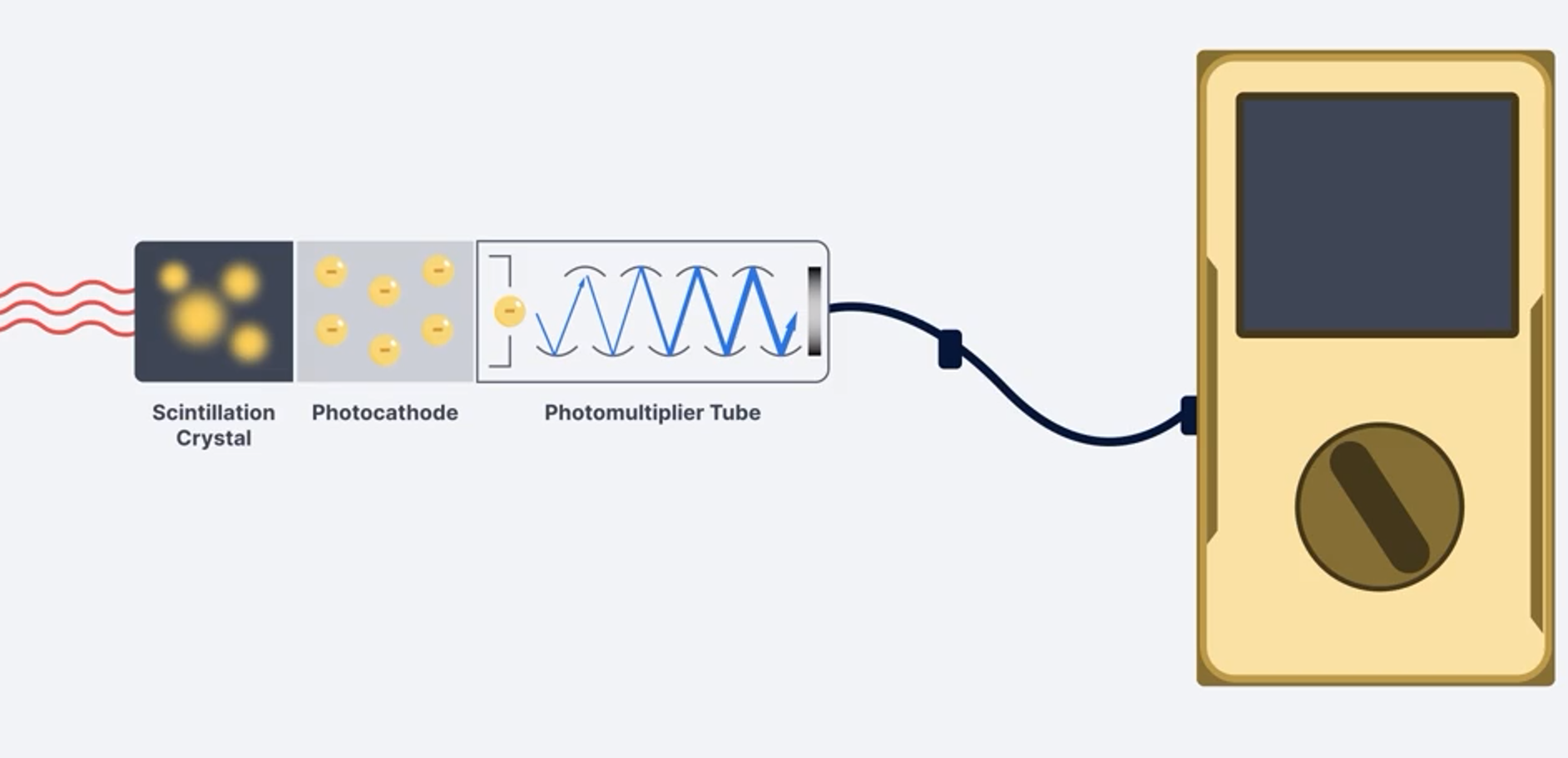
Photomultiplier tube
Third layer of the Scintillation detector.
-Multiplies the electrical signal from the photocathode so it can be measured.
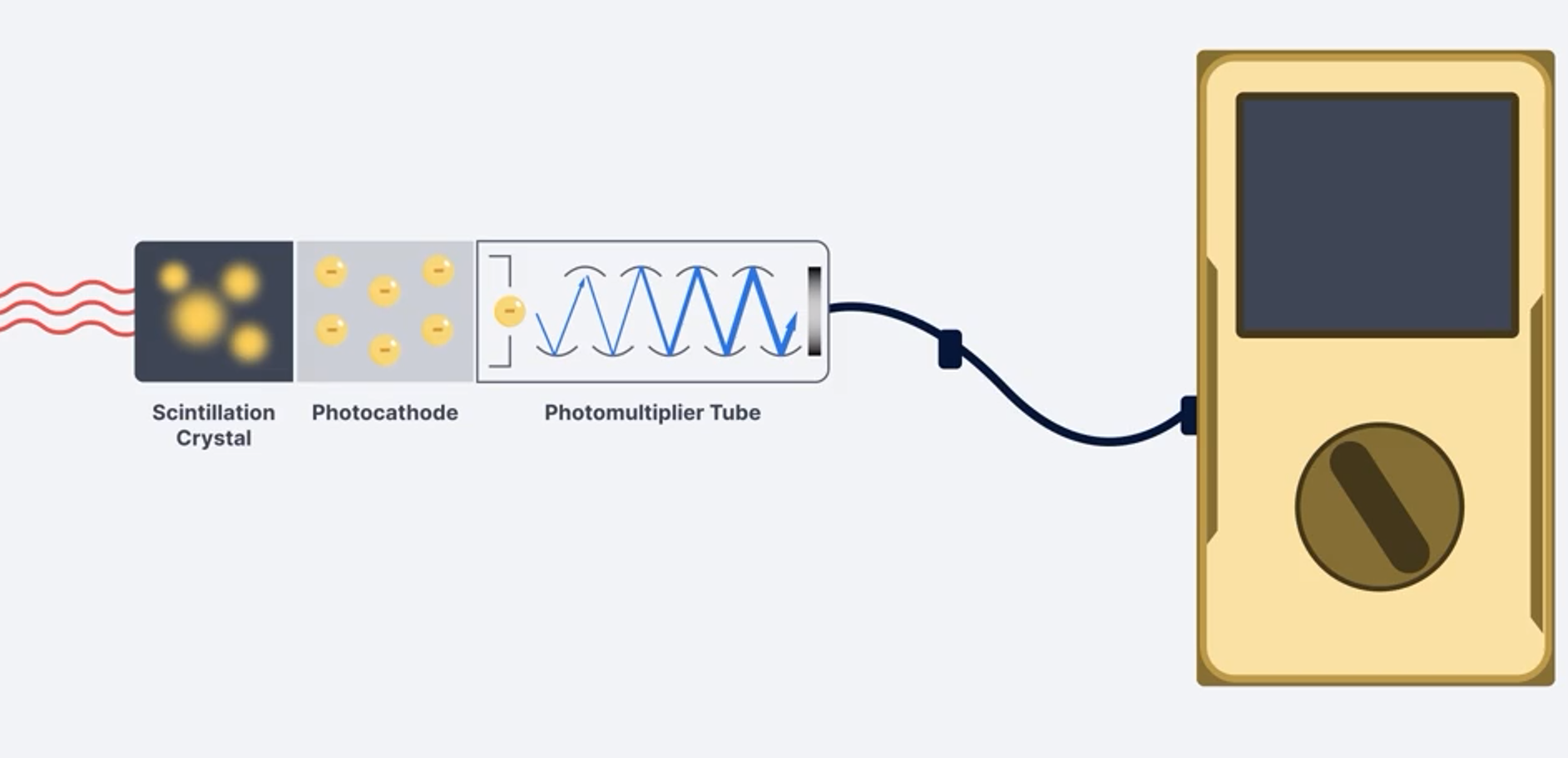
Readout screen
Where the electrical signal from the Scintillation detector is sent after it passes through its 3 layers.
Converts it into a useful measurement.
Radioactivity (Becquerel)
Most Scintillation detectors are used to measure:
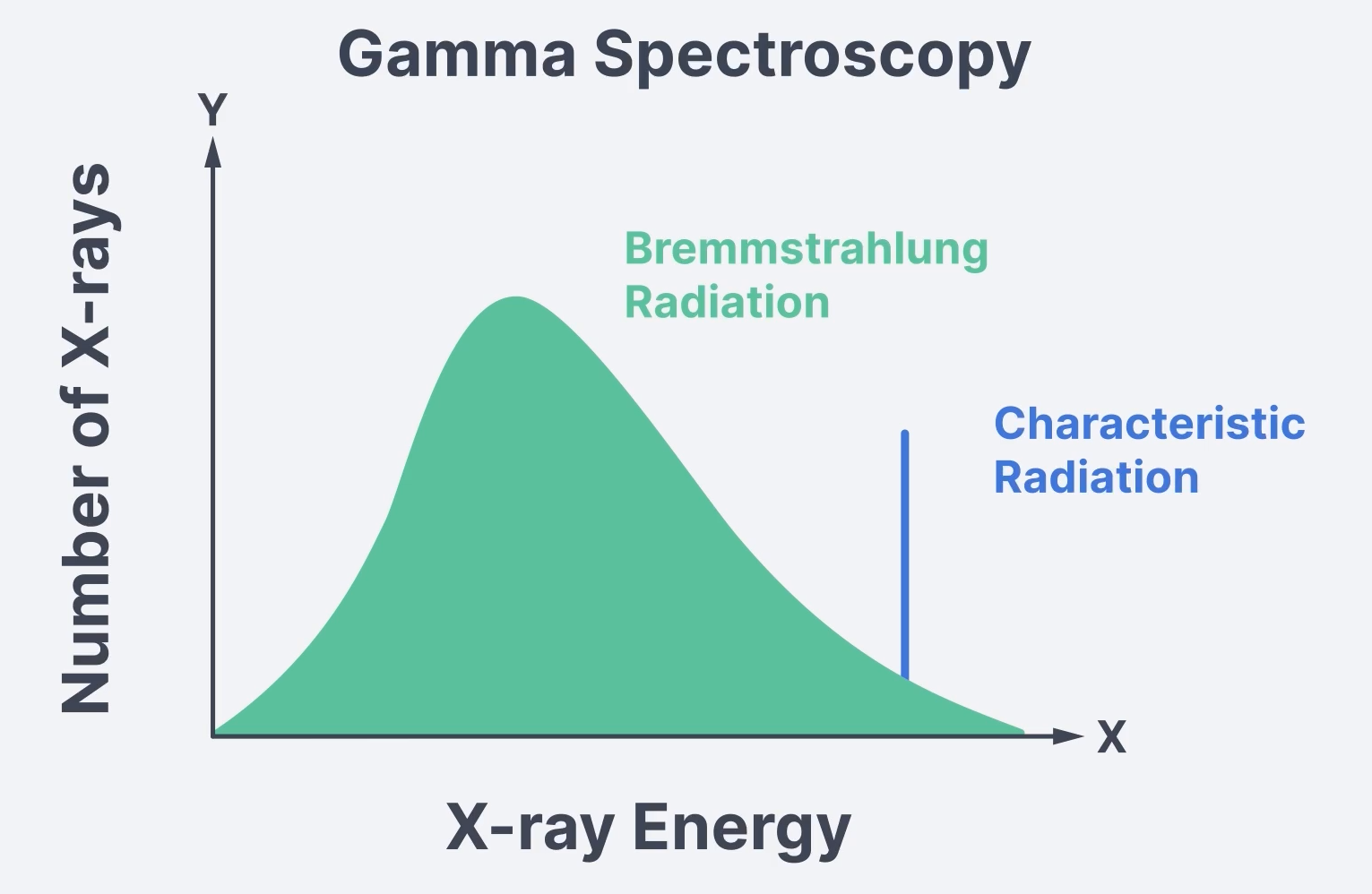
gamma spectroscopy (also called photon spectroscopy)
The process which the X-ray beam energy is measured (keV)
Visible Light
Scintillation is a process that creates which of the following?
Semiconductor crystal → Amplifier → Display Screen
Semiconductor detectors components in order:
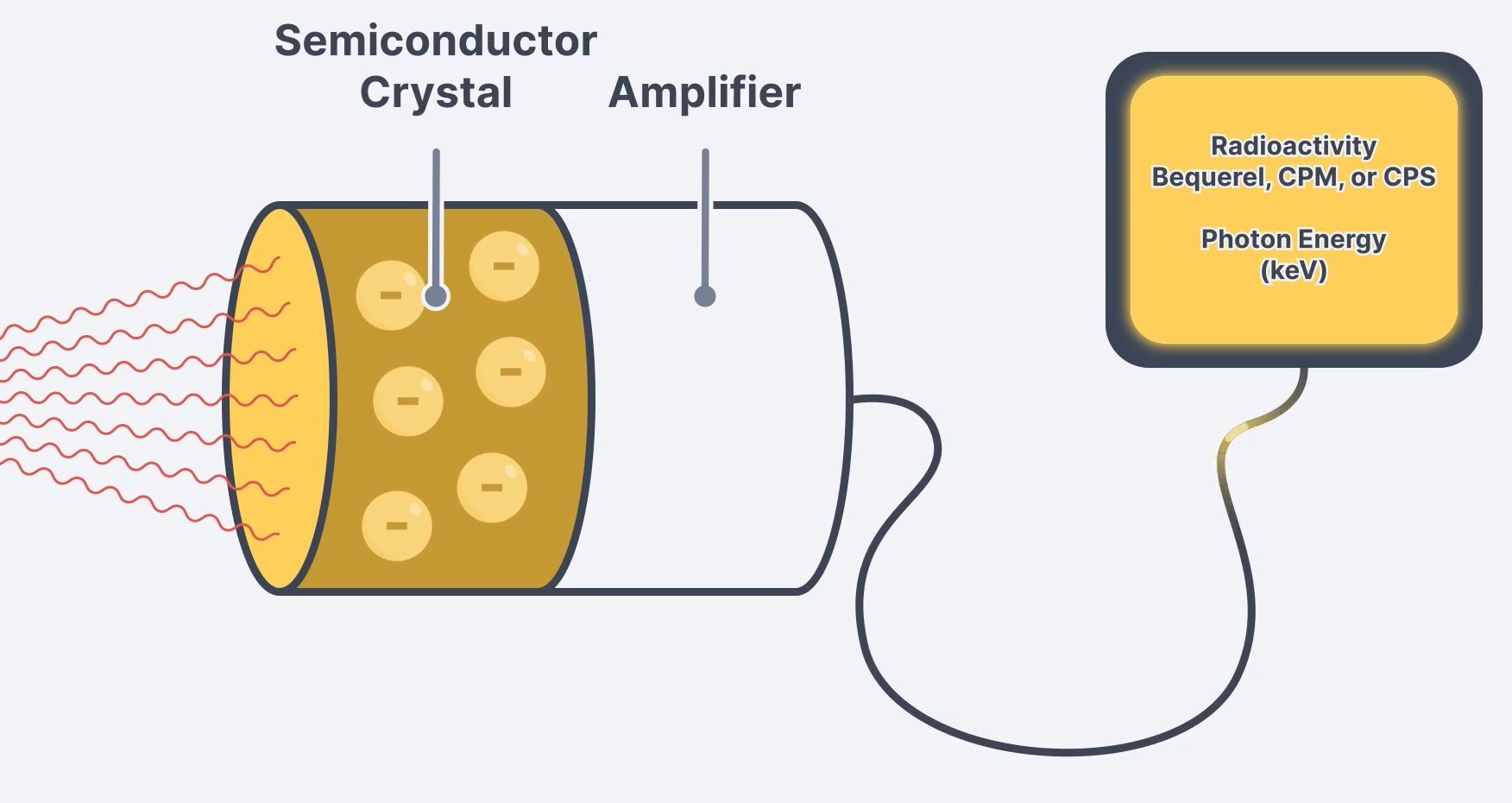
Semiconductor Crystal
First component of a Semiconductor detector.
-When photons strike this material, it immediately creates electrons.
-Called a semiconductor b/c it conducts electricity when stimulated by radiation.
-Sometimes called a photoconductor b/c it conducts electricity in response to photons.
A semiconductor detector does not have a photocathode.
-Semiconductors do not produce visible light as they directly convert x-ray photons into the electrical signal.
What makes a semiconductor detector different from a scintillation detector?
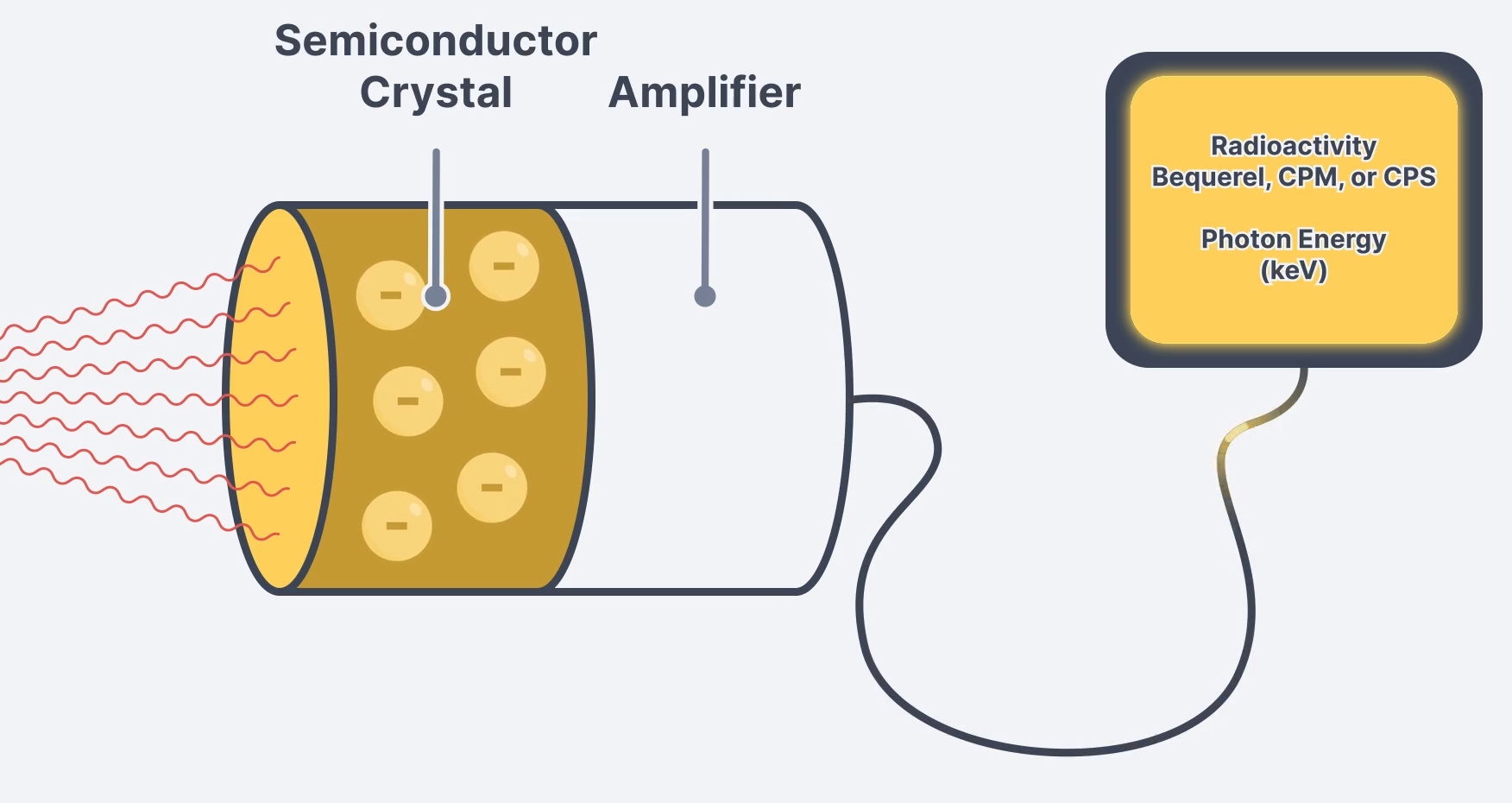
Amplifier/multiplier
Second component of a Semiconductor detector.
-Electrical signal from Semiconductor Crystalis is too weak to measure, so it is increased here.
to measure radioactivity (Becquerel)
Semiconductor detectors are usually used to measure:
50 mSv
Healthcare Worker Annual effective dose limit to the whole body is ____
(these limits are used to limit the probability of stochastic effects like cancer)
150 mSv
Healthcare Worker Annual effective dose limit to the eyes is _____
(these limits are used to limit the probability of radiation-induced cataracts)
500 mSv
Healthcare Worker Annual effective dose limit to the skin and extemity is _____
(these limits are used to prevent deterministic effects, which are only possible at very high doses.)
10%
The dose limits for the members of the public are ___ of the occupational dose limit.
5 mSv
Worker Annual effective dose limit for members of the public for whole body is ____
(these limits are used to limit the probability of stochastic effects like cancer)
15 mSv
Worker Annual effective dose limit for members of the public for the eyes is _____
(these limits are used to limit the probability of radiation-induced cataracts)
50 mSv
Annual effective dose limit for members of the public for the skin and extemity is _____
(these limits are used to prevent deterministic effects, which are only possible at very high doses.)
1 mSv
Limit of __ mSv applied to frequently exposed members of the public such as clerical staff and others that work near radiation.
Occupational dose
X-ray exposure from the worker’s own medical procedures and background sources from their own home does not count towards the worker’s _______________.
Thermoluminescent dosimeter (TLD)
Optically stimulable luminescent Dosimeter (OSL)
The 2 types of personal dosimeters
Deep Dose
Dose from the Dose Report that corresponds to the whole body dose
Shallow Dose
Dose from the Dose Report that corresponds to the dose to the skin
Eye Dose
Dose from the Dose Report that corresponds to the dose to the eyes
-Quarterly
TLDs and OSLs are used to track dose over time.
-They are read on a ________ basis to ensure dose stays within the annual limits.
Lithium fluoride crystal
TLDs contain a __________ crystal that absorbs all forms of ionizing radiation.
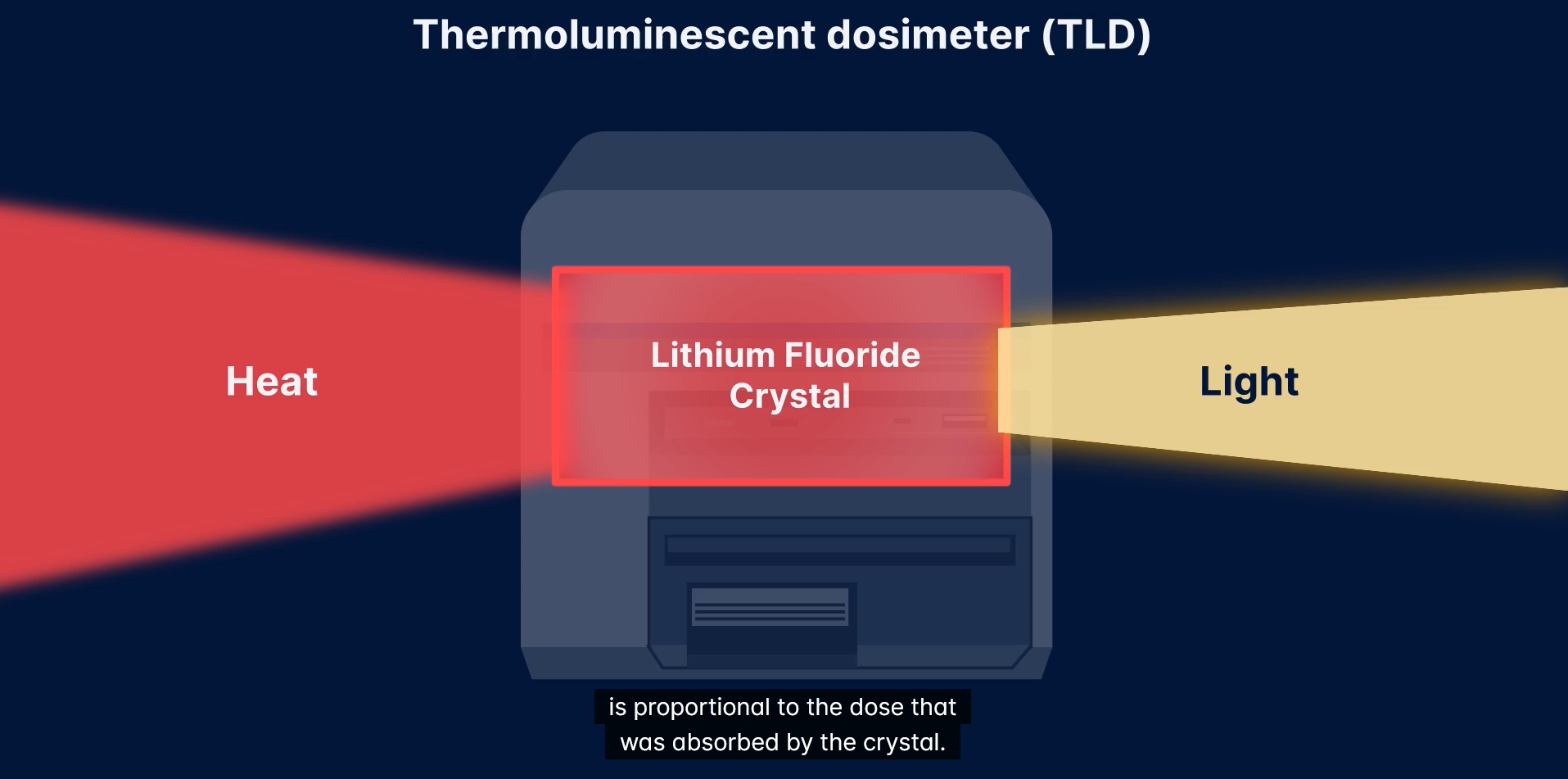
Light
When the TLD is ready to be read, it is placed in a TLD reader.
-The TLD Lithium fluoride crystal responds to HEAT which then releases a _______ which is used to measure and used to calculate the dose to the worker.
Thermoluminescent dosimeter (TLD)
Released stored radiation energy as LIGHT in response to HEAT.
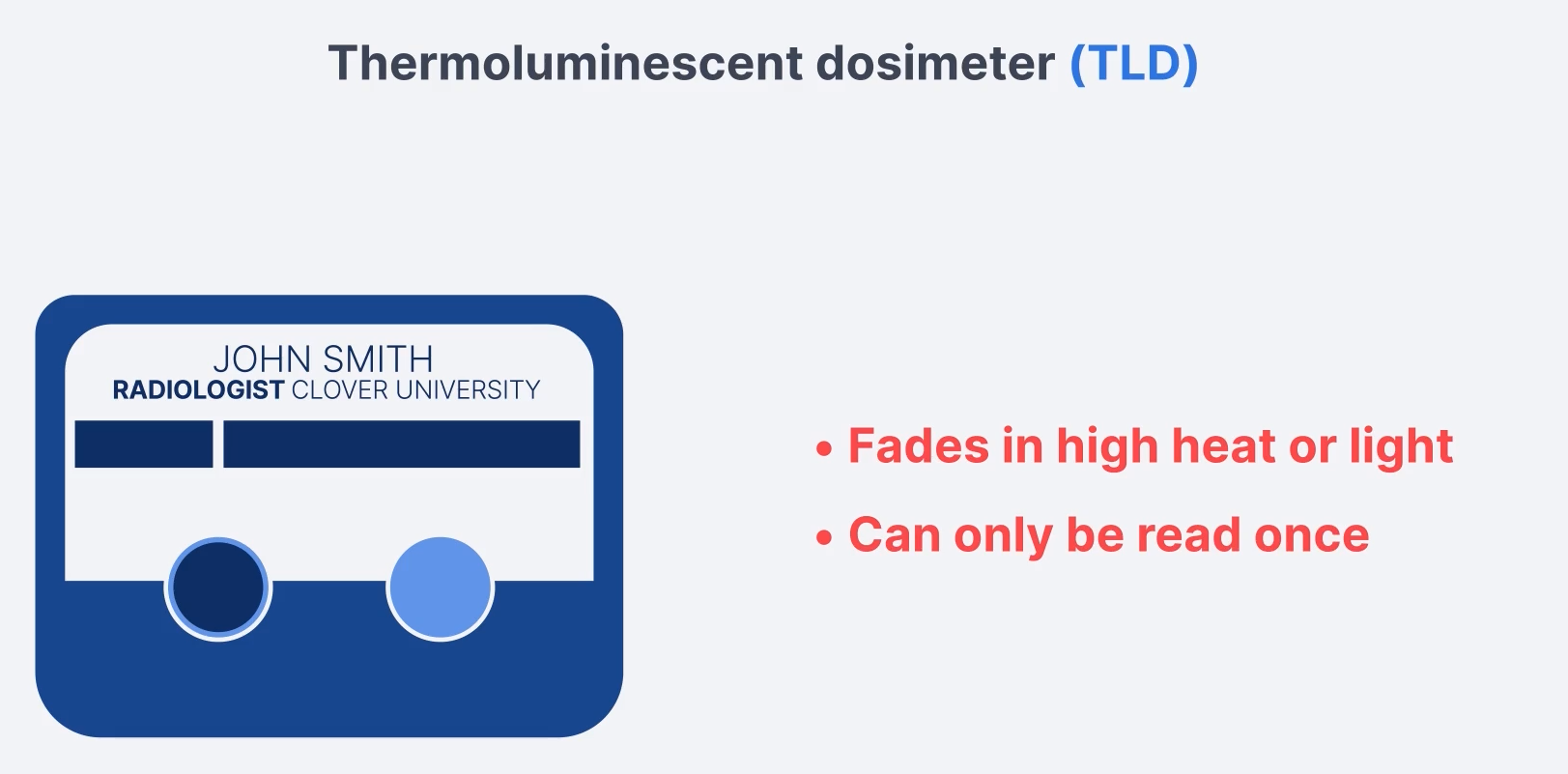
Prone to fade in high heat or light (leaving it out in the sun or hot car can release stored radiation energy in the TLD crystal - called fading.)
TLD can only be read once (so if there’s a mistake in processing, that info is permanently gone.)
Disadvantager of TLDs (List 2)
Aluminium Oxide Crystal
The OSL badge is composed of __________ crystal.
-This crystal absorbs the radiation energy until it is time to read the dosimeter.
Laser light
When the OSL crystal in placed in the OSL reader, it is exposed to a _______ instead of heat which is used for TLD readers.
-When exposed to ______, the crystal releases its stored energy as VISIBLE LIGHT which is measured and used to calculate the dose to the radiation worker.
OSLs are more expensive than TLDs
One major disadvantage of using OSLs is
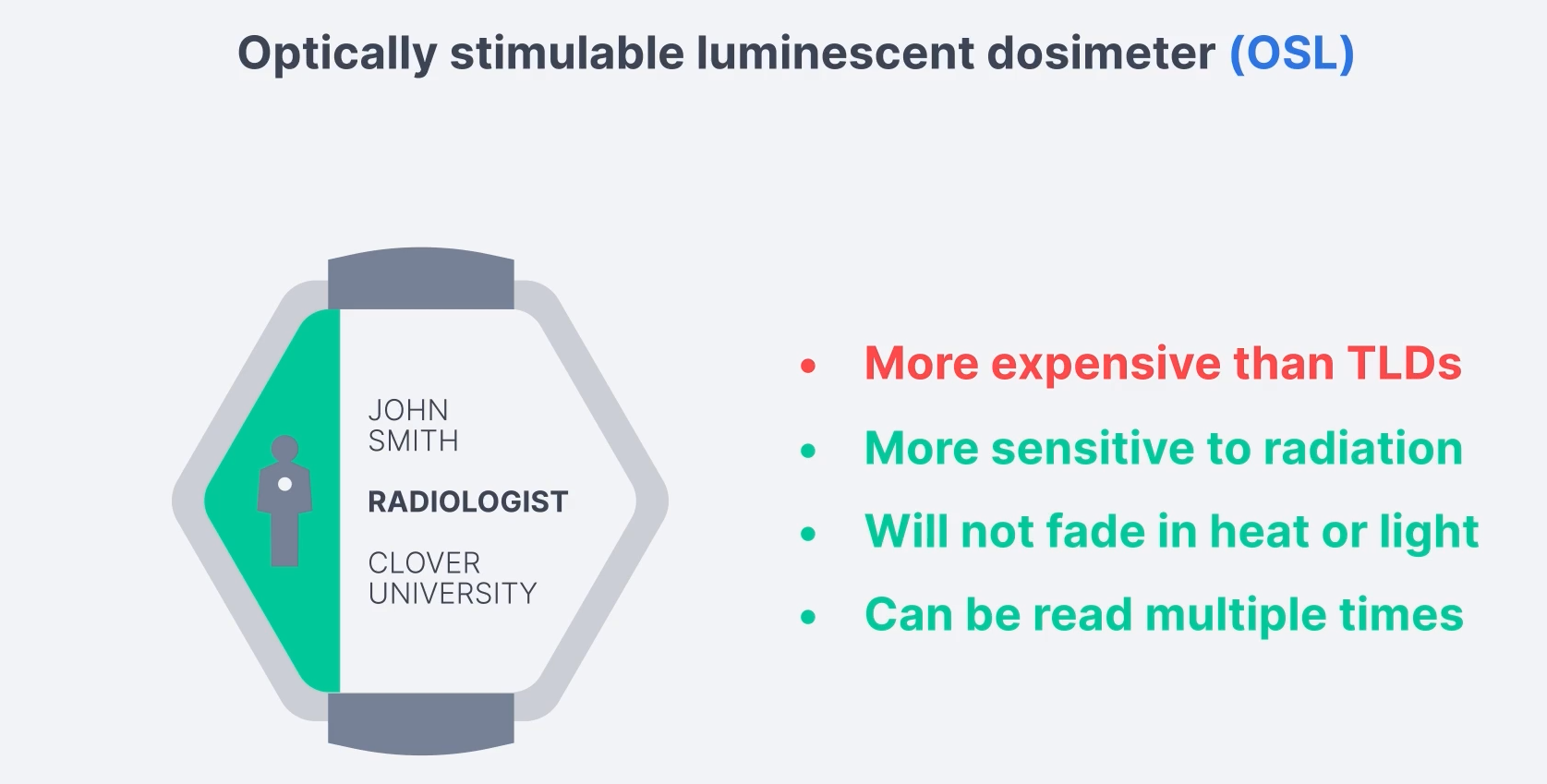
More sensitive to radiation
Will not fade in heat or light
Can be read multiple times
Advantages of using OSLs
Cancer
The only significant stochastic effect
nonthreshold effects because they have no minimum threshold dose.
-Stochastic effects can occur at any dose.
Stochastic effects are (threshold/nonthreshold) effects
Deterministic Effects
Includes:
-Cataracts
-Skin erythema = 2,000 mGy (2 Gy)
-Epilation (destroy hair follicles) 3,000 mGy
-Decreased Sperm count = 100 mGy
Tissue Reactions and Threshold effects
Deterministic effects can also be called ___________.
Stochastic effects
What is this?
Probability increases as the dose increases, but not the severity
Deterministic Effects
-Predictable.
-Only occur when specific dose thresholds are reached.
-ARS
Ionization
Is the chief cause of biological damage from radiation.
Target theory
What is this?
Adverse radiation effects are only observed when sensitive target molecules in the cells are affected.
-The “target” is DNA
Cell death or cell mutation
Radiation damage within the DNA can result in:
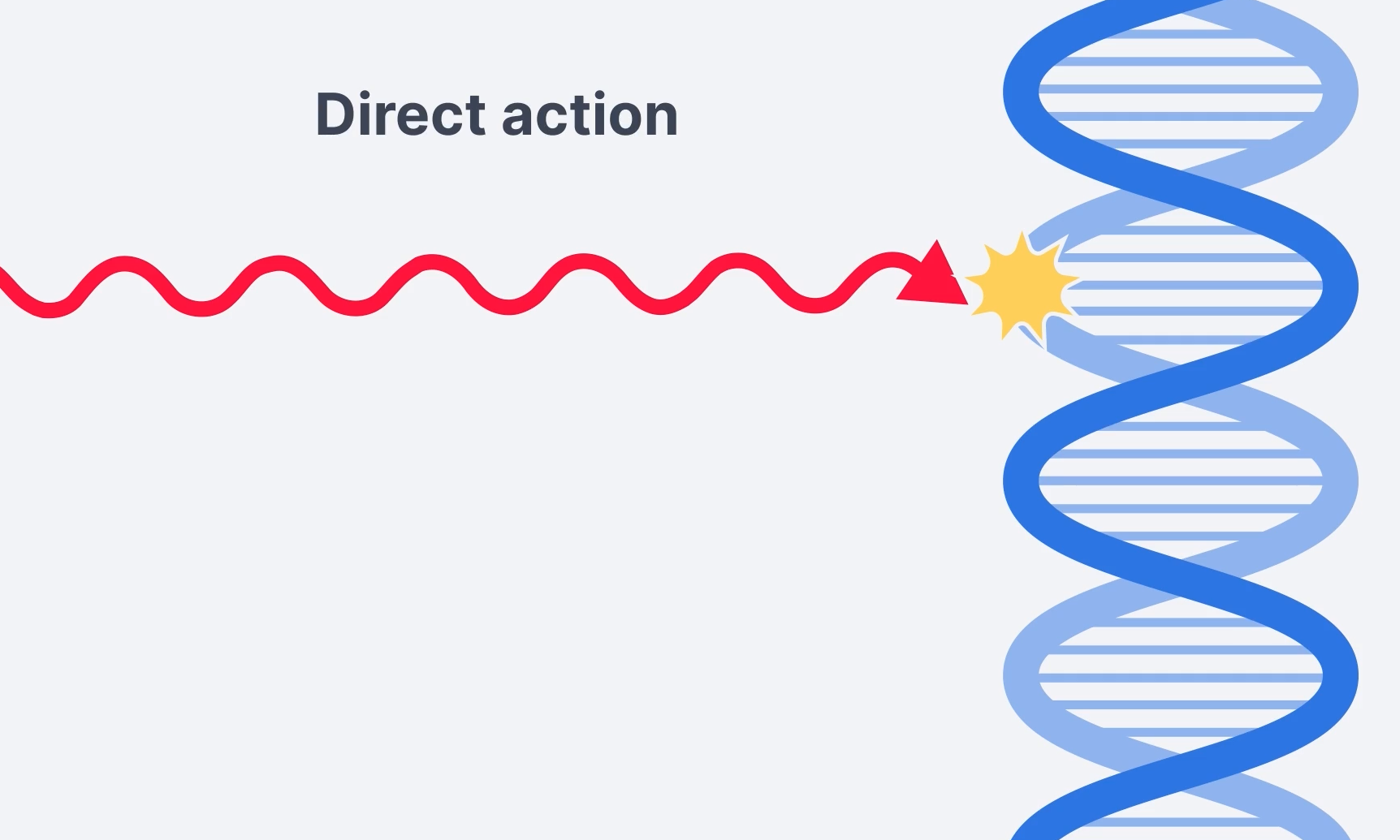
Direct Action
When the X-ray photon itself or a free electron created by the photon interacts directly with the DNA molecule.
-Is extremely uncommon as DNA itself represents only 1% of the mass of the cell.
indirect action
When the initial radiation interaction is with water in the cell.
-Most often the cause of cell damage because the cell is nearly 80% water.
Radiolysis
Ionization of water
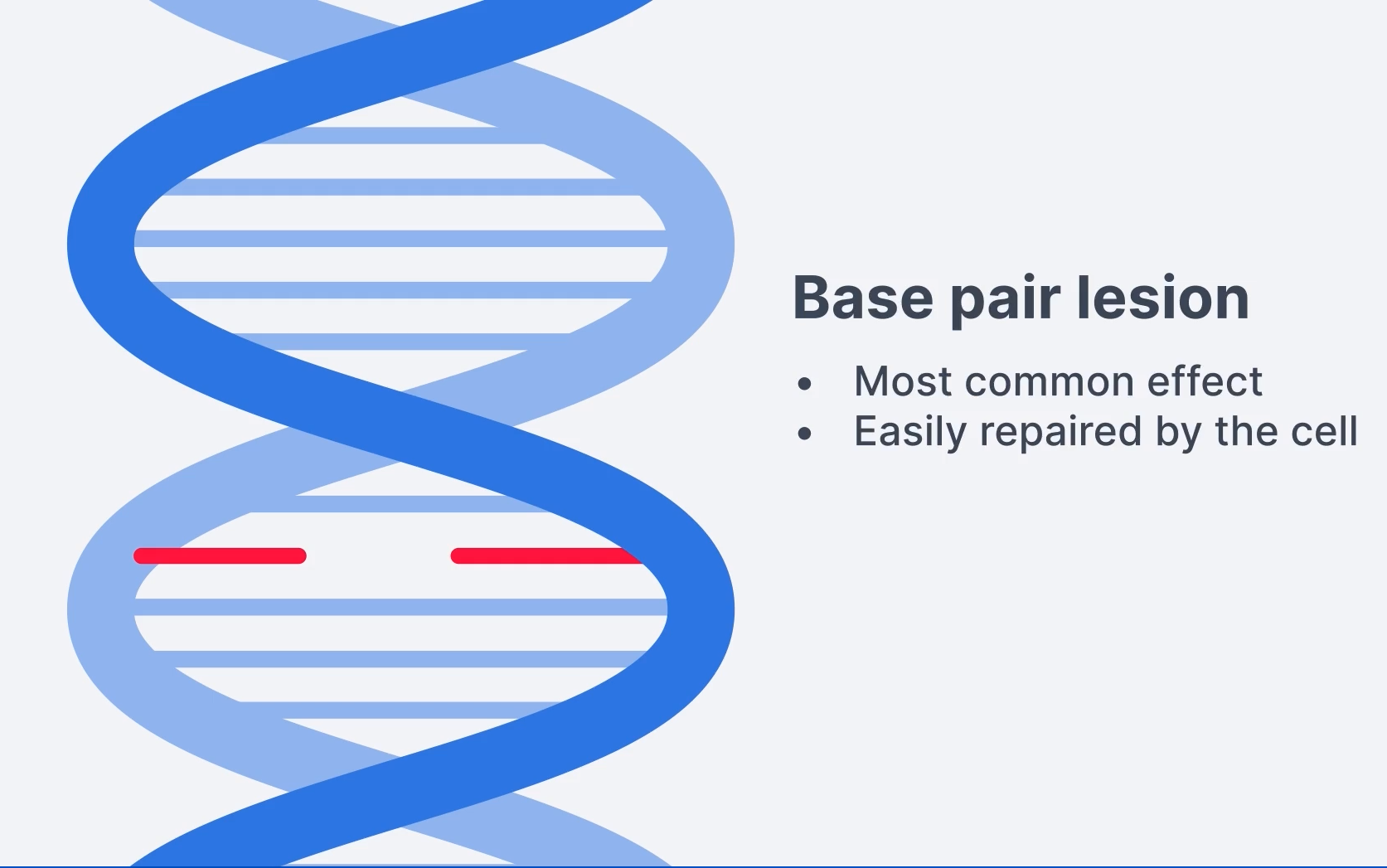
Base Pair Lesion
Most common effect when DNA is damaged by radiation.
-Easily repaired by the cell.
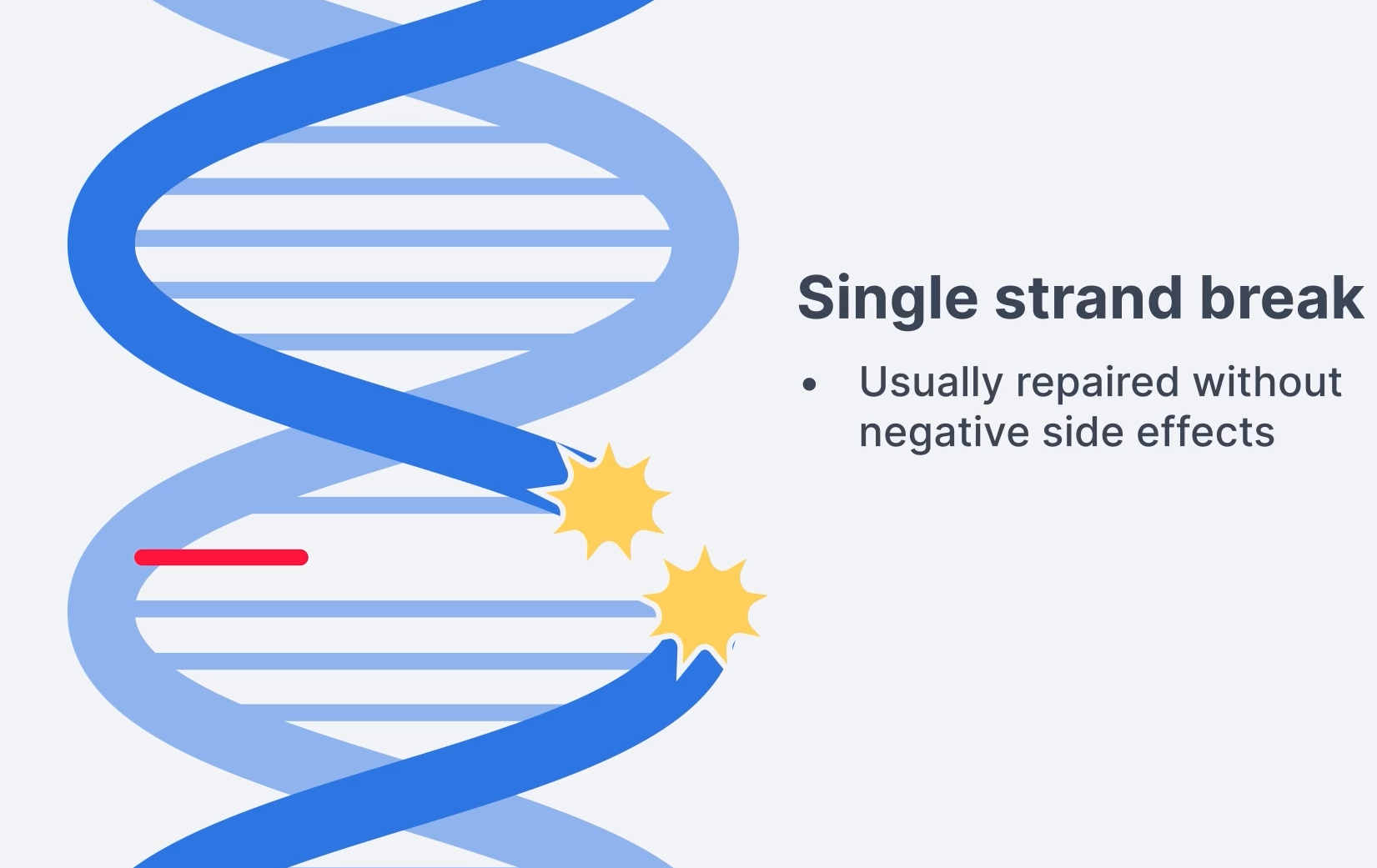
Single Strand Break
A common effect when DNA is damaged by radiation.
-Usually repaired without negative side effects.