ID2241 - Mesopotamian (Test #1, video 2/2) - GaTech
 Call Kai
 Learn
Learn Practice Test
 Spaced Repetition
 Match
Match Flashcards
 Knowt Play
1/19

There's no tags or description
Looks like no tags are added yet.
Name | Mastery | Learn | Test | Matching | Spaced | Call with Kai | Chat |
|---|
No analytics yet
Send a link to your students to track their progress
20 Terms
Two Kinds of Narration:
Symbolic
- Symbolizes their power and rulership (metaphors)
Realistic
Actually telling a story (Realistically...obv)
Anthropomorphized
gods and goddesses represented in the form of humans

White Temple, Uruk (3200BC) (Warka Iraq today)
Physical attributes:
Mud Bricks
faced w/ white plaster
40ft H, 60ft L
Built on a Ziggurat
mound of earth w/ slopping sides
Non-Physical attributes:
Dedicated to sky 'god' "Anu" (Anu district)
Temple placed off the ground to represent the sky "god"
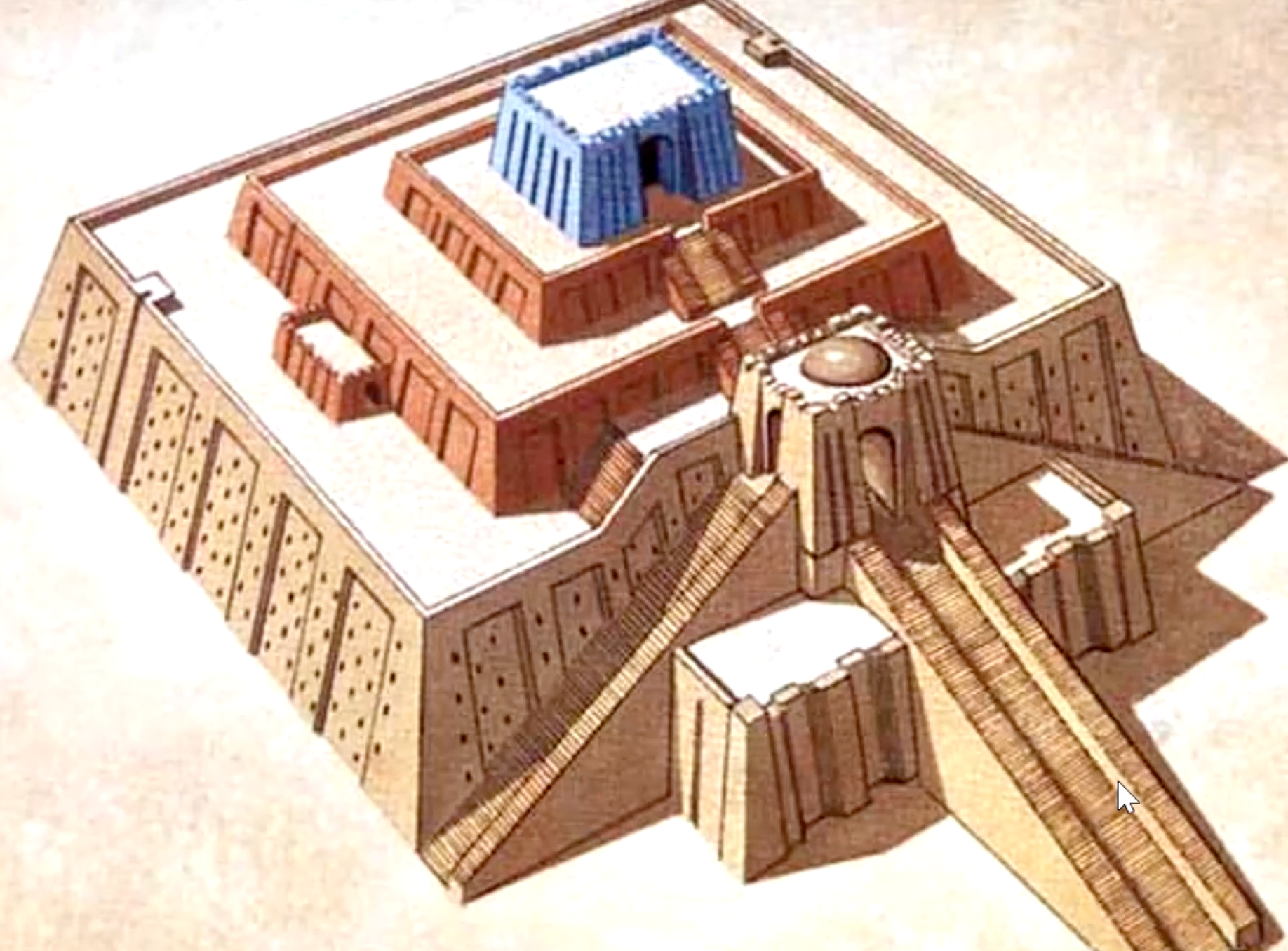
Assyrian word for "high" "raised up"
Stepped platforms
Raised off the earth/ground
Ziggurat @ Ur:
2100BC (recontructed 1968 AD)
Dedicated to Nanna (Sumerian "god" of the moon)
210ft L, 148ft W, 98ft H
Exactly 100 steps
Prioritized access for priests and officials (stairs)
- Designating your status/class
Maybe the stairs going straight up are supposed to symbolize the "god" descending down to earth
Bent-axis approach (The 2 stairs going from the side then turning and going to the center)

Female Head (Inanna?) 3200-3000 BC (Uruk)
Inanna:
Sumerian goddess of love, fertility, warfare "queen of heaven"
Other name: Ishtar (Assyrian)
Anthropomorphized = in the form of a human
(Anthro = human form)
(Morphic = in the form of)
reciprocal:
god/goddess = human like
human = in the image of "god" (which is why we're made to look like those "gods" and the "gods" look like us)
Should've had inlaid eyes and eyebrows (coral, lapiz, and gemstones)
plus a headdress
Made sure to be "perfect" so that they don't look like ordinary humans.
Symmetry
Repetition (see below image)
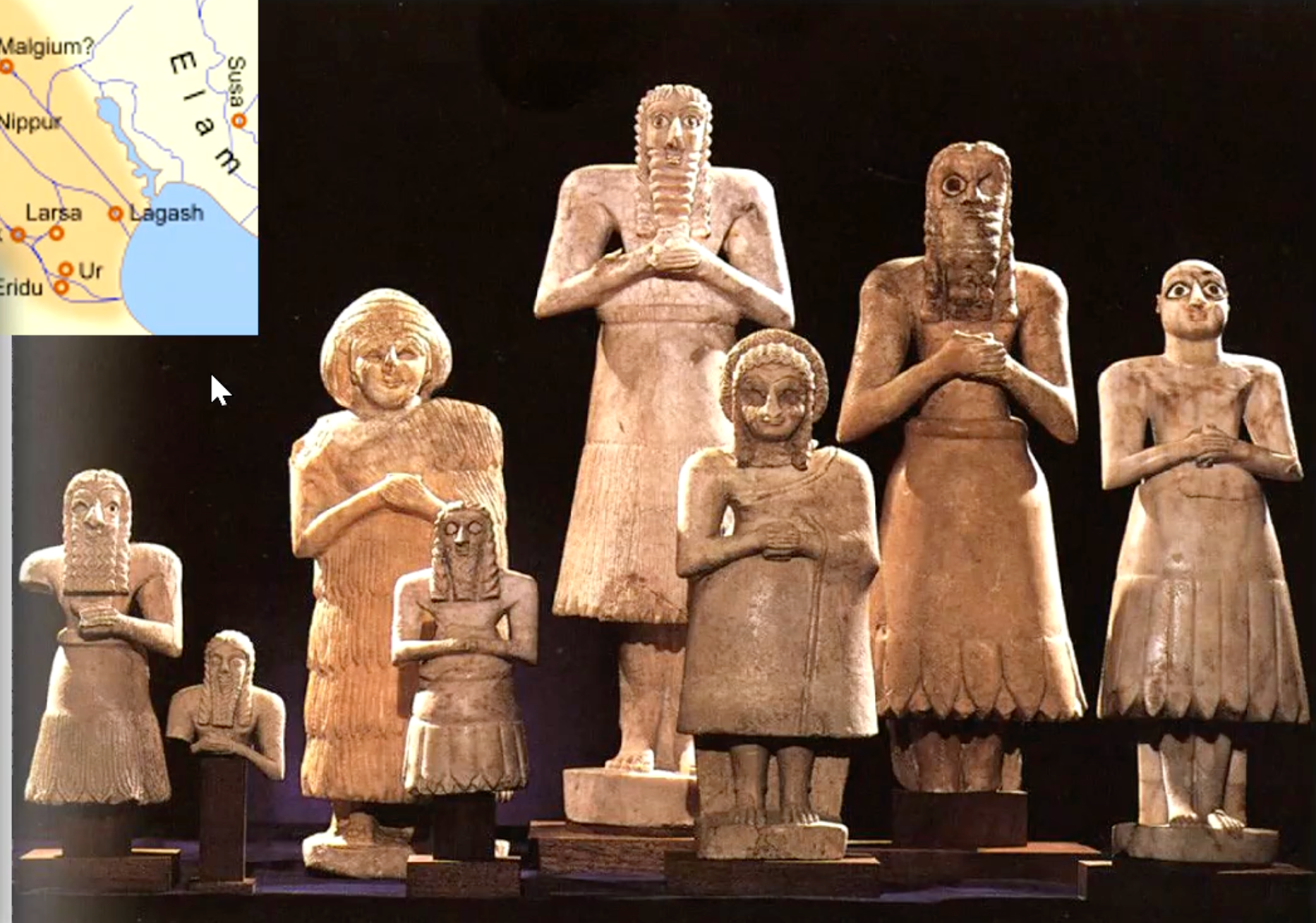
Statuettes from the Square Temple at Eshnunna (2700BC) (Modern Tel Asmar Iraq):
The 12 statuettes found (1933): "the Tel Asmar Hoard"
Physical Attributes:
Made of limestone(soft) inlaid w/ shell (stone) (eyes)
8 inches to 28inches

The above is the largest figure
Has an eagle inscription on the base
the "god" Abu = god of plants, vegetation
Apparently the beard = the steps from the Ziggurat at Ur (that's not the connection bro but ok)
reciprocity of form of god to the form of the temple
god = anthropomorphized as human
temple= form of god
god = form of temple (human worship)
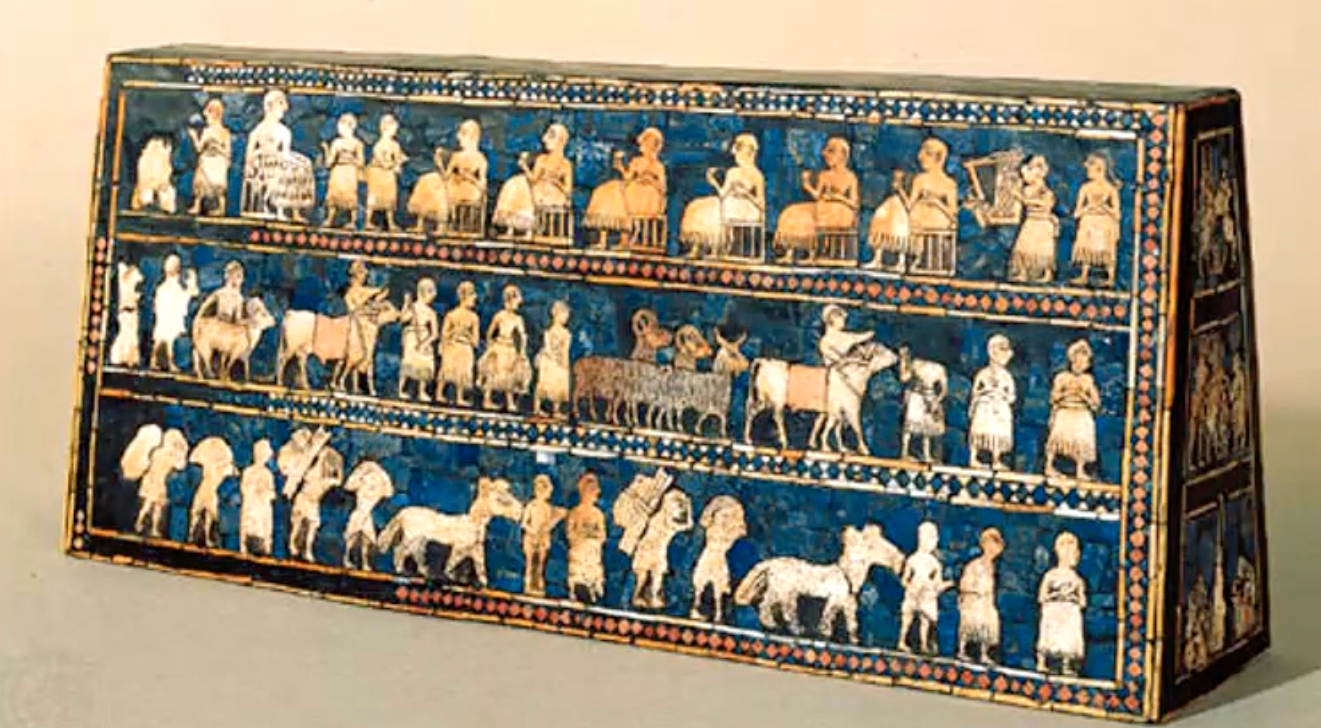
Standard of Ur, 2600 BC
Physical Attributes:
double sided
in the form of a standard
a message board carried on a pole
Registers:
sections (synonym)
separate scenes = separate time, space
(The 3 horizontal "bands")
inlaid w/ ivory, coral, lapis lazuli
Meant to be read bottom to top (Battle trampling enemy -> herding prisoners -> prisoners judged)
weapons, wheel w/ axels carriages
multiples overlapping
Composite view (see 1st below) (profile / frontal)
The wedge shapes (1st below) matches the cuneiform system
“Scenes of War” and “Celebration of Victory”
Value Perspective:
Some figures are bigger... assigning importance through size or scale
gods or goddess to celebrate w/ humans
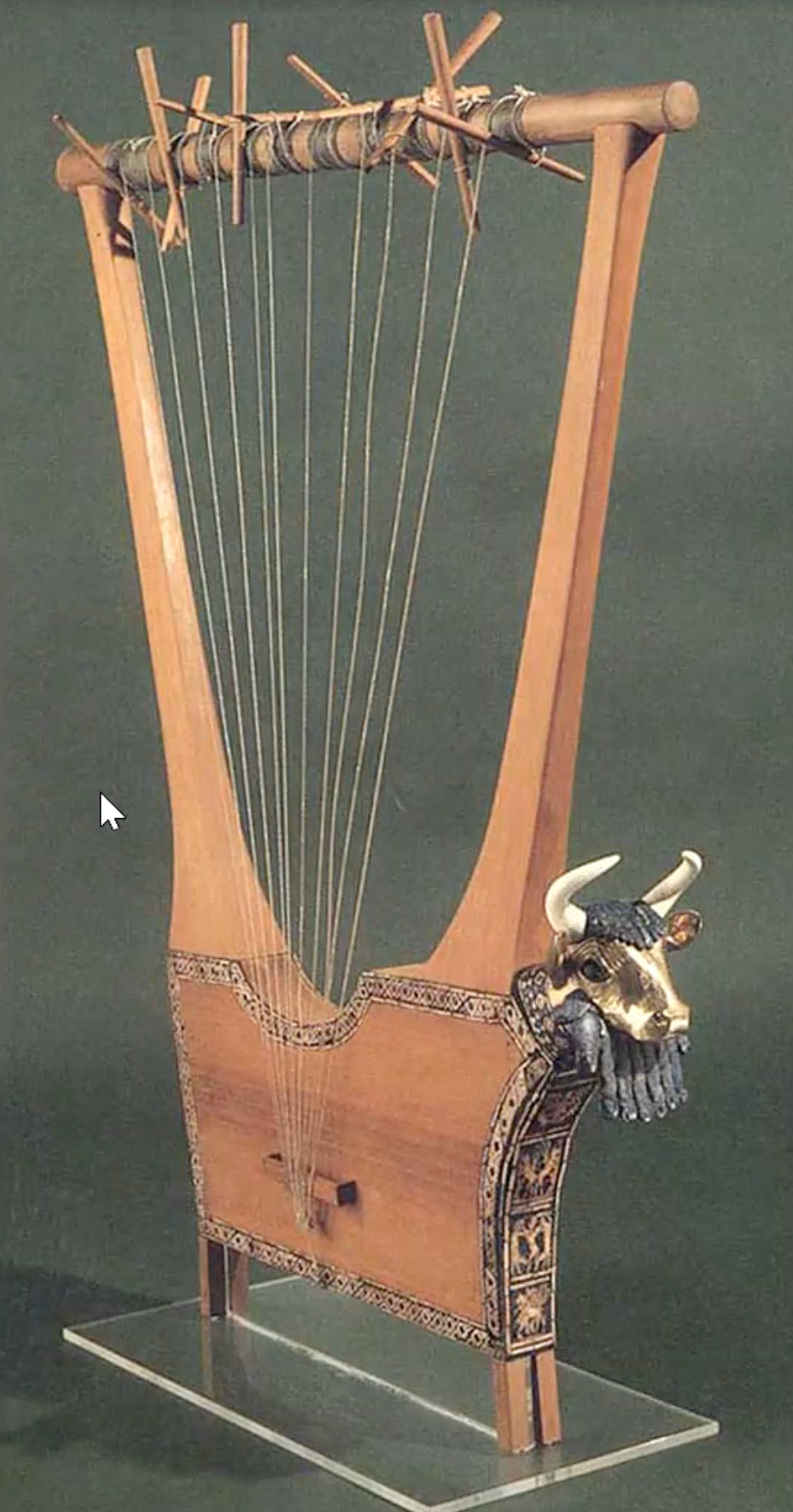
Bull-headed lyre (2600BC)
Physical Attributes:
Made of wood (didn't survive this was re-constructed)
possibly narrating story of "Gilgamesh"
Gilgamesh:
2750-2500BC (Hero-King Uruk)
epic poem
12 clay tablets
1800BC
Cuneiform script
Hero
Controls animals, nature, forces
Zoomorphism:
transferring animal qualities to a human "scorpion man"

Head of Akkadian Ruler (but really it’s Sargon)
(2200BC)
Physical:
mutilated (the eye) (totemic ritual of killing him by taking his eye)
bronze; life size
bronze alloy
copper and tin: 3000BC
copper and zinc: 1000BC
stronger than copper alone
Lost-Wax Process of Bronze Casting (a)
missing a headdress
Symmetrical (perfect as he is a hero)
Lost-Wax Process of Bronze Casting
Start w/ carved wax sculpture
Cover w/ sand, clay, or ash to form a mold
Pour molten bronze inside the mold
melts the wax; drain the wax
Break the mold to uncover the bronze form

Victory Stele of Naram Sin, 2254-2218 BC
Stele:
flat slab of stone
carved
positioned upright
Physical Attributes:
6.5ft
Sandstone
Naram-Sin is near the mountain (he's separate from the others) value perspective
Zagros Mountains
3 stars: represent gods/divine
Composite View (frontal eye, torso profile)
Value Perspective
By himself
larger than others

Stele of Hammurabi, 1780BC
Physical Attributes:
7ft 4inch
carved in basalt(harder stone)
"Law Code of Hammurabi"
"Hammurabi and Shamash" (see below)
Shamash: Sun god
"horned helmet": Zoomorphism
ring/staff: opposites (just how it's translated)
Composite View
Stepped platform: ziggurat
Value Perspective (seated )
"Law Code"
282 Laws:
Contracts, wages, property, divorce, paternity, military service
"an eye for an eye"
Discovered 1901: deciphered Akkadian language w/ cuneiform script

Hittite: Lion Gate, Bogazkoy, 1400 BC:
Guardian Figures: "Wards off evil spirits"
propagandistic (don't mess with us)

Statue of Sargon II, 700 BC:
Physical Attributes:
Symmetrical
composite view
hero: Controls animal (lion)

Citadel of Sargon II, Khorsabad, 720-705 BC; lamassu;
The guardian are in the Lamassu form
Zoomorphism
Composite form
mixed forms
wings of eagle
body of lion
head of Sargon II
13ft 10inch tall

Banqueting Scene:
Image above to the right
Value Perspective
Composite View

“Ashurnasirpal Hunting Lions,” 875 BC:
Profile view more consistant but still a frontal eye
Overlapping:
implies multiple planes/spaces
"realistic narration"

Neo(late)-Babylonian Art: Ishtar Gates, 575 BC
(This is in a muesum)
discovered 1899
excavated by Koldewey
relocated to museum in Berlin
shipped by boat
Physical attributes:
individually sculpted bricks
glazed brick: fired with mineral "slip"
Lapis
numbering system
Lions are protecting the city
Lion walking on the brick (really realistic)

Palace of Darius I and Xerxes, Persepolis,521-465BC: apadana:
Apadana: Audience hall
200ft x 148ft
60ft columns
audience of 1,000
(Alexander the Great destroyed it - to prevent any more wars)

"Offerings of the People" (Look like they're climbing the steps) (Peacefulness)
profile view but with frontal eye "Realistic narration"
Findings are from Persepolis (the above city):
Stele of Naram Sin
Stele of Hammurabi
Clearly they plundered Babylon