Muscles - Biomechanics, Chapter 1
 Call Kai
 Learn
Learn Practice Test
 Spaced Repetition
 Match
Match Flashcards
 Knowt Play
1/46

There's no tags or description
Looks like no tags are added yet.
Name | Mastery | Learn | Test | Matching | Spaced | Call with Kai | Chat |
|---|
No analytics yet
Send a link to your students to track their progress
47 Terms
What are the three types of muscle?
Smooth, cardiac, and skeletal
Where is smooth muscle located?
In organs and blood vessels
Where is cardiac muscle located?
The heart
Where is skeletal muscle located?
Bones, causing them to move
What are the four properties of skeletal muscle?
Extensibility, elasticity, contractibility, excitability
Skeletal muscles attach to bones by what?
Tendons
What is the muscle origin for skeletal muscle?
Attached to proximal bone of a joint
What is the muscle insertion for skeletal muscle?
Attached to distal bone of a joint
What are the four functions of skeletal muscle?
Movement, protection, joint support, heat production
What do smooth muscles typically do inside of blood vessels?
Open and close the lumen to assist with blood flow
What is peristalsis?
A rhythmic contraction helping with the opening and closing of lumen
What does Systole refer to?
Contraction of cardiac muscle
What does Diastole refer to?
Period when cardiac muscle relaxes
Finish the rest of the skeletal muscle forms:
Fusiform, Quadrate, Triangular…
Unipennate, bipennate, multipennate, and longitudinal
What are most skeletal muscles?
Fusiform or pennate
What are the three types of muscle contraction?
Concentric, eccentric, isometric
What does the SAID principle stand for?
Specific Adaptation to Imposed Demands
What does the SAID principle mean?
Muscle is able to change in size and strength based on the demands placed on them
All skeletal muscle contains what? What does Fascicular arrangement do?
Fascicles; Determines name
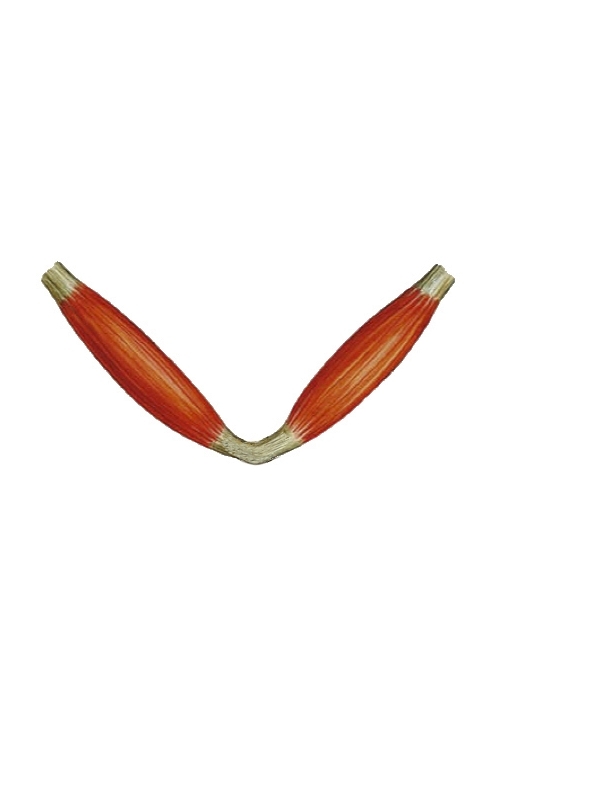
What kind of muscle shape is this? Describe it.
Digastric; two muscle bellies with an intermediate tendon
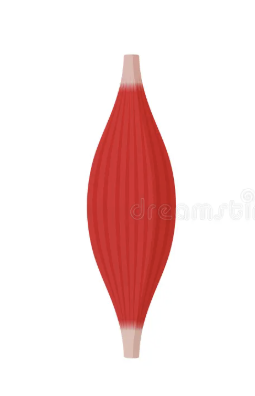
What kind of muscle shape is this? Describe it.
Fusiform; Spindle-shaped
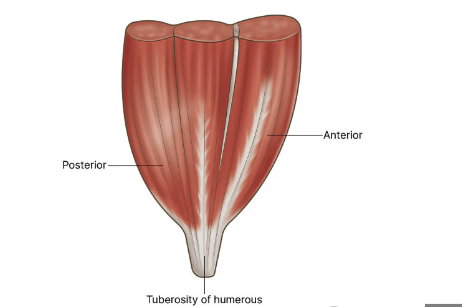
What kind of muscle shape is this? Describe it.
Multipennate; fibers arranged at multiple angles
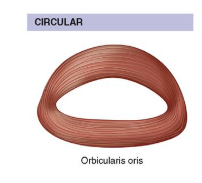
What kind of muscle shape is this? Describe it.
Sphincter; Circular muscle surrounding openings
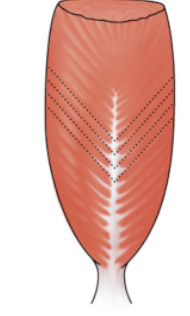
What kind of muscle shape is this? Describe it.
Bipennate; Fibers attached on both sides of tendon
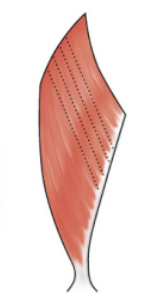
What kind of muscle shape is this? Describe it.
Unipennate; Fibers attached on one side of tendon
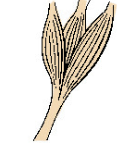
What kind of muscle shape is this? Describe it.
Tricipital; muscle with three heads
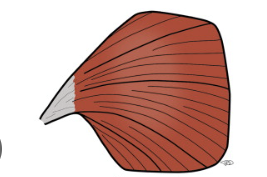
What kind of muscle shape is this? Describe it.
Triangular (convergent); Fibers fan toward one tendon
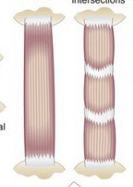
What kind of muscle shape is this? Describe it.
Strap; Long parallel fibers with tendinous insertions
What are tendon sheaths?
Connective tissue covering tendons, protecting them from wear and tear
What is the main muscle producing a particular movement called?
Prime mover, or agonist
What is a muscle helping an agonist accomplish its action called?
Synergist
What is the agonist typically opposed by with another muscle?
Antagonist
What is the name of a muscle holding a bone in place while another muscle performs its function?
Action is fixation, muscle is fixator
What type of connective tissue is skeletal muscle encased in?
Epimysium
What is the fibrous sheath that wraps around bundles of muscle fibers called?
Perimysium
Within the perimysium, what is the connective sheath called enclosing those muscle fibers?
Endomysium
What is the contractile element of muscle?
Myofibrils
Individual myofibrils are enclosed by a viscous material known as what? After that, they’re then wrapped in a membrane known as what?
Sarcoplasm; Sarcolemma
What are the functional units of skeletal muscle?
Sarcomeres
What are the two types of skeletal muscle fibers?
Fast-twitch and slow-twitch fibers
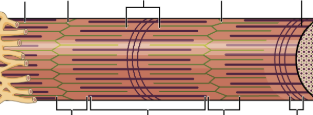
What is the green zigzag line on the left and right called?
Z-line
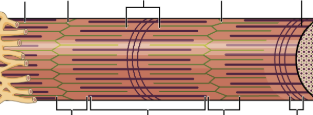
What is the middle portion called? (with the 3 lines)
H-zone
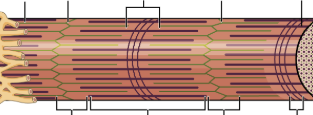
Before both of the z-lines, what is that portion called?
A-band
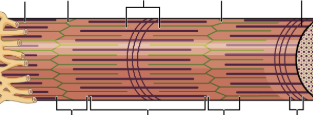
After the thin actin filaments and before the a-band, what is that portion called?
I-band
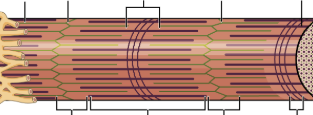
From the left z-line to the right z-line, what is that whole section called?
Sarcomere
What are the characteristics of fast-twitch fibers?
Large and white, appear in muscles used to perform strength activities
What are the characteristics of slow-twitch fibers?
Small and darker red color, appear in muscles involved in endurance activities