Lect 5: Axial Skeleton Myology
 Call Kai
 Learn
Learn Practice Test
 Spaced Repetition
 Match
Match Flashcards
 Knowt Play
1/87

Earn XP
Description and Tags
(and thoracic vert) pair with lab manual info + a brain map
Name | Mastery | Learn | Test | Matching | Spaced | Call with Kai | Chat |
|---|
No analytics yet
Send a link to your students to track their progress
88 Terms
How many vertebrae in the thoracic spine?
12
What curvature is rounded in the saggital plane toward the posterior?
kyphotic
What features distinguish typical thoracic vertebrae?
small circular vertebral foramen
equal thoracic bodies
2 pairs (inferior and superior) of costal (demi) facets
that articulate with ribs

Which vertebrae have bodies that are approximately equal anterior-posterior and transversly?
thoracic
Which thoracic vertebrae are considered typical?
T2-8
How many costal facets are found on a typical thoracic vertebrae?
2 pairs (4 total)
2 superior + 2 inferior
What is another term for demifacets?
costal facels
Where are the superior demifacets located?
root of the pedical

Where are the inferior demifacets located?
just anterior to the vertebral notch
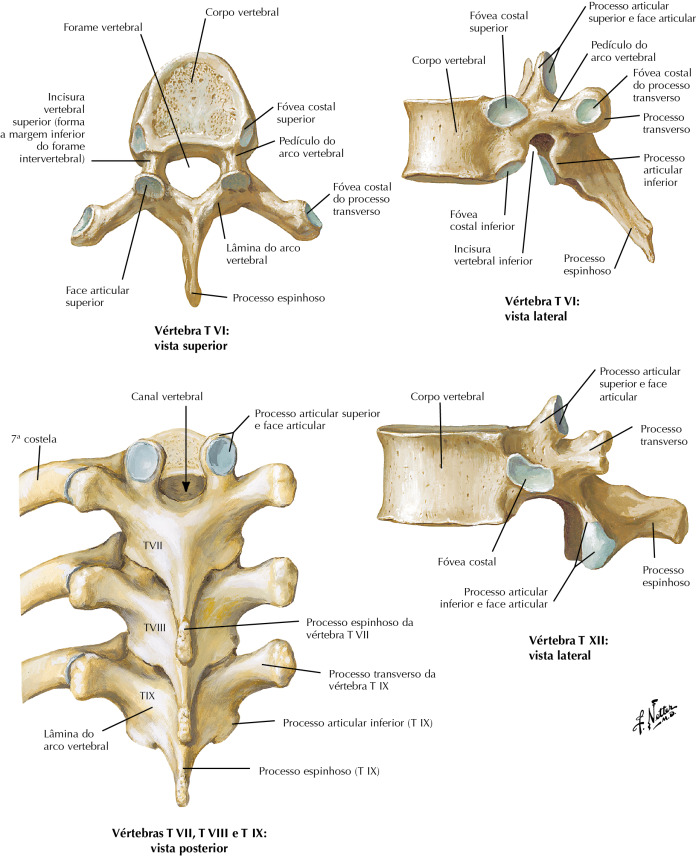
what 3 parts of the thoracic vertebrae articular with the ribs?
superior + inferior (demi/(costal) facets
transverse process
Which demifacet articulates with the numerically responding rib?
superior demifacet (costal facet)
rib 5 articulate with superior facet of T-5
'superior bc coorelate to same #'

Rib 6 articulates with the inferior facet of what vertebrae?
T5
'inferior bc don't line up'
How does does the structure/function of the spinous processes of T-vertebrae effect movement?
slants posteriorly / inferiorly (in groups of 3- rule of threes)
usually overlap with vertebrae below
limit extenion
How do the inferior vs superior articular facets of T-vertebrae slant?
superior facets: face posterior, slight lateral/superior
inferior facets: face anterior, slight medial/inferior

What are the features of the transverse processes of T vertebrae?
thick
lat / slight post
oval facets anterior tip - articulate with tubercles of #cooresponding rib
What does the Rule of Threes (Thorax) describe?
spinous processes in relation to transverse processes
Which thoracic vertebrae have spinous processes projecting post in same plane as transverse processes?
T1-3
T12
(rule of threes)
Which Thoracic spinous processes slant slightly down, midway between transverse of own and vertebra below?
T4-6
T11
(rule of threes)
Which Thoracic spinous processes are in the same plane as the transverse processes of the vertebra below?
T7-9
T10
(rule of threes)
Rule of Threes (ALL)
T1-3: post same plase as own transverse
T4-6: slightly down, between own transverse and one below
T7-9: in same as plane transverse below
(then in inverse order)
T10- same as 7-9
T11- same as 4-6
T12 -same as 1-3
Which plane is the spinous process of T10 in?
plane as transverse of below
same as 7-9
Which plane is the spinous process of T11 in?
midway between own transverse process and below
same as 4-6
Which plane is the spinous process of T-12 in?
same plane as own transverse processes
same as T1-3
What are the features of a thoracic intervertebral discs?
relatively thin (esp in upper Ts)
uniform thickness (no binder)
nucleus pulposis not developed as well
Typical thoracic vertebra include vertebra:
A. T1
B. T5
C. T9
D. T11
T5
(T2-8)
Facet Joints: what plane are they oriented in? what movement do they favor?
frontal plane (primarily)
flexion / extension
*limited in upper thoracic- rib cage
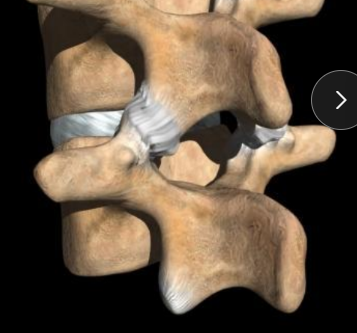
Anterior Longitudinal Ligament
(Hour glass- thin/broad - narrow thick)
relatively thick
narrow in thoracic region
attatchments into thoracic intervertebral discs

Posterior Longitudinal Ligament
(“Opp of hour glass” doesn’t attach to C discs, potential herniating L)
upper thoracic region: broad / uniform width
lower T: narrow over bodies broader over disks
attachments into thoracic intervertebral discs

Which ligaments have attachments into thoracic intervertebral discs?
Anterior longitudinal + Posterior longitudinal ligaments

How do facet joint capsules differ between the cervical and thoracic regions?
more taught in thoracic (restrict excessive flexing- forward bending)
Ligaments in the thoracic region
Facet joint capsules- more taught than cervical
Ligamentum flavum- relatively thick
Supraspinous- blended with fascia
Interspinous ligament- thin
Intertransverse ligament- rounded cords
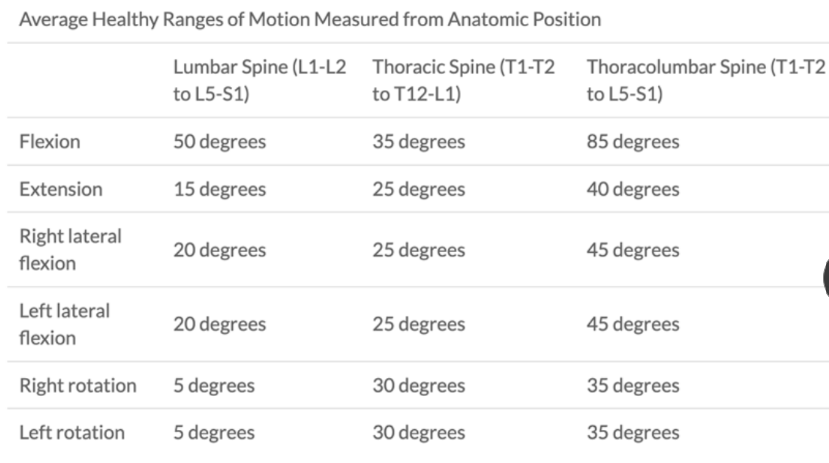
To what extent does each movement occur in the thoracic spine?
more flexion than extension
flexion: checked by ligament, discs, ant height of vertebral body, joint capsules, postvertebral muscle tension
extension: limited by spinous process contact
rotation: relatively free, alway coupled with some lateral flexion, more in upper less caudal bc facet orientation
lateral flexion: facet orientation doesn’t limit, movement limited esp upper bc ribs/sternum
Describe rotation ability of the thoracic region
relatively free
alway coupled with some lateral flexion
more in upper less caudal bc facet orientation
How many vertebrae make up the Lumbar spine?
5
What are the destinguishing features of lumbar vertebrae?
large bodies (greater load)
body/disc *deeper anteriorly- binder effect- sacrovertebral angle
sturdy laminae
short pedicle- vertebral canal triangular
transverse process L1-4 1” and thing, L5 short/thick
spinous process- short/sturdy hatchet (‘Lumbarjack’)
facets (synovial) stabilize from excessive moevement/shear
pars interarticularis- L5 common for spondylolisthesis
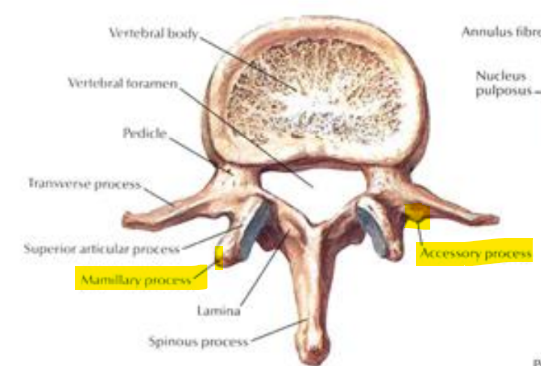
accessory* + mamillary* processes
(moose- in the woods)

What processes (besides spinal/transverse) are found on lumbar vertebrae?
accessory processes: roots of TPs, medial intertransverse muscle attachment
*mamillary: tip of superior facet, multifundus attachment
What are the components of an intervertebral disc?
anulus fibrosus
nucleus pulposis

What animal could help you remember each section of the spine?

Pars interarticularis of L5 is a common site for what issue?
spondylolisthesis

issues that can occur at the par interarticularis


help understanding difference

Iliolumbar ligament
O: L5/4 transv proc > 2 bands (to ilium)
counteract ant shear forces at L5/S1
reinforcing lig of lumbosacral
How does movement vary by combined use of spinal segments?
most movement when used in conjunction
Intervertebral discs are uniform in thickness is
this region:
A. Cervical
B. Thoracic
C. Lumbar
thoracic
(cervicle and lumbar (more so- binders)
What main movements do neck/back muscles contribute to?
flexion / extension
side bending
rotation (ipsi/contralateral)
What divides anterior and lateral prevertebral muscles?
sternocleidomastoid
Cervical spine: Prevertebral Muscle Overview
anterior
longus capitis
longus colli
rectus capitis anterior
anterior scalene*
sternocleidomastoid divide ant/lateral muscles
lateral
rectus capitis lateralis*
splenius capitis*
levator scapula
middle + post scalenes*
Cervical spine: Postvertebral muscle overview
suboccipital
rectus capitis post major + rectus capitis post minor
obliquus capitis inf + obl cap superior
Postvertebral muscles
splenius capitis
splenius cervicis
What do the scalenes do?
scalenes (3): anterior, middle, lateral
all: lat neck flex
ant / mid : elevate 1st rib
lat: elevate 2nd rib
What do all the suboccipital muscles do?
rectus capitus posterior (major + minor, not lat)
obliquus capitus (superior + inferior)
rotate C1 on C2 (minor j assists)
extend head on C1
What are all the suboccipital muscles innervated by?
Dorsal rami C1
What are the suboccipital muscles?
rectus capitus posterior minor
rectus capitus posterior Major
obliquus capitus superior
obliquus capitus inferior
What are the postvertebral muscles of the cervical spine?
splenius capitis
splenius cervicis
Where do both the splenius (capitis + cervicis) insert?
nuchal ligament + spinous process C7-T6
Anterior Scalene
(OIAN) - think abt how muscle pulls
O: trans proc C3-6
I: 1st rib
A: (elevate 1st rib) (lat neck flex)
N: ventral rami C4-6
‘scale/raise- scaling something 1st = a flex’

Sternocleidomastoid
(OIAN) - picture pull
O: mastoid process + lat ½ sup nuchal line
I: (sternal head- ant surface manubrium) (clavicular head- sup medial 1/3 clavicle)
unilaterally: ipsilateral aide bend, contralateral rot
bilaterally: neck extension at OA joint, cervical flexion, approximation chin to chest
N: spinal accessory nerve (CN XI)

Middle Scalene
(OIAN) - picture pull
O: post TP C4-7
I: sup surface 1st rib (post to groove for subclavian artery)
elevate 1st rib + lat neck flex
N: ventral rami C spinal Nerves
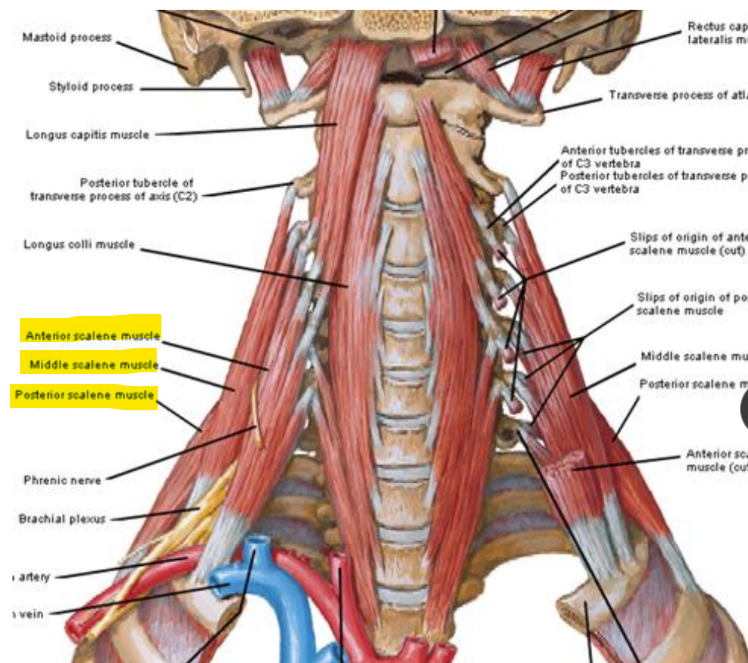
Post Scalene
(OIAN) - picture pull
O: post TP C4-6
I: external boarder *2nd rib
elevate 2nd rib
lat neck flex
N: ventral rami CN C7 and C8
Rectus Capitis Lateralis
(OIAN) - picture pull
O: occipital bone jugular process
I: ant surface lateral mass of C1
N: ventral rami CN C1-2
flex head

Suboccipital muscles overview

Rectus Capitis Posterior Minor
(OIAN) - picture pull
O: occiput along the medial 1/3 of inferior nuchal line
I: post tubercle of posterior arch C1
N: dorsal ami C1
extend head on C1
assist major with rotation C1-2
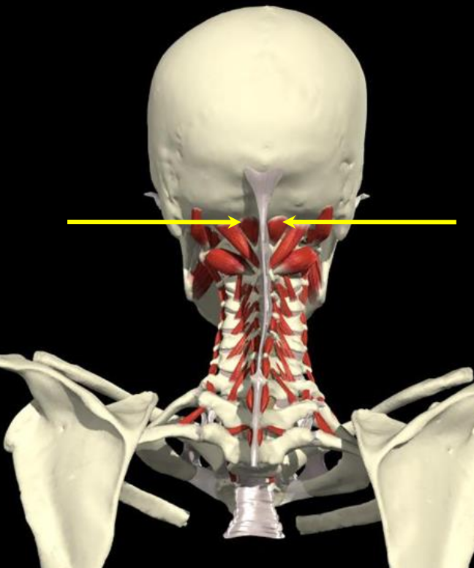
Rectus Capitis Posterior Major
(OIAN) - picture pull
O: occiput along the lat inferior nuchal line
I: spinous process of C2
N: dorsal rami C1
extend head C1
rotate head C1 on C2

Obliquus Capitis Superior
(OIAN) - picture pull
O: Occipital bone between inferior and superior nuchal line
I: transverse process C1
N: dorsal rami C1
extend head C1
Rotate head C1 on 2

Obliquus Capitis Inferior
(OIAN) - picture pull
O: transverse process of C1
I: posterior tubercle of post arch C2
N: dors ram C1
extend head C1
rotate head C1 on 2

Which of the following is a postvertebral muscle:
A. Obliquus Capitis Superior
B. Sternocleidomastoid
C. Posterior Scalene
D. Longus Capitis
Obliquus Capitis Superior
The middle scalene helps:
A. Extend the head on C1
B. Laterally flex the head
C. Elevate the 1st rib
D. Elevate the 2nd rib
lat flex
Back muscle general overview

Cervical Region muscles layers (lab inspired- just for this class)
*find spine superior = nucal ligament
Deepest: Suboccipitals
RCPm/M: rectus capitus posterior minor + major (inner/outer V)
extend head, do-M or assist with-m rotation C1/2
Obliquus capitis superior (straight) + inferior (angled)
extend (C1) and rotate (C1/2) head
Next layer: Semispinalis
capitis + cervicis blend
superficial: Splenius
capitis and cervisis unique (capitic closer to spine medially)
unilat: ipsilat side bend / rotation
bilat: extension
Splenius Capitis
OIAN- picture layer
O: mastoid process and lateral third of superior nuchal line
I: nuchal ligament & C7-T6 spinous processes
N: dorsal rami middle cervical spinal nerves
unilarerally: ipsilat side bend / neck rotation
Bilat: extension of head/neck
visually blend with cervicis
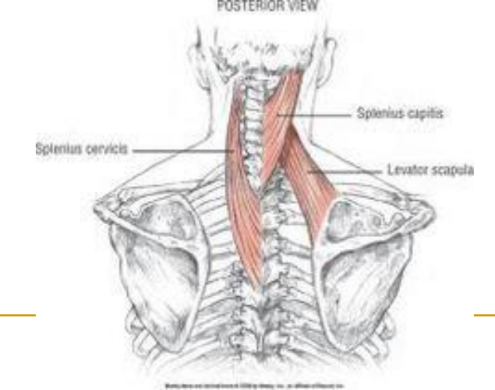
Splenius Cervicis
OIAN- picture layer
O: transverse process of C1-C4
I: nuchal ligament and spinous processes of C7-T6
N: dorsal rami SNs
unilat: ipsilat side bend / rotation
bilat: extension (head/neck)
visually blend with capitis

The Back Includes
1) The Skin and Subcutaneous Tissue
2.) Muscles:
a.) Superficial layer- Extrinsic Back Muscles
b.) Deep Layer- Intrinsic Back Muscles
3.) Vertebral Column
a.) Vertebrae
b.) Intervertebral Discs
c.) Joints and Ligaments
4.) Vertebral Canal
a.) Spinal cord
b.) Meninges and related spaces
Thoracic Lumbar Myology Overview
Minor Deep Intrinsics
unisegmental
interspinal
intertransverse
levators costarum
Deep intrinsics
transversospinal
rotatores
multifundus
semispinalis
Intrinsic back
Erector Spinae (ILS)
Iliocostalis- L, T, C, no cap
Longissimus- T, C, cap
Spinalis- T, C, cap
What is the structure/function of interspinal muscles in the lumbar region?
unisegmental
connect consecutive spinous processes
best developed in cervic + lumbar
aid in extension ^
What is the structure/function of intertransver muscles in the lumbar region?
unisegment
connect consecutive TPs
best developed in cervical + lumbar
side bending ^
bilaterally stabilize spine
%Rectus capitis anterior
and lateralis are
homologues of
intertransversarii
What are to transversospinal muscles occupy?
area between transverse and spinous processes
3 layers
What are the layers of the transversospinal muscles?
Deep outer layer: semispinalis
not in lumbar
Deep mid layer: multifidus
Deep inner layer: rotators

Semispinalis
OIAN
O: SP of lower thoracic vert 4-6 segments + sup medial occipital bone
I: TP of C4-T10
N: dorsal rami spinal nerves
extension (occipital, neck, trunk)
contralat rotation ^
*capitis, cervicis, and toracis

Semispinalis Capitis
(location/action)
occipital ext + contralat rotation
larest + strongest post neck muscle*

Multifundus
OAIN
O: SP of vertebra 2-4 segments above, oblique fibers
I: 1) aponeurosis of erector spinae in lumbar spine 20 TP of vertebrae 2-4 levels inferior 3) mamillary processes in L, T,a nd C4-5
N: dorsal rami
trunk ext
contralat rotation
stabilization during bilateral action
*best developed in Lumbar spine

Rotatores (brevis + longus)
OIAN
O: SP vertebrae 1 level (brevis) or 2 layer (longus) superior
I: junction of TP and lamina ½ levels inferior
N: dorsal rami
trunk extension
contralat rotation
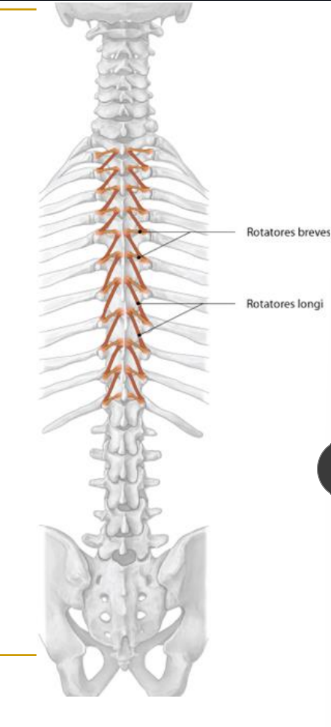
deep back visual review
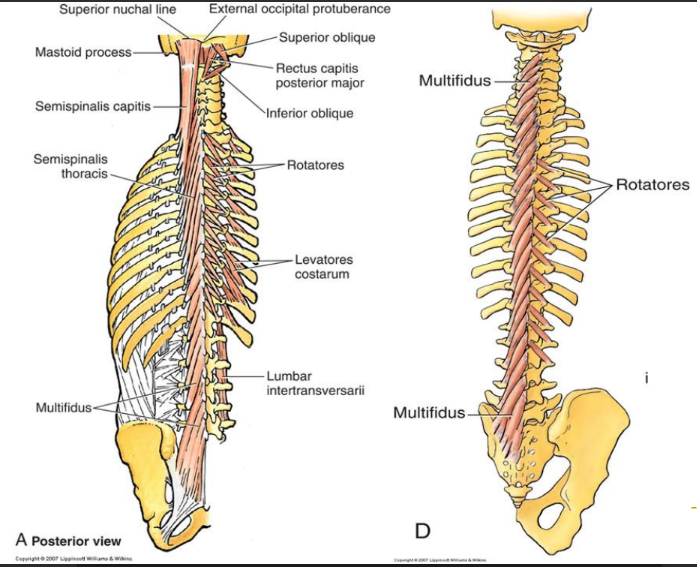
The actions of the transversospinal muscles (deep intrinsics) are:
A. Extension and ipsilateral rotation
B. Extension and contralateral rotation
C. Ipsilateral side bending
D. Contralateral side bending
*your deep back A shapes
bilateral: extension
unilateral: contralateral rotation
What muscles make up the intrinsic back? (erector spinae)
*I Love Spaghetti
iliocostalis
longissimus
spinalis
*all run along straight up/down one side of the spine:
bilat- trunk extension
unilat- ipsilat side bending
Iliocostalis
(OIAN) + what sections of the spine
O: angle of lower ribs + cervical TP
I: erector spinae aponeurosis > post ilium/sacrum
N: dorsal rami
trunk ext (bilat)
ipsilat side bend (unilat)
*L, T, C, no cap —-ech does A at associated level
*bc ilio-cost
(lumbar no cap)

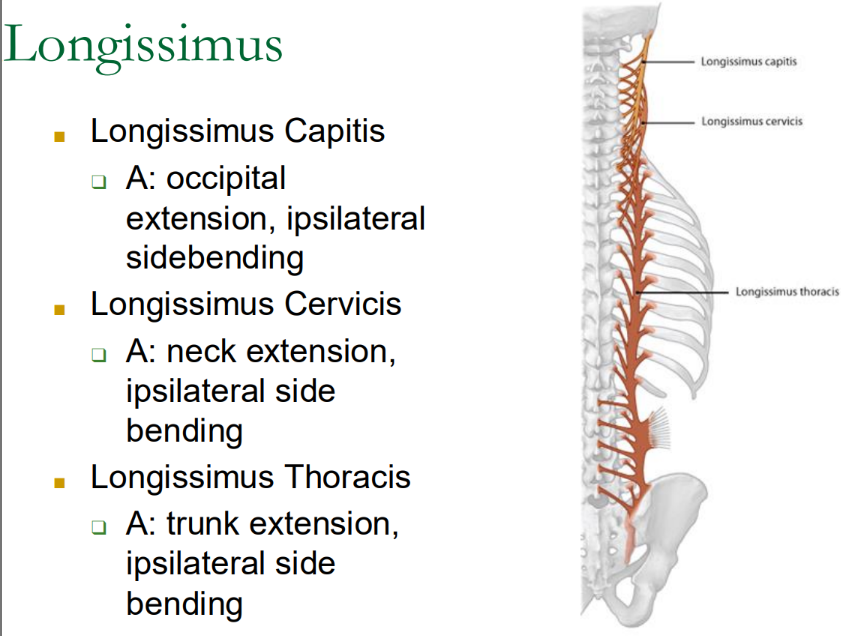
Longissimus
(OIAN) + what sections of the spine
O: ribs, T + cervical TPs, mastoid process
I: erector spinae aponeurosis
N: dorsal rami
trunk extension (bilat)
ipsilat side bending (unilat)
*thoracis, cervicis, capitis (3 seperate muscle names)
Spinalis
(OIAN) + what sections of the spine
O: thoracis SP, occiput
I: erector spinae aponeurosis
N: dorsal primary rami
trunk ext (bilat)
ipsilat side bending (unilat)
*thoracis, cervicis, capitis

What innervates the skin of the back?
each spinal sement innervated by dorsal ramus of te correspindin spinal nerve
(j like true/intrinsic back muscles)
The actions of the erector spinae are what?
extension + ipsilateral side bending