Week 8 - Derm
 Call Kai
 Learn
Learn Practice Test
 Spaced Repetition
 Match
Match Flashcards
 Knowt Play
1/65

There's no tags or description
Looks like no tags are added yet.
Name | Mastery | Learn | Test | Matching | Spaced | Call with Kai | Chat |
|---|
No analytics yet
Send a link to your students to track their progress
66 Terms
Macule:
Flat discoloration of skin or mucosa, seen but not palpated

Papule:
Small elevated bump of skin or mucosa

Vesicle:
Fluid-filled blister

Bulla:
Large fluid-filled blister

Pustule:
Blister filled with fluid and neutrophils

Ulcer:
Complete loss of surface epithelium with exposed connective tissue

Complete loss of surface epithelium is called _____.
Ulcer
Erosion:
Partial loss/wearing away of epithelial cells
Erythema:
Redness of skin or mucosa from inflammation
Urticaria / hives:
Erythema with soft edematous papules or plaque-like lesions
Keratosis / hyperkeratosis:
Increased keratinized layer, often presenting as a plaque
Oral keratotic plaques are called _____.
Leukoplakias
Scale:
Flaking/desquamating keratin from a keratotic lesion
What does pruritic mean?
Itchy
Excoriation:
Loss of surface cells from scratching
Maculopapular rash:
Usually infectious in children, allergic/drug reaction in adults
What is an example of infectious maculopapular rash?
Measles
Maculopapular rash in adults usually suggests:
Allergic or drug reaction
What stage of syphilis would you see macules and papules?
Secondary syphilis
Vesicular eruptions usually suggest:
Viral infection
What are examples of viral diseases that cause vesicles?
Herpes, chickenpox, smallpox, shingles
What to suspect when children have a widespread rash?
its usually viral, like measles or rubella
What to suspect when adults have a widespread rash?
drug reaction
Morbilliform exanthematous drug eruption:
Measles-like drug rash
Why does blister location matter?
the level of epithelial split helps diagnose the disease
Suprabasilar split:
separation of spinous layer cells from basal cells
Subepithelial/junctional split:
the entire epithelium separates from underlying connective tissue
Pemphigus vulgaris:
Autoimmune bullous disease with antibodies to desmoglein causing suprabasilar/intraepithelial blister
What is the Pemphigus vulgaris target antigen?
Desmoglein 1 and 3
Why can untreated pemphigus vulgaris be fatal?
Loss of protective epithelium → bacteremia, fluid loss, electrolyte imbalance
Mucous membrane pemphigoid:
Autoimmune blistering disease with antibodies to basement membrane/hemidesmosome proteins
What are the MMP target antigens?
BP180 and BP230
What procedures to do to diagnose bullous disease?
Biopsy for histology + direct immunofluorescence
Lichen planus:
Cell mediated disease with T-lymphocytes damaging epithelium
What are the skin findings in lichen planus?
Purple, pruritic, polygonal/planar papules, often flexor surfaces
Lichen planus oral findings:
Bilateral white striated/spiderweb lesions, erosions or ulcerations

Psoriasis:
Keratotic pruritic plaques, usually extensor surfaces and trunk
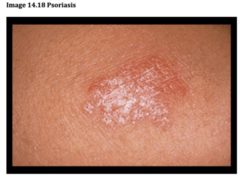
Does psoriasis commonly affect the mouth?
No, oral manifestations are rare
Auspitz sign:
scraping psoriasis leaves small points of hemorrhage
Describe the histological appearance of psoriasis ?
Neutrophils in epidermis
Verruca vulgaris:
Common wart, benign keratinocyte tumor
Verruca vulgaris location:
Hands and fingers
Describe the appearance of verruca vulgaris:
Round yellow/white keratotic nodules
Verruca vulgaris HPV types:
HPV 2 and 4
Seborrheic keratosis:
Benign brown waxy/oily lesion from epithelial hyperplasia
Seborrheic keratosis location:
Face, forehead, temples
Do verruca vulgaris and seborrheic keratosis have malignant potential?
No
Basal cell carcinoma:
Locally aggressive keratinocyte tumor that does not metastasize
BCC risk factor:
Sun exposure
Why is BCC dangerous if untreated?
it can invade locally into bone/brain causing tissue destruction
Actinic keratosis:
Flat scaly keratotic precancerous lesion caused by solar radiation
Squamous cell carcinoma:
Invasive keratinocyte malignancy that can metastasize
Describe the histological appearance of SCC:
Invasive epithelial islands with spinous/keratin layer differentiation and cytologic atypia
SCC spread:
Local lymph nodes or hematogenous spread
Nevus:
Benign melanocytic hamartoma
Melanoma:
Malignant tumor of melanocytes, one of the most deadly cancers
Melanoma pigmentation:
Usually brown/blue, but can be amelanotic
Superficial spreading melanoma:
Lateral spread along epidermal/dermal junction, low metastatic potential, better prognosis
Nodular melanoma:
Invasive melanoma with high nodal/hematogenous metastasis risk and poor prognosis
Melanoma oncogene mutation:
BRAF (40-50% of cases)
Fibrocystic disease of breast:
benign cystic duct derived masses with scar-like collagen
Does fibrocystic disease predispose to breast cancer?
No
Breast cancers are typically ______ and many subtypes exist.
adenocarcinomas
Hereditary breast cancer genes:
BRCA1/BRCA2 (5-10% of breast cancers)
HER2:
Human epidermal growth factor receptor Tyrosine kinase receptor
What is the treatment for HER2-positive breast cancers?
Trastuzumab / Herceptin