Day 13 correct (without images)
 Call Kai
 Learn
Learn Practice Test
 Spaced Repetition
 Match
Match Flashcards
 Knowt Play
1/41

There's no tags or description
Looks like no tags are added yet.
Name | Mastery | Learn | Test | Matching | Spaced | Call with Kai |
|---|
No analytics yet
Send a link to your students to track their progress
42 Terms
Slide 1 – Behavioural endocrinology
Behavioural endocrinology studies the two-way relationship between hormones and behaviour. Hormones influence behaviour, but behaviour can also change hormone secretion. Throughout this lecture, remember that hormones make behaviours more or less likely rather than directly causing them.
📸 Figure: Whole title slide.
⭐ Remember: Hormones ↔ Behaviour.
Slide 2 – Social interactions
Social interactions are behaviours between individuals that affect fitness (survival and reproduction). The four-box figure classifies interactions based on whether the actor (donor) and recipient each gain (+) or lose (−) fitness. Cooperation (+/+): both benefit. Selfishness (+/−): actor benefits, recipient loses. Altruism (−/+): actor pays a cost, recipient benefits. Spitefulness (−/−): both lose. All later examples fit into one of these four categories.
📸 Figure: Four-quadrant diagram (whole figure).
⭐ Remember: First ask "Does the actor benefit?", then "Does the recipient benefit?"
Slide 3 – Cooperation
Cooperation means both individuals benefit (+/+). The elephant experiment shows this perfectly. Food could only be obtained if both elephants pulled the ropes together. Some elephants even waited until their partner arrived before pulling, showing they understood cooperation was necessary rather than simply pulling randomly. You do not need to memorize the graph values—only the conclusion.
📸 Figure: Rope-pulling apparatus + bottom graph.
⭐ Remember: 🐘 + 🐘 = 🍌
Slide 4 – Altruism
Altruism means the actor pays a fitness cost while another individual benefits (−/+). Honeybees protect the colony even if this costs them energy or their own life. The thermal image shows bees clustering together to generate heat against a hornet. The key idea is that the individual sacrifices itself for the benefit of the colony.
📸 Figure: Thermal image + honeybee swarm.
⭐ Remember: 🐝 sacrifices itself → colony survives.
Slide 5 – Selfishness
Selfish behaviour benefits the actor while harming the recipient (+/−). The praying mantis is the classic example: after mating, the female may eat the male. She gains nutrients that improve reproduction, while the male pays the ultimate cost. Evolution only "cares" about reproductive success, not fairness.
📸 Figure: Praying mantis photographs.
⭐ Remember: I win, you lose.
Slide 6 – Spitefulness
Spitefulness means both the actor and the recipient pay a fitness cost (−/−). The lecture uses bonobo "aunting to death" as an example, where both individuals waste time and energy. Notice that lion infanticide is crossed out because it is NOT spitefulness: the male actually benefits by bringing females back into oestrus sooner, making it an example of selfishness instead.
📸 Figure: Bonobo photo + lion photo with red cross.
⭐ Remember: Lion infanticide = selfishness, NOT spitefulness.
Slide 7 – Territoriality
Territoriality is defending an area against other individuals because it contains valuable resources such as food, shelter, nesting sites or mates. Animals defend the resources within the territory, not the land itself. Territorial behaviour is an important form of social interaction because it often leads to competition and aggression.
📸 Figure: Title/transition slide.
⭐ Remember: Defend resources, not land.
Slide 8 – Sociality: benefits and costs
Living in groups has advantages and disadvantages. Benefits include increased mating opportunities, better foraging efficiency, the dilution effect (lower individual predation risk), and social affiliation (e.g. grooming and bonding). Costs include disease transmission, competition, conspicuousness to predators and increased aggression. Whether animals live socially depends on whether the benefits outweigh the costs.
📸 Figure: Benefits vs Costs overview.
⭐ Remember: Sociality evolves only if Benefits > Costs.
Slide 9 – Solitary versus social species
Species differ in how social they are. Wolverines are mostly solitary and only meet to mate, reducing competition and disease spread. Elephants live in stable family groups, benefiting from cooperation, protection and social learning. Neither strategy is "better"; the optimal strategy depends on ecology and environment.
📸 Figure: Wolverine (left) + elephant herd (right).
⭐ Remember: Sociality exists on a continuum.
Slide 10 – Flexible sociality
Social behaviour is flexible rather than fixed. Meadow voles are solitary during summer because females defend separate territories, but become much more social during winter when territories overlap and they share nests to conserve heat. This shows that environmental conditions and hormones interact to change behaviour.
📸 Figure: Meadow vole territory maps (summer vs winter).
⭐ Remember: Same animal, different season → different social behaviour.
Slide 11 – Hormonal regulation of sociality
Hormones regulate social behaviour. The lecture highlights especially testosterone (androgens) and estrogens. These hormones influence behaviours such as aggression, territoriality, dominance and mating. Hormones do not directly determine behaviour but change the likelihood that a behaviour occurs in a particular context.
📸 Figure: Hormones! (testosterone & estrogens).
⭐ Remember: Hormones change probability, not destiny.
Slide 12 – Sociality and personality
Hormones, the brain and behaviour continuously influence each other. Hormones affect perception, motivation and cognition, which influence behaviour. Behaviour then changes social interactions, which feed back to alter hormone levels. This feedback loop helps explain why individuals of the same species can have different personalities, such as being more aggressive, bold or social.
📸 Figure: Feedback-loop diagram.
⭐ Remember: Hormones → Behaviour → Hormones.
Slide 13 – Agonistic behaviour
Agonistic behaviour includes all behaviours occurring during conflicts between individuals, not only aggression. It includes attacking, threatening, defending, retreating and submitting. Submission is also agonistic behaviour because it is part of resolving conflict and reduces the risk of injury. Aggression is therefore only one part of agonistic behaviour.
📸 Figure: Agonistic behaviour overview.
⭐ Remember: Aggression ⊂ Agonistic behaviour.
Slide 14 – Reactive versus proactive aggression
Aggression is behaviour that causes harm to another organism. Reactive aggression is impulsive, emotional and occurs in response to a threat ("I react because I feel threatened"). Proactive (instrumental) aggression is planned and goal-directed ("I attack to obtain something"). Knowing the difference helps explain why not all aggression has the same hormonal regulation.
📸 Figure: Reactive vs Instrumental/Proactive aggression comparison.
⭐ Remember: Reactive = emotional response. Proactive/instrumental = planned strategy
Offensive aggression is used to obtain resources, such as territory, food or mates. Defensive aggression is used for protection, for example when an animal protects itself or its offspring. The key difference is motivation: offensive = trying to gain something; defensive = trying not to lose something. 📸 Figure: Left deer fight = offensive aggression; right elephant protecting itself/young = defensive aggression.
⭐ Remember: Offensive = obtain. Defensive = protect.
Testosterone can increase competitive behaviour, but it also has costs. The graphs show that higher testosterone can reduce normal responsiveness in some contexts and increase sensitivity to social/sexual cues in others. So testosterone is not simply "more = better"; it changes priorities and can create trade-offs. 📸 Figure: Left graph with implants + right testosterone-response curve + bird photo.
here it seems left that more testosterone = worse immune system.
however, right it seems more testosterone, better immune system. this is confounded bc those birds w high testosterone have blue colours early in winter but they can afford it bc they are fit enough. therefore they are the exception, but as these are the ones that survive/we can see, it seems like higher testosterone = better immunity = confounded. it was just that their immunity baseline level was higher, therefore still being able to survive winter despite loosing energy on their colours (not representative for birds that had a worse immune system and died as a response of high testosterone).
⭐ Remember: Testosterone helps competition, but it comes with costs.
📸 Figure: Whole slide with cost list + mouse/lizard graphs.
⭐ Remember: Testosterone is useful, but expensive.
📸 Figure: Central inverted-U graph + junco image.
⭐ Remember: Optimal testosterone ≠ maximum testosterone.
Hormones allow flexible regulation of social behaviour. Testosterone can rise during social challenges, support dominance signalling and then drop again to avoid long-term costs.
The left figures show the Challenge Hypothesis; the right graph shows that social stimuli can change testosterone in participants and observers. 📸 Figure: Challenge Hypothesis graphs on the left + dominance signalling graph on the right. ⭐ Remember: Hormones help animals respond only when needed.
📸 Figure: Multi-species testosterone curves across pre-breeding, sexual and parental phases.
⭐ Remember: Testosterone peaks when competition is high.
📸 Figure: Left salivary testosterone graph + right product preference graph.
⭐ Remember: Testosterone relates to competition/status, not only aggression.
📸 Figure: Car images + product liking graph.
⭐ Remember: Testosterone can promote status signalling.
📸 Figure: Football fan testosterone graph, Italy vs Brazil.
⭐ Remember: Winning team → fans’ testosterone up; losing team → down.
📸 Figure: Testosterone graphs for men/women + cortisol graph.
⭐ Remember: Social competition can affect hormones in the audience too.
📸 Figure: Same Challenge Hypothesis + dominance signalling overview as Slide 19.
⭐ Remember: Flexible hormones = benefits without constant costs.
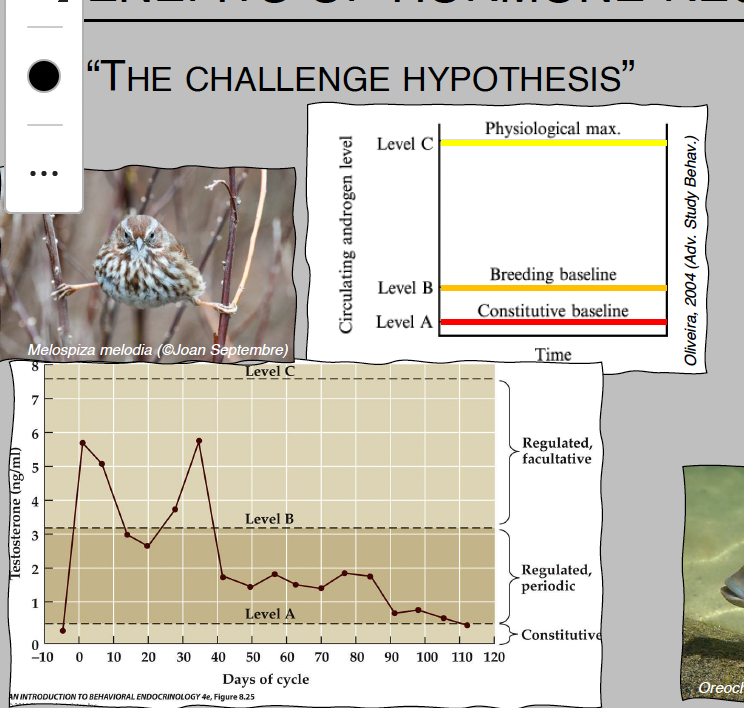
The Challenge Hypothesis states that a male animal's testosterone levels are driven by social challenges, such as competing with rival males, rather than just the change in seasons.
It explains that keeping testosterone permanently high is harmful because it lowers immunity and stops males from caring for their offspring. Therefore, testosterone only spikes when a male is actively challenged.
1. The Three Hormone Levels (Top-Right Diagram)
Level A (Constitutive baseline): The standard level during the non-breeding season. It keeps basic body functions running.
Level B (Breeding baseline): The elevated level needed automatically for the breeding season. It triggers singing and territory setup.
Level C (Physiological max): The maximum possible hormonal spike. It is only triggered by social challenges like a rival male showing up.
📸 Figure: Meadow vole photo + female territory maps in summer vs winter.
⭐ Remember: Summer = separate; winter = overlap.
📸 Figure: Left androgen-level model + right bar graphs comparing mating systems.
⭐ Remember: More male-male competition → stronger testosterone involvement.
📸 Figure: Winner vs loser testosterone graph + soccer photo.
⭐ Remember: Winning can boost testosterone.
📸 Figure: Bar graphs showing resident winners, attack latency and number of attacks + mouse photo.
⭐ Remember: Testosterone + winning experience = stronger future aggressi
• Higher testosterone → generally more aggression
• Testosterone mainly increases the motivation to compete, not aggression all the time.
• Environment and social situation still determine behaviour.
📸 Figure to use
Left graph: testosterone treatment increases aggressive behaviour.
Right graph: aggression rises with increasing testosterone concentration.
⭐ Remember
Testosterone facilitates aggression rather than directly causing it.
• Example: meadow voles
• Summer: females keep separate territories → less social.
• Winter: territories overlap → animals become more social.
• Hormones help regulate this seasonal shift.
📸 Figure to use
Meadow vole.
Territory maps: summer (little overlap) vs winter (large overlap).
⭐ Remember
Hormones regulate when animals live alone or together.
Oxytocin is the major hormone promoting social bonding and trust. • Produced in the hypothalamus. • Released by the posterior pituitary. • Promotes:
Bonding
Trust
Social affiliation
Maternal behaviour
• Often called the "cuddle hormone." 📸 Figure to use Human bonding picture. Oxytocin molecule/pathway figure. ⭐ Remember Oxytocin strengthens positive social relationships.
• Individuals with higher oxytocin generally show:
stronger attachment
more partner-directed behaviour
• Oxytocin helps maintain long-term relationships.
📸 Figure to use
Scatterplot showing positive relationship.
Couple image.
⭐ Remember
Oxytocin supports pair bond maintenance.
• Monogamous species
stronger pair bonds
more oxytocin receptor activity
• Polygamous species
weaker pair bonds
different receptor distribution
📸 Figure to use
Prairie vole vs meadow vole.
Central receptor distribution graph.
⭐ Remember
Bond strength depends more on receptor distribution than on oxytocin levels alone.
Changing oxytocin signalling changes pair-bond behaviour. • Increasing oxytocin signalling → stronger bonding (female = oxytocin. male = vasopressin). • Blocking oxytocin signalling → weaker bonding. • Demonstrates a causal role of oxytocin. 📸 Figure to use Left behavioural graph. Upper-right receptor graph. Meadow vole picture. ⭐ Remember Oxytocin is necessary for normal pair bonding.
• Can reduce aggression towards partners.
• Can increase defence of the social group.
• Promotes in-group cooperation, but sometimes out-group conflict.
📸 Figure to use
Behaviour graph.
Conflict illustration.
⭐ Remember
Oxytocin promotes social behaviour, not universal kindness.
• Animals spend more time together.
• Social interactions become more frequent.
• Group cohesion increases.
📸 Figure to use
Arena/grouping experiment.
Bar graph.
Animal photograph.
⭐ Remember
Oxytocin promotes living together in groups.
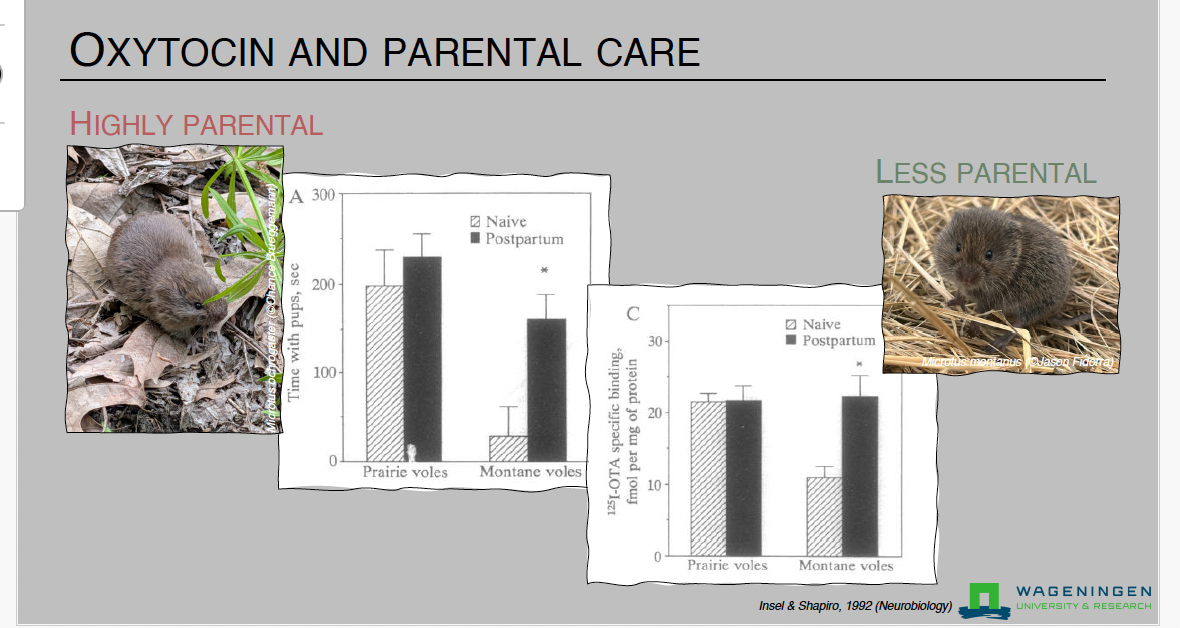
• More oxytocin →
increased parental care
increased grooming
increased nursing
• Important for successful offspring development.
📸 Figure to use
Monogamous vs polygamous rodents.
Two bar graphs.
⭐ Remember
Oxytocin promotes caring for offspring.
• Mothers with more oxytocin show:
more licking/grooming
more nursing
more offspring care
📸 Figure to use
Human/maternal hormone bar graph.
⭐ Remember
Oxytocin supports maternal behaviour immediately after birth.
• Social touch releases endorphins (opioids).
• Produces:
comfort
relaxation
reduced stress
• Blocking opioid receptors reduces the rewarding feeling of social contact.
📸 Figure to use
Hand holding chick.
Bar graph on opioid manipulation.
⭐ Remember
Oxytocin promotes bonding; opioids make bonding feel rewarding.
• Testosterone
regulates aggression
regulates dominance
has benefits and costs
• Oxytocin
promotes bonding
sociality
parental care
• Hormones do not directly determine behaviour; they change the probability that behaviours occur depending on the social context.
📸 Figure to use
Final title slide with turtles.
⭐ Remember
Behaviour = hormones × brain × environment × social contex