CPAC 1 Waves on a string
 Call Kai
 Learn
 Practice Test
 Spaced Repetition
 Match
 Flashcards
 Knowt Play
1/14

Earn XP
15 Terms
What equipment was used in this CPAC?
(9)
Signal Generator
Vibration Generator
Stand
Pulley
Wooden Bridge
100g masses with holder
Meter Ruler
1.5m Long String
Balance
What was out hypothesis?
The speed of the travelling waves will be constant for every length of string and can be determined by the wave equation or the tension in the string.
Outline the Method used.
Set up the apparatus as shown in the diagram.
Adjust the length l so that it is 1.000m, measured using the meter ruler.
Increase the frequency f until the string oscillates at the first harmonic.
Read and record f.
Reduce l by 0.100m and adjust f again until it oscillates at the first harmonic. Measure and record f and repeat this, reducing l by 0.100m each time down to 0.500m.
Repeat the experiment twice more and find and record the mean f for each l.
Measure the mass of the string on the balance and record it.
Draw a diagram of the apparatus
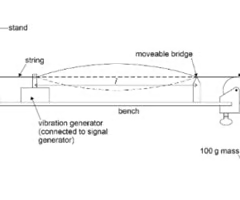
Graph and Calculations
Plot a graph of the mean value of f against 1/l and draw a line of best fit. The wave speed will be two times the gradient.
λ = 2l ⇒ v = 2 = fl G where G is the gradient.
The tension of the string is equal to the weight of the hanging mass (if 100g, 0.981N) and its mass per unit length can be found by dividing the mass of the string by its length (1.5m).
The speed of the wave is also given by v = which can be compared to the √μ T value obtained by the graph.
What piece of apparatus can be used to generate a wave in a piece of string?
A vibration generator, driven by a signal generator.
What piece of apparatus can be used to alter the length of string that is oscillating?
A bridge (a triangular prism shaped object) can be moved along the length of the string to alter the length of the oscillating region.
In RP1, the string is tied to a clamp stand. To carry out this experiment safely, what must you add to the stand?
A counterweight or g-clamp should be used to produce a counteracting moment that prevents the stand from toppling over.
Why should the signal generator be operated for a several minutes before use?
The signal generator needs time for the frequency to stabilise.
What safety precautions should be taken when using mass hangers?
Never stand directly under a mass hanger - if it falls it may cause injury. It is good practice to place a padded bucket below the hanger.
How can you measure the mass per unit length of a piece a string?
Measure the mass of a suitably long piece of string using a mass balance and then divide this by the string's length.
What is the advantage of using a long piece of string when measuring the mass per unit length?
The longer the piece of the string, the lower the percentage uncertainty in the measurement.
What improvements and notes can be made for this practical?
(3)
Experiment repeated with different masses to change the tension and different thicknesses to change the mass per unit length in order to investigate the effect of changing these parameters.
An oscilloscope can be used to verify the signal generator’s readings.
The signal generator should be left for about 20 minutes beforehand to calibrate and stabilize so that the measurement in more accurate.
Random Errors
The sharpness of resonance leads to the biggest problem in deciding when the first harmonic is achieved
This can be resolved by adjusting the frequency while looking closely at a node. This is a technique to gain the largest response
Looking at the amplitude is likely to be less reliable since the wave will be moving very fast
When taking repeat measurements of the frequency, the best procedure is as follows:
Determine the frequency of the first harmonic when the largest vibration is observed and note down the frequency at this point
Increase the frequency and then gradually reduce it until the first harmonic is observed again and note down the frequency of this
If taking three repeat readings, repeat this procedure again
Average the three readings and move onto the next measurement
Safety Considerations
Use a rubber string instead of a metal wire, in case it snaps under tension
If using a metal wire, wear goggles to protect the eyes in case it snaps
Stand well away from the masses in case they fall onto the floor
Place a crash mat or any soft surface under the masses to break their fall