Hist 134 Western Civilization Chapters 15-22 Quizzes Study Set
 Call Kai
 Learn
Learn Practice Test
 Spaced Repetition
 Match
Match Flashcards
 Knowt Play
1/192

There's no tags or description
Looks like no tags are added yet.
Name | Mastery | Learn | Test | Matching | Spaced | Call with Kai | Chat |
|---|
No analytics yet
Send a link to your students to track their progress
193 Terms
What was the purpose of Louis XIV's expansion and professionalization of the French military?
To expand French power in Europe and increase France's territorial holdings on the continent
Which of the following did Louis XIV employ as a counter to the parliaments, provincial estates, aristocratic governors, and hereditary officials, many of whom had purchased their offices?
Louis XIV employed intendants as a counter to the parliaments, provincial estates, aristocratic governors, and hereditary officials, many of whom had purchased their offices.
What was the name given to runaway serfs and poor nobles who formed outlaw bands in the no-man's-land of southern Russia and Ukraine?
Cossacks
Which territory did the Austrian Habsburgs take from the Turks between 1683 and 1699?
Hungary

How did the Rump Parliament respond to the execution of Charles I on January 30, 1649?
It abolished the monarchy.
In what ways did governments become involved in the sciences during the seventeenth century?
They saw science as a means to enhance their prestige and invested monetary and social resources in scientific research.
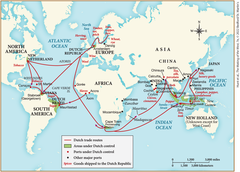
According to this map, South American territories primarily exported which good to the Dutch Republic during the seventeenth century?
Sugar
How did the absolutist monarchy of Frederick William of Hohenzollern differ from that of Louis XIV?
Frederick William allowed his nobles more independence than Louis, and he rebuffed the ostentation of the French court, welcoming Huguenot refugees from France.
Why did Louis XIV persecute the Jansenists and drive them underground?
They prioritized individual conscience over the requirements of the church hierarchy.
Parliament offered the throne jointly to William (r. 1689-1702) and Mary (r. 1689-1694) on the condition that they accept which of the following?
A bill of rights making Parliament a full partner in state governance
After the conclusion of the Thirty Years' War in 1648, what largely disappeared as a major cause of war among European states?
Religious differences
What was the significance of the Church of England's Thirty-Nine Articles of Religion, which were issued in 1563 under the authority of Queen Elizabeth I?
They combined elements of Catholic ritual with Calvinist doctrines.
By the end of the Thirty Years' War, the balance of power in Europe
had shifted away from the Habsburg powers toward France, England, and the Dutch Republic.
Why did King Henry IV declare "Paris is worth a Mass"?
He converted to Catholicism to ensure his control over France, believing that he needed to place the interests of the state ahead of his Protestant faith.
Which of the following astronomers provided mathematical backing for heliocentrism and was the first to assert that planetary orbits are elliptical?
Johannes Kepler
According to this map, which European nation was the most successful at colonizing the Americas in the seventeenth century?
According to this map, Spain was the most successful at colonizing the Americas in the seventeenth century.

Principia Mathematica (1687), which synthesized the laws of movement and universal gravitation, was the work of what great scholar?
Principia Mathematica was the work of Isaac Newton.
What divided the northern and southern provinces of the Netherlands even after they drove out the Spaniards in 1576?
The southern provinces remained largely Catholic, while the northern provinces were predominantly Protestant.
Which of the following was the only European state to emerge unscathed from the economic downturn of the early seventeenth century, thanks to its growing population and a tradition of agricultural innovation?
The Dutch Republic
What prompted Philip II to send his Spanish Armada against England and Elizabeth I in 1588?
Elizabeth's execution of her Catholic cousin Mary, queen of Scots
How did the Russian tsar Peter the Great's imposition of the Table of Ranks in 1722 affect Russian society?
It divided the Russian nobility into compulsory military, administrative, and judicial service categories.
What did critics of the Enlightenment find so dangerous about the new intellectual movement?
Its proponents subjected everything to criticism and challenged both political and religious authority.
In England, Eliza Haywood was one of a number of eighteenth-century women who showed that they could succeed as
novelists.
Which of the following goods played an essential role in the Atlantic economy and the expansion of European consumer society?
Sugar
Which of the following was characteristic of the rococo style of painting that developed in the eighteenth century?
The depiction of scenes of intimate sensuality and a decorative quality
What controversial agricultural practice in England that eliminated community grazing rights normally required an act of Parliament?
Enclosure
Why was the Enlightenment a key historical moment in the discussion of the "woman question" in European society?
Feminist ideas were presented systematically for the first time, representing a fundamental challenge to traditional ways of society.
Children of Spanish men and Indian women were called
mestizos.
After some two hundred years of tolerating and even supporting piracy, why did the English and Dutch governments suddenly try to stamp it out around 1700?
English, Dutch, and French bands of sailors began to form associations of pirates, especially in the Caribbean, that preyed indiscriminately on shipping lines of every national origin.
Although in Britain's constitutional system the monarch ruled with Parliament, power was still contained within a very small elite in the eighteenth century. What was the reason for this?
Only a few hundred thousand propertied men could vote, and most members of Parliament came from the landed gentry.
Although the publication of William Petty's Political Artithmetik in 1690 raised governments' interest in public health as an element of state power, it had little effect on the health of most people because
medicine was not a unified practice, the causes of disease were not known, and many people were not treated.
What was the most populous city in Europe in 1750?
London
How did Mary Astell's A Serious Proposal to the Ladies (1694) challenge the subservient roles traditionally ascribed to women?
It advocated the founding of a private women's college to remedy women's lack of education.
In seventeenth and eighteenth century Europe, doctors viewed insanity not as an emotional ailment, but as a physical one caused by
an imbalance of bodily humors.
Plantations in the New World can best be described as
large tracts of land owned by colonial settlers from western Europe that were farmed by slave labor and produced staple crops.
By the eighteenth century, many Europeans began to try to provide rationale for the institution of slavery based predominantly on what grounds?
The purported mental and spiritual inferiority of African people.
Why did plantation slavery replace indentured servitude as the major economic anchor of the Atlantic system?
African slave labor was cheaper than indentured servants, allowing plantations to produce mass quantities of commodities at low prices.
What sorts of professions made up the developing urban middle classes of the eighteenth century?
Government officials, merchants, professionals, and small land owners.
How did the French government respond to Voltaire's Letters Concerning the English Nation, published in the early 1730's?
They ordered his arrest.
How did the Russian tsar Peter the Great's imposition of the Table of Ranks in 1722 affect Russian society?
It divided Russian nobility into compulsory military, administrative, and judicial serve categories.
By the 1700s, most slaves were purchased from
Africa
Which state had the best-trained and most up-to-date military force in Europe, despite being smaller than those of its rivals?
Prussia
Why did clothing develop special importance in eighteenth-century cities?
Clothing became a reliable indicator of people's social status and occupation further distinguishing the social classes.
How did the Dutch respond to their decline in international affairs and manufacturing during the eighteenth century?
They shifted their interest away from international power politics and began to focus on areas of trade and finance where they could establish an enduring presence.
Why did George Frideric Handel infuse operatic drama with a religious theme in his 1741 oratorio Messiah?
To combine musical materials into a dramatic form that would touch the emotions of the new concert-going public.
Which of the following was a consequence of the early eighteenth century consumer revolution in Europe?
The demand for consumer goods, such as housewares, rose dramatically as ordinary people had more disposable income, leading to job creation.
In his 1721 book Persian Letters, the baron of Montesquieu (1689-1755) used what genre of writing to satirically explore good government and morality?
Travel Literature
Which of the following goods played an essential role in the Atlantic economy and the expansion of the European consumer society?
Sugar
The common link among Princeton University, the Hasidim, and John Wesley is that they all
flourished because of religious revivalism in the eighteenth century.
The Scottish philosopher Adam Smith (1723-1790) made what contention about individual self-interest?
That it contributed ultimately to the general welfare of society
As a result of the Seven Years' War, territory in the Americas changed hands. Which of the following statements describes these changes?
Canada is indicated as being a British possession, whereas it was a French possession before the war.
How did the rise of public opinion as a force independent of court society influence European politics in the eighteenth century?
It forced leaders, including monarchs, to engage with their citizens and take reform and opposition to reform seriously.
What was the opinion of Enlightenment writers on the role of religion in society?
They did not necessarily oppose organized religion, but they strenuously objected to religious intolerance.
While the spread of salons, concerts, and exhibitions took place among the middle and upper classes, what forms of entertainment demonstrated the persistence of traditional forms of popular culture among the lower classes?
Peasants continued to enjoy fairs and festivals, while the urban lower classes went to taverns and cabarets and attended forms of entertainment that included organized gambling.
Oxford-educated John Wesley (1703-1791) was the founder of which of the following reform movements?
Methodism
Why was the nobility of western Europe more open to the new ideas of the Enlightenment than the nobility of eastern and southern Europe?
Western European nobles had sometimes married into middle-class families and formed with them a new elite, united by common interests in reform and new cultural tastes.
Although most intellectuals of the Enlightenment publicly embraced the doctrine of religious toleration, many of them were still intolerant of which group?
Jews
How did Jean-Jacques Rousseau first become well-known?
He wrote a prize-winning essay about the corruption of public morality.
In the Treaty of Paris of 1763, France officially acknowledged its defeat overseas, ceding which of its territories to Great Britain?
Canada
What was Empress Catherine II's response to the Pugachev rebellion, a massive uprising by the long-oppressed serfs of Russia in 1773?
She increased the nobles' power over their serfs and harshly punished anyone who criticized serfdom.
Why did the Seven Years' War have such a significant impact on American-British relations?
The costs incurred by the British during the war raised taxes in the colonies, which the colonists first resisted by protest and then by outright rebellion.
What label have historians given to eighteenth-century rulers who aimed to promote Enlightenment reforms without giving up their absolutist powers?
Enlightened despots
What new artistic movement developed in the eighteenth century in reaction to what some saw as the Enlightenment's excessive reliance on the authority of human reason?
Romanticism
Which of the following territories was under Spanish control by about 1780?
Louisiana
The artistic and architectural style known as neoclassicism gained popularity in the eighteenth century thanks to what cultural phenomenon?
The rise of "grand tours," in which upper-class youths traveled to Greek and Roman ruins
The Sorrows of Young Werther (1774), by the German writer Johann Wolfgang von Goethe (1749-1832), is considered to be a reaction against the Enlightenment because its hero
indulges in intense love, intense melancholy, and suicide.
The militarization of Prussian society in the late eighteenth century led to which of the following effects?
It kept the peasants enserfed to their lords and blocked the middle classes from access to estates or high government positions.
In the Treaty of Paris of 1763, France officially acknowledged its defeat overseas, ceding which of its territories to Great Britain?
Canada
Which nation expanded their position along the Baltic Sea as a result of the First Partition of Poland in 1772?
Prussia
Although eighteenth-century food riots were a direct response to the lack of available food, they were also a reaction to
the lower classes' lack of access to the political system and their desire for government regulation of the price of grain.
Some of the more influential economic reforms of the eighteenth century were suggested by a group of economists in France called the physiocrats. What reforms did they support?
They urged the government to deregulate the grain trade, make the tax system more equitable, and abolish urban guilds that prevented free entry into the trades.
In 1784, the German philosopher Immanuel Kant used which of the following phrases to represent what he felt the Enlightenment stood for?
Sapere aude ("Dare to know")
Why do many historians and philosophers consider the Enlightenment to be the origin of modernity?
It advanced the secularization of European society and the idea that human reason, rather than theological doctrine, should govern social and political life.
Who among the following leaders was the only enlightened ruler to end the personal aspects of serfdom?
Joseph II of Austria
Which enlightened absolutist, whose reforms and accomplishments included the abolition of torture and the support of religious toleration, boasted, "I am the first servant of the state"?
Frederick the Great of Prussia
What did the writers of the Enlightenment call themselves?
Philosophes
In order to make tax increases more palatable, how did the "enlightened absolutists" of Europe actively modernize government?
By enacting administrative and legal reforms
What was the significance of the event known as "the flight to Varennes"?
It demonstrated to the French public that Louis XVI and Marie-Antoinette were traitors to the revolution, as the royal family had attempted to flee the country and gather resistance.
As a reward for his efforts in fighting off the Spanish armies, the French appointed Toussaint L'Ouverture, a former slave, governor of St. Domingue. Which of the following is also true of Toussaint L'Ouverture?
He later died in a French prison after his arrest by Napoleon's army.
German states reacted to the French Revolution with an artistic and intellectual revival that was linked to
anti-French nationalism stirred by distrust of France's advancing armies.
What new reforms resulted after the sans-culottes attacked the Tuileries in August, 1792?
The legislature ordered elections for a constitutional convention and instituted universal male suffrage; when the National Convention met, it abolished the monarchy and established a republic.
The Thermidorian Reaction refers to
the successful efforts of anti-Jacobins in France to roll back the Terror after the death of Robespierre
What was the role of the twelve-member Committee of Public Safety, created in 1793?
To set the course for government and the war and coordinate the purge of unreliable officials
Which of the following statements is supported by this map of France in the 1790s?
France expanded its territorial claims significantly during this time.

What issue inspired the dispute in the French National Assembly between the Girondins and the Mountain?
The Mountain believed that the king, Louis XVI, should be executed for treason, while the Girondins argued that he should be given clemency or exile.
According to historians, approximately how many people were imprisoned under the repression implemented by Robespierre?
300,000
How did most European elites react to the French Revolution?
They were alarmed and even enraged by the abolition of monarchy and nobility and the encouragement of popular participation in politics.
When the Estates General met in 1789, what did their first decision concern?
The contentious issue of voting procedure
What was the cause of France's fiscal crisis in the late 1780s?
A mounting deficit stemming from France's support of the Americas in the American War of Independence and compounded by it's inadequate tax system.
When the Estates General met in 1789, what did their first decision concern?
The contentious issue of voting procedure
In an attempt to appease the devout rural populace, how did the Committee of Public Safety institute an alternative to its campaign of de-Christianization?
It replaced the secular Cult of Reason with the deistic Cult of the Supreme Being.
The fall from grace of Robespierre and the Committee of Public Safety came about when Robespierre
began to order the execution of members of the Convention itself.
Why did the revolutionaries' decision to take over the education of boys and girls ultimately fail?
They removed the Catholic clergy who had been teachers but did not have other teachers ready to take their place.
Why did Charlotte Corday assassinate Jean-Paul Marat in July 1793?
She believed that she was avenging innocent Girondins who had been executed because Marat had called for their heads.
What country disappeared from the map of Europe after Russia divided its territory with Austria and Prussia in 1795?
Poland
Which of the following was the first region to be annexed by France during the 1790s?
The Papal Territories
What three events contributed to rising tensions in the months before elections to the Estates General were held?
The king refused to mandate voting by head rather than order, censorship broke down, and food shortages occurred.
Republican festivals sponsored by the Committee of Public Safety were designed to
destroy the mystique of the monarchy and make the republic sacred through symbolism.
According to this map, what did the Neapolitan, Roman, and Helvetic Republics all have in common?
All of these republics were established by revolutionary France.
What did the deputies to the National Assembly declare in the "tennis court oath" of June 20, 1789?
That they would not disband until they had given France a binding constitution