ch4 p3
 Call Kai
 Learn
Learn Practice Test
 Spaced Repetition
 Match
Match Flashcards
 Knowt Play
1/43

There's no tags or description
Looks like no tags are added yet.
Name | Mastery | Learn | Test | Matching | Spaced | Call with Kai | Chat |
|---|
No analytics yet
Send a link to your students to track their progress
44 Terms
Before We Start: Why Do We Need Molecular Orbital Theory?
Up until now, you've probably learned:
Lewis Structures
VSEPR
Hybridization
These all belong to the Localized Electron Model.
Localized means:
Electrons belong to one atom or are shared between two specific atoms.
Example:
H—H
The bonding electrons are thought to exist only between these two hydrogen atoms.
This works really well...
BUT it cannot explain everything.
For example:
Why O₂ is magnetic
Why some molecules exist while others don't
Why some bonds are stronger than others
Resonance and delocalized electrons
So chemists developed Molecular Orbital Theory (MO Theory).
The Big Idea of Molecular Orbital Theory
Instead of electrons belonging to ONE bond...
MO theory says:
Electrons belong to the entire molecule.
Think of the molecule as one giant object instead of separate atoms.
Imagine two houses.
Localized model:
Each family stays inside its own house.
MO theory:
Everyone can move freely throughout BOTH houses.
Electrons are spread across the whole molecule.
This is called delocalization.
What is a Molecular Orbital?
First remember:
Atomic Orbital (AO)
An atomic orbital belongs to one atom.
Examples:
1s
2s
2px
2py
2pz
These are where electrons live before atoms bond.
Molecular Orbital (MO)
A molecular orbital belongs to the entire molecule.
Electrons no longer belong to just one atom.
Instead, they occupy orbitals that spread over both nuclei.
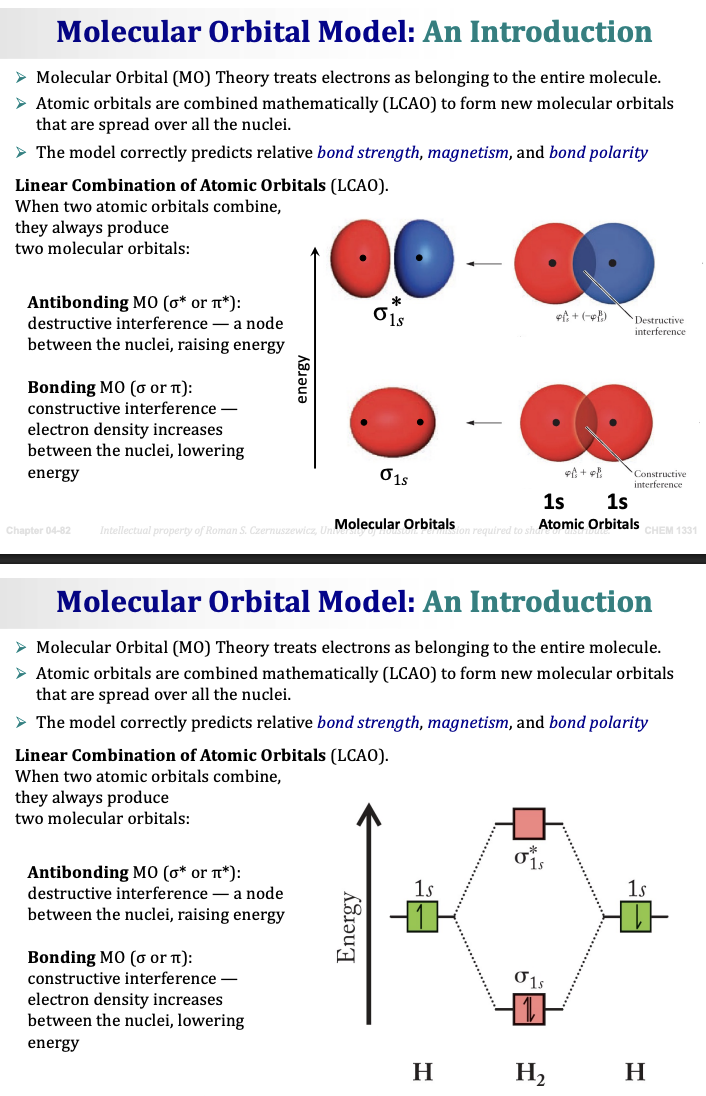
How Do Molecular Orbitals Form?
This is called:
LCAO
Linear Combination of Atomic Orbitals
Sounds scary.
It simply means:
We mathematically combine atomic orbitals together to make new orbitals.
Think of it like:
AO + AO → MO
Example:
1s + 1s
becomes
one bonding MO
one antibonding MO
This ALWAYS happens.
VERY IMPORTANT RULE
Whenever atomic orbitals combine:
The number of molecular orbitals formed ALWAYS equals the number of atomic orbitals used.
Examples
2 atomic orbitals
↓
2 molecular orbitals
4 atomic orbitals
↓
4 molecular orbitals
6 atomic orbitals
↓
6 molecular orbitals
Nothing disappears.
Orbitals are simply rearranged.
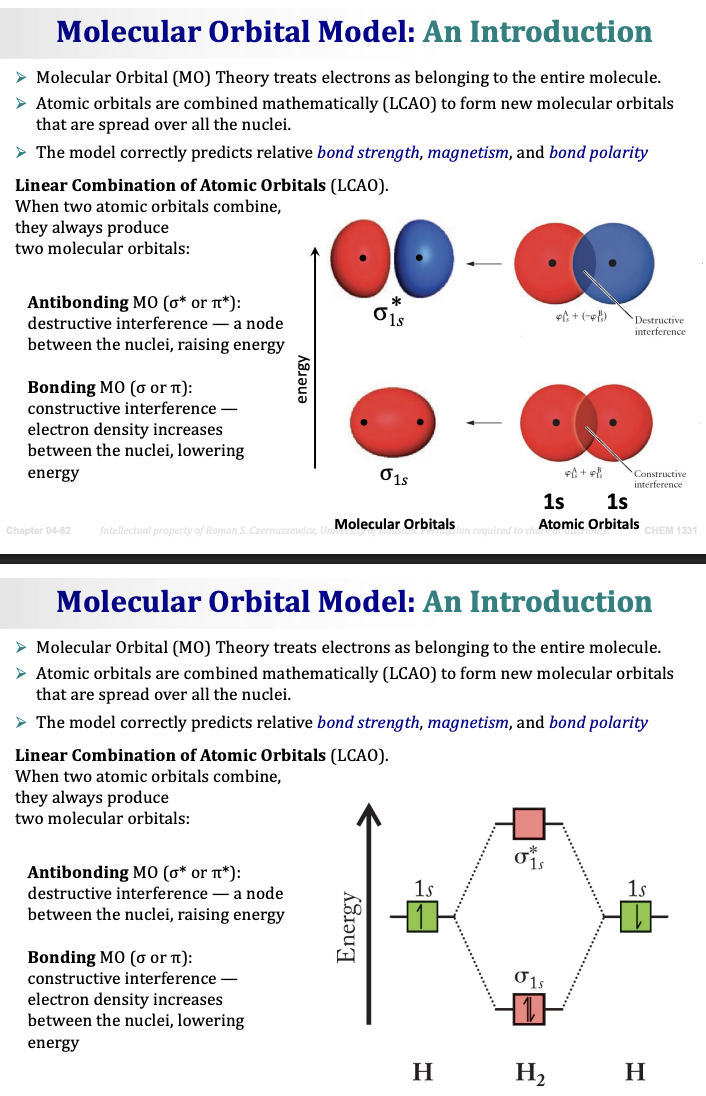
Two Types of Molecular Orbitals
Whenever two orbitals combine...
You ALWAYS get:
1. Bonding Orbital
and
2. Antibonding Orbital
You never get only one.
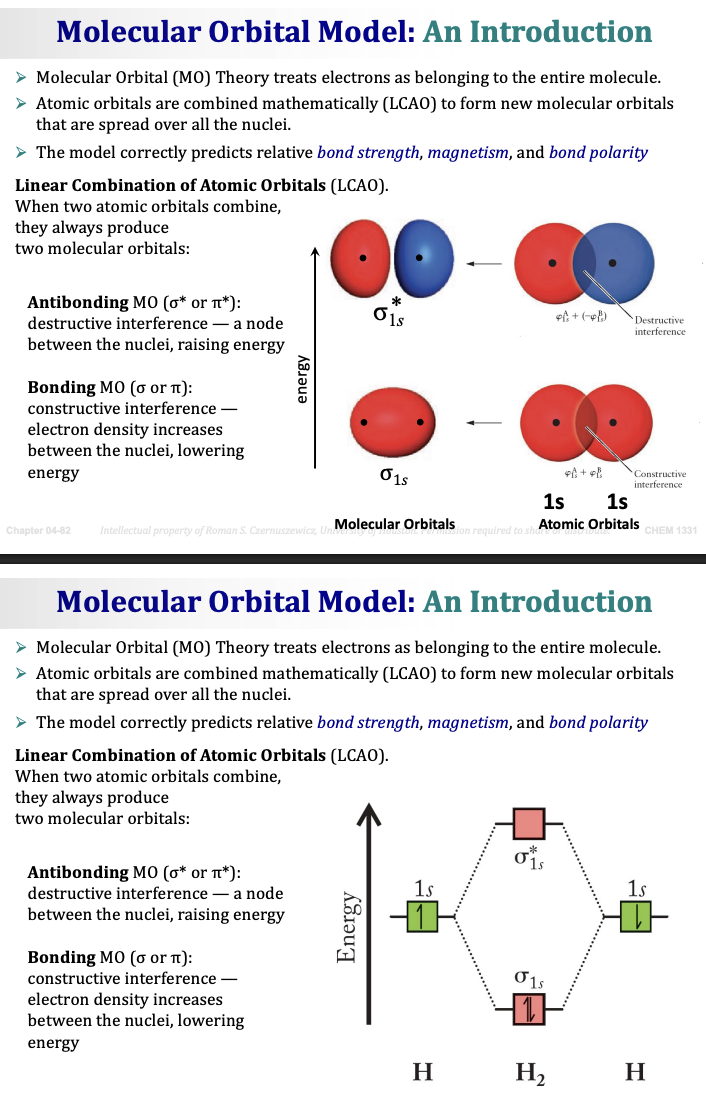
Bonding Orbital (σ or π)
These are the GOOD orbitals.
How do they form?
The waves line up.
Positive overlaps positive.
Negative overlaps negative.
This is called
Constructive Interference
Think about two ocean waves.
If both waves go upward together...
They make one BIGGER wave.
Same idea here.
What Happens?
Electron density increases between the nuclei.
That means:
More electrons sit between the atoms.
Those electrons attract BOTH nuclei at the same time.
Imagine two positive magnets.
Normally they repel.
Now imagine putting negative charges between them.
Those negatives pull both positives inward.
The atoms are pulled together.
A bond forms.
Bonding Orbitals Have
✅ lower energy
✅ greater stability
✅ electrons between nuclei
✅ stronger bonding
Lower energy always means more stable.
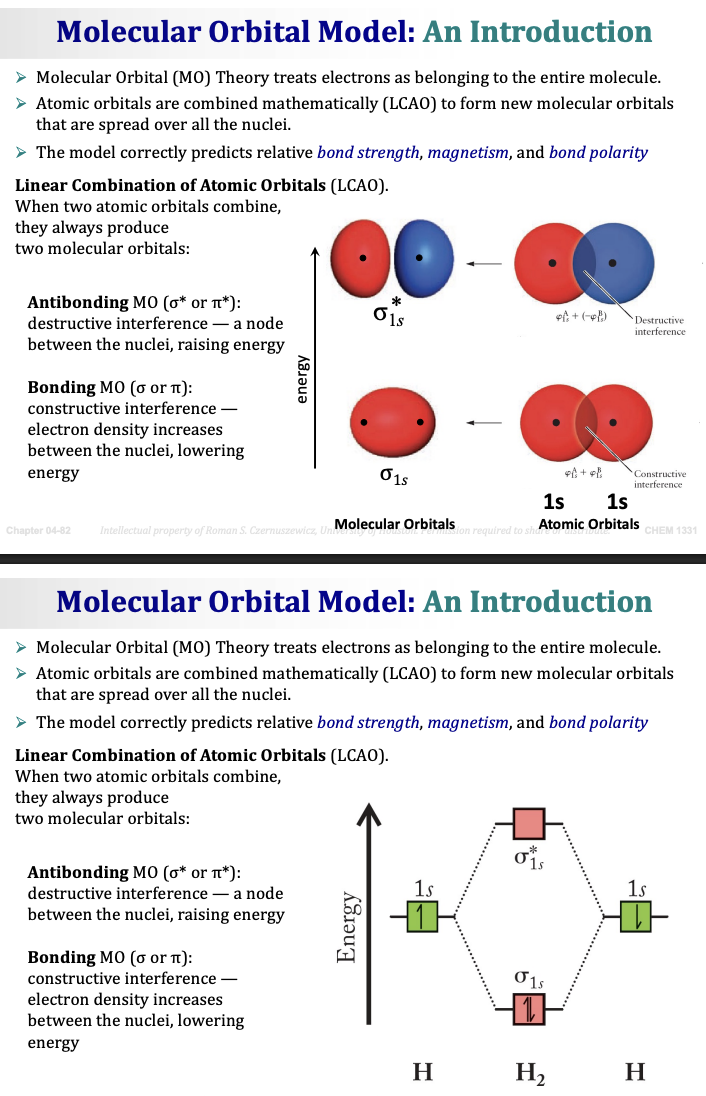
Antibonding Orbitals (σ* or π*)
These are the BAD orbitals.
Notice the star (*).
The star ALWAYS means
antibonding
Example
σ*
π*
How do antibonding orbitals form?
Positive overlaps negative.
The waves cancel.
This is called
Destructive Interference
Imagine two waves.
One goes up.
One goes down.
They cancel.
What Happens?
Electron density disappears between nuclei.
Instead...
A gap forms.
This gap is called
a node
What is a Node?
A node is
a region where there is ZERO probability of finding electrons.
No electrons exist there.
Since there are no electrons between the nuclei...
Nothing pulls the atoms together.
Instead...
The positive nuclei repel.
The bond becomes weaker.
Antibonding Orbitals Have
Higher energy
Less stable
Node between nuclei
Weaken bonding
Easy Memory Trick
Bonding orbital
↓
Electrons BETWEEN nuclei
↓
Atoms pulled together
↓
Lower energy
↓
Stable
Antibonding orbital
↓
No electrons between nuclei
↓
Atoms repel
↓
Higher energy
↓
Unstable
Sigma (σ) Molecular Orbitals
Now the slides move into p orbitals.
First...
Remember p orbitals have three directions.
px
py
pz
Each direction can overlap differently.
Sigma Bonds from p Orbitals
The slides use
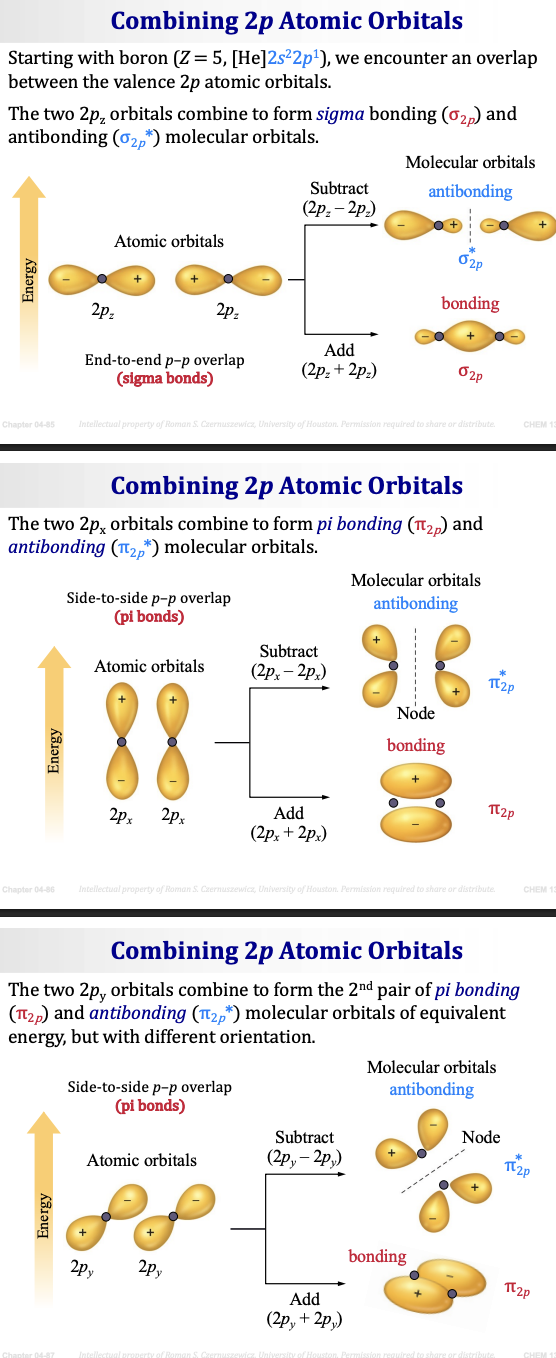
2pz + 2pz
The two p orbitals point directly at each other.
Imagine two balloons touching tip-to-tip.
This is called
End-to-End Overlap
This produces
σ2p
and
σ*2p
Bonding Sigma Orbital
The orbitals add together.
Electron density increases in the middle.
Lower energy.
Stable.
Antibonding Sigma Orbital
The orbitals subtract.
A node forms.
Higher energy.
Unstable.
Why is it Called Sigma?
Sigma overlap happens
DIRECTLY along the line connecting both nuclei.
Think
Head-on collision.
Pi (π) Molecular Orbitals
Now instead of pointing directly at each other...
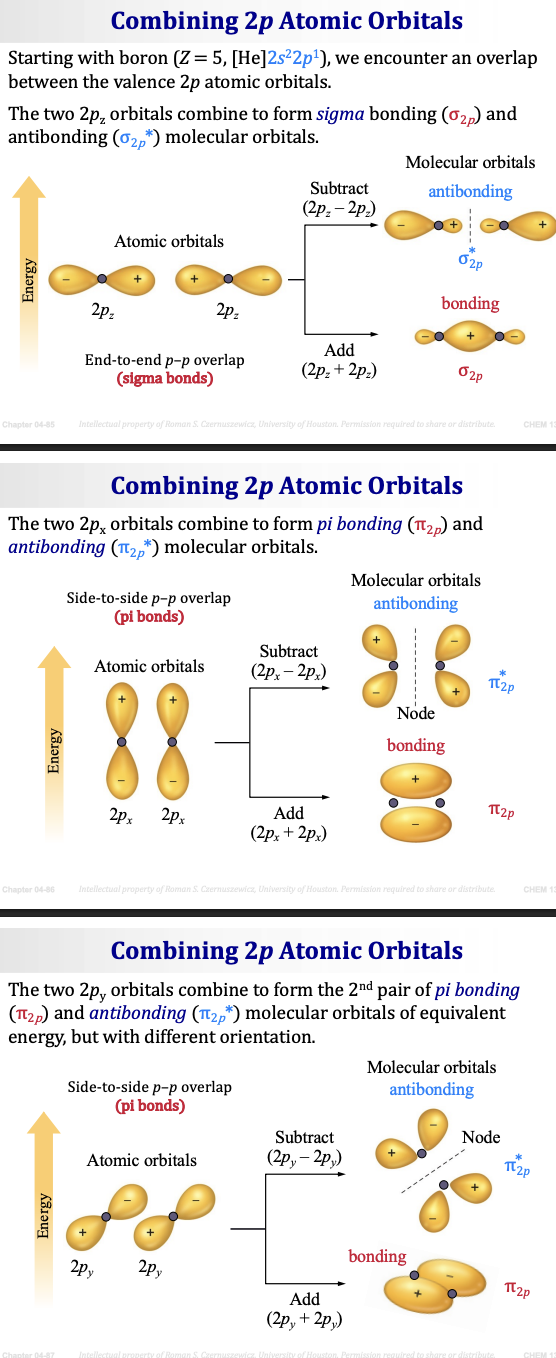
The p orbitals sit side-by-side.
Like two hot dogs next to each other.
This is
Side-to-Side Overlap
This creates
π2p
and
π*2p
Again...
Adding orbitals
↓
Bonding π orbital
Lower energy
Subtracting orbitals
↓
Antibonding π*
Higher energy
Node forms
Why Are There TWO π Orbitals?
Remember
There are
px
and
py
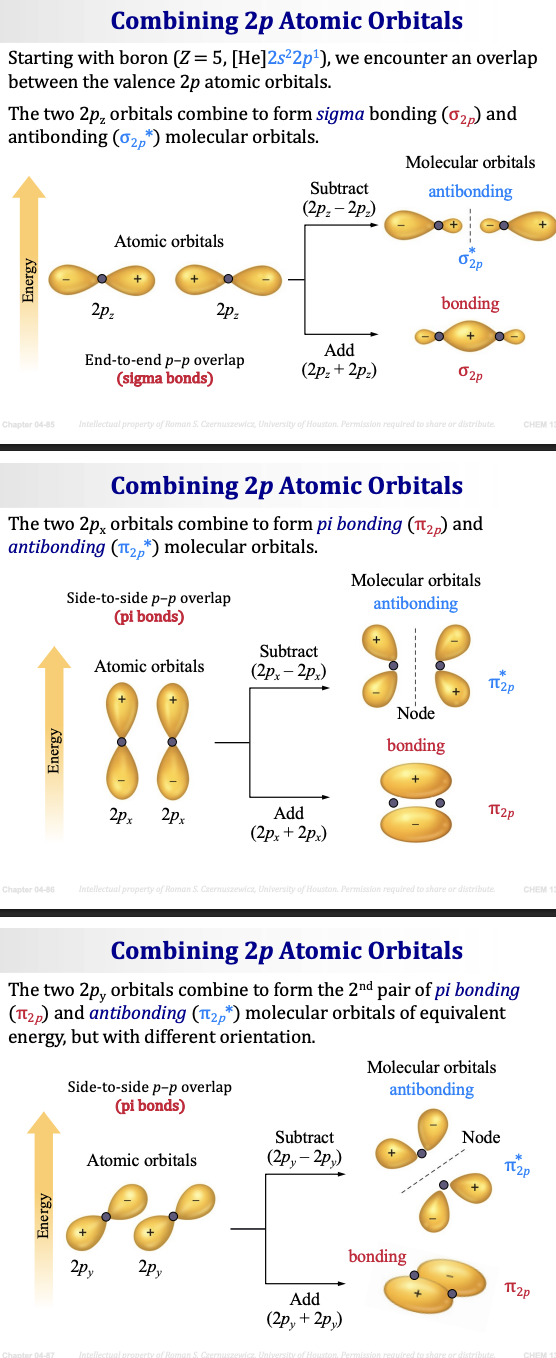
Both can overlap sideways.
So you actually get
πx
and
πy
They have
identical energy
different orientation
This is called
Degenerate Orbitals
Definition:
Orbitals that have the same energy.
Sigma vs Pi
Sigma | Pi |
End-to-end overlap | Side-to-side overlap |
Usually stronger | Usually weaker |
Electron density directly between nuclei | Electron density above and below bond axis |
Forms first | Forms after sigma |
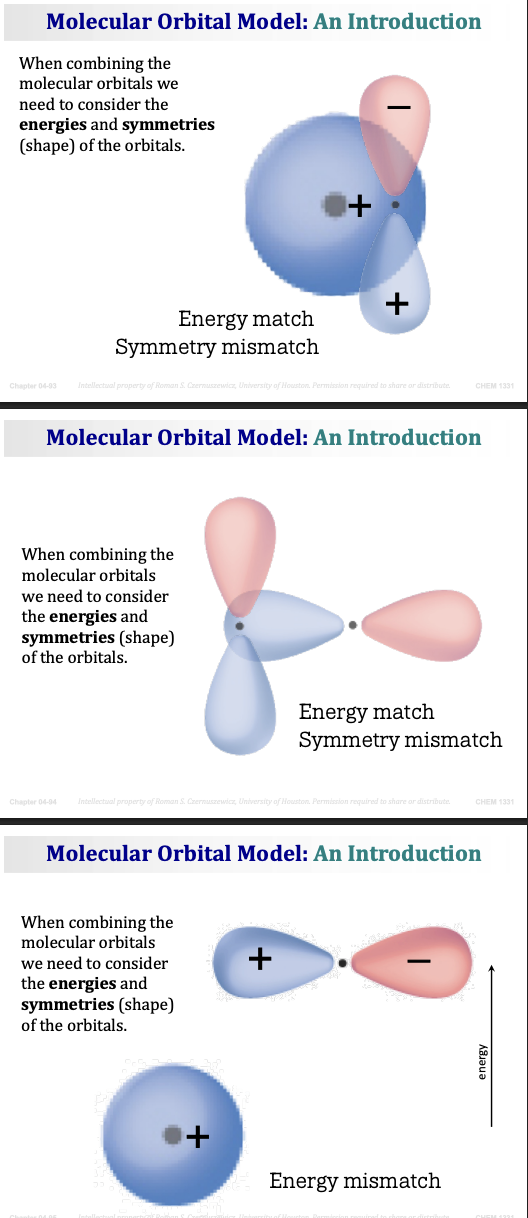
Can Any Orbitals Combine?
NO.
Two things MUST match.
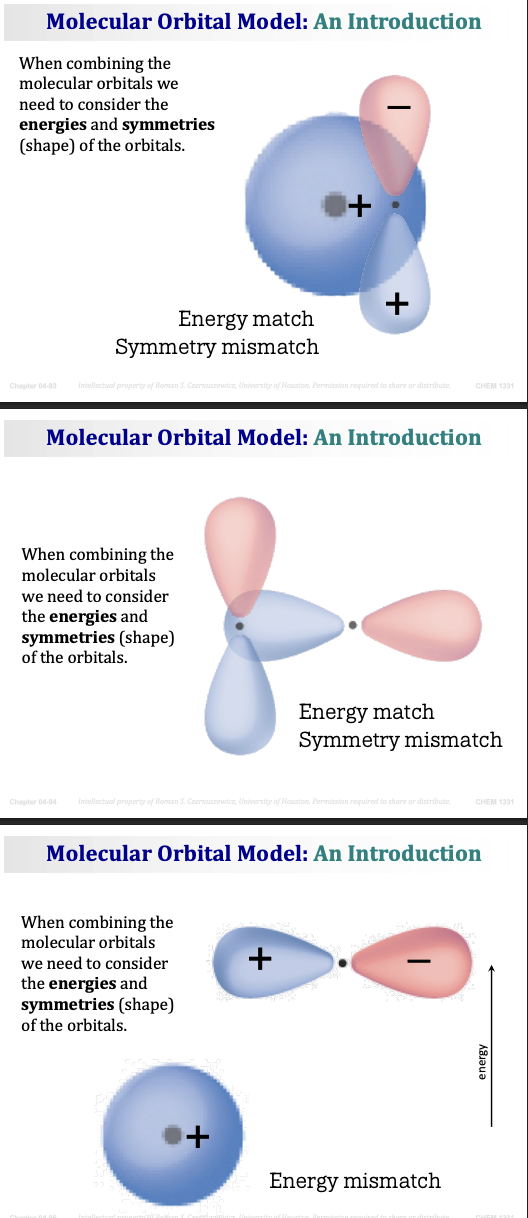
Rule 1 — Energy Match
Orbitals must have similar energies.
Example
2p with 2p
✅ Works
1s with 4p
❌ Doesn't work well.
Why?
The energy difference is too large.
They cannot mix effectively.
Think about trying to dance with someone jumping on a trampoline while you're standing on the floor.
The motions don't match.
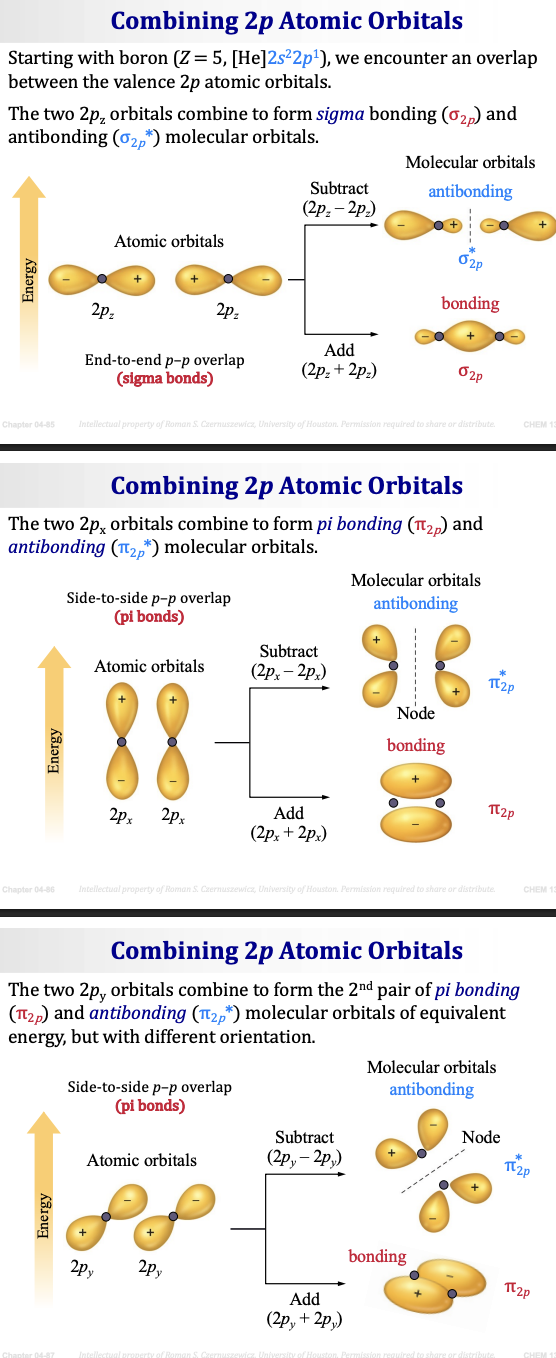
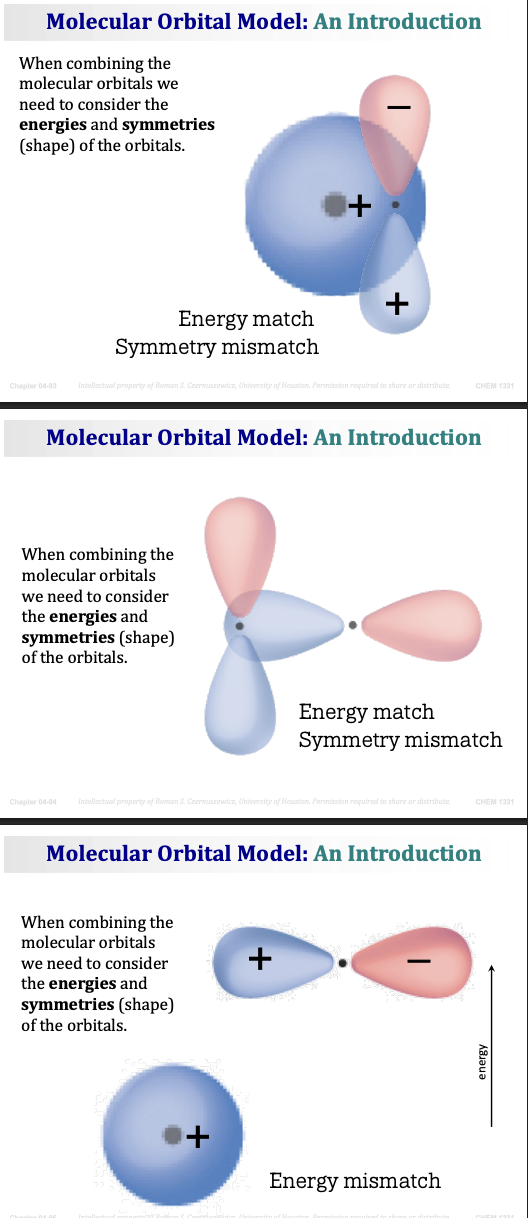
Rule 2 — Symmetry Match
The shapes must line up correctly.
Even if energies match...
If the orbitals point the wrong way...
They cannot overlap.
Example
Two p orbitals facing each other
✅ Good overlap
One p orbital sideways while another points forward
❌ Almost no overlap
BOTH Conditions Must Be True
Good bonding requires
✔ Similar energies
AND
✔ Proper orientation
Missing either one means little or no molecular orbital forms.
Big Picture So Far
Atoms have atomic orbitals.
When atoms approach each other, their atomic orbitals combine.
Every pair of atomic orbitals forms:
one bonding orbital
one antibonding orbital
Bonding orbitals:
lower energy
electrons between nuclei
stabilize molecules
Antibonding orbitals:
higher energy
node between nuclei
weaken molecules
Sigma bonds come from head-on overlap.
Pi bonds come from side-by-side overlap.
Orbitals only combine if they have:
similar energies
matching symmetry
Exam Tips
Memorize these:
Bonding
Constructive interference
Lower energy
Stable
Electrons between nuclei
Antibonding
Destructive interference
Higher energy
Node
Unstable
Sigma
Head-on overlap
Stronger
Pi
Side-by-side overlap
Weaker
LCAO
Atomic orbitals combine
Number of MOs = number of AOs
What is the Purpose of MO Diagrams?
Molecular Orbital (MO) diagrams show where electrons go after atoms bond.
MO diagrams help answer these questions:
Does the molecule exist?
How strong is the bond?
Is the molecule magnetic?
How many bonds are there?
Everything depends on where the electrons are placed.
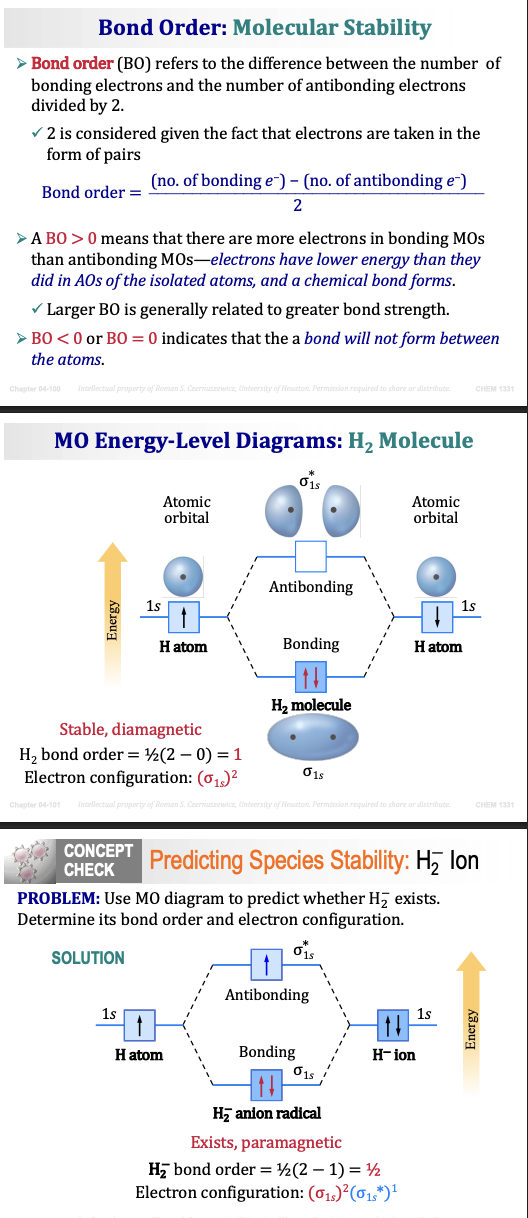
Bond Order (BO)
Definition
Bond order tells you how strong a bond is.
It compares:
Electrons that help form the bond (bonding electrons)
Electrons that weaken the bond (antibonding electrons)
Formula:
Bond Order = (Bonding Electrons − Antibonding Electrons) ÷ 2
Why do we divide by 2?
Each complete bond contains 2 electrons.
Examples:
2 bonding electrons = 1 bond
4 bonding electrons = 2 bonds
That's why we divide by 2.
Interpreting Bond Order
Bond Order > 0
The molecule exists.
More electrons help the bond than hurt it.
Bond Order = 0
The molecule does NOT exist.
Bonding and antibonding effects completely cancel.
Higher Bond Order means:
Stronger bond
Shorter bond
Harder to break
Examples:
BO = 3 → Very strong bond
BO = 2 → Double bond
BO = 1 → Single bond
BO = 0.5 → Weak bond
BO = 0 → No bond
Memory Trick:
Bonding electrons "pull" atoms together.
Antibonding electrons "push" atoms apart.
Rules for Filling Molecular Orbitals
Electrons fill molecular orbitals exactly like atomic orbitals.
Rule 1: Aufbau Principle
Fill the lowest-energy orbitals first.
Electrons always want the lowest possible energy.
Rule 2: Pauli Exclusion Principle
Each orbital can hold a maximum of 2 electrons.
The two electrons must have opposite spins.
Correct:
↑↓
Incorrect:
↑↑
Rule 3: Hund's Rule
If two orbitals have the same energy:
Put one electron in each orbital first.
Pair electrons only after each orbital has one electron.
Correct:
↑ ↑
Incorrect:
↑↓ empty
MO Diagram for H₂
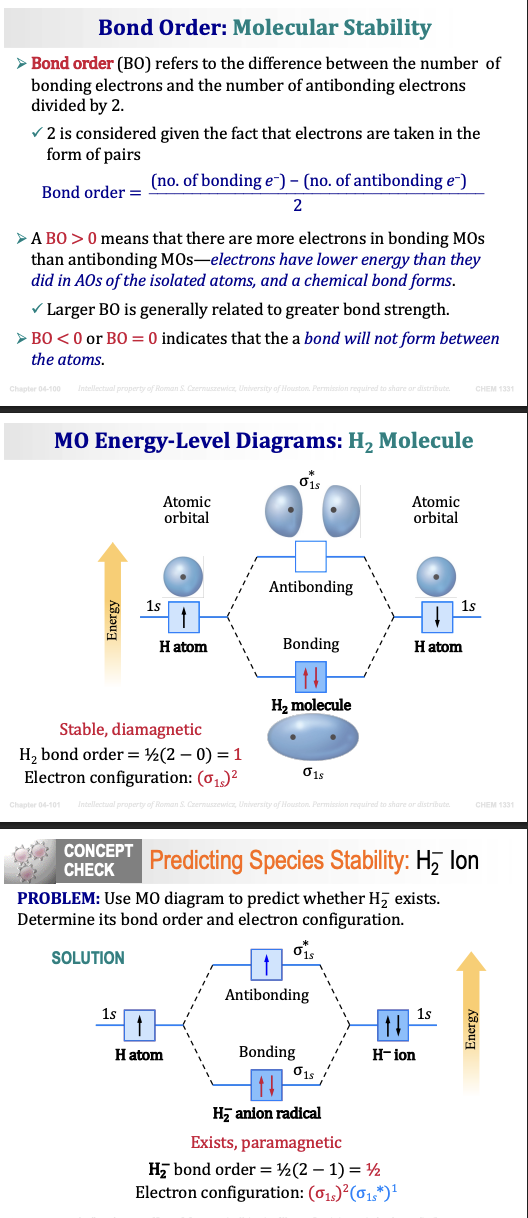
Step 1: Count electrons.
Each hydrogen atom has 1 electron.
2 H atoms = 2 total electrons.
Step 2: Form molecular orbitals.
Two 1s orbitals combine to form:
σ1s (bonding, lower energy)
σ1s* (antibonding, higher energy)
Step 3: Fill the orbitals.
Both electrons go into the lowest-energy orbital.
Electron configuration:
(σ1s)²
Step 4: Calculate bond order.
Bonding electrons = 2
Antibonding electrons = 0
Bond Order = (2 − 0) ÷ 2 = 1
What does this tell us?
H₂ exists.
It has one single bond.
The bond is stable.
Magnetism of H₂
Both electrons are paired.
There are no unpaired electrons.
Therefore:
H₂ is diamagnetic.
Diamagnetic
Definition:
A substance with ALL electrons paired.
Properties:
Not attracted to a magnetic field.
Easy Memory Trick:
Diamagnetic = Double = Every electron has a partner.
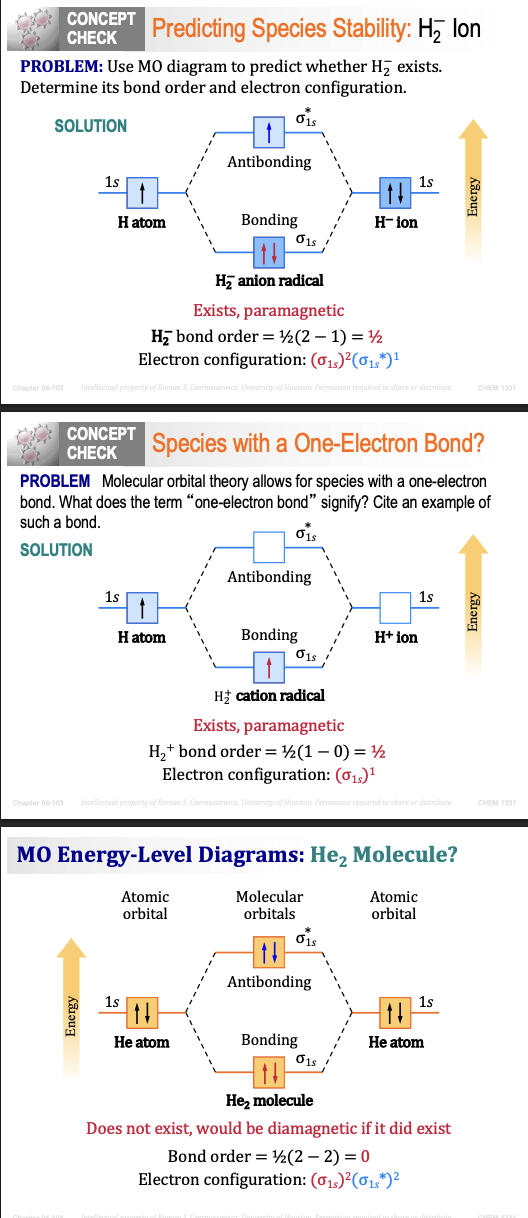
MO Diagram for H₂⁻
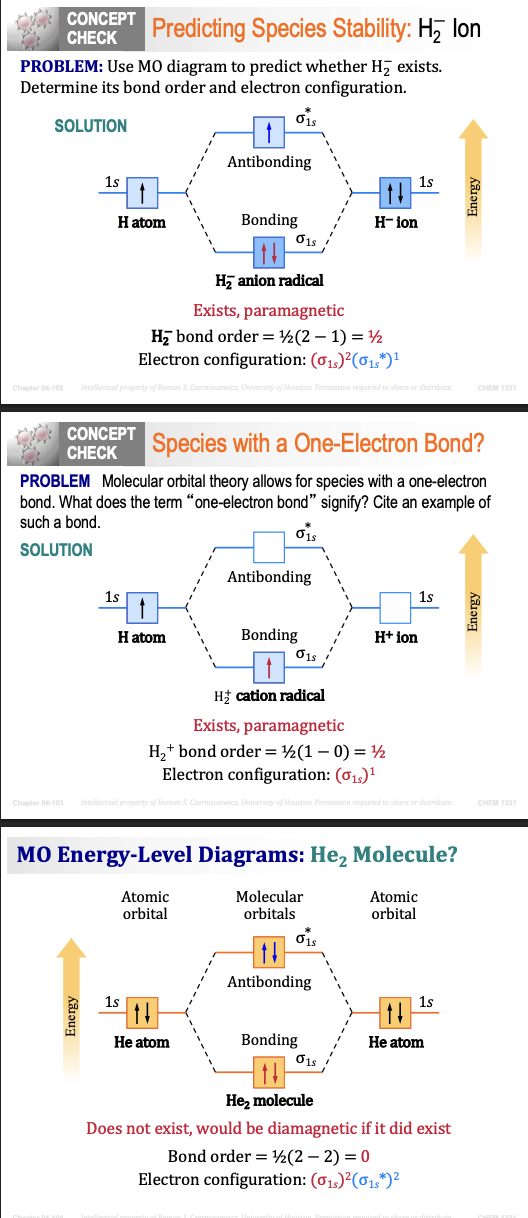
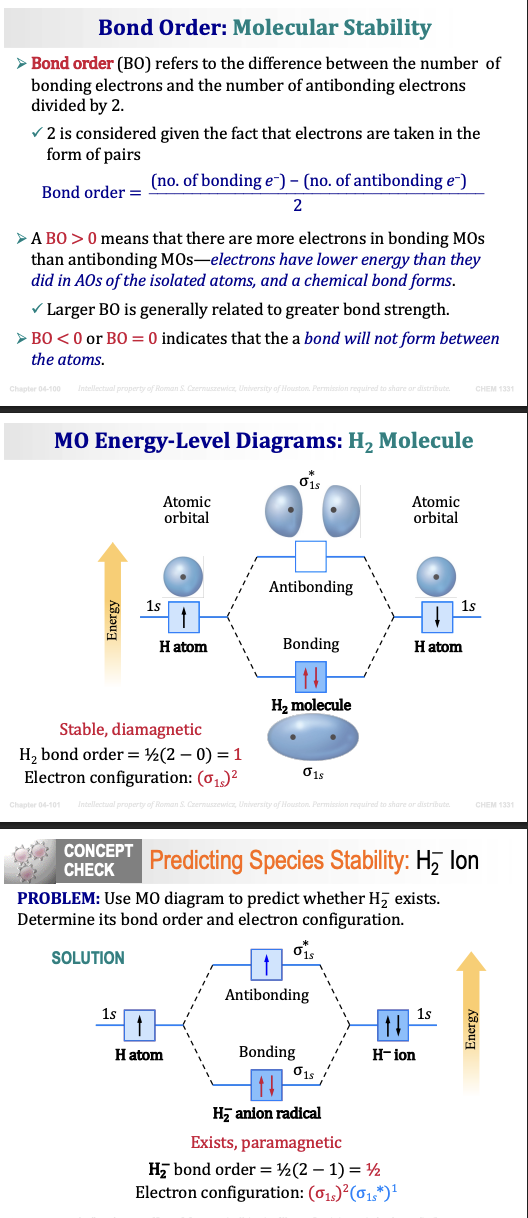
One extra electron is added.
Total electrons = 3
Electron configuration:
(σ1s)²(σ1s*)¹
Calculate Bond Order
Bonding electrons = 2
Antibonding electrons = 1
Bond Order = (2 − 1) ÷ 2 = 0.5
What does this mean?
H₂⁻ exists.
The bond is weaker than H₂.
Why?
The extra electron went into an antibonding orbital, which weakens the bond.
Magnetism of H₂⁻
One electron is unpaired.
Therefore:
H₂⁻ is paramagnetic.
Paramagnetic
Definition:
A substance with one or more unpaired electrons.
Properties:
Attracted to a magnetic field.
Easy Memory Trick:
Paramagnetic = Partial pair = Someone is left alone.
Compare H₂ and H₂⁻
H₂
Bond Order = 1
Stronger bond
Diamagnetic
Stable
H₂⁻
Bond Order = 0.5
Weaker bond
Paramagnetic
Still exists
Important:
Adding an electron does NOT always strengthen a bond.
It depends on which orbital the electron enters.
If it enters an antibonding orbital, the bond becomes weaker.
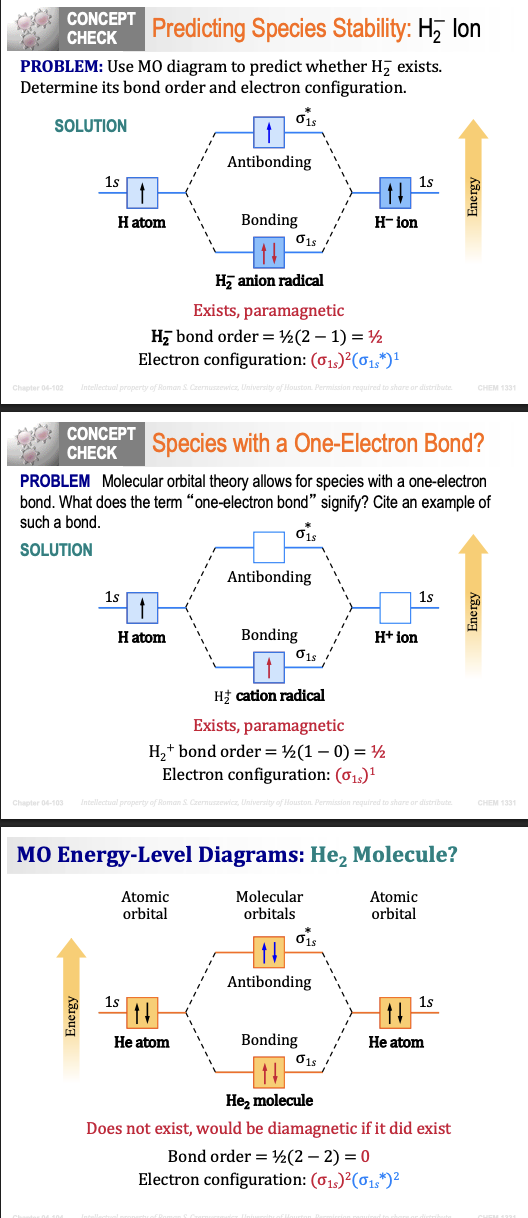
MO Diagram for H₂⁺
Remove one electron from H₂.
Total electrons = 1
Electron configuration:
(σ1s)¹
Calculate Bond Order
Bonding electrons = 1
Antibonding electrons = 0
Bond Order = (1 − 0) ÷ 2 = 0.5
What does this mean?
H₂⁺ exists.
It has a weak bond.
One-Electron Bond
Normally:
2 electrons make one bond.
In H₂⁺:
Only 1 electron forms the bond.
This is called a one-electron bond.
It is weaker than a normal bond but still exists.
Magnetism of H₂⁺
One electron is unpaired.
Therefore:
H₂⁺ is paramagnetic.
Compare Hydrogen Species
H₂
Bond Order = 1
Exists
Diamagnetic
H₂⁺
Bond Order = 0.5
Exists
Paramagnetic
H₂⁻
Bond Order = 0.5
Exists
Paramagnetic
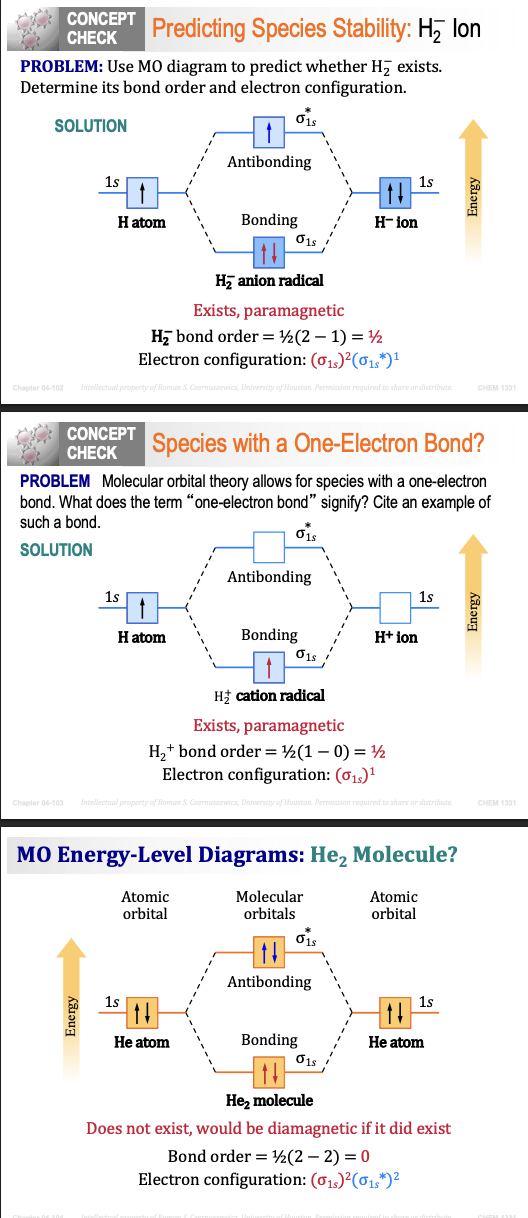
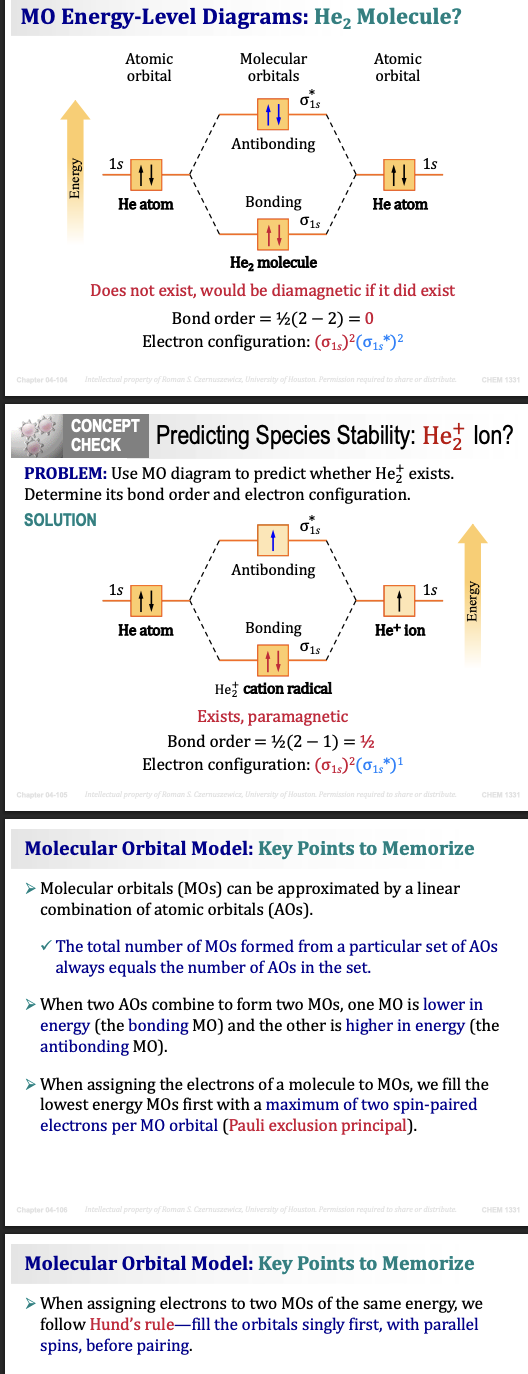
MO Diagram for He₂
Each helium atom has 2 electrons.
Total electrons = 4
Electron configuration:
(σ1s)²(σ1s*)²
Calculate Bond Order
Bonding electrons = 2
Antibonding electrons = 2
Bond Order = (2 − 2) ÷ 2 = 0
What does this mean?
He₂ does NOT exist.
The bonding electrons and antibonding electrons completely cancel each other.
No bond forms.
Why Doesn't He₂ Exist?
Helium already has a full 1s orbital.
When another helium atom approaches:
The bonding orbital fills first.
The remaining electrons must enter the antibonding orbital.
Those antibonding electrons cancel the stabilization provided by the bonding electrons.
Result:
Bond Order = 0
No bond forms.
Magnetism of He₂
All electrons are paired.
Therefore:
He₂ would be diamagnetic if it existed.
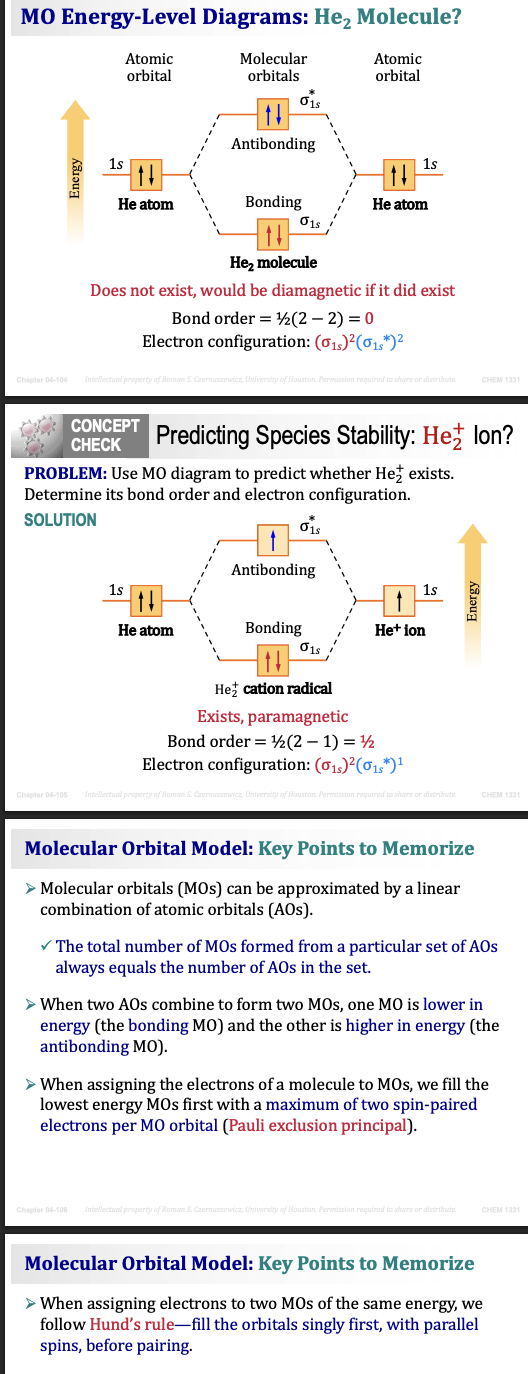
MO Diagram for He₂⁺
Remove one electron from He₂.
Electron configuration:
(σ1s)²(σ1s*)¹
Calculate Bond Order
Bonding electrons = 2
Antibonding electrons = 1
Bond Order = (2 − 1) ÷ 2 = 0.5
What does this mean?
He₂⁺ exists.
It has a weak bond.
Magnetism of He₂⁺
One electron is unpaired.
Therefore:
He₂⁺ is paramagnetic.
Summary of Helium Species
He₂
Bond Order = 0
Does not exist
Diamagnetic
He₂⁺
Bond Order = 0.5
Exists
Paramagnetic
Steps for Solving Any MO Diagram Problem
Step 1
Count the total number of electrons.
Step 2
Draw the correct MO diagram.
Step 3
Fill the orbitals from lowest energy to highest energy.
Step 4
Use Hund's Rule if orbitals have equal energy.
Step 5
Count the number of bonding electrons.
Step 6
Count the number of antibonding electrons.
Step 7
Calculate bond order.
Bond Order = (Bonding − Antibonding) ÷ 2
Step 8
Determine if the molecule exists.
BO > 0 → Exists
BO = 0 → Does not exist
Step 9
Determine magnetism.
All electrons paired → Diamagnetic
At least one unpaired electron → Paramagnetic
Key Rules to Memorize
Number of molecular orbitals = Number of atomic orbitals used.
Two atomic orbitals always form one bonding MO and one antibonding MO.
Bonding orbitals are lower in energy and stabilize the molecule.
Antibonding orbitals are higher in energy and weaken the molecule.
Fill lower-energy orbitals first (Aufbau Principle).
Maximum of 2 electrons per orbital (Pauli Exclusion Principle).
Equal-energy orbitals fill singly first (Hund's Rule).
Positive bond order means the molecule exists.
Larger bond order means a stronger bond.
All paired electrons = Diamagnetic.
Any unpaired electrons = Paramagnetic.
Exam Tips
Adding an electron does NOT always make a bond stronger.
If it goes into a bonding orbital → bond becomes stronger.
If it goes into an antibonding orbital → bond becomes weaker.
You do NOT need to memorize whether molecules exist.
Just calculate the bond order.
BO > 0 → Exists
BO = 0 → Does not exist
You do NOT need to memorize magnetism.
Simply check the electrons.
All paired → Diamagnetic
Any unpaired → Paramagnetic
Molecular Orbital (MO) Diagrams for Period 2 Molecules (Li₂–F₂)
Why Are We Learning This?
So far, we only looked at hydrogen and helium because they only have 1s orbitals.
Now we're moving to Period 2 elements:
Li
Be
B
C
N
O
F
Ne
These atoms have 2s and 2p orbitals, making their MO diagrams more complicated.
The goal is to predict:
Whether the molecule exists
Bond order
Bond strength
Magnetism
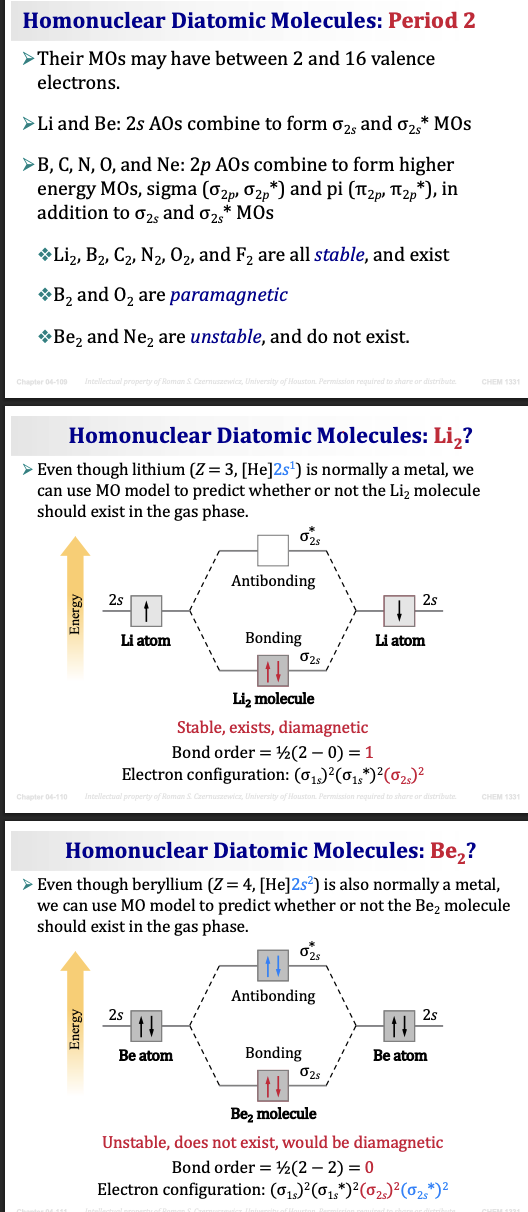
Homonuclear Diatomic Molecules
Definition
"Homonuclear" means:
Both atoms are the same element.
Examples:
H₂
N₂
O₂
F₂
Cl₂
"Homo" = Same
"Diatomic" = Two atoms
So a homonuclear diatomic molecule is simply two identical atoms bonded together.
Only Valence Electrons Matter
When drawing MO diagrams, ignore the core electrons.
Only use valence electrons because they participate in bonding.
Example:
Nitrogen
Electron configuration:
1s² 2s² 2p³
Ignore:
1s²
Use only:
2s²2p³
Reason:
Core electrons stay close to the nucleus and do not help form chemical bonds.
Number of Valence Electrons
Each molecule has a different number of valence electrons.
Examples:
Li₂
1 + 1 = 2 valence electrons
Be₂
2 + 2 = 4 valence electrons
B₂
3 + 3 = 6 valence electrons
C₂
4 + 4 = 8 valence electrons
N₂
5 + 5 = 10 valence electrons
O₂
6 + 6 = 12 valence electrons
F₂
7 + 7 = 14 valence electrons
Ne₂
8 + 8 = 16 valence electrons
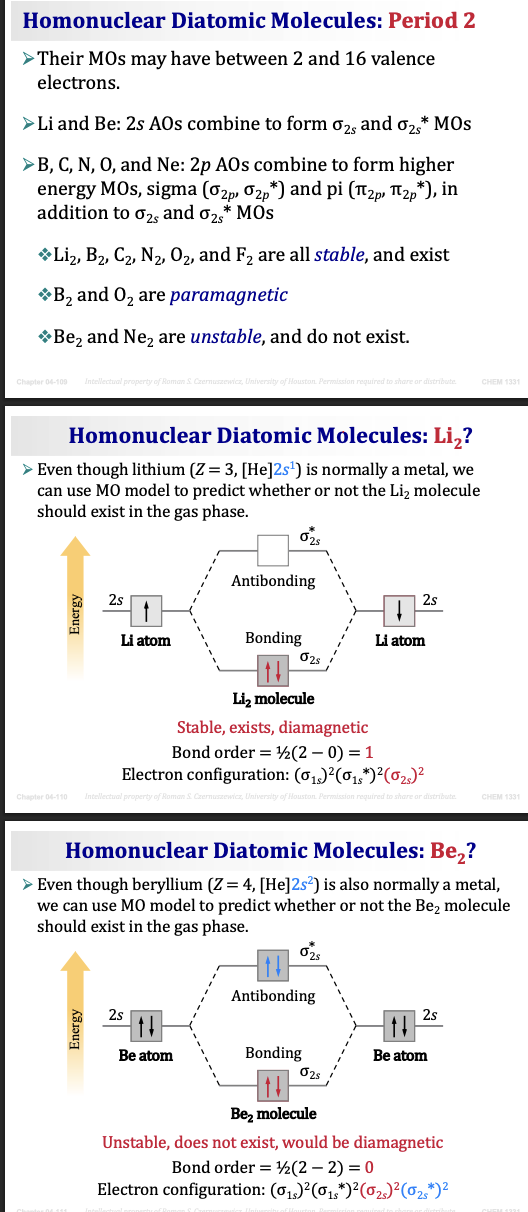
Li₂
Lithium electron configuration:
1s²2s¹
Ignore the 1s electrons.
Only the two 2s electrons bond.
MO configuration:
(σ2s)²
Bonding electrons = 2
Antibonding electrons = 0
Bond Order:
(2 − 0) ÷ 2 = 1
Result:
Li₂ exists.
Single bond.
Diamagnetic (all electrons paired).
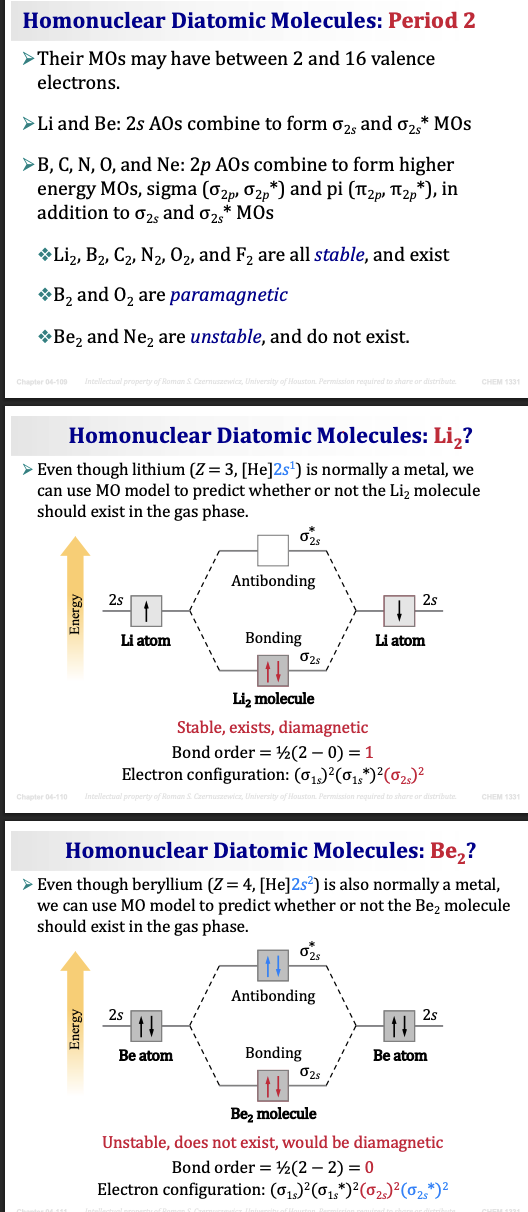
Be₂
Beryllium electron configuration:
1s²2s²
Each Be contributes 2 valence electrons.
Total valence electrons = 4
Configuration:
(σ2s)²(σ2s*)²
Bonding electrons = 2
Antibonding electrons = 2
Bond Order:
(2 − 2) ÷ 2 = 0
Result:
Be₂ does NOT exist.
Bonding and antibonding cancel each other.
Diamagnetic (all electrons paired).
Once We Reach Boron...
Starting with boron, atoms now have electrons in 2p orbitals.
This creates more molecular orbitals.
Instead of only:
σ2s
σ2s*
we now also have:
π2p
σ2p
π2p*
σ2p*
The diagrams become larger because there are more orbitals available.
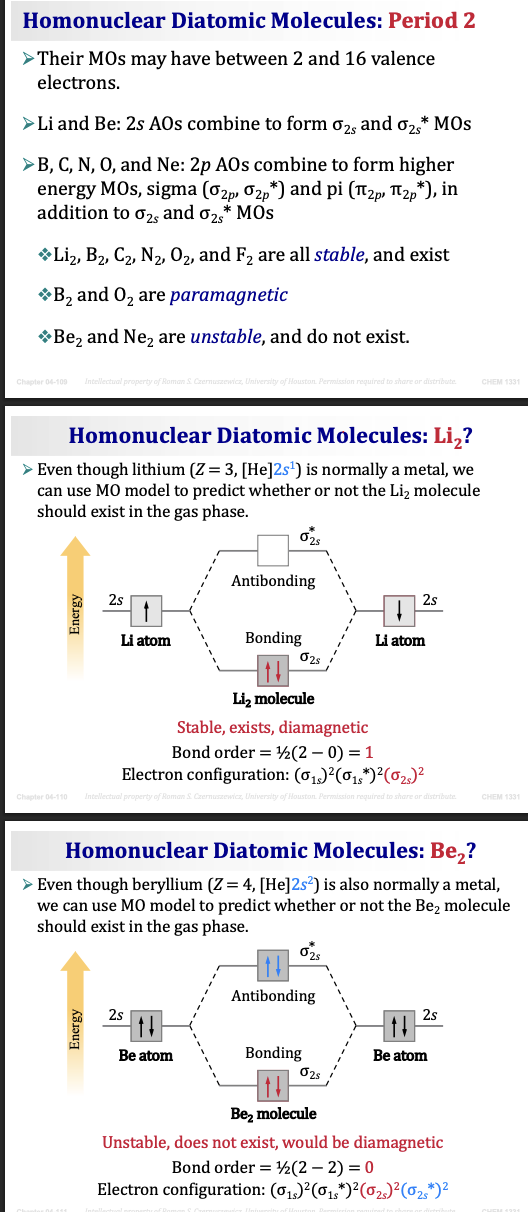
Two Different MO Diagrams
This is one of the most confusing topics in General Chemistry.
There are TWO possible MO energy diagrams for Period 2 molecules.
Which one you use depends on the element.
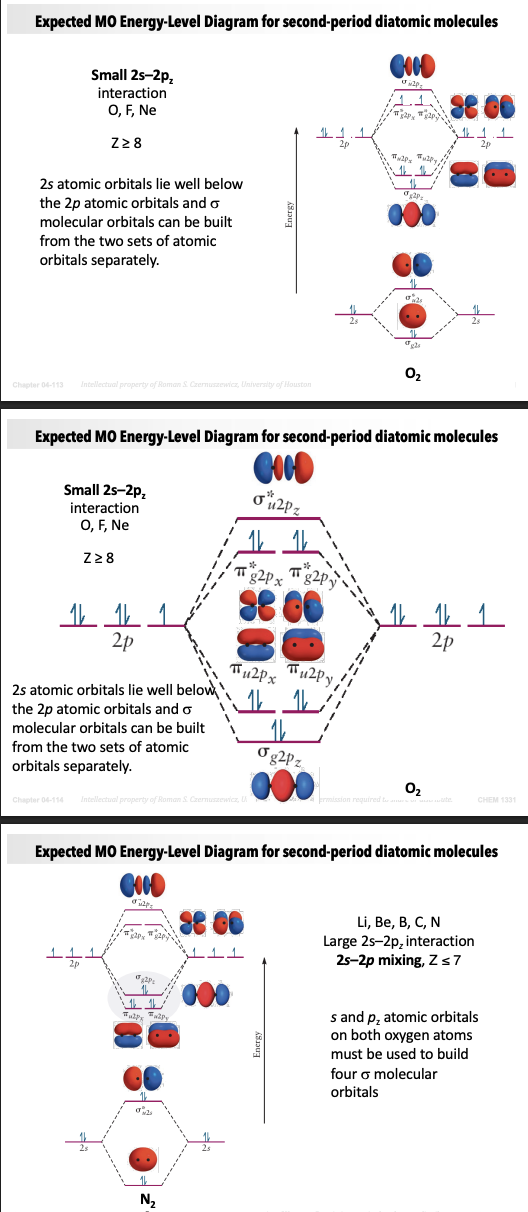
Diagram 1
Used for:
Li₂
Be₂
B₂
C₂
N₂
These have atomic numbers 7 or less.
Diagram 2
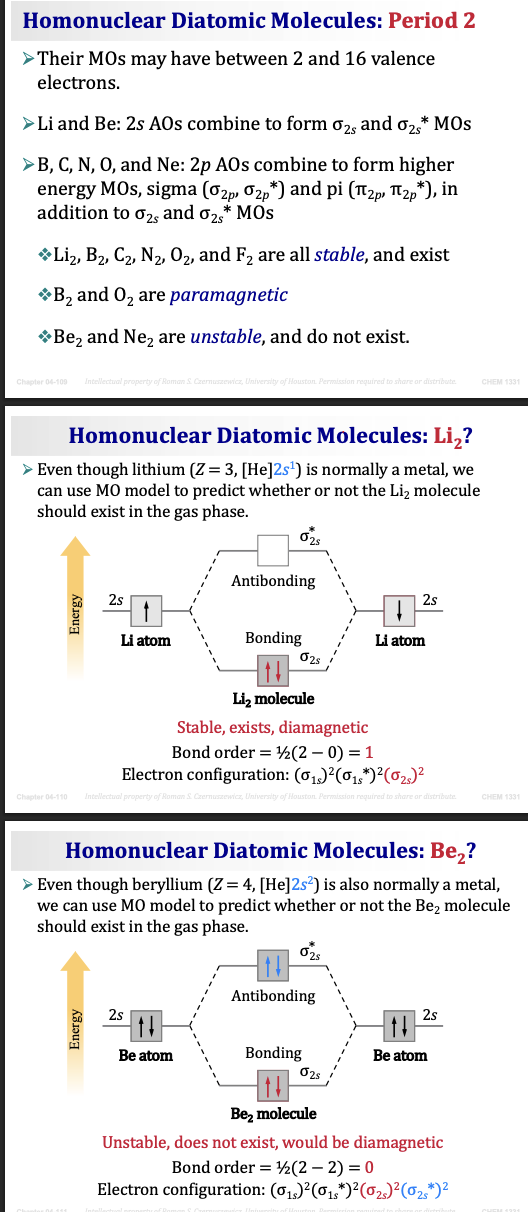
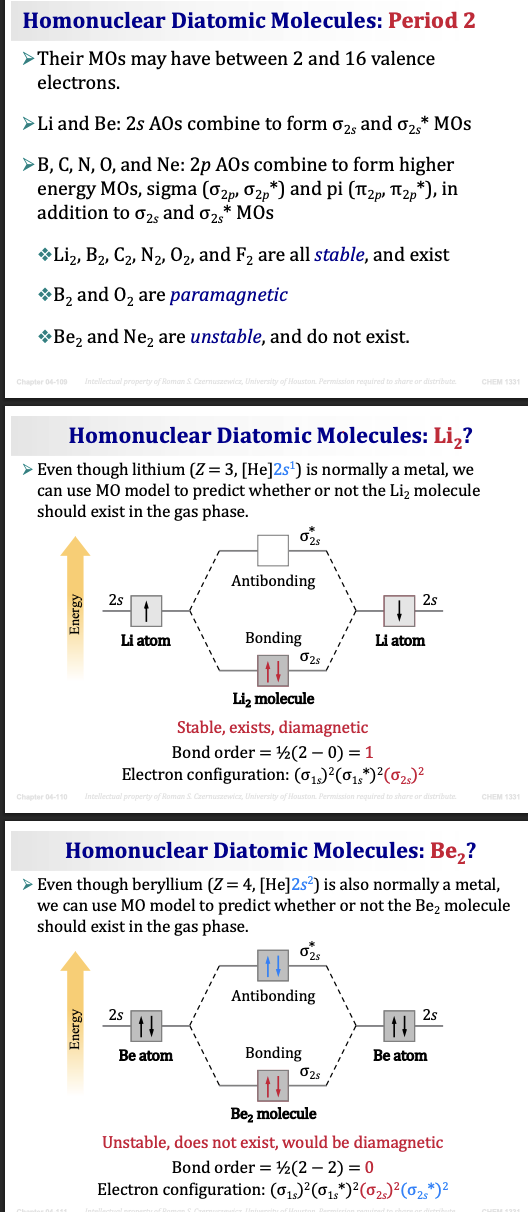
Used for:
O₂
F₂
Ne₂
These have atomic numbers 8 or greater.
Why Are There Two Different Diagrams?
The answer is called:
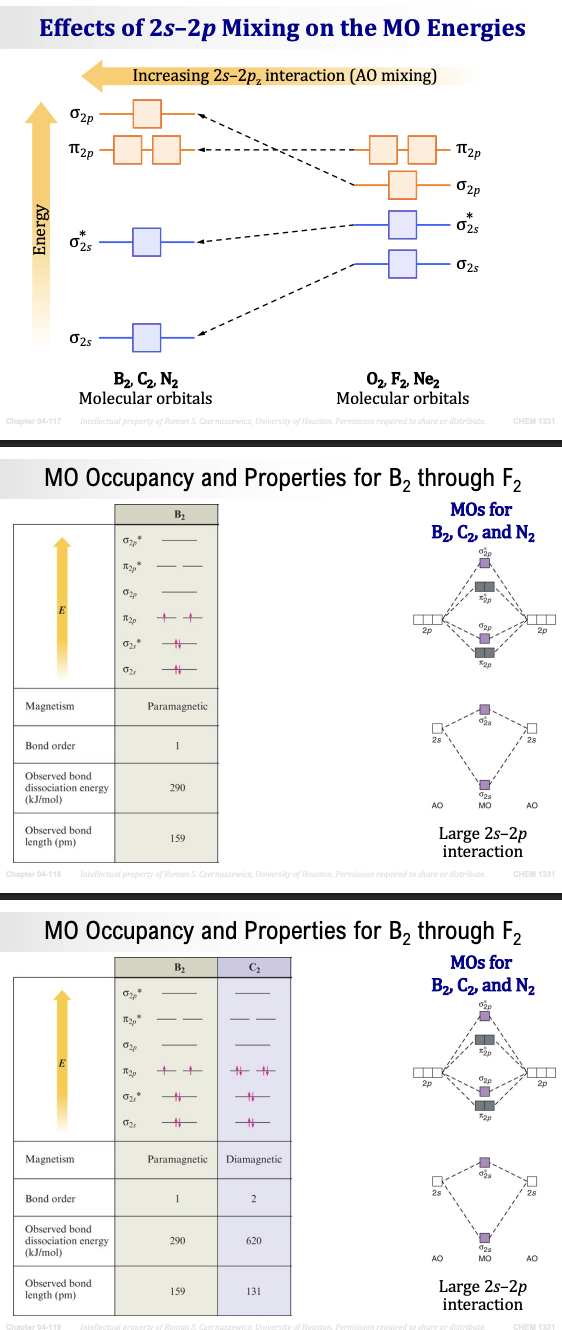
2s–2p Mixing
Also called:
s-p mixing
What Is 2s–2p Mixing?
Normally:
2s orbitals and 2p orbitals are separate.
But for lighter atoms (Li–N)...
The energies of the 2s and 2p orbitals are very close together.
Because their energies are similar,
they interact and mix.
This changes the order of the molecular orbitals.
Easy Analogy
Imagine two students studying.
If they sit close together,
they can easily talk and help each other.
If they sit on opposite sides of the room,
they barely interact.
Same idea here.
If orbital energies are close,
they mix.
If orbital energies are far apart,
they do not.
cont
Large 2s–2p Mixing
Occurs in:
Li
Be
B
C
N
Reason:
Their 2s and 2p orbitals have similar energies.
Because they mix,
the MO energy order changes.
Small (Almost No) 2s–2p Mixing
Occurs in:
O
F
Ne
Reason:
The 2s orbital is much lower in energy than the 2p orbital.
They are too far apart in energy to mix significantly.
So the orbitals stay in their normal order.
The Important Difference
For Li₂ through N₂:
The π2p orbitals are LOWER in energy than σ2p.
Order:
σ2s
σ2s*
π2p
σ2p
π2p*
σ2p*
For O₂ through Ne₂:
The σ2p orbital becomes LOWER than π2p.
Order:
σ2s
σ2s*
σ2p
π2p
π2p*
σ2p*
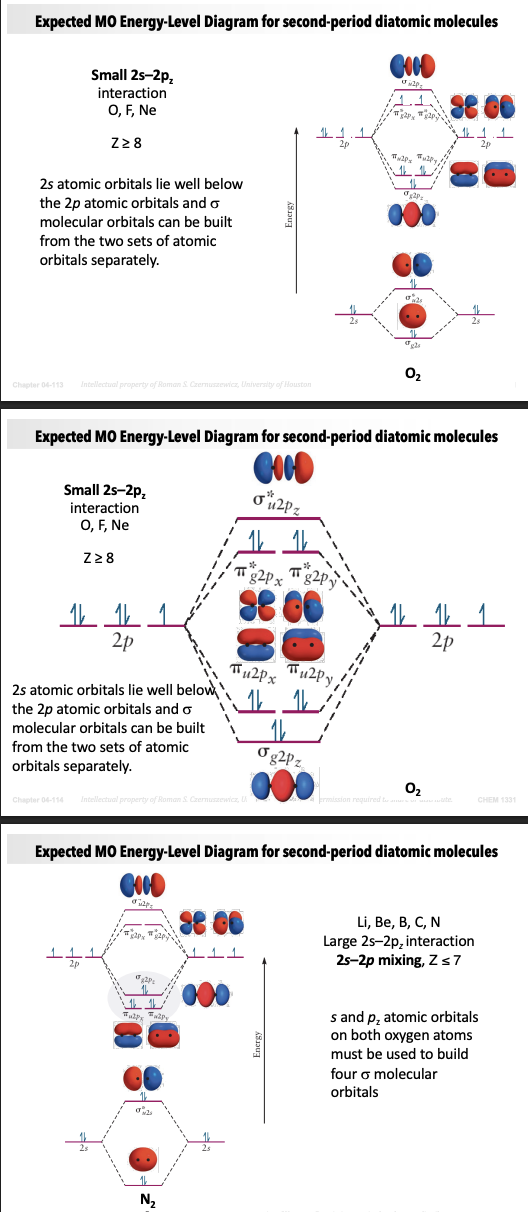
THIS IS THE MAIN THING TO MEMORIZE.
The order changes because of 2s–2p mixing.
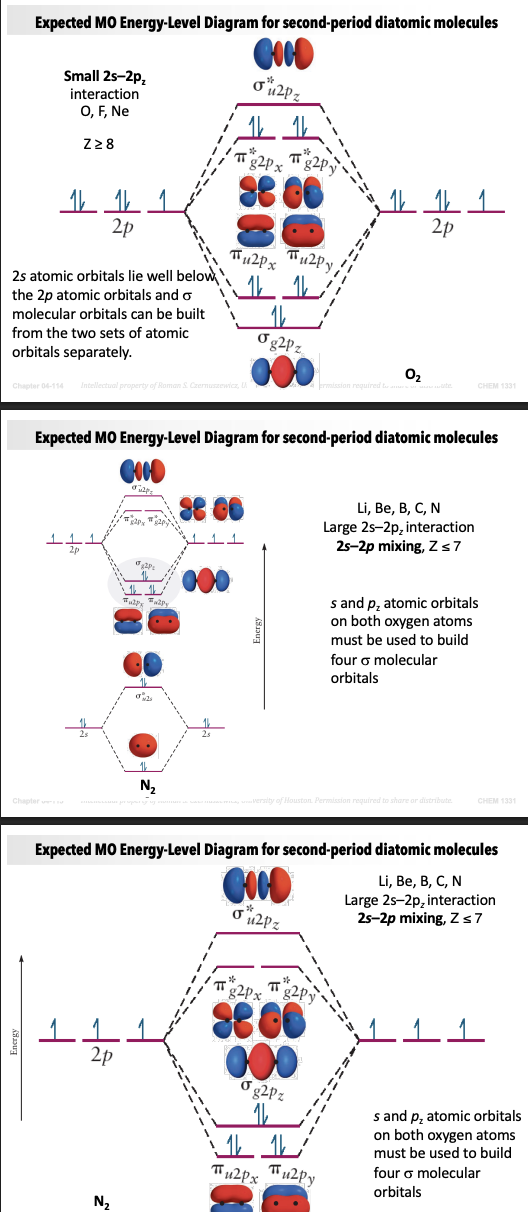
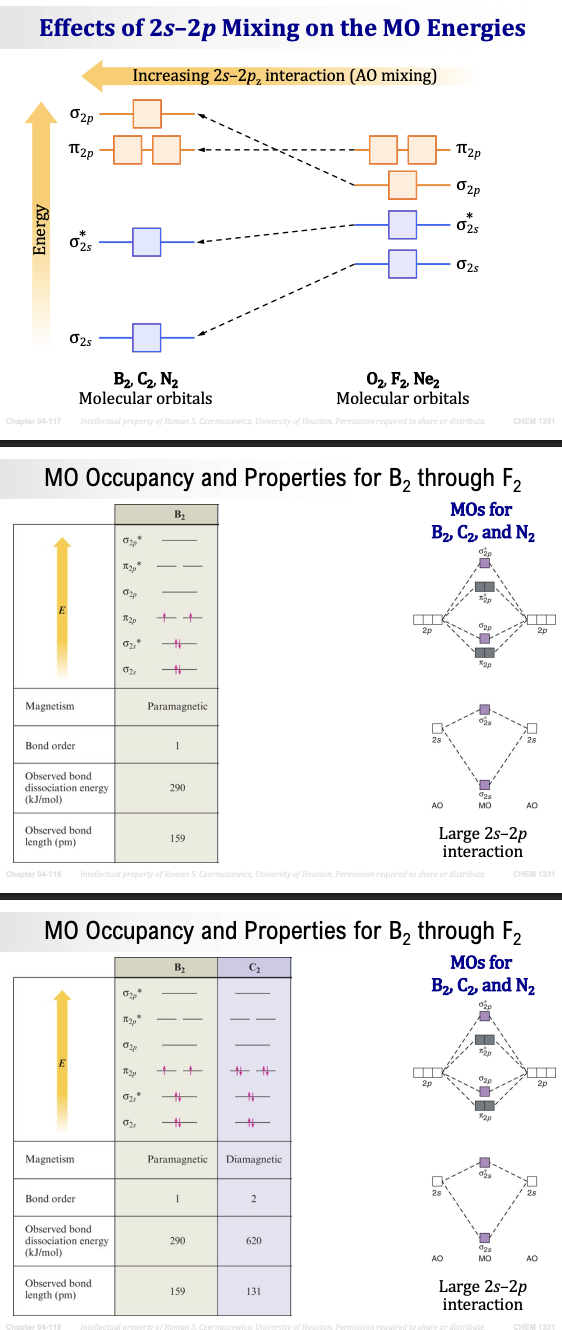
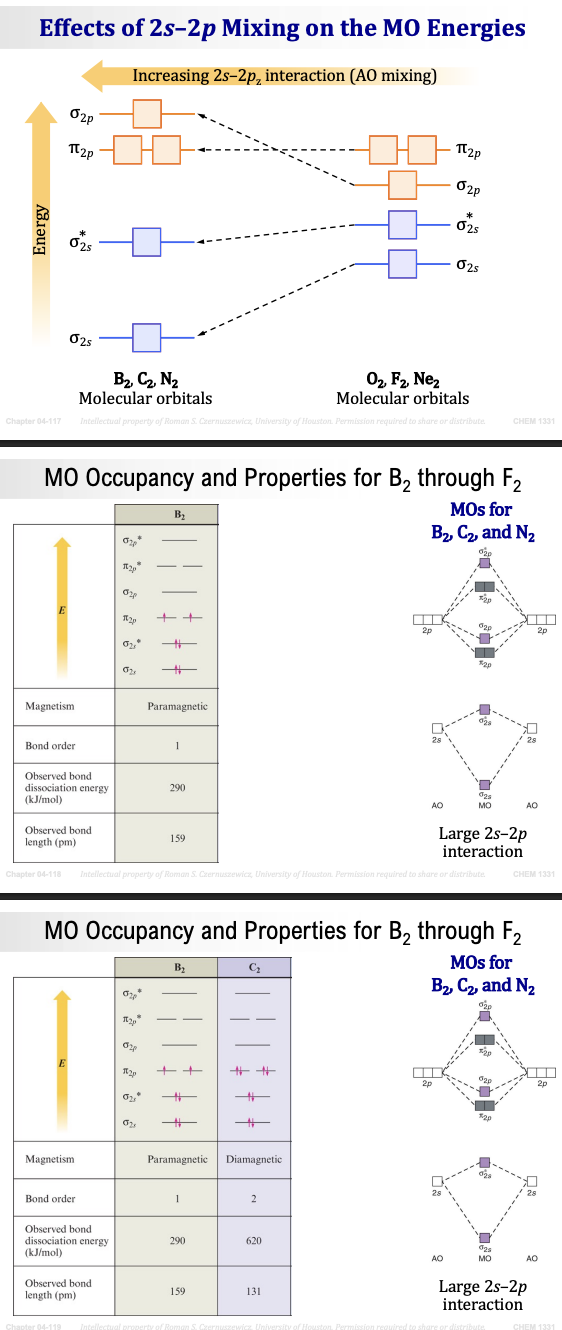
B₂ (Boron)
Each boron atom has:
3 valence electrons
Total:
6 valence electrons
Fill the orbitals using the Li₂–N₂ ordering.
Configuration:
(σ2s)²
(σ2s*)²
(π2p)¹
(π2p)¹
Notice something important.
The last two electrons go into separate π orbitals.
They do NOT pair up because of Hund's Rule.
cont: Magnetism of B₂
Magnetism of B₂
There are 2 unpaired electrons.
Therefore:
B₂ is paramagnetic.
This surprises many students because they expect all stable molecules to have paired electrons.
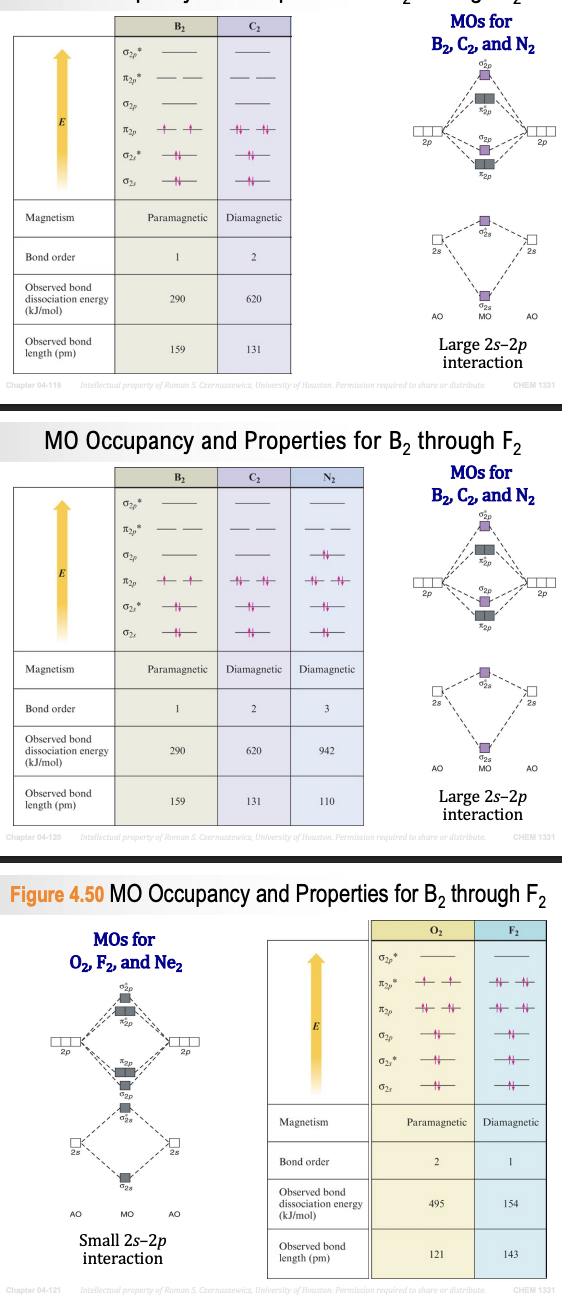
C₂
Total valence electrons:
8
Configuration:
(σ2s)²
(σ2s*)²
(π2p)⁴
Everything is paired.
Bond Order:
(6 − 2) ÷ 2 = 2
Result:
C₂ exists.
Double bond.
Diamagnetic.
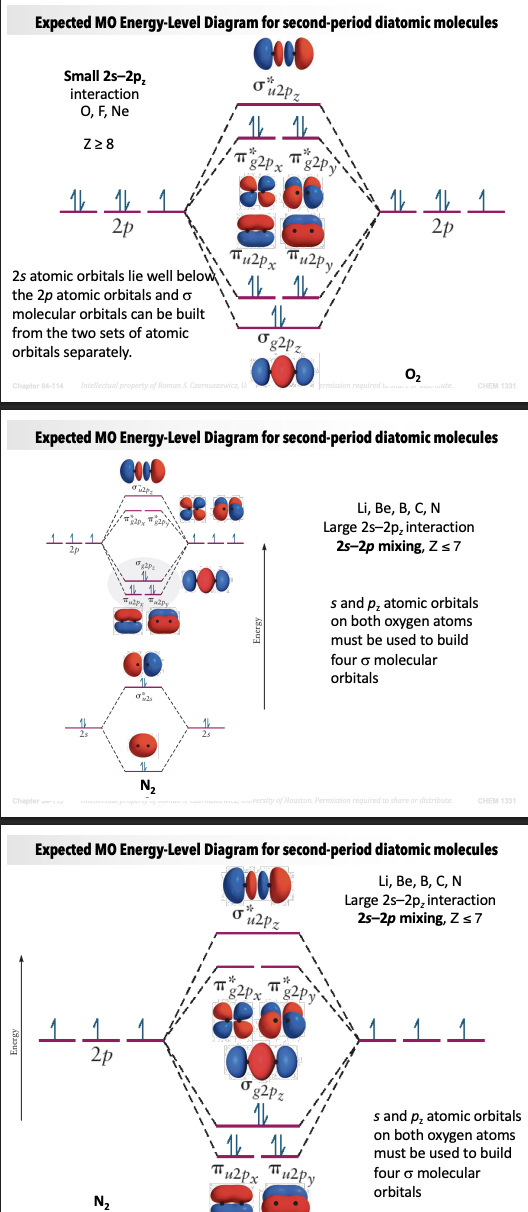
N₂
Total valence electrons:
10
Configuration:
(σ2s)²
(σ2s*)²
(π2p)⁴
(σ2p)²
Bonding electrons = 8
Antibonding electrons = 2
Bond Order:
(8 − 2) ÷ 2 = 3
Result:
Triple bond.
Extremely strong bond.
Diamagnetic.
Fun fact:
Nitrogen gas is difficult to break apart because its bond order is 3, making it one of the strongest covalent bonds.
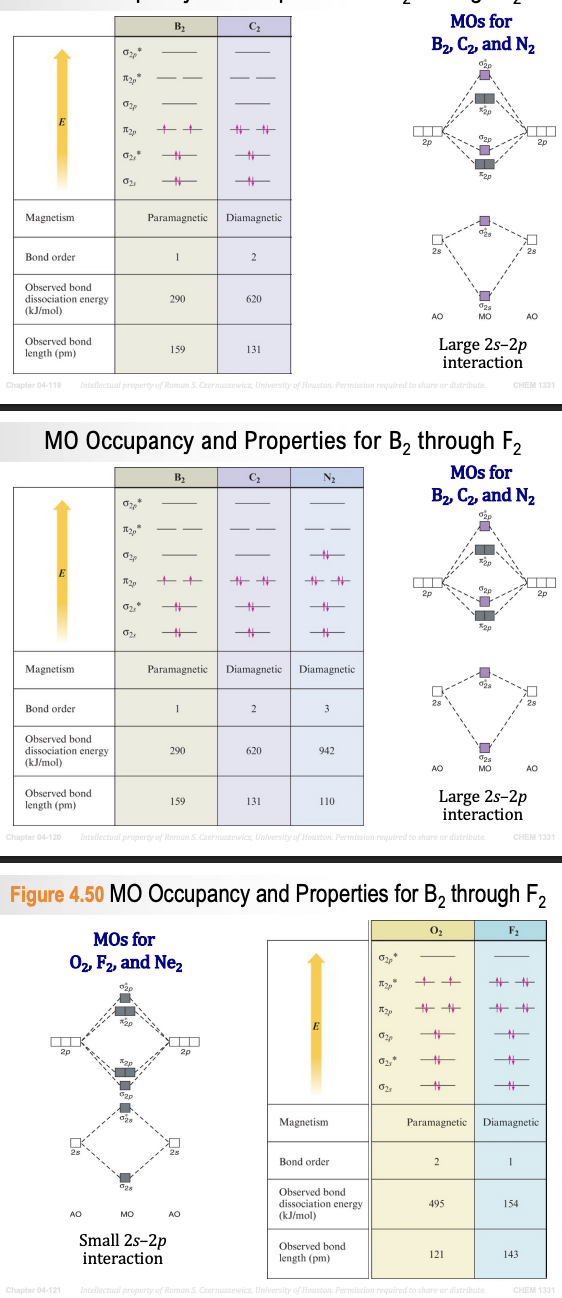
O₂
This is probably the MOST IMPORTANT molecule in MO Theory.
Lewis structures predict:
All electrons paired.
So oxygen should NOT be magnetic.
But experimentally...
O₂ IS magnetic.
Lewis structures cannot explain this.
MO Theory can.
O₂ Configuration
Use the O₂–Ne₂ orbital order.
After filling all orbitals,
the last two electrons go into separate π* orbitals.
Configuration ends with:
(π2p*)¹
(π2p*)¹
Each orbital contains one electron.
Magnetism of O₂
There are 2 unpaired electrons.
Therefore:
O₂ is paramagnetic.
This is one of the greatest successes of Molecular Orbital Theory.
It explains a real experimental observation that Lewis structures cannot.
cont
Bond Order of O₂
Bonding electrons = 8
Antibonding electrons = 4
Bond Order:
(8 − 4) ÷ 2 = 2
Result:
O₂ exists.
Double bond.
Paramagnetic.
F₂
Total valence electrons:
14
After filling all orbitals:
All electrons are paired.
Bond Order:
(8 − 6) ÷ 2 = 1
Result:
Single bond.
Diamagnetic.
Ne₂
Total valence electrons:
16
Bonding electrons = 8
Antibonding electrons = 8
Bond Order:
(8 − 8) ÷ 2 = 0
Result:
Ne₂ does NOT exist.
The bonding and antibonding electrons completely cancel.
Summary of Period 2 Molecules
Li₂
Bond Order = 1
Exists
Diamagnetic
Be₂
Bond Order = 0
Does not exist
Diamagnetic
B₂
Bond Order = 1
Exists
Paramagnetic
C₂
Bond Order = 2
Exists
Diamagnetic
N₂
Bond Order = 3
Exists
Diamagnetic
O₂
Bond Order = 2
Exists
Paramagnetic
F₂
Bond Order = 1
Exists
Diamagnetic
Ne₂
Bond Order = 0
Does not exist
Diamagnetic
Memory Tricks
Molecules that DO NOT exist
Be₂
Ne₂
Both have:
Bond Order = 0
Paramagnetic Molecules
Only remember these two:
B₂
O₂
Both have unpaired electrons.
Everything else in this section is diamagnetic.
Bond Orders to Memorize
Li₂ = 1
Be₂ = 0
B₂ = 1
C₂ = 2
N₂ = 3
O₂ = 2
F₂ = 1
Ne₂ = 0
Notice the pattern:
1 → 0 → 1 → 2 → 3 → 2 → 1 → 0
Big Picture
As you move across Period 2:
More electrons are added to molecular orbitals.
Bond order increases until N₂ (the strongest bond), then decreases as electrons begin filling antibonding orbitals.
Filling antibonding orbitals weakens the bond.
MO theory correctly predicts that O₂ is paramagnetic, something Lewis structures cannot explain
Heteronuclear Molecules, Ionization, and Combining MO Theory with Localized Bonding
Up Until Now...
Everything we've studied has been homonuclear diatomic molecules.
That means:
Two identical atoms
Same atomic orbitals
Same orbital energies
Examples:
H₂
N₂
O₂
F₂
Because the atoms are identical, drawing MO diagrams is fairly straightforward.
Now we're moving to heteronuclear molecules.
Heteronuclear Diatomic Molecules
Definition
"Heteronuclear" means:
The molecule contains two different atoms.
Examples:
NO
HF
CO
HCl
"Hetero" = Different
"Diatomic" = Two atoms
So:
Heteronuclear diatomic = two different atoms bonded together.
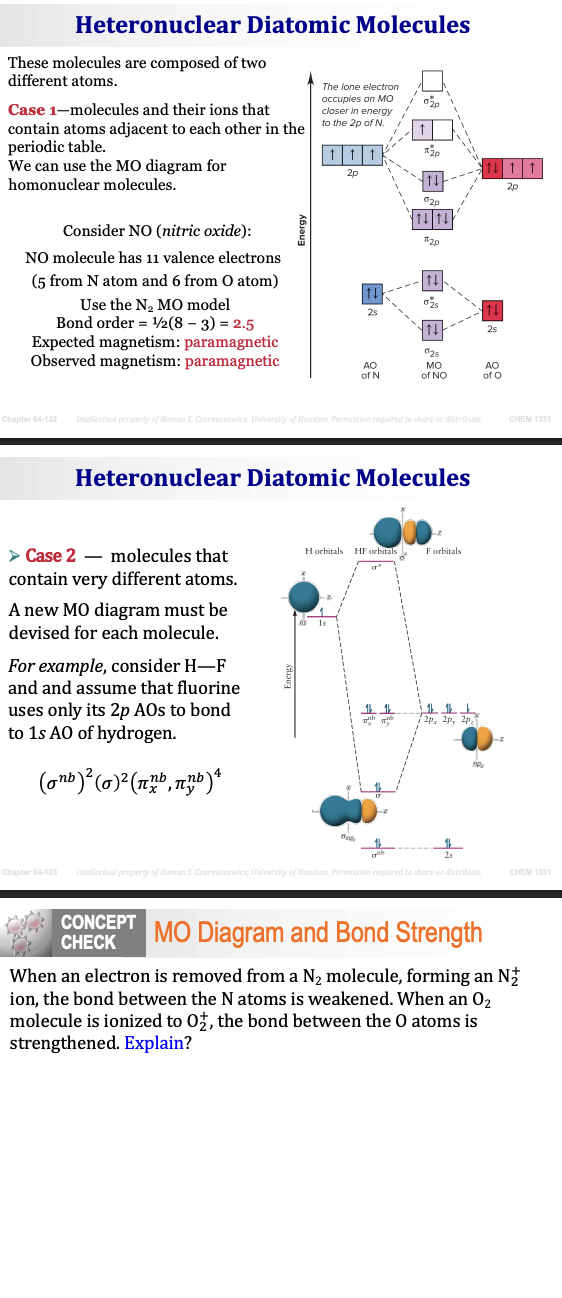
Why Are They More Complicated?
Different atoms have:
Different electronegativities
Different orbital energies
Different sizes
Because of this,
their atomic orbitals are NOT at the same energy level.
This makes the MO diagram less symmetrical.
Case 1 – The Atoms Are Similar
Example:
NO
Nitrogen and oxygen are next to each other on the periodic table.
Their orbital energies are fairly similar.
Because they are similar,
you can usually use the same MO diagram you already know for homonuclear molecules.
This makes the problem much easier.
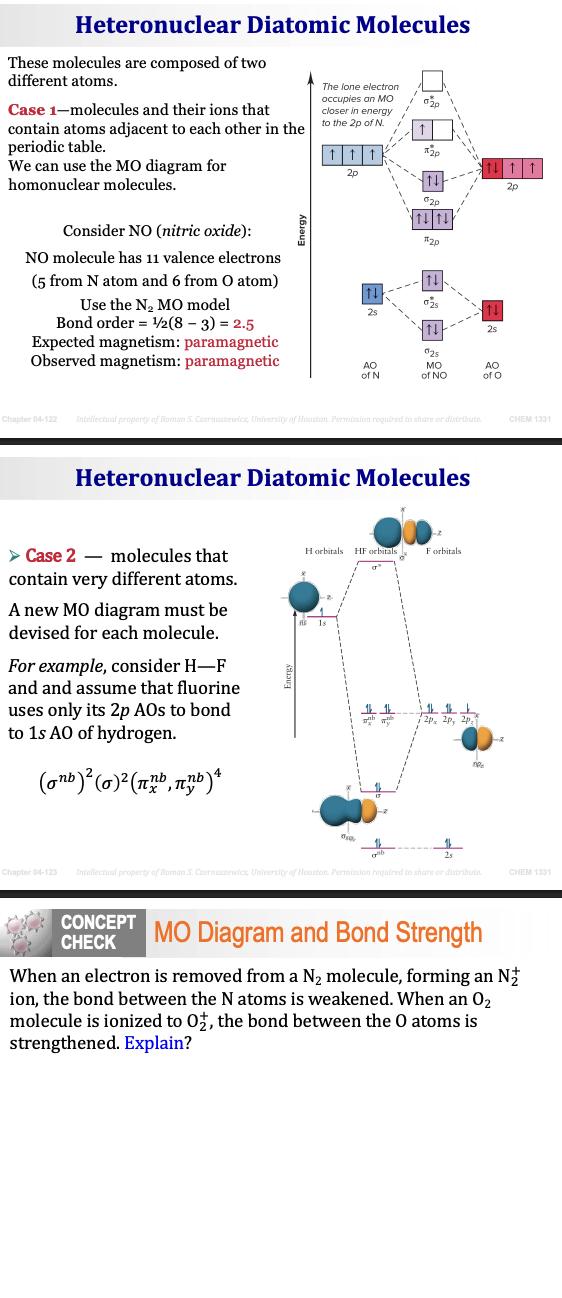
Example: NO (Nitric Oxide)
Nitrogen contributes:
5 valence electrons
Oxygen contributes:
6 valence electrons
Total:
11 valence electrons
Which MO Diagram Do We Use?
Since oxygen is involved,
many students wonder whether to use the N₂ diagram or the O₂ diagram.
Your professor says:
Use the N₂ MO model for NO because nitrogen and oxygen are adjacent in the periodic table and have similar orbital energies.
cont
Electron Configuration
The slides don't list every orbital, but they tell you the important result.
Bonding electrons = 8
Antibonding electrons = 3
Bond Order:
(8 − 3) ÷ 2
= 2.5
What Does a Bond Order of 2.5 Mean?
Remember:
Bond order doesn't have to be a whole number.
A value of 2.5 means:
Stronger than a double bond
Weaker than a triple bond
It is halfway between.
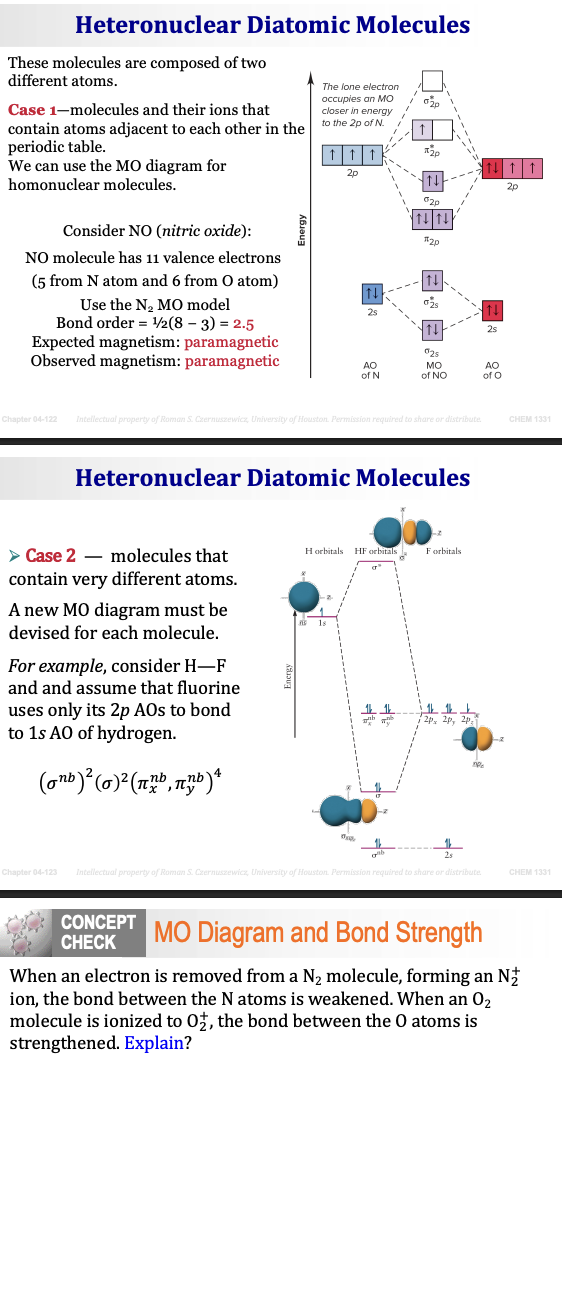
Magnetism of NO
There is one unpaired electron.
Therefore:
NO is paramagnetic.
This matches experimental observations.
MO Theory correctly predicts what scientists actually measure.
Important Exam Point
NO has:
Bond Order = 2.5
Paramagnetic
These are two facts professors love asking about.
Case 2 – The Atoms Are Very Different
Example:
HF
Hydrogen and fluorine are very different atoms.
Hydrogen has:
1s orbital
Fluorine has:
2s and 2p orbitals
Their orbital energies are very different.
Can We Use the Same MO Diagram?
No.
When atoms are very different,
the standard MO diagrams no longer work well.
Instead,
a new MO diagram must be created specifically for that molecule.
Why Doesn't Every Orbital Bond?
Not every atomic orbital can combine.
Remember the two requirements from Part 1:
Similar energy
Correct symmetry (shape)
HF is a perfect example.
Which Orbitals Actually Bond?
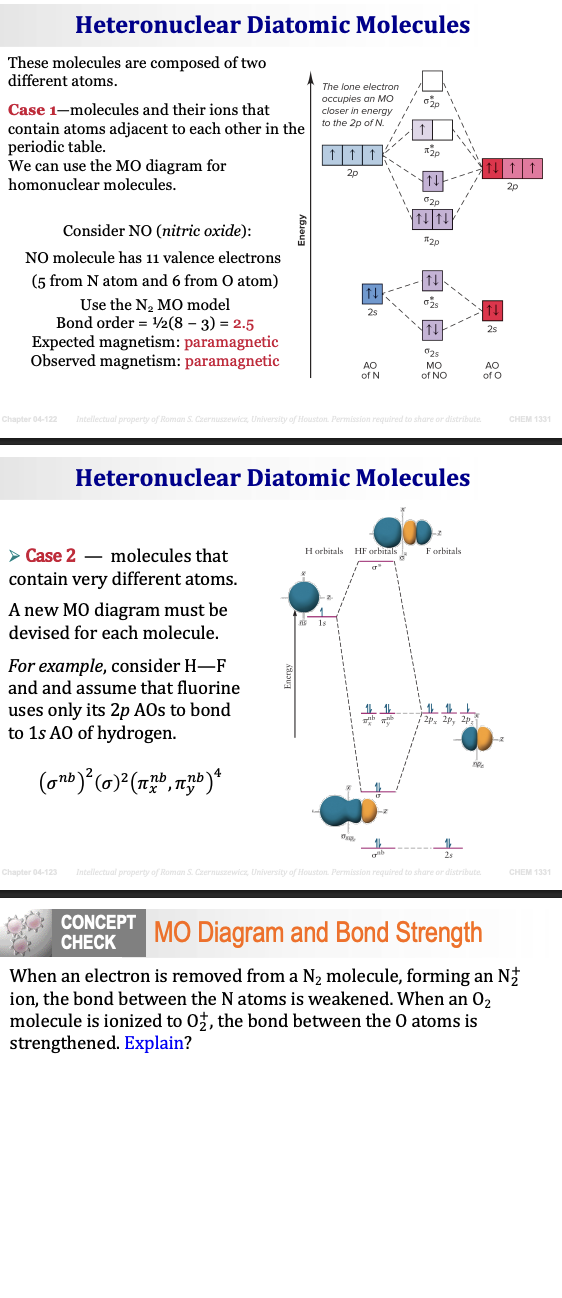
Hydrogen contributes:
1s orbital
Fluorine has:
2s
2px
2py
2pz
The hydrogen 1s orbital mainly overlaps with the fluorine 2p orbital that points directly toward hydrogen (usually labeled 2pz).
Those orbitals have the correct orientation for a σ bond.
What Happens to the Other Fluorine Orbitals?
The remaining fluorine p orbitals do not overlap effectively with hydrogen.
They stay mostly unchanged.
These are called nonbonding orbitals.
Nonbonding Orbitals
Definition
A nonbonding orbital is an orbital that:
Contains electrons
Does not help form a bond
Does not weaken a bond
It simply exists on one atom.
These electrons are usually what we call lone pairs.
Summary of HF
Hydrogen 1s orbital:
Forms a σ bond with fluorine.
Other fluorine orbitals:
Remain nonbonding.
This is why HF requires its own MO diagram.
Removing Electrons (Ionization)
Now the slides ask a very important conceptual question.
Question
Why does removing an electron from N₂ weaken the bond,
but removing an electron from O₂ strengthens the bond?
This confuses a lot of students.
The answer depends on which orbital loses the electron.
Removing an Electron from N₂
N₂ has:
Bond Order = 3
The highest occupied orbital is a bonding orbital.
When you remove an electron,
you remove one that was helping hold the atoms together.
Result:
Fewer bonding electrons
Bond order decreases
Bond becomes weaker
Removing an Electron from O₂
O₂ has:
Bond Order = 2
The highest occupied orbital is an antibonding orbital.
When you remove an electron,
you remove one that was weakening the bond.
Now there are fewer antibonding electrons.
Result:
Bond order increases
Bond becomes stronger
Easy Way to Remember
Removing a bonding electron
↓
Bad
↓
Bond gets weaker
Removing an antibonding electron
↓
Good
↓
Bond gets stronger
This Is a Very Common Exam Question
Always ask:
"Which orbital is losing the electron?"
Not simply,
"Did we remove an electron?"
The orbital matters more than the electron itself.
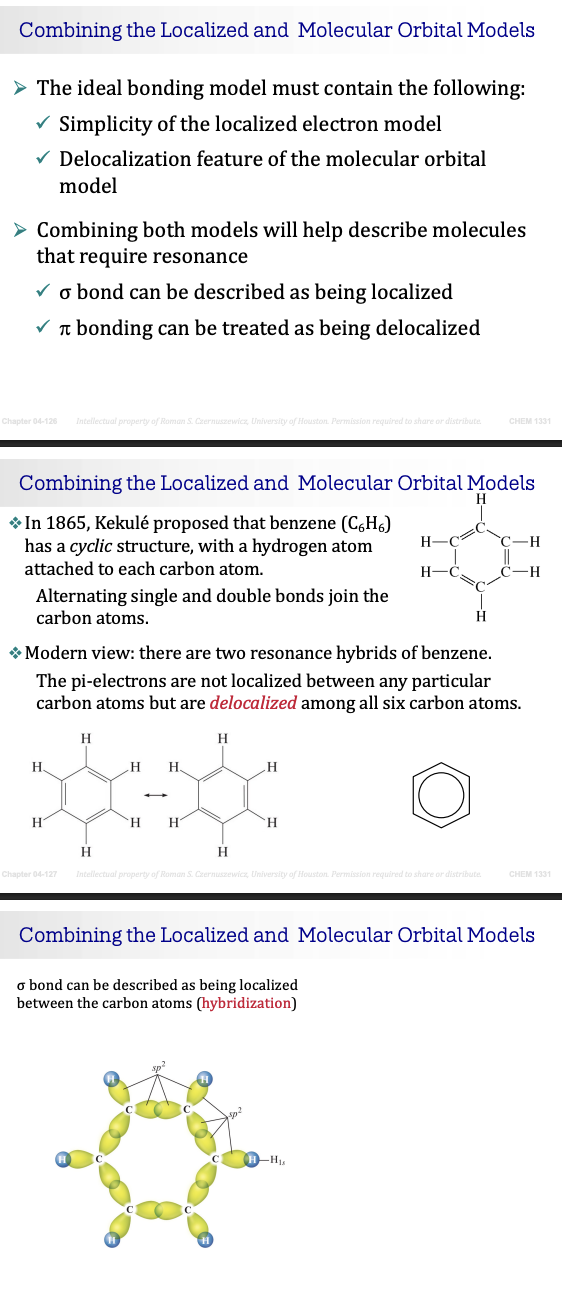
Combining Two Bonding Models
The chapter finishes by comparing the two bonding models you've learned.
Localized Electron Model
This includes:
Lewis Structures
VSEPR
Hybridization
Idea:
Electrons belong to one bond between two atoms.
Example:
A C–C single bond belongs only to those two carbon atoms.
Molecular Orbital Theory
Idea:
Electrons are spread over the entire molecule.
Instead of belonging to one bond,
they can be shared by many atoms.
This is called delocalization.
Which Model Is Better?
Neither.
Each explains different things well.
Localized Model is good for:
Drawing Lewis structures
Molecular geometry
Hybridization
Sigma bonds
MO Theory is good for:
Magnetism
Resonance
Delocalized electrons
Bond strength
Bond order
Chemists often use both models together because each has strengths.
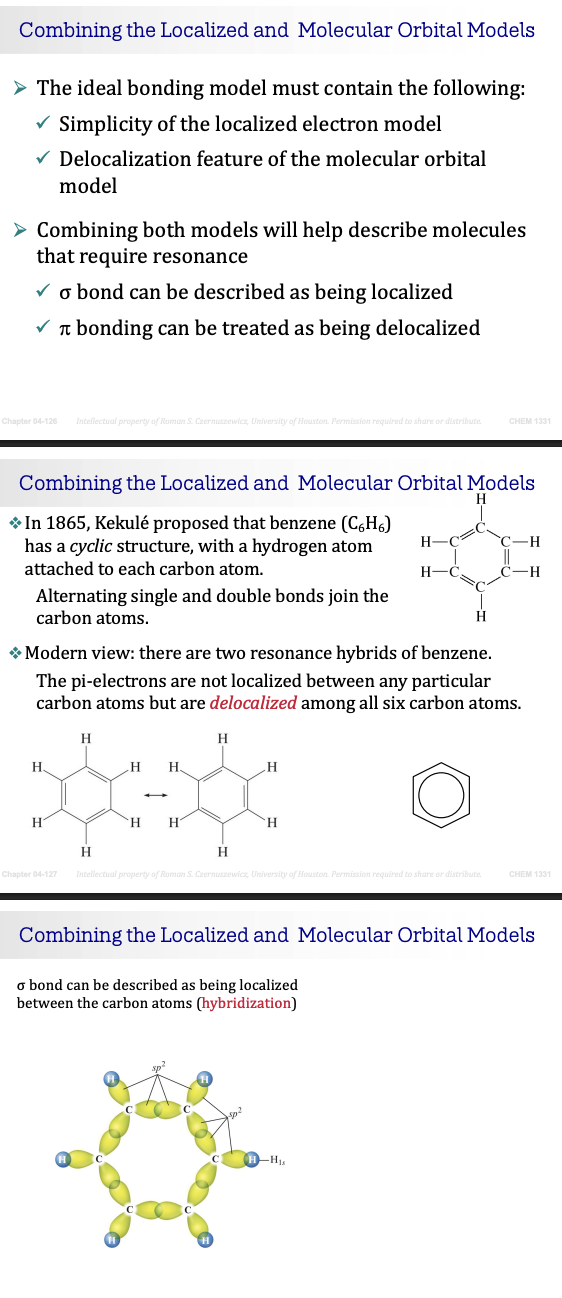
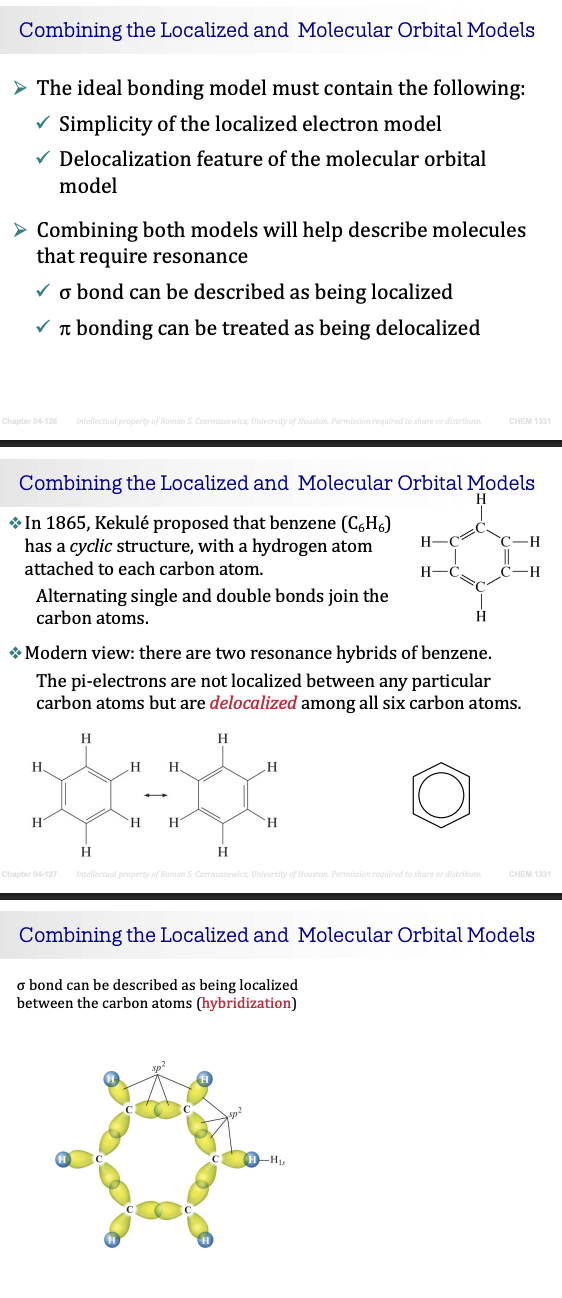
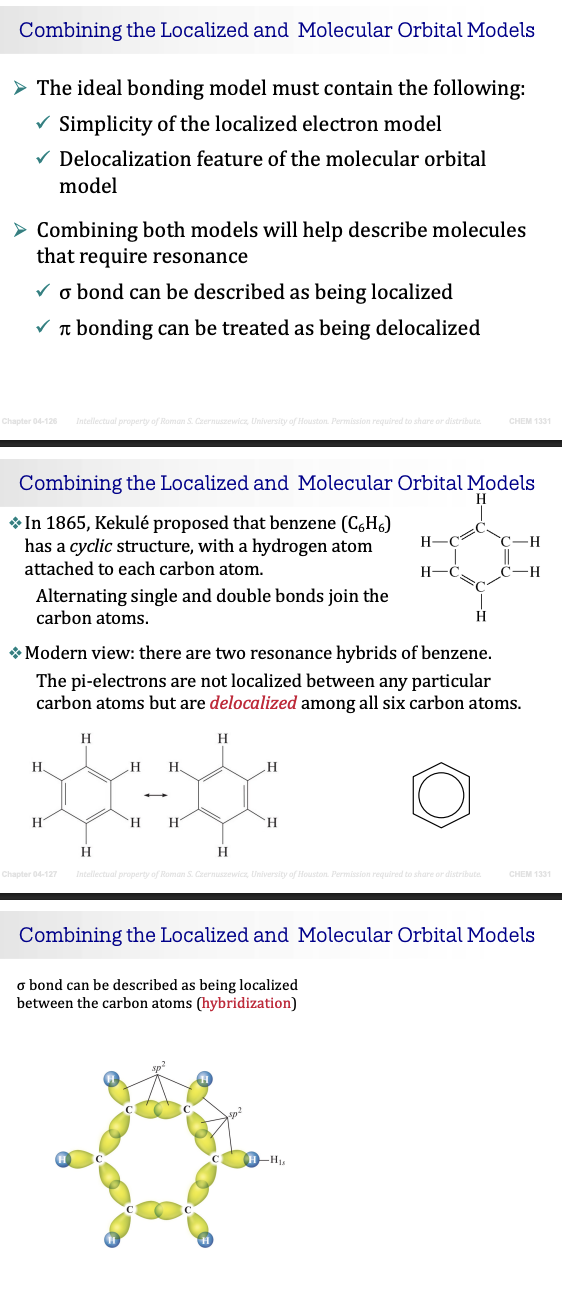
Benzene (C₆H₆)
Benzene is the perfect example of why both models are needed.
Kekulé's Original Model
In 1865,
Kekulé proposed that benzene looked like this:
Single bond
Double bond
Single bond
Double bond
Single bond
Double bond
A ring with alternating single and double bonds.
This was a great first model,
but experiments showed it wasn't completely correct.
Modern View of Benzene
Benzene is actually a resonance hybrid.
Instead of electrons staying in one double bond,
the π electrons are shared equally around the entire ring.
Delocalized π Electrons
The six p orbitals on the carbon atoms combine to form six molecular orbitals.
The π electrons move throughout the ring instead of belonging to one specific bond.
This is called delocalization.
What About the σ Bonds?
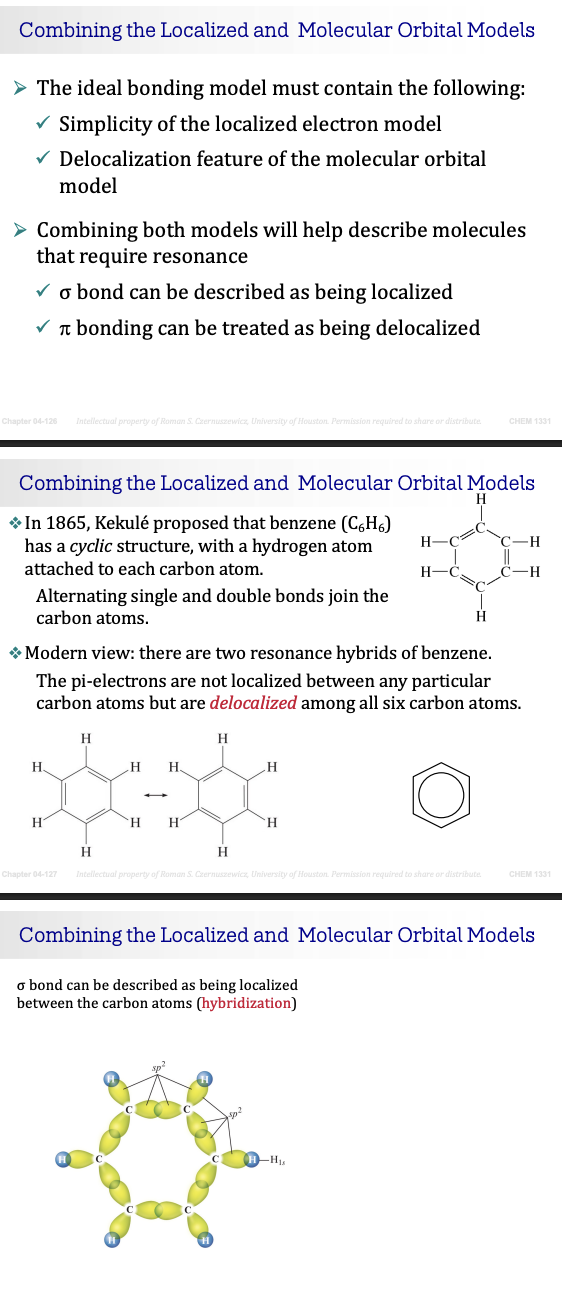
The σ bonds are still treated using the Localized Electron Model.
They remain between neighboring carbon atoms.
So:
σ bonds = localized
π bonds = delocalized
This combines both bonding theories.
What Does the π Cloud Look Like?
The six p orbitals overlap above and below the flat benzene ring.
This creates one continuous cloud of electrons.
Think of it as:
A "donut-shaped" electron cloud surrounding the ring.
The electrons are free to move around the ring instead of being trapped between two carbons.
Why Is Benzene So Stable?
Because the π electrons are delocalized,
their energy is lowered.
Lower energy means:
Greater stability
Stronger overall bonding
Less reactive than expected
This extra stability is called resonance stabilization (or aromatic stabilization in more advanced chemistry).
Final Summary of the Entire MO Theory Chapter
Localized Electron Model
Electrons belong to individual bonds.
Best for Lewis structures, VSEPR, hybridization, and σ bonds.
Molecular Orbital Theory
Electrons belong to the entire molecule.
Explains bond order, bond strength, magnetism, resonance, and delocalized electrons.
Bond Order
Bond Order = (Bonding − Antibonding) ÷ 2
Higher bond order = stronger bond.
Bond Order > 0 = molecule exists.
Magnetism
All electrons paired → Diamagnetic.
One or more unpaired electrons → Paramagnetic.
Homonuclear Molecules
Same atoms.
Use standard MO diagrams.
Heteronuclear Molecules
Different atoms.
Similar atoms (like NO) can often use a homonuclear MO diagram.
Very different atoms (like HF) require a new MO diagram.
Ionization
Removing a bonding electron weakens a bond.
Removing an antibonding electron strengthens a bond.
Benzene
σ bonds are localized.
π electrons are delocalized over the entire ring.
The delocalized π cloud makes benzene unusually stable.
Chapter "Must Know" Facts
Molecular orbitals belong to the entire molecule.
Bonding orbitals lower energy; antibonding orbitals raise energy.
A positive bond order means the molecule is stable enough to exist.
O₂ is paramagnetic because it has two unpaired electrons.
NO has a bond order of 2.5 and is paramagnetic.
Removing electrons from bonding orbitals weakens bonds.
Removing electrons from antibonding orbitals strengthens bonds.
Benzene's σ bonds are localized, but its π electrons are delocalized, making the molecule especially stable.