inflation and deflation aqa
 Call Kai
 Learn
Learn Practice Test
 Spaced Repetition
 Match
Match Flashcards
 Knowt Play
1/25

There's no tags or description
Looks like no tags are added yet.
Name | Mastery | Learn | Test | Matching | Spaced | Call with Kai |
|---|
No analytics yet
Send a link to your students to track their progress
26 Terms
What is inflation?
a sustained increase in the general price level leading to the fall in the purchasing power of money. It measures the change in the average costs for a household buying a basket of different goods and services and is usually measured as a percentage change in the consumer price index.
what is the target rate of inflation?
it is usually 2% +-1 (between 1-3%)
how is the rate of inflation measured?
the annual percentage change in consumer prices. it is the 12 month percentage change in inflation
what is deflation?
a sustained period when the general price level for goods and services declines (under 0%). this means that a weighted basket of goods and serviced is becoming less expensive over time. normally there is a fall in AD which creates a negative output gap.
what is disinflation?
a fall in the rate of inflation but not sufficient to bring about price deflation. during a period of disinflation, consumer prices are still rising but at a slower rate
what are inflation expectations?
what people and businesses expect to happen to consumer prices in the future
- if people expect inflationn, this feeds through to higher wages and labour costs
- therefore a wage price spiral can become imbedded in an economy- can lead to cost push inflation
what is stagflation?
refers to an unfortunate and costly combination of stagnant (slow) economic growth, rising unemployment and high and rising inflation
what is hyperinflation?
a phase of extremely rapid inflation nearly always the result of mass money printing by the government with money as an asset ending up worthless. it is also associated with economics where there has been a collapse in real output/supply
A02 knowledge for deflation
- economic stagnation and price deflation in Japan between 1991 -2001 was known as "Japan's Lost Decade" and the root cause of deflation was slow growth and a high level of spare capacity that drove prices lower.
- the US experienced deflation during the great recession, however was less severe than predicted (economists worried that deflation would lead to a prolonged recession, rising unemployment and further strain on the economy)
A02 for UK inflation
-an example of high inflation during the period 1974 to 1980, the price index increased from 100 to 263, an increase of 163%
- in 1950s-60s: low inflation (except korean war)
- in 1970s: instability oil price rises
- in 1974/75 prices rose nearly 25%
- inflation relatively low 2000-2020
what are the two types of inflation?
demand pull inflation and cost push inflation
what is cost push inflation?
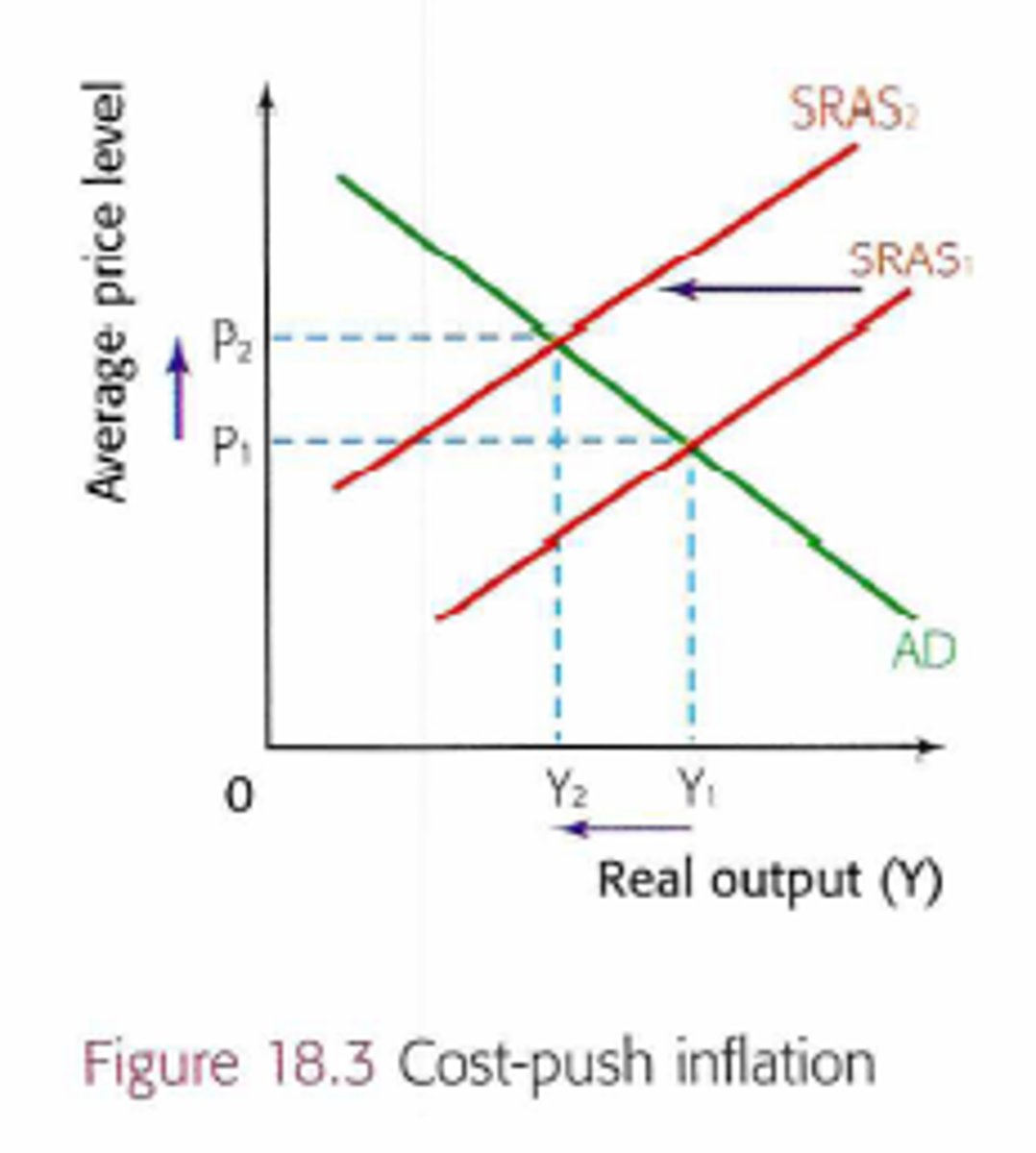
occurs when a businesses responds to rising unit costs by increasing prices to protect their profit margins, it can about from both domestic and external sources including a fall in the value of the exchange rate which then leads to a fall in the value of the exchange rate which then leads to a rise in price of imported products. rising costs can shift the SRAS curve to the left as firms are less willing to produce at any given price level - this causes prices to rise and output to fall
causes of cost push inflation
1. a rise in the cost of productions - this will reduce business profit margins unless selling prices are increased to compensate, thus increasing inflation (if firms accepted a lower profit margin when faced with rising cost, cost push inflation may not occur)
2. a rise in wage levels due to a tight labour market- caused by wage increases, which are greater than improvements in productivity. wage costs often rise when unemployment is low because skilled workers become scare and this can drive pay levels higher. wages may also increase when people expect higher inflation so they ask for more pay in order to protect their real income. trade unions may use their bargaining power to bid for and achieve increasing wages
3. a fall in exchange rate - this can cause cost push inflation because it leads to an increase in the prices of imported products eg. essential raw materials etc. (often referred to a imported inflation)
4. expectation of inflation - when people see prices are rising for everyday items, they get concerned about the effects of inflation on their real SOL
5. monopoly employers/ profit push inflation - where dominant firms in a market use their market power (at whatever level of demand) to increase prices well above costs
6. measures imposed by government or firms that increases their costs eg. rise in indirect taxes - depending on price elasticity of demand and supply for their products, suppliers may choose to pass on the burden of the tax onto consumers
cost push inflation diagram
a leftward shift in the SRAS curve from SRAS1 to SRAS2 will lead to higher prices caused by cost push factors. it will also lead to a lower equilibrium output level
what is demand pull inflation?
a phase of accelerating inflation which arises from rapid growth in AD. it occurs when economic growth is too fast. businesses can take advantage of high demand by raising their profits to widen (increase) profit margins. typically demand pull inflation is associated with an economic boom
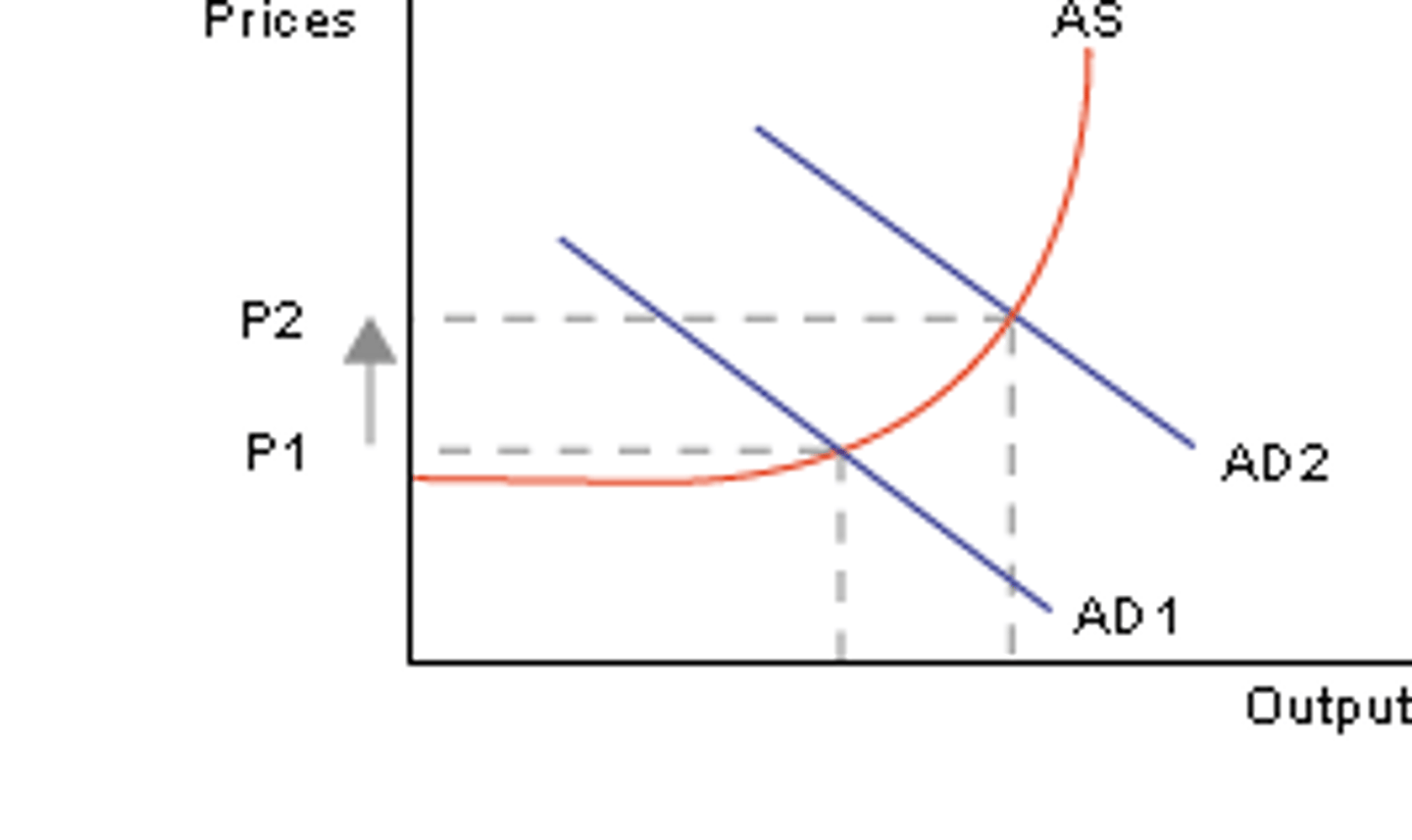
demand pull diagram
eventually, when the economy is operating on the LRAS, any increase in AD will lead only to inflation rather than to increases in output. growth in AD from AD1 to AD4 increases output but eventually leads to increasing rises in demand pull inflation, shown by increasingly large rises in the price level from P1 to P4. reducing demand pull inflation is reducing any components of AD
what causes demand pull inflation?
1. high levels of spending give signals to firms to increase output, but as we get closer to the capacity level of the economy, the higher spending will lead to firms increasing their prices actively as they incur higher costs in producing more output
2. a depreciation of the exchange rate increases the price of imports and reduces the foreign price of a country's exports. if consumers buy fewer imports, while exports grow, AD will rise 3. and there may be a multiplier effect on the level of demand and output
3. higher demand from a fiscal stimulus - eg. lower direct or indirect taxes or higher government spending - if direct taxes are reduced , consumers have more disposable income causing demand to rise. higher gov spending and increased borrowing creates extra demand in the circular flow
4. monetary stimulus to the economy- a fall in interest rates may stimulate too much demand
5. fast growth in other countries provides a boost to UK exports overseas. export sales provide an extra flow of income and spending into the UK circular flow
6. also may be caused by growth of the money supply. persistent budget deficits and increased government spending increases the money supply resulting in increased aggregate demand
consequences of inflation on consumers
if people's incomes do not rise with inflation then they will have less to spend , which could cause a fall in living standards
There is a negative income effect - the income effect is the change in demand for a good or service caused by a change in a consumer's purchasing power resulting from a change in real income.
Those who are in debt will be able to pay it off at a price which is of cheaper value, but those who are owed money lose because the money they get back is of cheaper value. Consumers who have saved will lose out as their money is worth less (e.g. negative interest rate on savings)
Fall in consumer surplus Task - draw a diagram to demonstrate this
Inflation has psychological effects on consumers: because prices are rising, they may feel less well-off, even if their income is rising in line with inflation, and so this may cause them to decrease their spending
Consumers indulge initially in anticipatory buying, to beat the inflation but in reality the increased aggregate demand increases the inflation. Continuing inflation brings fears of job loss leading to an increase in the savings ratio leading to a rapid fall in aggregate demand and the possibility of a recession
Shoe leather costs - If prices are stable, consumers (and firms) come to have some knowledge of what is a fair price for a product and which suppliers are likely to charge less than others. At times of rising prices, consumers and firms will be less clear about what is a reasonable price. This will lead to more 'shopping around' (wearing out your shoes), which in itself is a cost. Finding which saving account gives the best rate is an example of shoe leather costs
Distributional effects - In so far as governments try to achieve a reasonably fair distribution of income inflation is extremely hard on some social groups like pensioners on fixed incomes ( and workers in a weak bargaining position who are unable to increase their incomes to offset inflation)
consequences of inflation on firms
If inflation in Britain is higher than other countries, British goods will be more expensive. They will become less competitive and make them more difficult to export, reducing a producers market share. This will also affect the balance of payments
Higher costs e.g. increased wage demands
Increased producer surplus Task - draw a diagram to demonstrate this
Higher revenues for those with price inelastic demand for product
Deflation isn't good as it encourages people to postpone their purchases as they wait for the price to fall further. People will be more likely to save as the value of their money will rise in the future and they will be prevented from borrowing as deflation means the real value of their debt increases. This can lead to a fall in demand for goods, leading to a fall in firms' profit, and in business confidence which can lead to a long term reluctance to invest
In general, inflation/deflation/disinflation is difficult to predict and so this means that firms cannot plan for the future potentially reducing investment
Another effect of changing prices is that firms will have to calculate new prices then change their menus, labelling etc. and this can be expensive
Unreliable price signals may result in a misallocation of resources
consequences of inflation on government
Tax Revenue impact
Specific taxes are indirect taxes where a fixed sum is paid per unit sold. Examples of such taxes in the UK are excise duties on tobacco, alcoholic drinks and petro. If the government fails to change excise taxes (taxes at a set amount e.g. £1) in line with inflation then real government revenue will fall
However, if they fail to change personal income tax allowances (the amount a worker can earn tax free) then real government income will increase and taxpayers will have less money
Real value of debt falls
Demands for higher public sector spending to compensate for higher prices
Government revenue may fall if high inflation causes a downturn in the economy
what is the role of expectations and changes in the price level?
Expectations play a significant role in economic theory including those relating to inflation and deflation. Decisions by consumers, firms and governments can all affect future rates of inflation or deflation and many decisions will be affected by expectations
- Wage settlements: Employees and trade unions will push for percentage wage increases to at least match their expectations of future inflation, thereby protecting real wages and future living standards.
- Pricing decisions: One influence on the prices that are set by firms will be expected rates of inflation. If prices are expected to rise by, say 2.5%, firms will feel more confident in raising prices to at least this extent without risking the loss of too many sales. This helps to protect profit margins.
- Expectations of inflation are influenced by past and current rate of inflation, rates of price increased experienced by major trading partners as well as forecasts for the economy's macroeconomic performance. If future growth rates are expected to be high and rising, this is likely to lead to expectations of upward pressure on prices.
what are the causes of deflation?
- can be caused by an increase in productive potential, which leads to an excess of aggregate supply over demand
- benign (good) deflation is caused by an increase in aggregate supply eg. a period of rapid technological development. this has the effect of shifting the supply curve to the right and, assuming unchanged AD brings the price level down
- If falling prices are caused by higher productivity, as happened in the late 19th century, then it can go hand in hand with robust growth. On the other hand, if deflation reflects a slump in demand and persistent excess capacity, it can be dangerous, as it was in the 1930s, triggering a downward spiral of demand and prices. If the falling prices are simply the result of improving technology or better managerial practices, that is fine.
- malign (bad) deflation occurs when prices fall because of a structural lack of demand which creates huge excess capacity in an economic system. if there is a slump in demand, companies go out of business and sack people and hence demand falls again - the negative multiplier effect starts to have its effect
- bad deflation is caused by a collapse in aggregate demand - with n immediate change in the supply curve price levels falls and so does the output of the economy
what are the consequences of deflation on consumption
- Deflation discourages borrowing by consumers and firms. As a result consumption falls. When consumption falls, AD will fall. If the economy is in recession, this will lead to AD falling further, unemployment will increase and economic growth will decrease. Negative multiplier effect.
- Expectations: if customers and businesses expect the GPL to fall further, then they will postpone consumption and investment
- Debts increase: The real value of debt rises when the general price level is falling and the real cost of borrowing increases: Real interest rates will rise if nominal rates of interest do not fall in line with prices. If inflation is negative, the real cost of borrowing increases.
a higher real debt mountain can be a drag on consumer confidence and people's willingness to spend.
- Household (consumer) confidence will fall with deflation. postponement of consumption will lead to a significant decline in AD and consumers will come to expect further declines in AD, economic growth and an increase in unemployment which may lead to further declines in consumption (deflation spiral
Those on fixed incomes benefit during times of deflation as their real income increases.
- Redistribution effects (those on fixed incomes benefit), those who borrow lose with a falling price level as they must pay out sums that have increasing value., This has a major impact on individuals who have a large amount of loans (e.g. credit cards, mortgages, loans) and businesses (loans for capital goods). The positive impact on those on fixed incomes is arbitrary will not compensate for the decline that borrowers face.
- Confidence and saving: Falling asset prices such as price deflation in the housing market hit personal sector wealth and confidence - leading to further declines in aggregate demand.
what are the consequences of deflation on firms
- Lower profit margins: Lower prices can mean reduced revenues and profits for businesses - this can lead to higher unemployment as firms seek to reduce their costs by shedding labour. Less consumption will also mean sales and profit are likely to fall
With lower profit and greater uncertainty, business investment is likely to fall.
Menu costs for firms (firms have to change menus, catalogues, advertisements and price labels)
Uncertainty: Deflation creates uncertainty for firms which are unable to forecast costs and revenues due to declining price levels.
- Expectations: if customers and businesses expect the GPL to fall further, then they will postpone consumption and investment
This will lead to an increase in staff being laid off leading to an increase in unemployment
It is difficult for firms to lower prices as wages are sticky. If firms lower prices (and wages cannot lower) then firms profit levels will fall. Wages are sticky due to factors such as contracts, minimum wage union resistance and legislation). (Remember wages are a significant cost of production for firms so this has a major impact.
The impact on profits, for example, if consumption is postponed or wages are 'sticky' downwards, investment will decrease
- Debts increase: The real value of debt rises when the general price level is falling and The real cost of borrowing increases: Real interest rates will rise if nominal rates of interest do not fall in line with prices. If inflation is negative, the real cost of borrowing increases.
- Higher ability: Oligopolistic firms tend to avoid decreasing their prices as price wars will develop, therefore firms often avoid cutting prices.
what is a commodity
a homogenous product that is used as a basic input into production
how changes in world commodity prices affect domestic inflation
commodity prices are volatile and commodities are often traded to generate profits through speculation of future price changes
oil prices affect the inflation rate due to its significance as a production input
oil producing nations often coordinate the output of oil to restrict the quantity of oil produced as a reduction in supply leads to large increases in oil prices due to demand being very price inelastic
this can result in sharp prices in inflation as it happened in the UK in the 1970s when inflation peaked to 25%

