L10&11- Amniotes and Reptiles

0.0(0)
Studied by 0 people
call kaiCall Kai
learnLearn
examPractice Test
spaced repetitionSpaced Repetition
heart puzzleMatch
flashcardsFlashcards
GameKnowt Play
Card Sorting

1/43

encourage image

There's no tags or description

Looks like no tags are added yet.

Last updated 11:51 AM on 5/23/24
Name
Mastery
Learn
Test
Matching
Spaced
Call with Kai

No analytics yet

Send a link to your students to track their progress

44 Terms

1
New cards

2 main groups of non-amniote tetrapods:

  1. Batrachomorphs→ gave rise to the amphibians

  2. Reptilomophs→ gave rise to the amniotes

2
New cards

The diversification of the tetrapods:

  • 1st diversification was to form the reptilomorphs

    • driven by diversification of insects, food source

  • 2nd diversification was to form the two main groups of amniotes

    • Synapsids→ gave rise to the mammals

    • Sauropsids→ gave rise to the reptilian groups

    • spilt ~355 mya, end Carboniferous-Permian
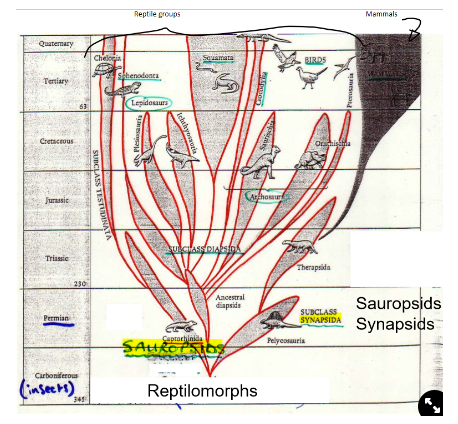
<ul><li><p>1st diversification was to form the reptilomorphs</p><ul><li><p>driven by diversification of insects, food source</p></li></ul></li><li><p>2nd diversification was to form the two main groups of amniotes</p><ul><li><p><strong>Synapsids</strong>→ gave rise to the mammals</p></li><li><p><strong>Sauropsids</strong>→ gave rise to the reptilian groups</p></li><li><p>spilt ~355 mya, end Carboniferous-Permian</p></li></ul></li></ul>
3
New cards

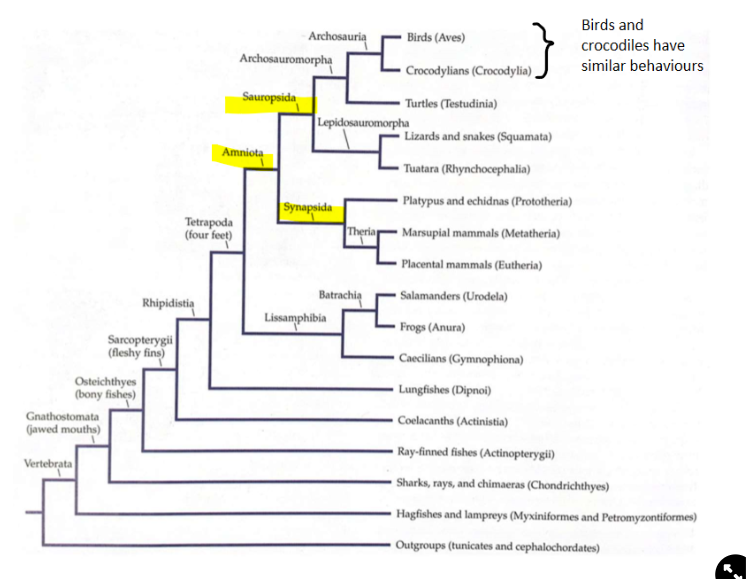
Phylogeny of amniotes:

knowt flashcard image
4
New cards

Early Amniotes varied in size but are linked by the common feature→

Amniotic Egg

  • distinguishes amniotes (reptiles, birds, mammals) from non-amniotes (fish, amphibians)

5
New cards

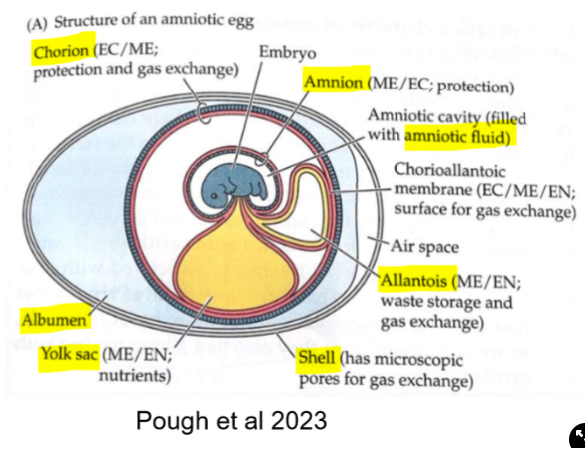
Amniotic egg has 3 extraembryonic membranes→ from the embryo itself:

  • Allantois→ waste storage, vascularised (gas exchange), is left

  • Amnion→ grows around embryo, sac has amniotic fluid, protection

  • Chorion- surrounds all contents, can be vascularised too

6
New cards

Other features of the amniotic egg:

  • Albumin→ surround chorion, source of protein and water

  • Shell→ surrounds albumin, added from female tract later on

  • Yolk sac→ food source

    • Germinal disc→ where embryo is fertilised

    • Chalaza→ keeps yolk in position

<ul><li><p>Albumin→ surround chorion, source of protein and water</p></li><li><p>Shell→ surrounds albumin, added from female tract later on</p></li><li><p>Yolk sac→ food source</p><ul><li><p>Germinal disc→ where embryo is fertilised</p></li><li><p>Chalaza→ keeps yolk in position</p></li></ul></li></ul>
7
New cards

Reproduction of amniotes:

  • internal fertilisation

  • most males have intromittent organs and females have clitorises/hemiclitores

  • the ancestral forms determined sex based on environmental conditions (seen in many groups)

  • egg has to be laid on land

8
New cards

The extraembryonic membranes in egg-layers and non-egg layers are:

homologous
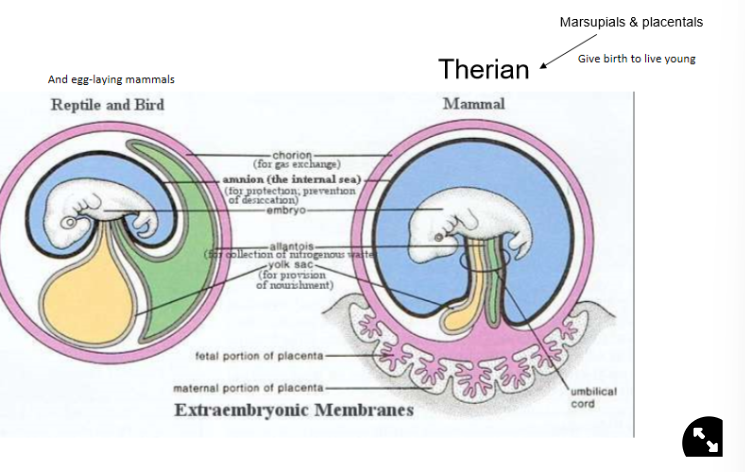
<p>homologous</p>
9
New cards

Theories of why extraembryonic membranes evolved:

  • Increases SA for gas exchange

  • Having a shell provides support

  • Can lead to larger eggs and larger adults

10
New cards

Derived features of amniotes:

  1. skeletal characters

  2. skin

  3. ventilation

  4. temporal fenestration

11
New cards
  1. skeletal characters-

  • Cervical vertebrae (in the neck) have become modified

  • Axis (C2) has become enlarged

  • Is connected to Atlas (C1) that is also connected to the skull

    → are able to rotate head
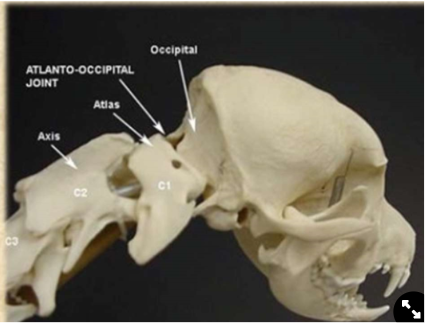
<ul><li><p>Cervical vertebrae (in the neck) have become modified</p></li><li><p>Axis (C2) has become enlarged</p></li><li><p>Is connected to Atlas (C1) that is also connected to the skull</p><p>→ are able to<strong> rotate head</strong></p></li></ul>
12
New cards
  1. skin and feathers-

  • reduced permeability, thicker, keratinised, more lipids

    • all amniotes have alpha keratin, sauropsids have beta keratin (stronger)

    → don’t need to rely on water like amphibians

  • have scales, hair, feathers, formed from epidermal placode

    → all homologous, just different gene expressions

13
New cards
  1. ventilation-

  • have costal ventilation→ use rib movements for ventilating lungs

  • allows air to be drawn in a longer distance→ have longer necks

  • longer necks allow more complex nerves to control forelimbs

14
New cards
  1. temporal fenestration-

  • presence of holes in the skull

  • anapsid→ no holes

  • synapsid→ have 1 hole and 1 bar (arch) underneath

  • diapsid→ have 2 holes and 2 bars

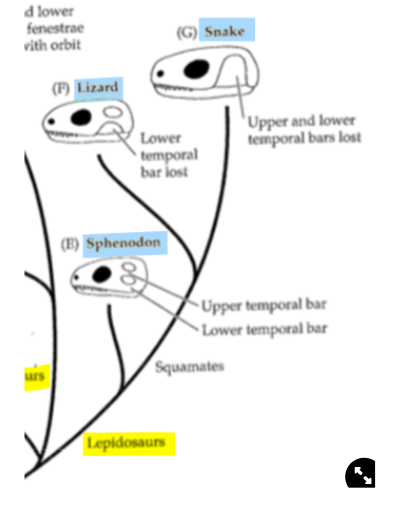
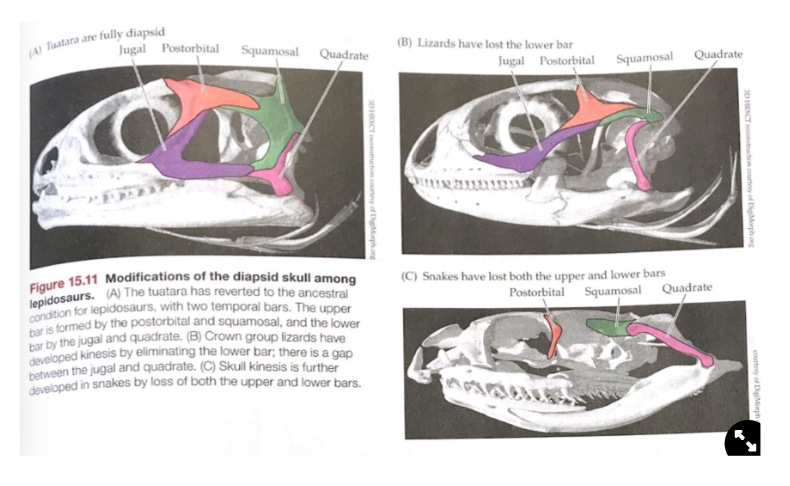
    • can be modified→ lower arch is lost in lizards, both lost in snakes
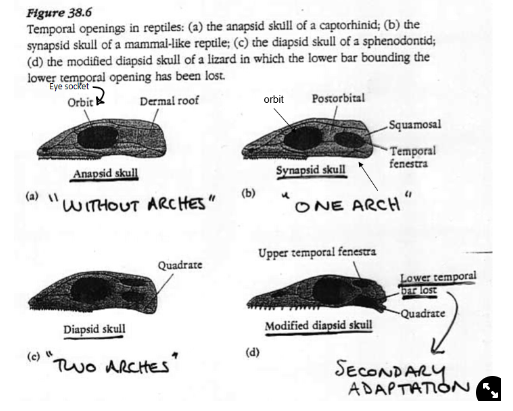
<ul><li><p>presence of holes in the skull</p></li><li><p><strong>anapsid</strong>→ no holes</p></li><li><p><strong>synapsid</strong>→ have 1 hole and 1 bar (arch) underneath</p></li><li><p><strong>diapsid</strong>→ have 2 holes and 2 bars</p><ul><li><p><span>can be modified→ lower arch is lost in lizards, both lost in snakes</span></p></li></ul></li></ul>
15
New cards

holes in the skull evolution:

  • synapsids had one hole but sauropods did not have holes when they diverged→ has evolved independently in synapsids and sauropsids

  • is highly modified→ orbit has combined with the hole in modern-day mammals
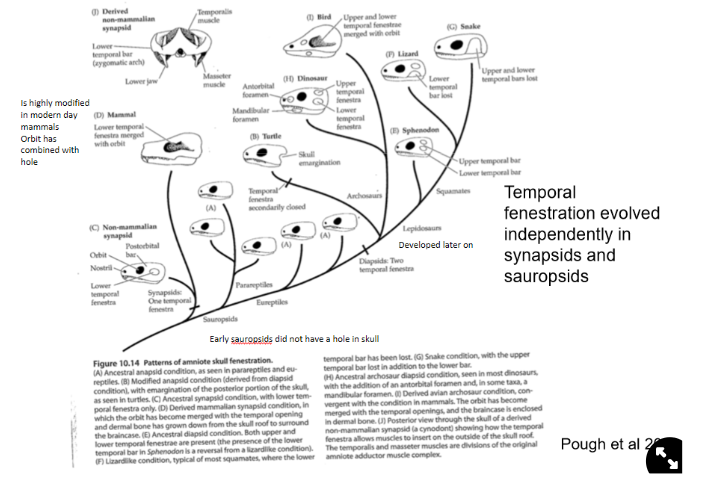
<ul><li><p>synapsids had one hole but sauropods did not have holes when they diverged→ <strong>has evolved independently in synapsids and sauropsids</strong></p></li><li><p>is highly modified→ <span>orbit has combined with the hole in modern-day mammals</span></p></li></ul>
16
New cards

Why do amniotes have holes in their skull:

  • Non-amniotes→ can only do buccal pumping (mouth sucking to feed) so have flat skulls, has 1 unmodified muscle (adductor muscle)

    → could only open and close mouth

  • Amniotes→ can do costal ventilation so have dome-shaped skulls, muscle has differentiated to 2 muscles

    → can open and close mouth and also apply pressure
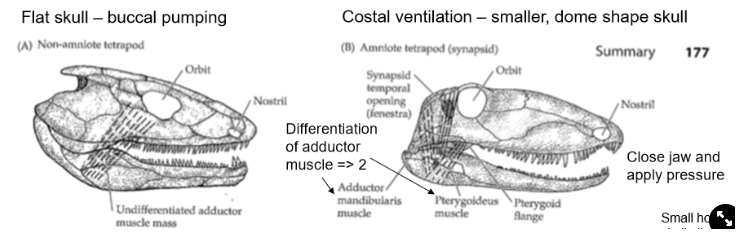
<ul><li><p>Non-amniotes→ can only do <strong>buccal pumping</strong> (mouth sucking to feed) so have flat skulls, has <strong>1 unmodified muscle</strong> (adductor muscle)</p><p><strong>→ could only open and close mouth</strong></p></li><li><p>Amniotes→ can do <strong>costal ventilation</strong> so have dome-shaped skulls, muscle has differentiated to <strong>2 muscles</strong></p><p><strong>→ can open and close mouth and also apply pressure</strong></p></li></ul>
17
New cards

How did the holes form:

  • Non-amniotes→ muscle is attached to the inside of the skull

  • Amniotes→ muscles are attached to the top of the outside of the skull through gaps in the bones, allows muscle enlargement and an improved jaw
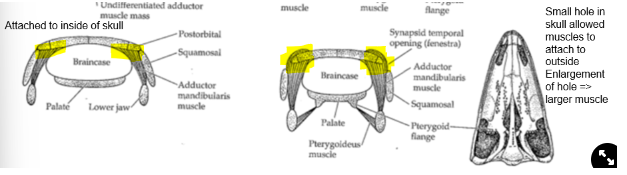
<ul><li><p>Non-amniotes→ muscle is attached to the <strong>inside of the skull</strong></p></li><li><p>Amniotes→ muscles are attached to the top of the <strong>outside of the skull</strong> through gaps in the bones, allows muscle enlargement and an improved jaw</p></li></ul>
18
New cards

Holes in the phylogeny:

  • Turtles look anapsid but are actually diapsid (holes are just covered)

  • Turtles are sister group to the Archosaurs

  • Archosaurs are the crocodiles, birds, pterosaurs and dinosaurs

  • Lepidosaurs are the tuatara (sphenodon), snakes and lizards

    • these two groups diverged in the Permian
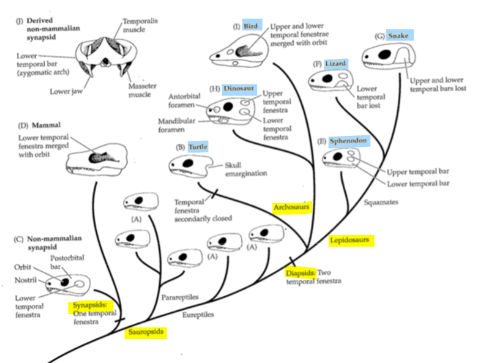
<ul><li><p>Turtles look anapsid but are actually diapsid (holes are just covered)</p></li><li><p><strong>Turtles</strong> are sister group to the Archosaurs</p></li><li><p><strong>Archosaurs</strong> are the crocodiles, birds, pterosaurs and dinosaurs</p></li><li><p><strong>Lepidosaurs</strong> are the tuatara (sphenodon), snakes and lizards</p><ul><li><p>these two groups diverged in the Permian</p></li></ul></li></ul>
19
New cards

Turtles/Tortoises (Chelonia)→ structure:

  • Carapace→ top, Plastron→ bottom

    • made of bone, covered in beta keratin→ can form scutes (pattern)

  • The Vertebrate and Ribs are fused to the carapace

  • Ancestors had teeth but modern-day have a keratin beak instead

  • Have a flexible and retractable neck→ can retract forward or sideways (side-necked/snake-necked turtle)
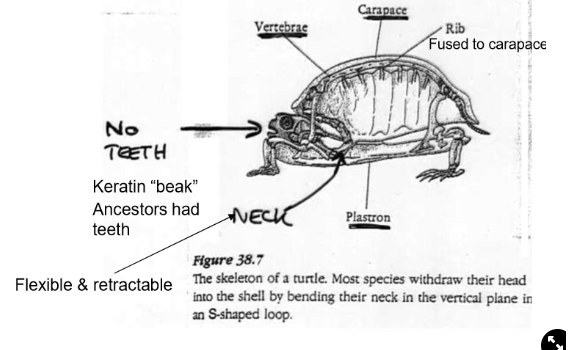
<ul><li><p><strong>Carapace</strong>→ top, <strong>Plastron</strong>→ bottom</p><ul><li><p>made of bone, covered in beta keratin→ can form scutes (pattern)</p></li></ul></li><li><p>The <strong>Vertebrate and Ribs</strong> are fused to the carapace</p></li><li><p>Ancestors had teeth but modern-day have a <strong>keratin beak</strong> instead</p></li><li><p>Have a flexible and <strong>retractable</strong> <strong>neck</strong>→ can retract forward or sideways <span>(side-necked/snake-necked turtle)</span></p></li></ul>
20
New cards

Turtles/Tortoises (Chelonia)→ ventilation:

  • Cannot do costal ventilation as ribs are connected to the carapace

  • Instead connective tissue holds lungs and gut together, so:

    • inspire→ contract side muscles, gut moves down, moves lungs down too, increase in volume, take air in

    • expire→ muscles contract, push gut up, lungs move up too, decrease in volume, release air

  • Can be modified:

    • aquatic turtles use the hydrostatic pressure of the water too

    • some use a vascularised pharynx or a vascularised cloaca
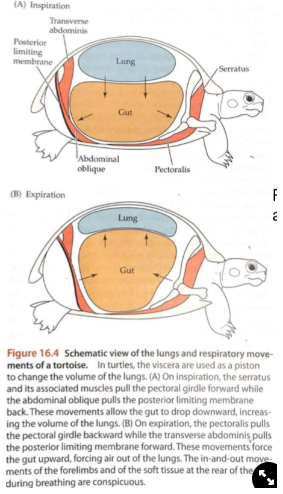
<ul><li><p>Cannot do costal ventilation as ribs are connected to the carapace</p></li><li><p>Instead <strong>connective tissue holds lungs and gut together</strong>, so:</p><ul><li><p>inspire→ contract side muscles, gut moves down, moves lungs down too, increase in volume, take air in</p></li><li><p>expire→ muscles contract, push gut up, lungs move up too, decrease in volume, release air</p></li></ul></li><li><p>Can be modified:</p><ul><li><p><span>aquatic turtles use the hydrostatic pressure of the water too</span></p></li><li><p><span>some use a vascularised pharynx or a vascularised cloaca</span></p></li></ul></li></ul>
21
New cards

Turtles/Tortoises (Chelonia)→ varied body forms:

  • are all egg layers, on land

  • most are carnivorous (sometimes mistake plastic as jellyfish)
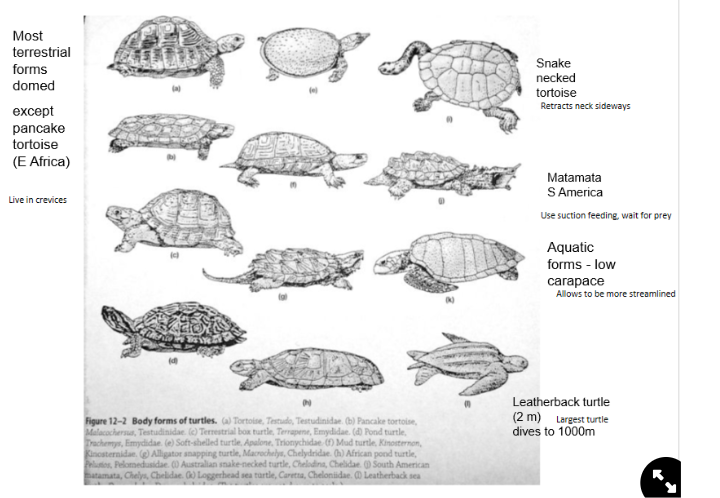
<ul><li><p>are <strong>all egg layers</strong>, on land</p></li><li><p><strong>most are carnivorous</strong> (sometimes mistake plastic as jellyfish)</p></li></ul>
22
New cards

green turtles:

  • are herbivorous

    • have huge migrations→ feed in one area, nest far away

    • hatchlings crawl to the sky over sea light (brighter than sky over land)→ go out to the ocean

    • use chemosensory info to pick nesting site (light, wave direction, magnetism) and are site-faithful
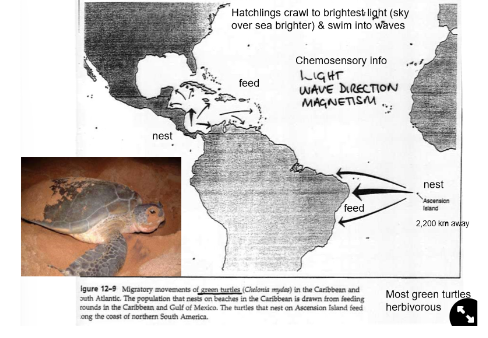
<ul><li><p>are herbivorous</p><ul><li><p>have <strong>huge migrations</strong>→ feed in one area, nest far away</p></li><li><p>hatchlings crawl to the sky over sea light (brighter than sky over land)→ go out to the ocean</p></li><li><p>use chemosensory info to pick nesting site (light, wave direction, magnetism) and are site-faithful</p></li></ul></li></ul>
23
New cards

Turtles/Tortoises (Chelonia)→ varied mating behaviours:

  • males have to mount the females, can be kicked off

  • bobbing→ signal to work out who is who

  • male hooks tail underneath female

  • both have a cloaca→ reproductive opening that also excretes waste
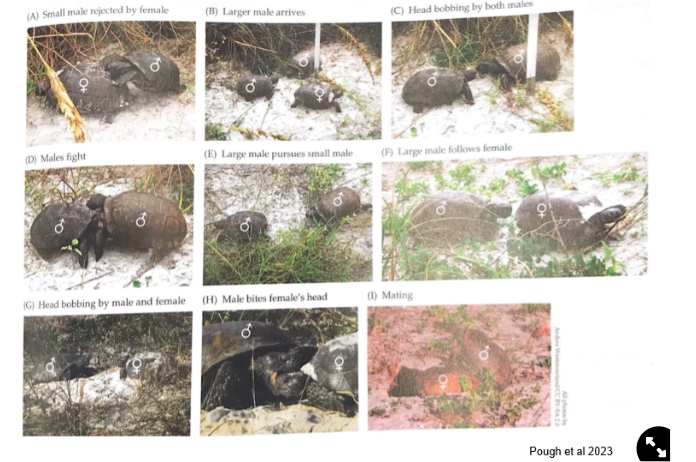
<ul><li><p>males have to mount the females, can be kicked off</p></li><li><p>bobbing→ signal to work out who is who</p></li><li><p>male hooks tail underneath female</p></li><li><p>both have a <strong>cloaca</strong>→ reproductive opening that also excretes waste</p></li></ul>
24
New cards

Turtles/Tortoises (Chelonia)→ sex determination:

Environmental Sex Determination:

  • temperature determines sex

  • females are formed when temperature is high in turtles

  • females are formed when temperature is low in lizards

    → theory is that the sex at the higher temperature is the larger sex
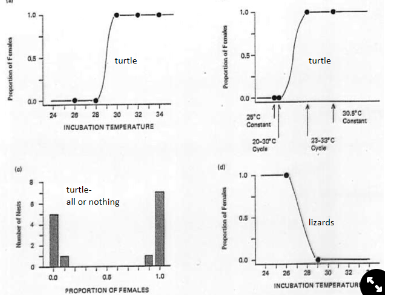
<p><strong>Environmental Sex Determination:</strong></p><ul><li><p><strong>temperature determines sex</strong></p></li><li><p>females are formed when temperature is high in turtles</p></li><li><p>females are formed when temperature is low in lizards</p><p>→ theory is that the sex at the higher temperature is the larger sex</p></li></ul>
25
New cards

Turtles/Tortoises (Chelonia)→ conservation:

implications from environmental sex determination:

  • e.g. Kemp’s Ridley turtles:

    • environmental sex determination was discovered in 1985

    • tried to establish another population before this but had few females

    • realised needed to increase the temperature→ got more females
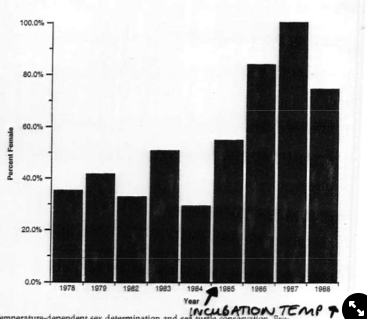
<p>implications from environmental sex determination:</p><ul><li><p><span>e.g. Kemp’s Ridley turtles:</span></p><ul><li><p>environmental sex determination was discovered in 1985</p></li><li><p>tried to establish another population before this but had few females</p></li><li><p>realised needed to increase the temperature→ got more females</p></li></ul></li></ul>
26
New cards

Lepidosaurs:

  • Tuataras→ Sphenodonta

  • Lizards and Snakes→ Squamates

<ul><li><p><strong>Tuataras</strong>→ Sphenodonta</p></li><li><p><strong>Lizards and Snakes</strong>→ Squamates</p></li></ul>
27
New cards

Tuatara→

  • are found on islands, have spines on their back

  • are nocturnal but have a low body temp and are still active

  • live in burrows with seabirds

    • mess of seabird nest attracts arthropods→ feed on these

    • arthropods are active at night→ may be why tuatara are nocturnal

  • have a diapsid skull

  • have 2 rows of teeth on the upper jaw and 1 set of teeth on the lower jaw that fits in between→ manipulate food
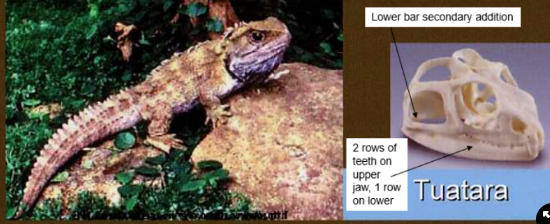
<ul><li><p>are found on islands, have spines on their back</p></li><li><p>are <strong>nocturnal</strong> but have a <strong>low body temp</strong> and are still <strong>active</strong></p></li><li><p>live in <strong>burrows with seabirds</strong></p><ul><li><p>mess of seabird nest attracts <strong>arthropods→ feed on these</strong></p></li><li><p>arthropods are active at night→ may be why tuatara are nocturnal</p></li></ul></li><li><p>have a <strong>diapsid skull</strong></p></li><li><p>have<strong> 2 rows of teeth on the upper jaw and 1 set of teeth on the lower jaw </strong>that fits in between→ manipulate food</p></li></ul>
28
New cards

Skulls of Lepidosaurs:

  • Tuatara→ classically diapsid skull

    • the lower bar was lost and then reformed again (secondary addition)

  • Lizards→ bottom bar has been lost and not reformed

    • have an enlarged hole but still 2 holes

  • Snakes→ top and bottom bar have been lost and both have not reformed

    • have 1 big hole

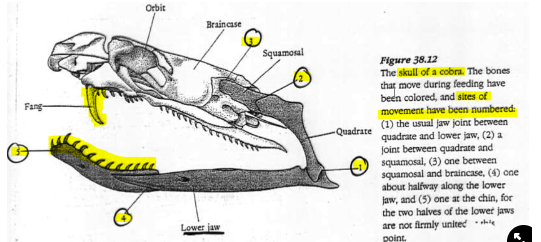
<ul><li><p><strong>Tuatara→ classically diapsid skull</strong></p><ul><li><p>the lower bar was lost and then reformed again (secondary addition)</p></li></ul></li><li><p><strong>Lizards→ bottom bar has been lost and not reformed</strong></p><ul><li><p>have an enlarged hole but still 2 holes</p></li></ul></li><li><p><strong>Snakes→ top and bottom bar have been lost and both have not reformed</strong></p><ul><li><p>have 1 big hole</p></li></ul></li></ul>
29
New cards

Snake and lizards skulls are both…

kinetic

  • allows a very flexible jaw, not as strong bite force though

  • an exception is the Amphisbaenian→ does not move jaw at all as it uses its head for burrowing into the ground
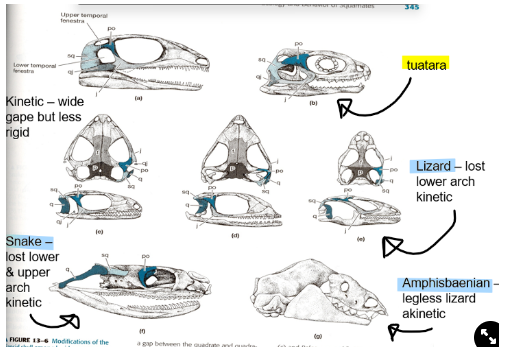
<p><strong>kinetic</strong></p><ul><li><p>allows a <strong>very flexible jaw</strong>, not as strong bite force though</p></li><li><p><span>an exception is the Amphisbaenian→ does not move jaw at all as it uses its head for burrowing into the ground</span></p></li></ul>
30
New cards

Lizards-

  • 80% are <20g→ are very small to feed on insects

  • Larger lizards are mostly herbivores

  • Lizards move by undulating body

  • Many are arboreal (live in trees)

  • Have evolved limb reduction >60 times

31
New cards

Exception to herbivore lizards-

  • Exception→ Monitor Lizards e.g. Komodo Dragon/Monitor:

    • feeds on large prey

    • has venom glands→ lower blood pressure + anticoagulant

    • move fast using gular pumping

32
New cards

Lizards→ undulating

  • use the same muscles for costal ventilation→ creates a conflict for locomotion and ventilation

    • some have adapted gular pumping to counter this→ use throat to pump air into lungs instead of ribs

33
New cards

Lizards→ arboreal

  • e.g. Chameleon, have adaptations for this:

    • Zygodachtylous→ join digits together to form an opposable toe for grip

    • Prehensile tail for grip

    • Eyes can move independently and also focus together too

    • Have a fast tongue projection

34
New cards

Lizard limb reductions-

  • is an adaptation for moving

  • surface dwellers (in high vegetation) have long tails

  • burrowers have short tails

35
New cards

Snakes evolution:

  • Are very specialised legless lizards

    • branched from lizards in the Cretaceous

    • main theory is that a group of lizards started digging, almost lost eyes, came back up, reformed eyes→ snakes have no eyelids

36
New cards

Snakes features:

  • Have few neck and tail vertebrae, most of animal is thorax

  • lack pectoral and pelvic girdles

    • some species have vestigial (tiny) ones e.g. pythons and boas, used for mating (not locomotion)

  • Elongation of body lead to a reduction in diameter but have a very flexible jaw with lots of points of articulation to eat a wide variety of prey

  • Have backward facing teeth→ push prey back into oesophagus

  • Feed live

<ul><li><p>Have <strong>few neck and tail vertebrae, most of animal is thorax</strong></p></li><li><p><strong>lack pectoral and pelvic girdles</strong></p><ul><li><p>some species have vestigial (tiny) ones e.g. pythons and boas, used for mating (not locomotion)</p></li></ul></li><li><p>Elongation of body lead to a reduction in diameter but have a very <strong>flexible jaw with lots of points of articulation</strong> to eat a wide variety of prey</p></li><li><p>Have <strong>backward facing teeth</strong>→ push prey back into oesophagus</p></li><li><p><strong>Feed live</strong></p></li></ul>
37
New cards

few neck and tail vertebrae-

  • caused by changes in gene expression in developmental genes:

    • Oct4 genes→ get lots of thoracic vertebrae and less limbs

    • Shh protein stimulates limb formation, is controlled by ZRS protein→ ZRS is mutated so there is less ZRS, less Shh, less limb formation

    → all leads to elongation of the body and a reduction in limbs

38
New cards

snakes fossils:

  • fossil forms had back legs but no front legs→ lost front legs first

  • another fossil form had 4 small limbs and has features suggesting burrowing → is debated if this was a snake or not though
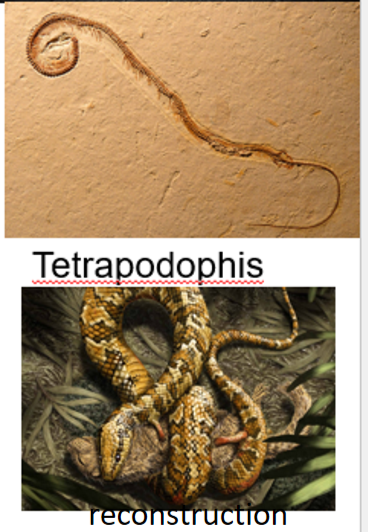
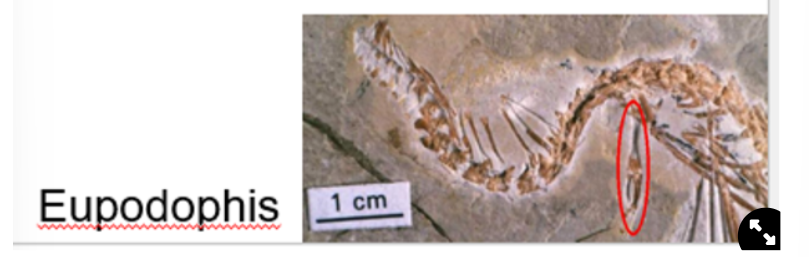
<ul><li><p>fossil forms had back legs but no front legs→ <strong>lost front legs first</strong></p></li><li><p>another fossil form had 4 small limbs and has features suggesting burrowing<img src="https://knowt-user-attachments.s3.amazonaws.com/ba5af62a-a74b-4e9a-bafd-8fa8eb7eb7e3.jpeg" width="105" height="151.734375">  → is debated if this was a snake or not though</p></li></ul>
39
New cards

snakes- feeding:

  • Have specialised methods→ some swallow whole, some have teeth to feed

  • Subdue prey by either constriction (reduce blood flow to organs) or venom (use fang to immobilise prey)

40
New cards

Archosaurs→ Crocodylia:

  1. Alligators

  2. Gharials

  3. Crocodiles

  • There are 26 living species but there used to be a lot more, e.g.:
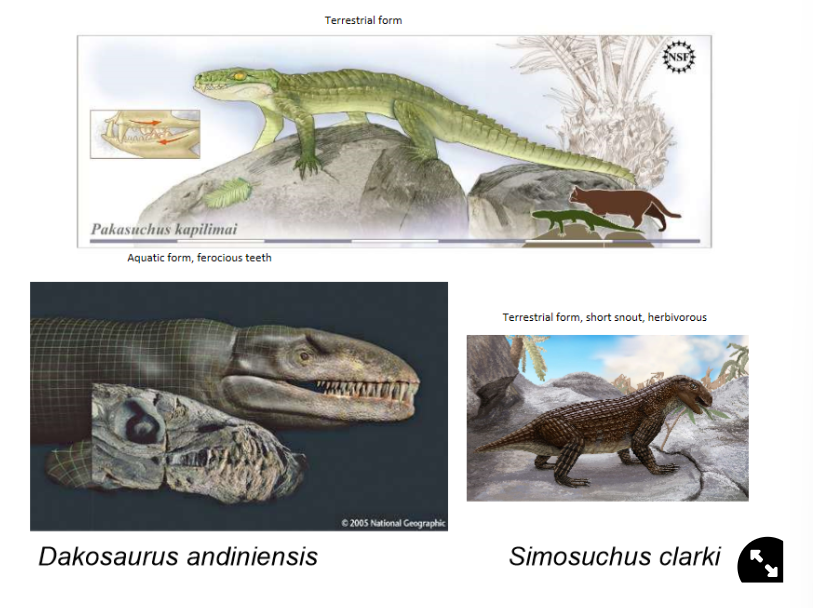
<ol><li><p><strong>Alligators</strong></p></li><li><p><strong>Gharials</strong></p></li><li><p><strong>Crocodiles</strong></p></li></ol><ul><li><p>There are 26 living species but there used to be a lot more, e.g.:</p></li></ul>
41
New cards

physical structures of crocodylia:

  • Have a classically diapsid skull→ 2 holes

  • Have thecodont teeth→ teeth in sockets

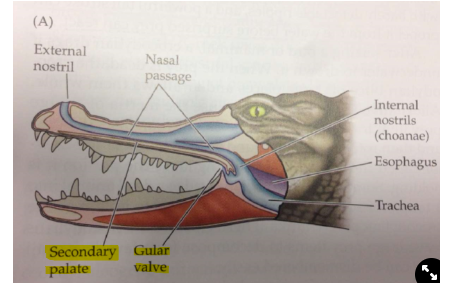
  • Have a secondary palate (like mammals)

  • Have integumentary sensory organs around jaw/face/body

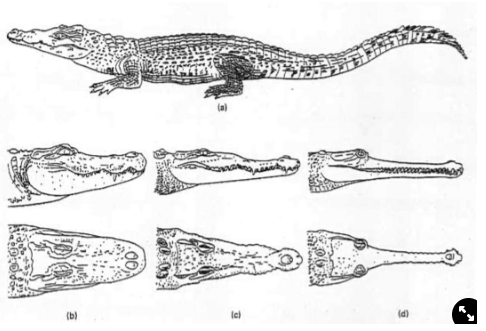
  • Varied head shape

    • believed to be associated with diet→ Gharial feeds on fish and False Gharial feeds on lots of prey but both have slender snout

      → is not associated with diet
<ul><li><p>Have a <strong>classically diapsid skull</strong>→ 2 holes</p></li><li><p>Have<strong> thecodont teeth</strong>→ teeth in sockets</p></li><li><p>Have <strong>a secondary palate</strong> (like mammals)</p></li><li><p>Have <strong>integumentary sensory organs</strong> around jaw/face/body</p></li><li><p><strong>Varied head shape</strong></p><ul><li><p>believed to be associated with diet→ Gharial feeds on fish and False Gharial feeds on lots of prey but both have slender snout</p><p>→ is not associated with diet</p></li></ul></li></ul>
42
New cards

secondary palate in crocodylians:

  • separates nasal passage from the mouth

  • allows breathing through nostrils when swimming

  • also have a gular valve→ stops water going down the trachea

43
New cards

integumentary sensory organs in crocodylians:

  • are very sensitive pressure receptors

  • use jaw instead of forelimbs to detect prey and parental care

44
New cards

behaviours of Crocodilians:

  1. Can swim (tail), crawl (drag body), walk (lift body) and gallop (fast)

  2. Use liver movement to ventilate lung

    • adaptation to moving and ventilation conflict

  3. Use sound for social behaviour (like birds)

    • e.g. territories, mating, parental care

  4. Lay eggs

    • using environmental sex determination

  5. Show extensive parental care

    • e.g. guarding nest, transferring in mouth, looking after in crest

  6. Show play behaviour

    • costs energy but has no advantage

  7. Can use lures to attract prey e.g. putting sticks on top of themselves to attract birds and then catch them

  8. Are semi-aquatic and primarily aquatic predators
<ol><li><p>Can swim (tail), crawl (drag body), walk (lift body) and gallop (fast)</p></li><li><p>Use <strong>liver movement to ventilate lung</strong></p><ul><li><p>adaptation to moving and ventilation conflict</p></li></ul></li><li><p>Use <strong>sound for social behaviour</strong> (like birds)</p><ul><li><p>e.g. territories, mating, parental care</p></li></ul></li><li><p><strong>Lay eggs</strong></p><ul><li><p>using environmental sex determination</p></li></ul></li><li><p>Show extensive<strong> parental care</strong></p><ul><li><p>e.g. guarding nest, transferring in mouth, looking after in crest</p></li></ul></li><li><p>Show <strong>play behaviour</strong></p><ul><li><p>costs energy but has no advantage</p></li></ul></li><li><p>Can use <strong>lures to attract prey</strong> e.g. putting sticks on top of themselves to attract birds and then catch them</p></li><li><p>Are semi-aquatic and primarily aquatic predators</p></li></ol>