Exam 1 - Encounters with the Arts of Global Africa
 Call Kai
 Learn
Learn Practice Test
 Spaced Repetition
 Match
Match Flashcards
 Knowt Play
1/57

Earn XP
Description and Tags
Art History 1130 - Wayne State - Professor: Samantha A. Noel
Name | Mastery | Learn | Test | Matching | Spaced | Call with Kai | Chat |
|---|
No analytics yet
Send a link to your students to track their progress
58 Terms
7 Myths of Africa
Primal timeless Africa
African art as bound by place
African art as communitarian
Tribal Africa
Intuitive African art
Primitive art / “Art for arts sake”
African art as anthropologically framed

Drawing of the heads of an Ibo African man with a pronounced prognathism and an orangutan, found in Histoire Naturelle du Genre Humain by Julien Joseph Virey.
Portrays African people as ape-like, not entirely human
European man is superior
Hierarchy: human ➡ part-human ➡ animal
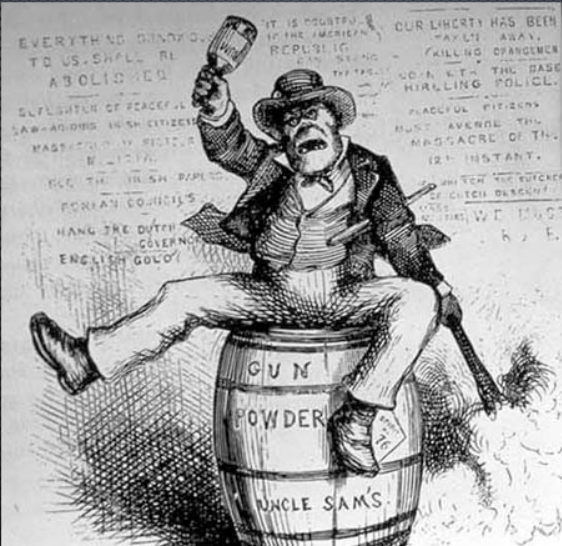
Thomas Nast, “The Usual Irish Way of Doing Things,” from Harper’s Weekly, 1871.
Irish man as an ape and violent
Fearmongering
Irish immigrants (stereotypes)
Ife
The holy city of Ife was an important city among the Yoruba kingdoms
Ade
Yoruba word for crown
Okin
A small royal bird that signifies royalty
Olorun
The supreme being
Orisha
Yoruba word for deities/gods and goddesses
Osun
The river goddess
Ogun
The deity of war and iron
Obatala
The deity of creativity, the creator of bodies of living beings
Eshu
The deity who is the embodiment of the crossroads; he is also the messenger of the gods
Shango
The deity of thunder; Shango was a medieval king
Babalawo
Yoruba priest
Ifa
The deity of divination
Ashe
The power to make things happen (God’s enabling light)
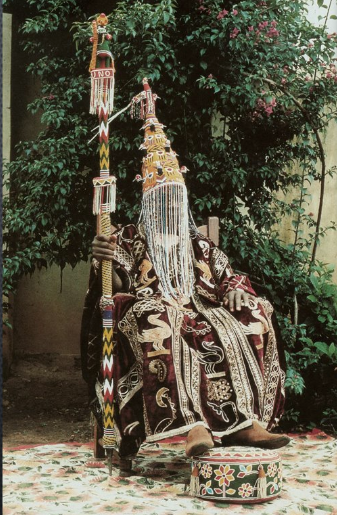
Ruler of Orangun-Ila, Airowayoye I, in beaded crown and other regalia, Yoruba (Nigeria), 1977.
Royal regalia, made up entirely of beads
Cone-shaped headpiece (the head of a person is very important)
Stylized faces & bird that symbolizes royalty and the great mothers
Holds a scepter, decorated & stylized with beads (design motif)
Beaded fringe to protect anyone looking at him
Too important/sacred to touch the ground
Looks powerful, but is also powerless
During colonization, the frequency of when rulers would wear regalia increased
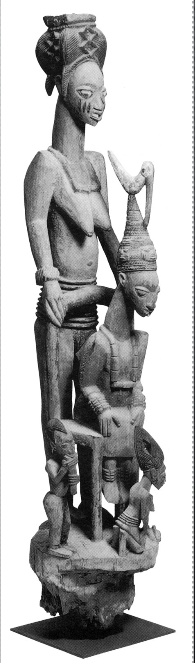
Olowe of Ise, Sculpture from the palace of Ikere, Yoruba, 1910-14.
Support from the palace
King & his wife; the wife is literally towering over him
Hierarchy of size: who is most important
People much smaller below the king (most likely his workers)
This wife may have done something important/is highly regarded (so are mothers)
Nudity ≠ sexual

Artist unknown, Eshu Figure, Yoruba, 19th century (?)
Eshu: trickster messenger god/deity
Man with headpiece standing (Eshu)
On the headpiece, there are bores filled with powder for the divination process (used to improve one’s life)
Also phallic (man), Eshu is also associated with love & romance
Body of a child, but his head is mature
Leather strings with cowrie shells (shells used as a form of currency)

Artist unknown, Shango Shrine Figure holding Dance staff, Yoruba, 19th century.
Shango: lightning
Kneeling woman devotee (with a child) (social expectation is to be a mother
Her head has a double axe

Ogboni Society elder with paired brass sculptures, Yoruba, 1949-50.
Powerful society of elders (Ogboni); they kept the king in check (the king answers to them)
Similar in status to the Supreme Court (would also judge non-king stuff)
Ogboni: wisdom & thirty (thirty members of the society)
Both men & women
Edan: emblem of the society, both male & female figures
Cowrie shells
A form of currency used in many forms of African art
Neolithic stone axes
Stone axes from the last phase of the stone age that are sacred to Shango
Ogboni
Thirty; wisdom
Edan
The best-known emblem of the Ogboni society
Gelede Festival
Gelede festival is to honor motherhood + family
The masqueraders of the festival are only men
2 major events
Ife ceremony (night before)
Daylight dances of Gelede
Components of Gelede costume
Mask, hair ties, & leg rattles

Arabi Ajigbale. Yoruba.
1st
Wearing the cloths of the iron deity, Ogun, Aravi Ajigbale sweeps the market to clear the way for the masqueraders that follow (cleanses the space)

Bearded Great Mother, lyanla.
Yoruba.
2nd
A beard is proof of wisdom as an elder
The bearded greate Mother, Iyanla, bent with age, trails white cloth on the ground

Oro Efe. Yoruba.
5th
Very elaborate headdress
In a headdress adorned with woodpeckers, snakes, and a leopard, and in a costume covered with geometric and representational images
Oro Efe moves through the performance area guided by his attendants

Gelede Mask featuring Role Recognition
Male & female subject matter (gender)
Able to recognize what gender is depicted
In image: male, important (size hierarchy), has a scepter, a child in his lap, people surrounding him

Gelede Mask of Ridicule
Criticizing society that is looked down upon
In image: satirizing/charicterizing a sex worker

Gelede Masks of Cosmological Forces
Animal imagery: animals are distinct from humans and can also be a metaphor for different personalities or roles (power dynamics)
Cultural practices/innovations outside of Yoruba (European)
Orunmila
Deity governing divination
Yemoja
The deity of motherhood, of family; the patron deity of the Gelede spectacle
Efe ceremony
The ceremony that occurs the night before the Gelede spectacle

Idomole Egungun. Yoruba.
The Idomole live up to their praise names which are translated as “that which entertains or pleases the eye”
Panels & patchwork (almost like a quilt), use of sequins & appliques
Each design has animals/symbols that mean transitioning to world of living to dead
Box like structure

Alubata Egungun
Highest ranking Egungun
Alubata means the one who plays the bata drum
Costume is voluminous & a lot of textile use, has white fur
When arms are raised it looks like a triangle (it’s fitted at the feet)

Onidan Fish. Yoruba.
This Egungun deals with highly regarded animals and also with social commentary
Entertainment element/portion of the festival
Mud fish is highly regarded because it can live longer than others out of water & it emits electric shock to predators

Onidan of Europeans. Yoruba.
Social commentary; has a watch, a modern bag, holds a pen (making fun of white scholars coming to study Africans)
Could also be commentary on colonization
Egungun Masquerade
Masquerade honors the ancestors. The masquerade allows the world of the living and the world of the dead to converge
Colobus Monkey
Associated with the origin of the myth of the Egungun.
Alubata Egungun
Highest ranking Egungun. Alubata means the one who plays the bata drum.
Idomole Egungun
The Idomole live up to their praise names which are translated as “that which entertains or pleases the eye.”
Onidan Egungun
This Egungun deals with highly regarded animals and also with social commentary.

Artist unknown, Memorial Sculpture in the form of a House, Fon, 19th century.
Dedicated to King Wegbadja
Asen (memorial)
Would usually feature an object related to the dead person
Places on a shaft or pole & would be found in a memorial shrine
The higher the pole, the higher the significance of the person (same with the material)
Calabash represents his rights of rulership
The cross is a sign for the meeting of religious forces
The cord represents him as the father of royal lineage

Royal Diejo (House for the soul), Fon, 1874.
Built after the king’s death to house his soul
Earth + added materials make the walls
Elegant metal sculptures (roof finials) on the roofs (with the symbol on the certain king)

Frederick E. Forbes, Parade of King's Wealth during Huetanu Ceremonies, Fon, 1851
Introduced by King Agaja
Appliquéd tent containing different icons referring to the history of the kingdom
6-7 thousand people carry goods/valueables
People of high ranking had parasols

Artist unknown. Sculpture of a man with fins, Fon, 19th 20" century.
Evidence of King Tegbesu’s influence
Made with silver on wood
Represents male & female priests associated with the court religion (what they would wear)
Necklaces with coins, headpiece with hanging coins, & no recognizable face (has stylized cowrie shells)
Has fins on shoulder (water/fish)

Artist unknown, Royal War Tunic Fon, 19"h century.
Kansawu (war tunic for kings & important military leaders)
Evidence of King Agonglo’s influence
Red is royal color (empowerment)
Gold rings; number = rank
Triangles meant to represent claws of leopard
Striking & beautiful design meant to grab attention
King Wegbadja
Founded the Dahomey kingdom
Asen
A memorial sculpture from the Dahomey kingdom
King Agaja
Second king of the Dahomey kingdom; the son of King Wegbadja
Diejo
Built after the king’s death to house his soul
Huetanu
A ceremony to celebrate the king’s wealth
King Tegbesu
The third king of the Dahomey kingdom; the son of King Agaja
King Agonglo
King Tegbesu’s grandson
Kansawu
War tunic for kings and important military leaders