Dental Materials I- Ch 43/ COMPLETED
 Call Kai
 Learn
Learn Practice Test
 Spaced Repetition
 Match
Match Flashcards
 Knowt Play
1/58

Earn XP
Description and Tags
Name | Mastery | Learn | Test | Matching | Spaced | Call with Kai |
|---|
No study sessions yet.
59 Terms
Dental Materials must?
Be able to withstand the biting and chewing force in the posterior area in the mouth
Force is?
Any push or pull-on matter
Stress can cause?
distortion
Strain results in?
Change in the material
Types of stress and Strain
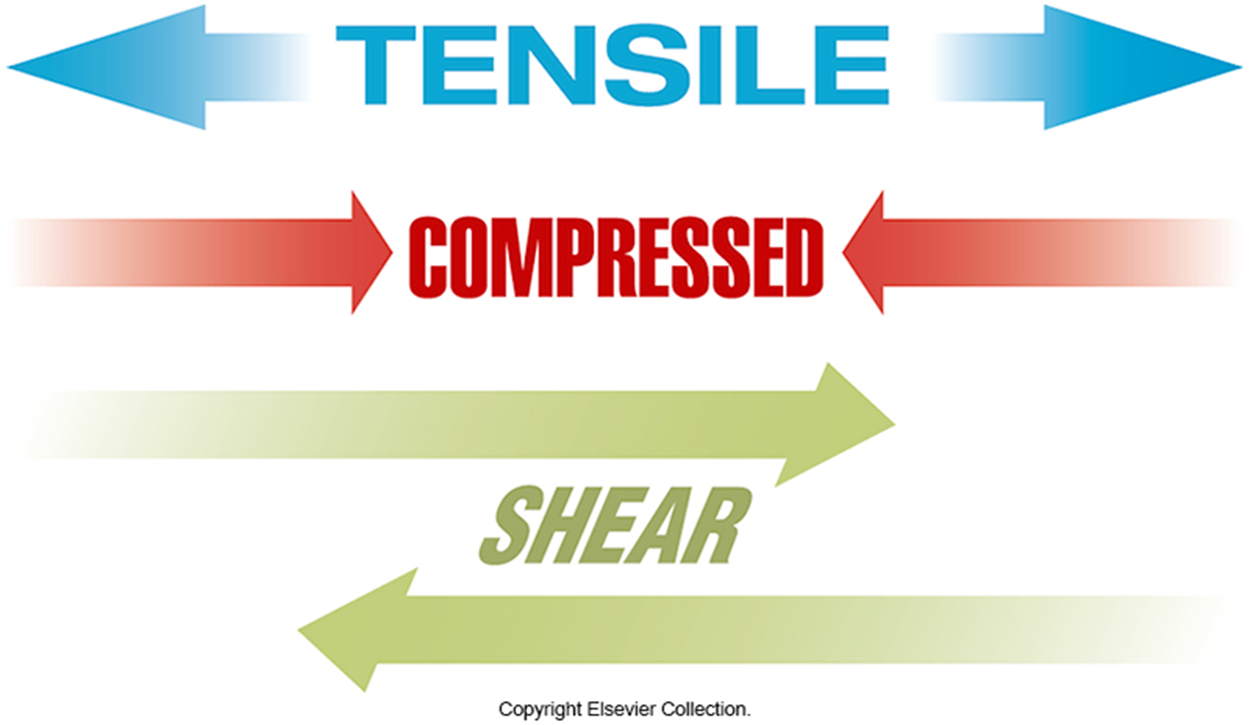
Tensile stress and strain:
(Pulls and stretches the material)
Compressive stress and strain:
(Pushes the material together)
Shear stress:
(Two forces of material parallel to each other sliding in opposite directions.) ((Think of like cutting a piece of paper with scissors, blades are parallel but work in opposite directions.))
Ductility means?
capacity of a metal to be stretched or drawn out by a pulling or tensile force without fracturing
Malleability means?
The capacity of a metal to be extended in all directions by a compressive force
Why are thermal changes a concern?
Thermal changes can lead to expansion or contraction of dental materials.
There is also a need to protect the pulp from thermal shock from extreme differences in temperature
Tensile means?
Compressed means?
Shear means?
Tensile: the ability of a material to withstand tension or pulling forces without breaking.
Compressed: subjected to a squeezing or pushing force that reduces its volume.
Shear: the ability of a material to withstand forces that cause one part of the material to slide past another.
How do microleakages occur?
Microleakages occur when there are gaps or spaces between the dental restoration and the tooth structure, allowing fluids and bacteria to enter, potentially leading to decay or other complications.
Can dental materials contract or expand at their own rate?
Yes
Electric current (or Galvanic Action) is?
When there are two different or dissimilar metals present in a dental restoration, an electric current can flow between them, leading to potential irritation or discomfort.
Corrosion
reaction within a metal exposed to corrosive products such as temperature, humidity, and saliva.
Hardness
is a measure of the resistance of a metal to indentation, scratching, or abrasion
Solubility
is the ability of a material to dissolve in a solvent, often influenced by temperature and composition.
A material that dissolves easily will?
wash away and leave the tooth structure exposed
Adhesion
is the tendency of different materials to cling together when they are in contact, essential for providing secure bonding and stability in dental applications.
Characteristics of dental materials that can affect the adhesion process are:
Wetting: Ability to flow over a surface (example: water flows easily)
Viscosity: Property of a liquid that causes it not to flow easily(thickness), (example: maple syrup)
Retention
is the ability of a material to maintain its position or hold onto a surface, crucial for the longevity of dental restorations and appliances.
Types of curing
Auto-cured or self cured: material hardens as a result of a chemical reaction of the materials once mixed together
Light-cured: material does not harden until exposed to a curing light
Dual-cured material: some curing takes place as the material is mixed
(The final cure does not occur until the material has been exposed to a curing light)
Materials used in these types of restorative and esthetic procedures are:
Amalgam
Composite resins
Glass ionomers
Temporary restorative materials
Tooth-whitening products
Amalgam
A dental material made from a mixture of metals, primarily mercury, silver, tin, and copper, used for filling cavities due to its durability and strength. Amalgam is a safe, affordable, and durable material used predominantly to restore premolars and molars.
Amalgam is not used as often today.
The alloy powder is a combination of metals
Silver, give strength
Tin, makes it workability and gives strength
Copper, for its strength and corrosion resistance
Zinc, to suppress oxidation
What are the controversial issues regarding mercury?
What is the response of the ADA and National Institution of Health-Nations Administrations have to say about this matter?
1.Potential harm to patients from mercury within the amalgams placed in their teeth
2.Toxicity level of mercury vapors affecting dental personnel exposed over a long period
Health risk for dental personnel is greater than that for a patient. The dentist and assistant who are exposed to mercury vapors daily should be aware of their toxic effects. An increase in exposure can result in tremors, kidney dysfunction, depression, and central nervous system disorders
The ADA and the National Institute of Health-Nations Administration have agreed that there is no basis for claims that amalgam is a significant health hazard
Trituration
The process of mixing powdered dental amalgam alloy with mercury to form a homogenous mass, essential for achieving optimal properties in dental restorations.
Condensation
The amalgam is carried by the amalgam carrier and placed in increments into the prepared tooth
Each increment is condensed immediately with the use of an amalgam condenser
Purpose of condensation is to:
Pack the amalgam tightly into all areas of the prepared cavity
Aid in removing any excess mercury
Carving and Finishing
Hand carving instruments: are used to carve back the amalgam material to the tooth’s normal anatomy
Burnisher: is used to smooth the amalgam
Once most of the carving has been completed, the patient is instructed to bite down lightly on articulating paper
Composite Resin
Widely accepted material of choice by dentists and patients
Placed mainly in anterior teeth because of their esthetic qualities.
Increasingly being placed in posterior teeth as well
Not as strong as amalgams or gold restorations
Class I restorations means?
restore defects on the occlusal surface of posterior teeth, the occlusal thirds of the facial and lingual surface of molars, and the lingual surfaces of maxillary anterior teeth.
Class II restorations means what?
restore defects that affect one or both of the proximal surfaces of posterior teeth.
Class III restoration means what?
used to repair cavities or decay on the anterior teeth
Class lV restorations mean what?
used to restore damage to the front teeth, specifically when both the crown and incisal edge are affected
Class V restorations mean what?
a specialized restorative solution designed to combat issues such as gum recession and non-carious cervical lesions (NCCL)
The composition of composite resins is a chemical mix, which includes
Organic resin matrix
Inorganic fillers
A coupling agent
Pigments
Fillers add?
the strength and characteristics that are needed in a restoration.
Flowable composites
Material wear-resistant
Flows easier
Sealant composites
Less viscosity to allow the material to flow into the pits and fissures
Coupling Agent
Adds strengthen to the resin by chemically bonding the filler to the resin matrix
Pigments
Add color
Differences for composites versus amalgam
The cavity preparation for a composite resin is designed to hold the resin material by means of a bonding system rather than by retention added into the preparation in a amalgam restoration.
Matrix systems will vary with composite resins.
Placement of composite resin is accomplished by increments; light-curing is performed before additional increments are added.
Shade selection
Most critical aspects when working with composite resins
Shade guide is always used when determine correct shade for application
Tips When Choosing a Shade
Determine tooth shade, if possible, in daylight or with standardized daylight lamps and not under normal ambient lighting
Make the choice quickly; always accept the first decision since the eyes begin to tire after approximately 5 to 7 seconds
Polymerization of Composite Resins
Polymerization is the process by which the resin material is changed from a pliable state into a hardened restoration. Occurs through auto-curing or light-curing
Light-curing uses a high-intensity light source
Finishing and Polishing
The finishing and polishing of composite resins are much different than an amalgam procedure
Because composite materials go from the soft, pliable state to being completely hardened by polymerization, the dentist cannot carve or adjust with hand instruments
Finishing burs and abrasive materials are used to contour and polish a finished composite resin
Glass Ionomers
Most versatile dental materials available
Because glass ionomers can adhere chemically to teeth
Most unique feature of glass ionomers they release fluoride after the final setting
Indications for Glass Ionomer Use
Primary teeth because of the fluoride release and minimal cavity preparation requirement
Final restorations in nonstress areas such as class V and root surfaces
Sealants
Core material for a buildup
Provisional (longer-term temporary) restorations
Composition of Glass Ionomers
Glass ionomer, combination of glass, ceramic particles, and a glassy matrix
Temporary Restorative Materials
Temporary restoration is designed to maintain and restore function and keep the patient comfortable for a limited time
If a tooth has lost a filling or has a small pit, an intermediate restorative material would be selected
If a cusp is gone, or dentist has prepared the tooth for a cast restoration (crown).
Intermediate Restorative Materials
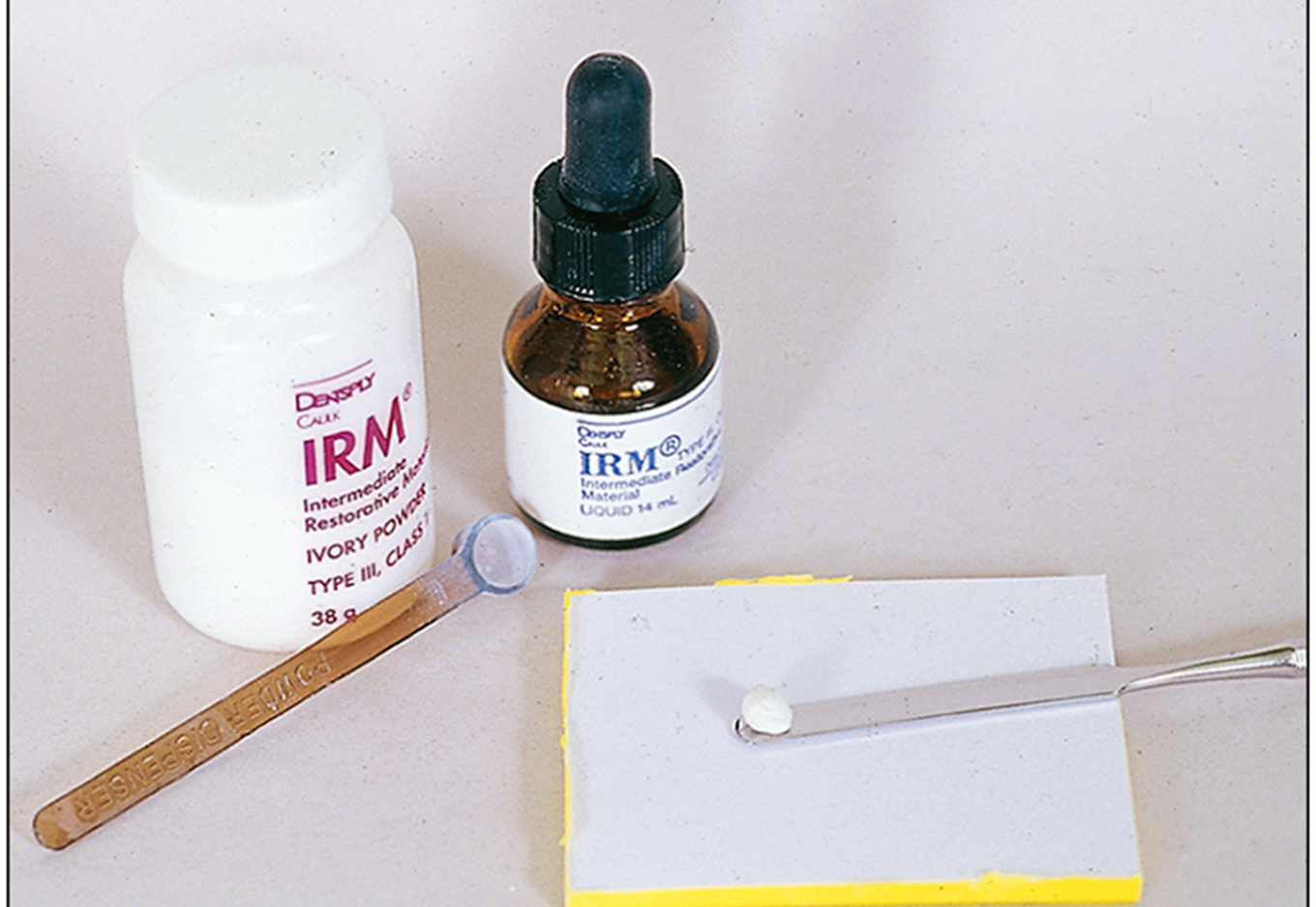
IRM is a reinforced zinc-oxide eugenol composition
Eugenol has a sedative effect on the pulp, and fillers are added to improve the strength and durability of the material
Common uses of IRM include:
Restoration of primary teeth
Restorative emergencies
Caries management programs
IRM is supplied as a powder and a liquid, which are mixed manually on a treated paper pad, or as premeasured capsules that are activated and then triturated
Provisional Restorative Materials
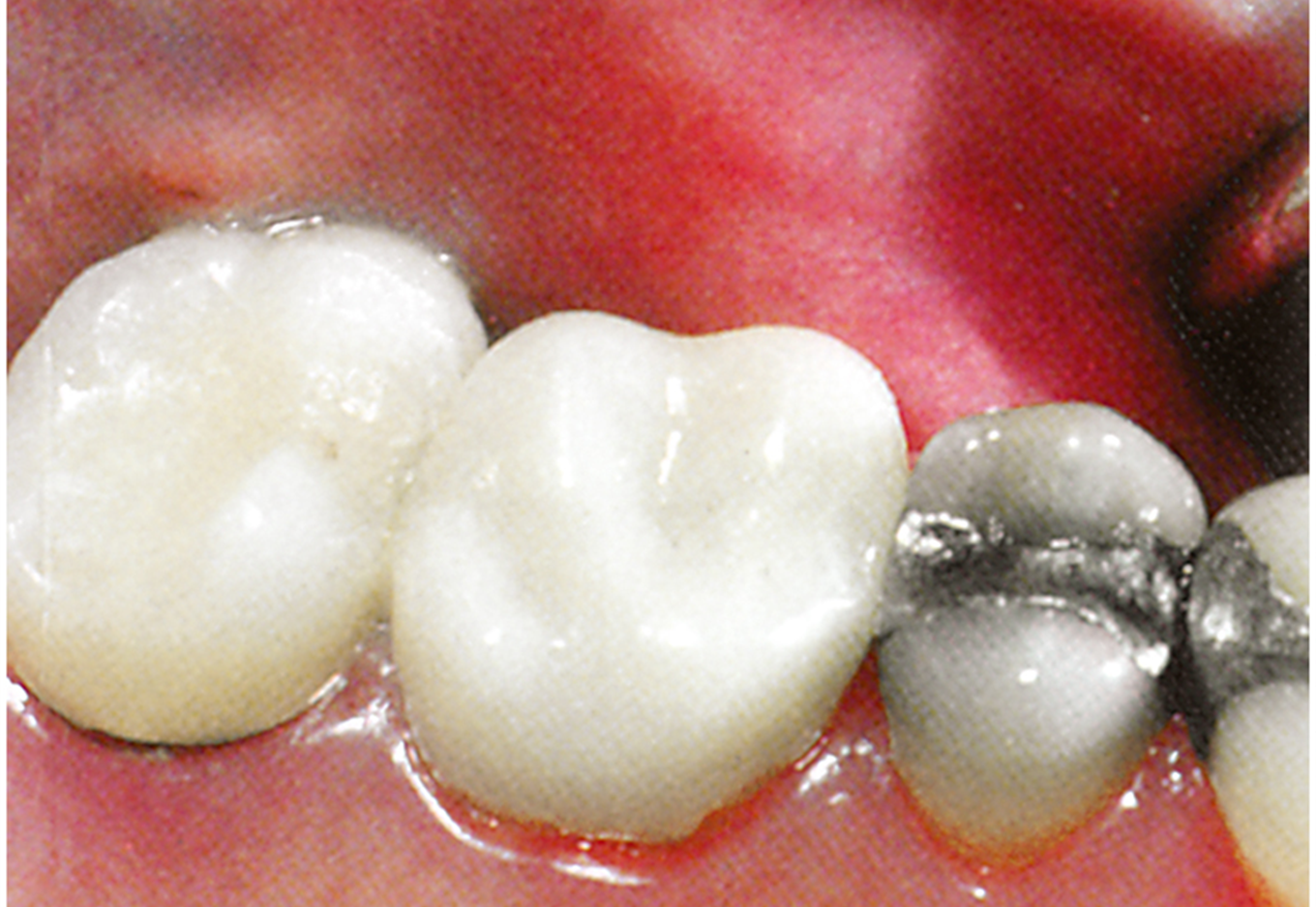
Designed to cover the major portion of a tooth or several teeth for a longer period
Acrylic resins are supplied in several ways: as a liquid/powder, in premeasured tubes, and auto-mix cartridge.
Tooth-Whitening Materials
Most popular and cost-effective ways of restoring the esthetic appearance of teeth
Whitening products can be found in many everyday items such as toothpaste, fluoride, mouth rinses, and even chewing gum
Composition of Whitening Materials
Most tooth-whitening products are made from a peroxide-based ingredient
Peroxide-based solutions are supplied in different concentrations
Works deep within the enamel to remove staining and discoloration
Reasons Teeth Become Discolored
Aging
Consumption of staining substances such as coffee, tea, colas, and tobacco
Trauma
Use of tetracycline
Excessive fluoride
Nerve degeneration
Aging of restorations
Methods of Tooth Whitening
“in office” or “at home”
The bleaching gel typically contains between 10% and 30% carbamide peroxide
Laser Bleaching done by light accelerating bleaching- isolation of the tissue done in the dental office.
Indirect Restorative Materials
An indirect restoration fabricated outside the mouth by a dental laboratory technician
Gold-Noble Metal Alloys
Gold in its purest form is much too soft for use in cast dental restorations
The combination of gold with other metals to form an alloy gives the characteristics and hardness required of an indirect restoration
Soft: Type I alloy
Used for casting inlays subject to slight stress during mastication
Medium: Type II alloy
Used for practically all types of cast inlays and posterior bridge abutments
Hard: Type III alloy
Acceptable for inlays, full crowns, three-quarter crowns, and anterior or posterior bridge abutments
Extra-hard: Type IV alloy
Designed for crowns, bridges, and cast-removable partial dentures
Ceramic Castings
Ceramics are compounds, which is a combination of metallic and nonmetallic elements.
Combinations of ceramic-metal restorations include the following:
Porcelain fused to metal (PFM)
Porcelain bonded to metal (PBM)
Ceramic-restorations (C/M)
Porcelain-metal (P/M)
Porcelain
Ceramic most used in dentistry
Combines strength, translucency, and the ability to match natural tooth color
Stronger than direct restorations, such as composite resins, which are created in the mouth
Why Porcelain?
Shading of colors matches tooth color well
Improves the esthetic appearance of anterior teeth
Has the strength of metal
Good insulator
Low coefficient of thermal expansion