Week 2 - The study of animal behaviour and its application
 Call Kai
 Learn
Learn Practice Test
 Spaced Repetition
 Match
Match Flashcards
 Knowt Play
1/27

There's no tags or description
Looks like no tags are added yet.
Name | Mastery | Learn | Test | Matching | Spaced | Call with Kai | Chat |
|---|
No analytics yet
Send a link to your students to track their progress
28 Terms
Result of the definition of behaviour
Behaviour is the internally coordinated responses (actions or inactions) of whole living organisms (individuals or groups) to internal and/or external stimuli, excluding responses more easily understood as developmental changes.
History of animal behaviour studies
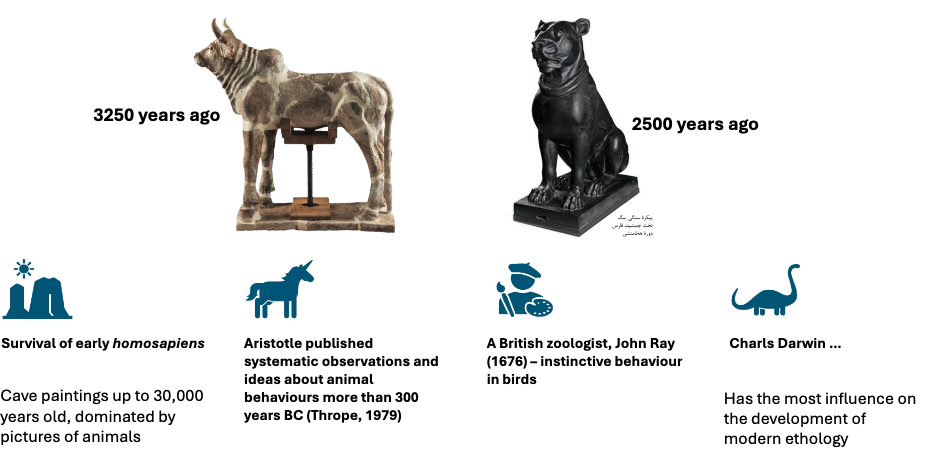
Major traditions in the history of animal behaviour studies
20th Century: Two Major Traditions
American researchers: controlled laboratory experiments
European researchers: naturalistic observation of animals’ behaviour in nature
Key question: How should we study animal behaviour?
History of animal behaviour studies: Learning through experience
Behaviour studied primarily through controlled laboratory experiments
Common model animals included rats and mice
Focus on learning and behaviour acquisition
Behaviour shaped by: Reinforcement & Punishment (general principles of learning)
The animal's evolutionary history and ecological context were often given relatively little emphasis
Advantage of learning animal behaviour through experience
This approach emphasized what animals do and how their behaviour changes, rather than asking what their behaviour might mean in their natural environments.
How is the development of ethology discovered through observation in a natural context
strong influence of naturalistic observation
animals studied in their natural environments
interest in: instinct, innate and adaptive behaviour
behaviour was considered in relation to the animal’s ecology and evolutionary history
How does an animal survive and reproduce in its environment
Challenge of observing in a natural context
internal mental processes were difficult to study scientifically because they were not directly observable
Who are the founds of ethology
Niko Tinbergen
Developed rigorous methods for studying behaviour in free-living animals
Combined observation with experimentation
Helped establish experimental ethology
Konrad Lorenz
Studied innate behaviour and instinct
Conducted extensive observations and experiments with animals
Developed influential ideas about the organization and development of innate behaviour

Modern approaches to ethology, 1960s onward
Ethology expanded into a broader scientific study of animal behaviour.Niko Tinbergen helped establish the conceptual framework for studying behaviour. His approach emphasized four questions:
Question Focus
Causation What mechanisms cause the behaviour?
Function What is the biological function or adaptive significance of the behaviour?
Ontogeny How does the behaviour develop during an individual's lifetime?
Phylogeny How did the behaviour evolve across generations/species?
What is the four questions missing?
Cognitive ethology: What cognitive processes may underlie animal behaviour?
Traditional behavioural approaches often focused on observable behaviour.
But animals also:
Perceive their environment
Learn from experience
Remember
Make decisions
Solve problems
Respond to their environment in flexible ways
Application of applied ethology includes:
welfare assessment
optimizing production
behavioural control
behavioural disorders
behaviour and conservation biology
Questions to ask when analyzing behaviour to help us assess welfare
What behaviours does the animal perform?
Which behaviours are important to the animal?
Can the animal perform those behaviours?
What happens when the behaviour is prevented?
Are there behavioural indicators of poor welfare?
Welfare assessment example with laying hens
Limited space can restrict opportunities to:
Perch
Dust-bathe
Forage
Move freely
What are the consequences of these restrictions?
Behavioural frustration?
Changes in motivation?
Stress?
Reduced behavioural opportunities?
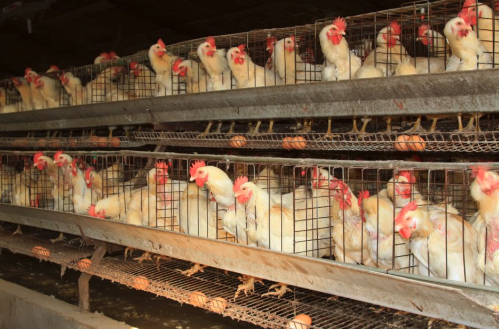
Welfare assessment example with high stocking density
A floor system may provide more opportunities for movement and behavioural expression than a cage, but high stocking density can create other welfare challenges.
Possible consequences include:
Increased competition for resources
Difficulty avoiding other birds
Feather pecking
Cannibalism

Optimizing production: Animals have species-specific patterns of:
Feeding
Activity
Rest
Social interaction
Optimizing production: For social species, feeding in groups can:
Allow animals to synchronize feeding behaviour
Support normal social interactions
Potentially influence feed intake and digestion

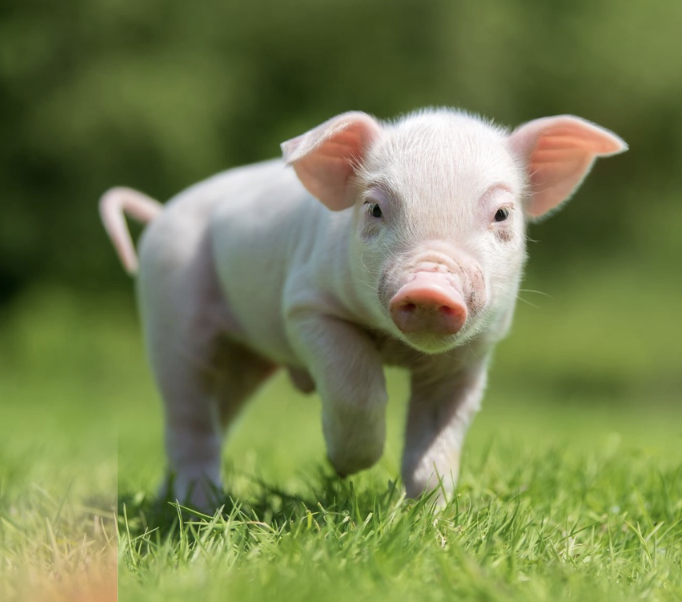
Optimizing production example with weaning in piglets
Weaning involves major changes in:
Nutrition: milk → solid food
Environment: familiar → potentially unfamiliar
Social relationships
Behaviour
Early or abrupt weaning may result in:
Reduced feed intake
Behavioural changes
Increased stress
Reduced growth rate
Behavioural control in captive animals. Management involves:
Preventing escape
Controlling reproduction
Managing movement and social interactions
Adapting animals to housing systems
Controlling access to food and other resources
How is behavioural control achieved?
Direct human actions
Housing and management practices
Technology and equipment
Behavioural control- Animal behaviour can also inform the design of equipment in:
Housing systems
Feeding equipment
Automated systems
Handling facilities
Monitoring technology

Behavioural control - Equipment designed without considering animal behaviour may:
Restrict normal behaviour
Cause fear or avoidance
Increase aggression
Create competition
Become damaged or dysfunctional
Behavioural control - if equipment does not account for the social relationships and hierarchies in social animals:
Dominant animals may monopolize resources
Subordinate animals may be displaced
Competition may increase
Aggression and biting may occur
Animal injury + equipment damage + reduced system efficiency
When behaviour goes wrong, potential factors may include:
Poor housing conditions
Inadequate resources
Social instability
Poor human–animal interactions
Malfunctioning equipment
Insufficient behavioural opportunities

Behavioural disorders: How can we address behavioural problems?
Environmental enrichment
More opportunities to explore
Manipulable materials
Appropriate feeding challenges
Opportunities for species-typical behaviour
Environmental modification
Changes to housing
Increased access to resources
Improved social management
Behavioural training
Reinforcing desirable behaviours
Providing alternative behaviours

Conservation biology: what are the two approaches to conservation

In-situ conservation and its important information
Understanding behaviour in the wild
Successful conservation requires knowledge of the species' normal behaviour.
Important information includes:
Social structure
Foraging strategies
Mating behaviour
Movement patterns
Territoriality
Vigilance
Conservation in captivity- applied ethology can help answer:
What social environment does the species need?
What behaviours should animals be able to perform?
What type of enclosure is appropriate?
How should animals be fed?
How should breeding be managed?
How can natural behaviours be maintained?
How can behaviour information conservation in the wild and in captivity
In the wild
Understand normal behaviour
Detect environmental changes
Identify threats
Improve habitat management
In captivity
Design appropriate environments
Support species-typical behaviour
Improve welfare
Support successful reproduction
Successful conservation is not just about keeping animals alive. It also requires understanding the behaviour they need to survive and reproduce.