IB Chemistry 3.1
 Call Kai
 Learn
Learn Practice Test
 Spaced Repetition
 Match
Match Flashcards
 Knowt Play
1/22

There's no tags or description
Looks like no tags are added yet.
Name | Mastery | Learn | Test | Matching | Spaced | Call with Kai | Chat |
|---|
No analytics yet
Send a link to your students to track their progress
23 Terms
Element
a pure substance made of only one kind of atom
Compound
a pure substance made of multiple kinds of atoms
Mixtures
a physical combination of substances that can still be separated
Homogeneous
a type of mixture with a uniform appearance
Heterogeneous
a type of mixture with distinct phase shifts
Separation techniques
evaporation, filtration, solvation, distillation, paper chromatography, recrystallization, separation funnel
Solvation
process of separating a mixture of a soluble and insoluble solid. First, the differentiating solvent is added, then the undissolved solid is filtered.
Distillation
an impure liquid is boiled to produce a vapor that is then condensed
Paper chromatography
a technique for separating dissolved compounds by their behavior in a separate liquid
Recrystallization
an impure solid is dissolved, then cooled down so that only the target substance freezes/recrystallizes
Kinetic molecular theory
theory stating all matter is composed of particles moving constantly in random directions due to kinetic energy, proportional to the substance's temperature. Assumes particle collisions are elastic and no energy is lost
Colloid
mixture containing small, undissolved particles that do not settle out and are uniformly dispersed
Deposition
change of state from gas to solid
Sublimation
change of state from solid to gas
Conversion from Kelvin to Celsius
C= K-273
Heating and cooling curve
plot of temperature vs. time for a substance where energy is added at a constant rate, showing changes of state as temperature plateaus
Endothermic changes of state
melting, vaporization, sublimation
Exothermic changes of state
freezing, condensation, deposition
Cation
positive ion
Anion
negative ion
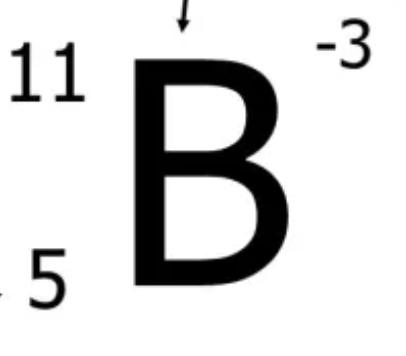
Atomic mass
left superscript representing the mass of an atom in atomic weight units, usually the sum of its protons and neutrons; 11
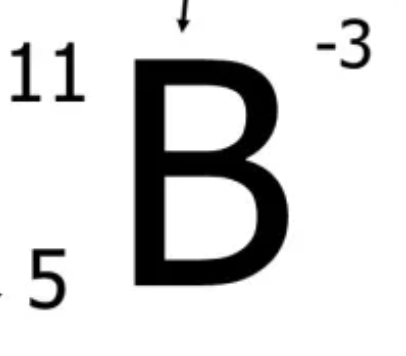
Atomic number
left subindex representing the amount of protons within the atom
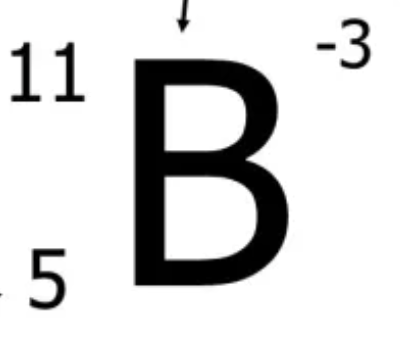
Charge
right superscript representing the charge of an ion, or the difference between its protons and electrons; -3