SOAP Exam, Preliminary Testing, and Visual Acuity Review
 Call Kai
 Learn
Learn Practice Test
 Spaced Repetition
 Match
Match Flashcards
 Knowt Play
1/48

Earn XP
Description and Tags
Flashcards covering the SOAP exam structure, preliminary testing procedures, clinical hygiene protocols, and visual acuity measurement rules from the Clinical Foundations I lecture.
Name | Mastery | Learn | Test | Matching | Spaced | Call with Kai | Chat |
|---|
No analytics yet
Send a link to your students to track their progress
49 Terms
What does the acronym SOAP stand for in optometric clinical documentation?
Subjective, Objective, Assessment, and Plan.
What information is included in the Subjective section of a SOAP exam?
The patient's observations, chief complaint(s) and symptoms (frequency, location, onset, association, duration, and severity), ocular history, medical history, family ocular/medical history, and social history.
What clinical elements belong in the Objective section of a SOAP record?
The clinician's observations and tests, including vision, refraction, visual acuity, muscle balance, pupils, motility, confrontation fields/gross perimetry, external/internal eye exams, and supplementary tests.
What is the primary function of the Assessment section in SOAP documentation?
It synthesizes subjective and objective data to express the clinician's understanding of the problem, its severity, and its change or stability into diagnoses.
What must be detailed in the Plan section of a SOAP exam?
The clinician's goals, actions, advice, interventions with rationale, referrals, additional tests or procedures, patient education, and follow-up/return visit timing.
Into what three basic categories is the Assessment broken down for a comprehensive ocular exam?
1) Refractive, 2) Functional (binocular/accommodative), and 3) Health.
Why must terminology in the Assessment match ICD-10 codes?
To maintain standardized diagnostic coding. For example, clinicians must use standard medical terms like Myopia instead of near-sightedness and Hyperopia instead of far-sightedness.
How is the primary diagnosis selected in the Assessment section?
The first diagnosis is based on the chief complaint or reason for visit, unless a clinically significant condition such as diabetes or retinal hemorrhage takes precedence.
How must the Plan section correspond to the Assessment section?
The Plan must follow the Assessment in exact order, addressing every significant diagnostic point identified in the Assessment.
What three major areas must be addressed to maintain examination hygiene in a clinical setting?
1) Clean workspace and floors, 2) Disinfected equipment (wiping patient-contact surfaces with disinfectant/alcohol before use), and 3) Clinician hygiene (clean coat/scrubs and handwashing).
According to clinic protocol, when must a clinician wash their hands during an encounter?
Hands must be washed before any testing is performed on the patient.
What is preliminary testing (also known as entrance tests) in an optometric exam?
A series of 8 to 12 low-cost, non-sophisticated screening procedures performed immediately after patient history to assess vision, health, and functional systems.
What is the clinical purpose of preliminary entrance testing?
To quickly evaluate health, visual acuity, and functional vision systems, establishing baseline data and directing the examination toward problem areas.
Why are preliminary tests considered screening tests rather than diagnostic tests?
Because they are screening in nature and require a specific back-up or confirmatory test to verify any abnormal findings.
What level of precision is required when recording preliminary test results?
Findings are estimates made with low-tech tools and should be rounded reasonably, such as recording Near Point of Convergence to the nearest centimeter (e.g., 8.0cm instead of 7.8cm).
When is an Amsler grid used during preliminary testing?
Routinely on patients older than 60 years or on diabetics to screen for macular degeneration/edema, or as a differential test when visual acuity is reduced without improvement by pinhole or refraction.
For which patient populations are stereopsis and amplitude of accommodation routinely indicated?
Stereopsis is tested on children, teens, and young adults with near complaints. Amplitude of Accommodation is tested on children, young adults, near CC patients, and emerging presbyopes in their early 40s.
How does testing in a room that is too dim affect visual acuity testing?
Most patients perform worse on visual acuity tests in a dim room due to enlarged pupil size.
What error can occur if a color vision test is conducted under incandescent lighting?
A patient who has a color vision defect may incorrectly pass the test.
What optical rule defines the construction of a Snellen chart letter?
A Snellen letter subtends an angle of 5 minutes of arc at the eye at the specified test distance (e.g., a 20/20 letter subtends 5 minutes of arc at 20 feet).
What do the Latin abbreviations 'cc' and 'sc' stand for in visual acuity documentation?
'cc' stands for cum correctione (with correction) and 'sc' stands for sine correctione (without correction).
What do the optometric abbreviations OD, OS, and OU represent?
OD = oculus dexter (right eye), OS = oculus sinister (left eye), OU = oculus uterque (both eyes).
In a visual acuity fraction such as 20/40, what do the numerator and denominator signify?
The numerator represents the actual test distance, and the denominator represents the letter size (the distance at which a normal eye resolves that letter).
If a patient reads the 20/40 line at a test distance of 10 feet, how should the visual acuity be recorded?
10/40
Why does an exam lane shorter than 12 feet without a mirror induce accommodation?
At distances shorter than 12 feet, the eye accommodates at least 0.25D regardless of chart calibration.
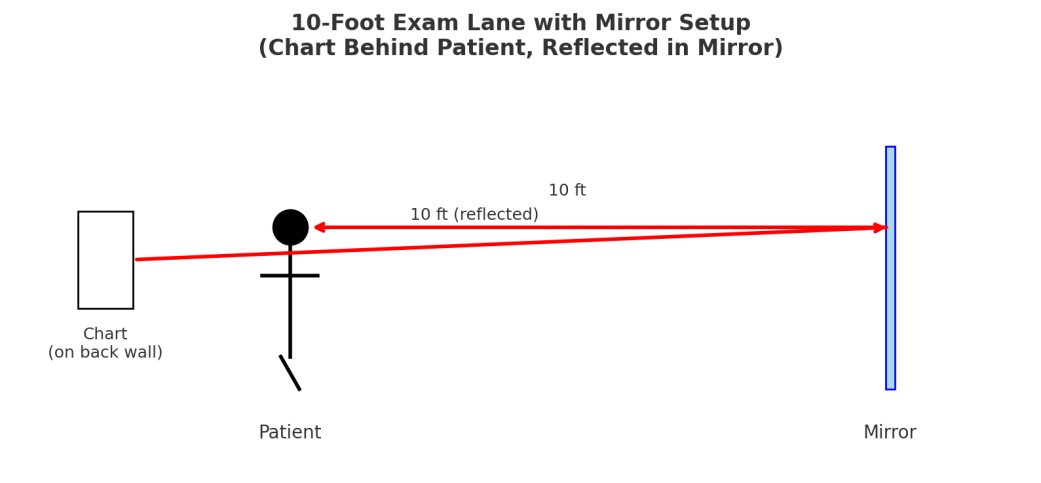
How does a 10-foot exam lane with a mirror achieve a standard 20-foot optical testing distance?
The patient views a mirror 10 feet away that reflects a chart on the wall behind them (10 feet away), giving a combined optical path of 20 feet (10ft direct + 10ft reflected).
What are the structural features of a LogMAR visual acuity chart?
It features an equal number of letters per line (usually 5), regular spacing between lines and letters, and a uniform logarithmic progression in letter size.
What is the stopping criterion when administering a LogMAR visual acuity test?
Have the patient read until they incorrectly identify at least 4 out of the 5 letters on a given line.
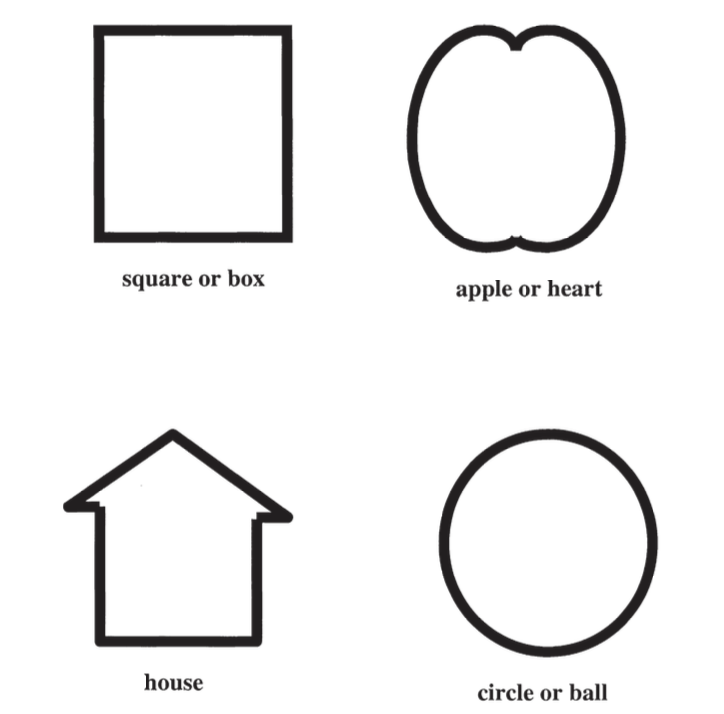
What four standardized shapes are used on the LEA Symbols chart?
House, square (or box), circle (or ball), and apple (or heart).
By definition, what angular subtense does a 1.0M letter subtend at a 1-meter distance?
A 1.0M letter subtends 5 minutes of arc at a distance of 1 meter.
What formula converts near M-unit acuity at a known test distance into a Snellen 20/x fraction?
M unittest distance=size of Snellen letter20ft
If a patient reads 2M print at a distance of 50 cm (0.50 m), what is their Snellen visual acuity equivalent?
20/80 (calculated via 2M0.50m=x20⟹0.25=x20⟹x=80).
What is the single exception where entrance visual acuity is NOT measured first in an eye exam?
A chemical burn or chemical splash to the eye, which requires immediate irrigation before measuring visual acuity.
When must uncorrected (unaided) visual acuity (sc) be tested?
For all new patients (baseline/insurance requirement), trauma or red eye presentations, and civil service occupational evaluations (e.g., police, military, FAA, DOT).
What is the standard eye sequence for VA testing, and how should an occluder paddle be held?
Test OD first, then OS, then OU. The occluder paddle must rest lightly against the brow toward the nose to avoid side-viewing or cornea-distorting pressure.
When testing Snellen visual acuity, when should you stop the patient from reading further?
Stop the patient when more than half of the letters on a line have been missed.
At what visual acuity threshold is pinhole (PH) testing indicated, and what is its purpose?
Indicated when distance visual acuity is 20/40 or worse. It determines whether vision loss is due to a refractive error or a pathological condition.
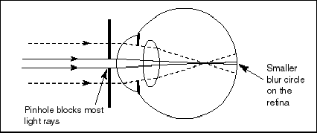
How does a pinhole occluder improve visual acuity in eyes with refractive error?
It blocks peripheral light rays and increases the depth of focus to infinity, producing a smaller blur circle on the retina.
What does the clinical recording 'PHNI' stand for?
Pinhole No Improvement, indicating that the reduced vision is likely caused by disease/pathology rather than an uncorrected refractive error.
What is the hierarchy of low vision testing methods when acuity cannot be read on a chart and is worse than 20/400?
Counting Fingers (CF) > Hand Motion (HM) > Light Projection (LProj) > Light Perception (LP) > No Light Perception (NLP).
How is legal blindness defined in the United States?
1) Inability to read any letters on the 20/100 line in the better-seeing eye with best correction, OR 2) A visual field diameter of ≤20∘ at its widest.
What lighting and distance parameters are used for near visual acuity testing?
Full room lighting on with the stand light on high pointing at the card from 12 to 18 inches away; the card is held at a standard reading distance of 40cm (16in).
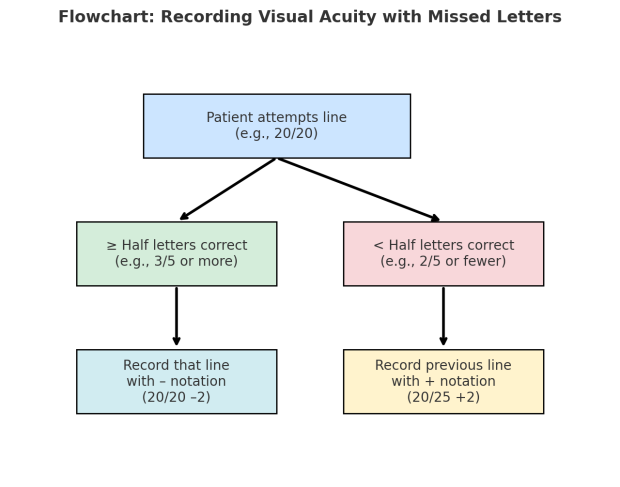
How do you record visual acuity using the Half Line Rule if a patient gets MORE than half the letters on a line correct?
Record that line's Snellen fraction minus the number of letters missed on that line (e.g., 20/30−2).
How do you record visual acuity using the Half Line Rule if a patient gets LESS than half the letters on a line correct?
Record the previous (larger) line's Snellen fraction plus the number of letters read correctly on the smaller line (e.g., 20/25+2).
What are the expected best corrected visual acuity ranges for pre-school children versus teenagers and adults up to age 50?
Pre-school children: ~20/30 to 20/50; Teenagers to 50-year-old adults: ~20/15 to 20/20.
What uncorrected visual acuity pattern is expected in an uncorrected myopic patient?
Poor distance vision and good near vision.
According to the Quarter Rule, how much visual acuity does an uncorrected myope lose per quarter diopter of refractive error?
An uncorrected myope loses approximately 1 line of distance visual acuity per 0.25D of uncorrected myopia starting from 20/20.
According to the Cylinder Rule, how much vision is lost per diopter of astigmatism, and which axis orientation loses more vision?
A patient loses approximately 1 line of visual acuity per 1.00DC of uncorrected cylinder; With-the-rule (x180) astigmatism loses more vision than Against-the-rule (x090).
At what best corrected visual acuity is a patient considered visually handicapped, and what chart distance is used in low vision evaluations?
When best corrected vision falls below 20/70; logarithmic low vision charts (e.g., Colenbrander or Feinbloom) are typically presented at 1 meter.