Bones of the Appendicular skeleton
 Call Kai
 Learn
Learn Practice Test
 Spaced Repetition
 Match
Match Flashcards
 Knowt Play
1/79

There's no tags or description
Looks like no tags are added yet.
Name | Mastery | Learn | Test | Matching | Spaced | Call with Kai | Chat |
|---|
No analytics yet
Send a link to your students to track their progress
80 Terms
what are the two types of bone formation?
1. endochondral ossification
2. intramembranous
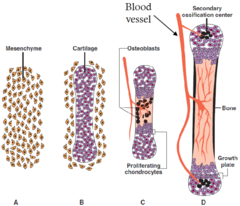
What is endochondral ossification?
mesoderm --> hyaline cartilage model --> bone
Mesenchyme is replaced with cartilage (chondroplast cells). The cartilage framework is then replaced with bone.

How many ossification centers are there during ossification?
there is one primary ossification center and the rest are secondary.
What is the nutrient foramen?
a small opening in the shaft of a bone that allows blood vessels to supply nutrients and aid in the growth of the bone. It is the main source of nutrients for long bones.

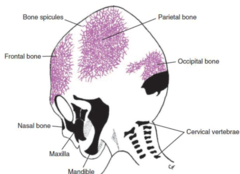
What is intramembranous ossification?
The mesoderm bypasses the cartilaginous stage and directly forms the bone (this is present in the flat bones of the skull)
What are the parts of a long bone?
Proximal/distal epiphysis, proximal/distal metaphysis, diaphysis, and physis
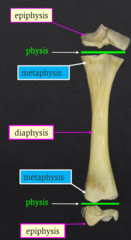
What is the metaphysis?
the wide, rapidly growing ends of the diaphysis. It is between the diaphysis and the physis

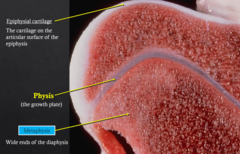
what is the physis?
a plate of growing cartilage that separates the shaft (metaphysis) from the epiphysis. At maturity, the physeal cartilage ceases to grow.
What is epiphyseal cartilage?
the cartilage on the articular surface of the epiphysis. This cartilage remains even into adulthood.
What is an ununited anconeal process (UAP)?
the failure of fusion of the anconeal process with the ulna after 5 months of age.

what is the function of the thoracic limb?
support
What bones make up the thoracic limb?
scapula, humerus, radius and ulna, manus
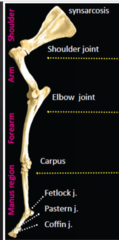
True/false- the thoracic limb has a bony connection to the axial skeleton
FALSE- there is no bony articulation with the axial skeleton (AKA synsarcosis = attached by muscles)
what bones make up the pectoral/thoracic girdle?
Scapula and clavicle
What is the function of the pelvic limb?
Propulsion
What bones make up the pelvic limb?
os coxae, femur, tibia and fibula, pes

true/false- the pelvic limb has bony attachment to the axial skeleton
TRUE- it connects to the axial skeleton through the sacroiliac joint
What bones make up the pelvic girdle?
ossa coxarum + sacrum + first coccygeal vertebra
What are the four regions of the thoracic limb?
1. scapular region
2. brachium
3. antebrachium
4. manus
What makes up the scapular region of the thoracic limb?
the scapula

what makes up the brachium in the thoracic limb?
the humerus

What makes up the antebrachium in the thoracic limb?
radius and ulna
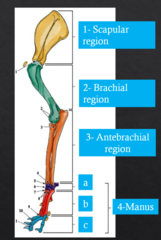
what makes up the manus of the thoracic limb?
carpal, metacarpal, and phalangeal regions
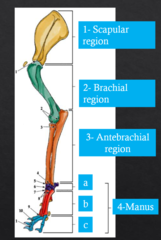
What is sweeny?
The muscles covering the scapula will atrophy and the spine of the scapula will be visible.
in horses?
True/false- cats have clavicles
True- they can often be mistaken for a bone in the esophagus on lateral radiographs
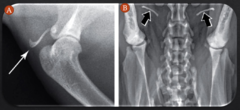
what is the clavicle like in the dog?
it is represented by fibrous clavicular intersection in the brachiocephalicus muscle
The head of the humerus is involved in what joint?
it articulates with the glenoid cavity to form the shoulder j.
What is the function of the deltoid tuberosity?
attachment site for the deltoideus M.
the humeral condyle is involved in what joint?
it articulates with the radius and ulna to form the elbow j.
What structure is present on the humerus of the dog only?
the supratrochlear foramen
What passes through the supratrochlear foramen?
NOTHING
What structure is present on the humerus of the cat only?
supracondylar foramen
What passes through the supracondylar foramen?
brachial A. and median N.
The head of the radius in involved in what joint?
it articulates with the humerus to form the elbow j.
The distal extremity of the radius is involved in what joint?
it articulates with the carpal bones and ulna (in carnivores) to form the antebrachiocarpal j.
What is the purpose of the three cranial grooves on the radius?
they are for extensor tendons

true/false- the ulna is weight-bearing
FALSE- it just serves for muscle attachment and formation of the elbow and carpal joints
true/false- animals with a fused radius and ulna are unable to supinate/pronate
TRUE- the radius and ulna must be unfused for them to be able to supinate/pronate
How many interosseous spaces are present in the fused horse radius/ulna?
ONE- proximal interosseous space

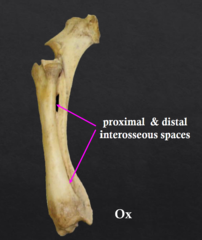
how may interosseous spaces are present in the fused ox radius and ulna?
TWO- proximal and distal interosseous spaces
How many carpal bones are there and how are they arranged?
seven arranged into two rows (proximal and distal)

What is the only carpal bone that has muscle attachment?
the accessory carpal bone
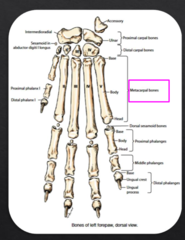
how is the distal row of carpals counted?
from medial to lateral

How are the metacarpals counted?
medial to lateral

How many phalanges does each digit have?
3 (except for the first digit which only has the first and third)
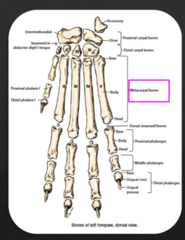
How many sesamoid bones are there in the dog manus?
at the metacarpophalangeal j. there are three: 1 dorsal and 2 palmar (except the first digit only has 2: one palmar and one dorsal)

What digits are weight-bearing in the dog?
4: Mc 2, 3, 4, and 5

What digits are weight-bearing in the pig?
2: Mc 3 and 4

How many digits are weight-bearing in the ox?
2: Mc 3 and 4 (fused to form the cannon bone)
5 are reduced
sesamoid bones dew claws behind fetlock

How many digits in the horse are weight-bearing?
1: Mc 3 (cannon bone)
2,4 reduced as splint bones
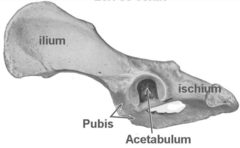
What bones make up the os coxae?
ilium, ischium, pubis, and acetabulum
unite around the acetabulum
The head of the femur is involved in what joint?
it articulates with the acetabulum to form the hip j.
The ilium is involved in what joint?
The auricular surface of the ilium articulates with the sacrum to form the sacroiliac j.
The condyles of the femur are involved in what joint?
The femoral condyles articulate with the tibial condyles to form the stifle j.
true/false- the fibula is weight-bearing
FALSE- the tibia is weight-bearing
How many tarsal bones are present in the dog and how are they arranged?
7 bones in three rows- two proximal, one in the middle row, and four in the distal row
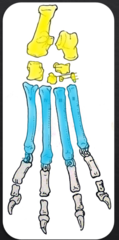
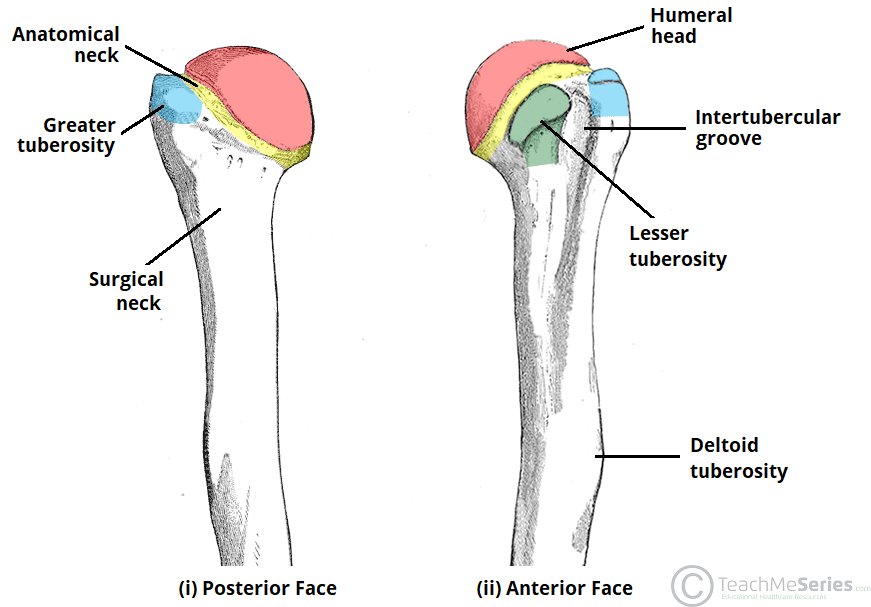
Species differences in the Greater tubercle of the humerus
lateral, next to head & point of shoulder
OX - BIG overhang groove, very (most) prominent
Horse - smaller than ox

Deltoid tuberosity in Horses/Ox
More prominent than in the cat/dog

Equine ulna
Rudimentary
medial styloid process
In Radius
medial styloid process is the most distal part (tip)
(lateral) styloid process
In ulna
Obturator foramen
large opening bounded by pubis and ischium. has muscles in real life.
Pelvic symphysis
joint between right and left os coxae halves.
Comrpised of pubic symphysis + ischial symphysis
ilium
most cranial, comprised of wing and body/shaft
Has a auricular surface
ear shaped, articulates with sacrum/sacroiliac joint
Ischium - caudal part of hip bone
ischial tuber = caudal most part of pelvic symphysis
Has 2 depressions
greater trochanter
VERY LARGE, proximolateral extremity

Third trochanter
In Horses and Dogs
Very prominent in Horses, tiny in dogs
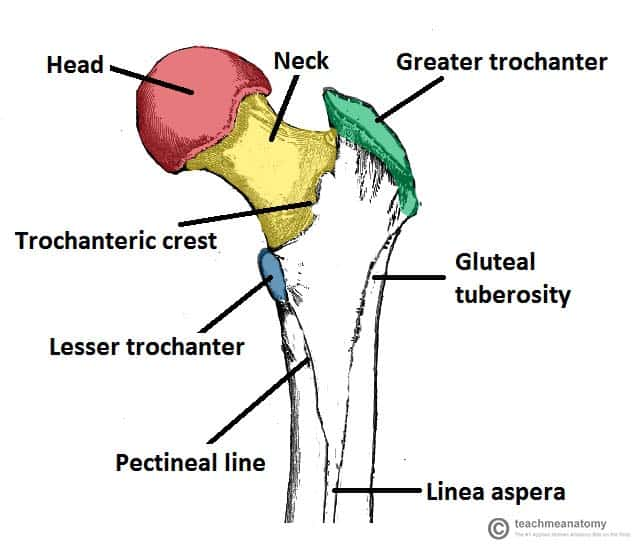
What is the censored structure?
Femoral / gluteal tuberosity
tibial tuberosity
cranial projection for patellar ligament
cochlea
distal articular surface
medial malleolus
non articular, sharp prominence
flat head
articulates with lateral tibial condyle
Fibula body - complete in carnivores
lateral malleolus
distal projection
Tibia + Fibula comparative: Horses
fused fibula, rudiment seen proximally
Tibia + Fibula comparative : Ox
absent fibula, head and distal remnant seen
distal remnant named MALEOLAR BONE
Tarsus
Arranged in 2.5 or 3 rows
7 bones. 2 proximal, 1, 4 distal
calcaneus is lateral
Metatarsus
4 bones
RUMINANTS
cannon bone = 3+4 fused. MT 5 absent unlike MC 5
instead MT 2 is present and called METATARSAL SESAMOID BONE (medial)
Distal interphalangeal joint name in horses
Coffin bone