Psych Exam 1
 Call Kai
 Learn
Learn Practice Test
 Spaced Repetition
 Match
Match Flashcards
 Knowt Play
1/111

There's no tags or description
Looks like no tags are added yet.
Name | Mastery | Learn | Test | Matching | Spaced | Call with Kai | Chat |
|---|
No analytics yet
Send a link to your students to track their progress
112 Terms
Behaviorism
The study of only observable behavior shaped by our environment (hugs, kisses, smiles) a figure associated with this is Watson Skinner. Real world examples: exposure therapy
Structuralism
Breaking down experiences into basic parts - reporting the sweetness, texture, and bitterness of a piece of chocolate. Wundt, Tichener.
Functionalism
How mental processes help us adapt and survive (William James) Ex: asking what the purpose of eating an apple is to survive
Psychodynamic
Unconscious drives and childhood (overlapping of past and present). Sigmund, Freud
Social-cultural perspective
Influence of our culture and society (independence vs interdependence) ex. putting family first
Evolutionary perspective
Traits passed down for survival. ex) why do we fear snakes more than electric outlets?
Neuroscience/ Biological perspective
How the brain and body create emotions and memories.
Critical Thinking
Examining assumptions, assessing a source, and uncovering hidden values in claims
Scientific Skepticism
Demanding evidence, testing beliefs for reliability
Overconfidence
Thinking we know more than we do
Hindsight bias
Believing after learning an outcome that we could have predicted it
Perceiving patterns/order in random events
The cognitive tendency to seek order, structure, or meaningful connections in random sequences (e.g., seeing faces in clouds or assuming a coin-flip streak has a cause).
Case studies
Examining one group or individual in depth
Naturalistic Observation
Examining responses in people’s natural environments without interference
Surveys
A research technique used to collect self-reported attitudes, opinions, or behaviors of a specific population by questioning a representative, random sample. (Asking people questions)
Correlational research
Measure of which two factors vary together and how well these factors predict each other
Manipulated variables
Independent variables (experimental group)
Affected variables
Dependent variables (control group)
Random assignment
A procedure that places participants into groups by chance, ensuring each person has an equal likelihood of being in any condition
Why experiments can help researchers determine cause and effect
Experiments control variables and use random assignment, allowing researchers to isolate the effect of the independent variable and establish causal relationships
Why correlation does not necessarily establish causation
Correlation only shows that two variables are related; it cannot rule out third variables or coincidences
Operational definitions
Specific, measurable descriptions of how variables will be observed, manipulated, or measured in a study.
Replication
Repeating a study with new participants or in new settings to see whether the original findings hold.
Why replication is important to science
It confirms reliability, reduces the chance that results were due to error or coincidence, and strengthens scientific confidence in findings.
Neurons
A nerve cell that sends and receives information through electrical and chemical signals
Synapses
Junction between one neurons axon and another’s dendrite/cell body
Neurotransmitter
chemical messengers that pass from one neuron to another to send a signal across the synapse
Hormone
A chemical messenger released by endocrine glands into the bloodstream that affects organs and behavior over longer periods.

Frontal Lobes (directly behind your forehead)
Responsible for speaking and muscle movements, plus making plans and judgement. ____ lobe damage can alter personality, as it did in the famous case of railroad worker Phineas Gage causing him to be irritable (Studies of others with damaged ___ lobes reveal similar losses — they know right from wrong but often don’t care.)
Prefrontal cortex
Enables our forward thinking — our planning, judgment, social interactions, and processing of new memories. People with damage to this area may have high intelligence test scores and great cake-baking skills

Parietal Lobes (the rear of your head)
Receives sensory information for touch and body position. Example: If a stroke or head injury destroyed part of your ___ lobes, you might lose mathematical and spatial reasoning
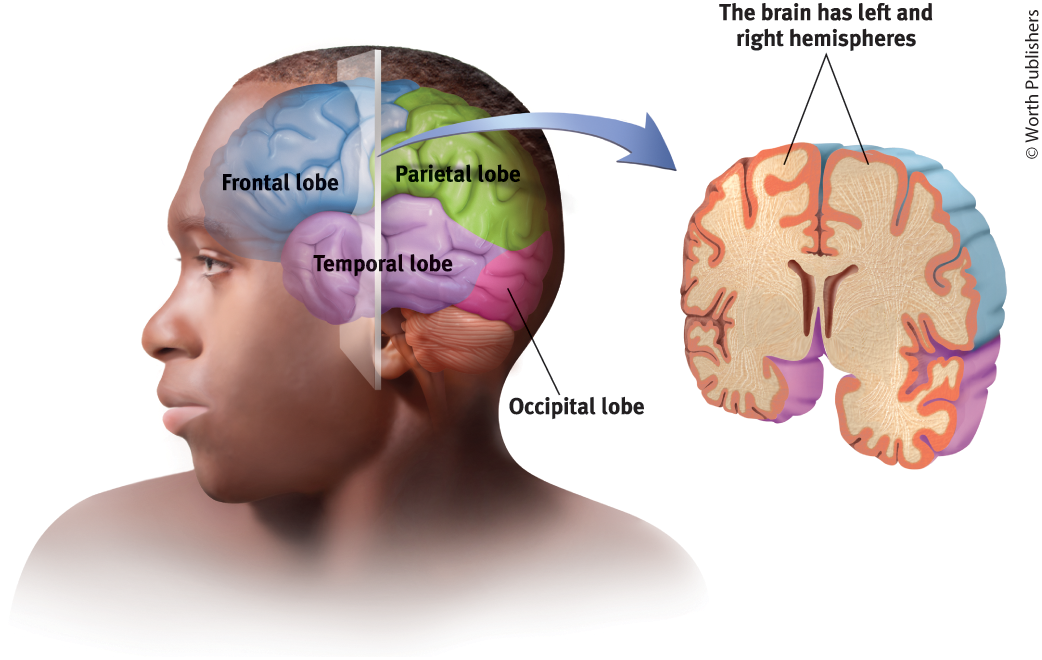
Temporal lobes (sides of your head above each ear)
the portion of the cerebral cortex lying roughly above the ears; includes areas that receive information from the ears.

Occipital (back of your head)
the portion of the cerebral cortex lying at the back of the head; includes areas that receive information from the visual fields

Motor cortex
The ____ cortex controls voluntary body movements. Stimulating one of its specific spots produces movement in the associated body part; damaging that spot produces corresponding paralysis.

Auditory cortex
If you have hearing, any sound you now hear is processed by your temporal lobes ____ cortex (just above your ears). Ex) If stimulated in your auditory cortex, you alone might hear a sound.
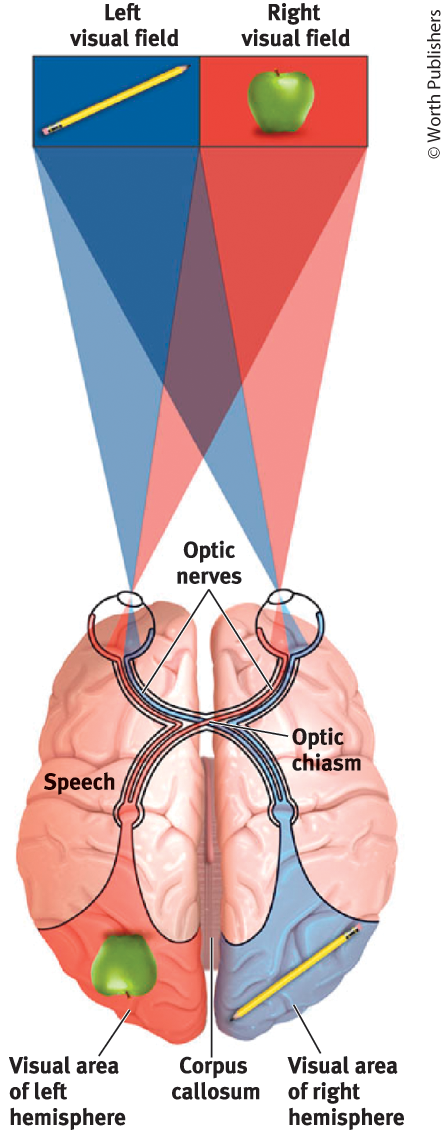
Left Hemisphere
The ___hemisphere is good at making quick, exact interpretations of language. Controls the right side of our bodies. Ex) A ___hemisphere stroke disrupts a deaf person’s signing, much as it disrupts a hearing person’s speaking.

Right Hemisphere
Involved with visual skills, artistic abilities, reasoned conclusions, inferences, and recognizing faces. Controls the left side of our bodies. Ex) If you performed a perceptual task like identifying a car on the road, a brain scan would show increased activity in your __ hemisphere

Contralateral control
Each hemisphere’s motor cortex controls voluntary movement on the opposite side of the body. Example) information from the left half of a person’s field of vision goes to their right hemisphere, and information from the right half of their visual field goes to their left hemisphere.

Amygdala
two almond-shaped neural clusters in the limbic system; linked to emotion, fear, and threat perception. Example) In 1939, researchers surgically removed a rhesus monkeys ____, turning the normally ill-tempered animal into the mellowest of creature
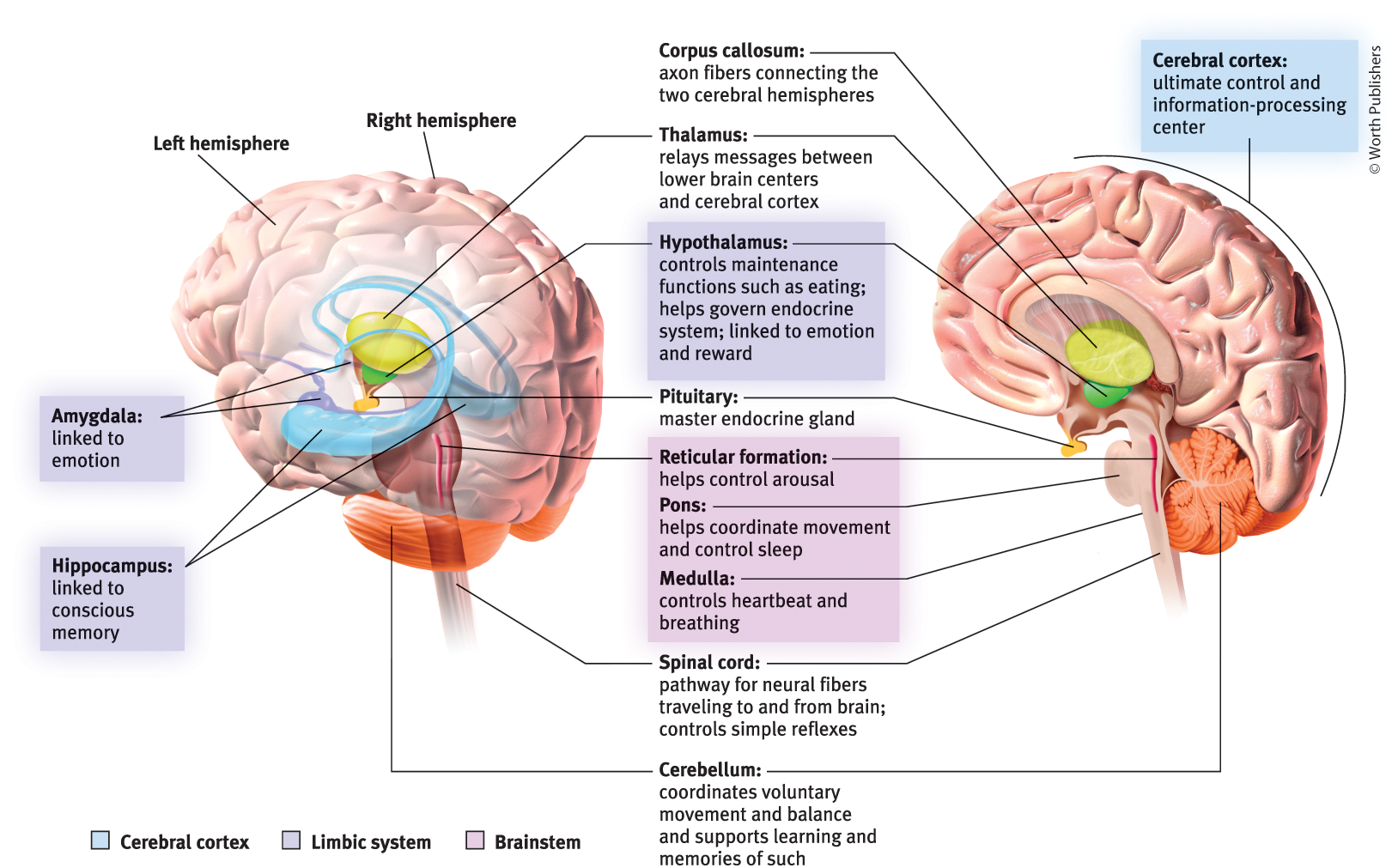
Hippocampus
Linked to conscious memory
REM Sleep
rapid eye movement sleep; a recurring sleep stage during which vivid dreams commonly occur. Also known as paradoxical sleep, because the muscles are relaxed (except for minor twitches) but other body and brain systems are active.
N1 sleep
During this you may experience fantastic images resembling hallucinations. You may have a sensation of falling (when your body may suddenly jerk) or of floating weightlessly.
N2 sleep
After N1, you relax more deeply and begin about 20 minutes of __ sleep. The EEG will show bursts of rapid, rhythmic brain-wave activity.
N3
After N2 you enter the deep sleep of ___. During this slow-wave sleep, which lasts for about 30 minutes, your brain emits large, slow delta waves. You would be hard to awaken
Delta wave sleep
large, slow brain waves associated with deep sleep
Alpha wave sleep/ slow wave
relatively slow brain waves of a relaxed, awake state
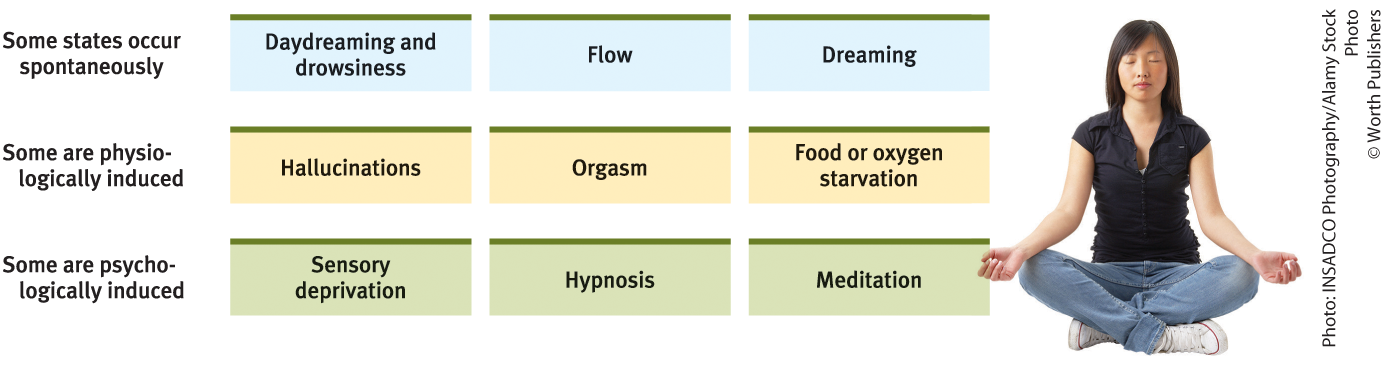
General states of consciousness
meditating, daydreaming, sleeping, hypnosis, and drug-induced hallucinating.
Narcolepsy
a sleep disorder in which a person has uncontrollable sleep attacks, sometimes lapsing directly into REM sleep.
Sleep apnea
a sleep disorder in which a sleeping person repeatedly stops breathing until blood oxygen is so low the person awakens just long enough to draw a breath.
REM sleep behavior disorder
a sleep disorder in which normal REM muscle paralysis malfunctions, and people act out dreams while sleeping, through physical movements (such as kicking or striking out) and vocal behaviors (such as talking or yelling)
Manifest dream content (Freud)
the remembered storyline of a dream
Latent dream content (Freud)
the underlying meaning of a dream, such as unconscious drives and wishes that would be threatened if expressed directly.
Learning
relatively permanent change in behavior that is acquired through experience

Classical conditioning (Ivan Pavlov)
a type of learning in which we link two or more stimuli and anticipate events
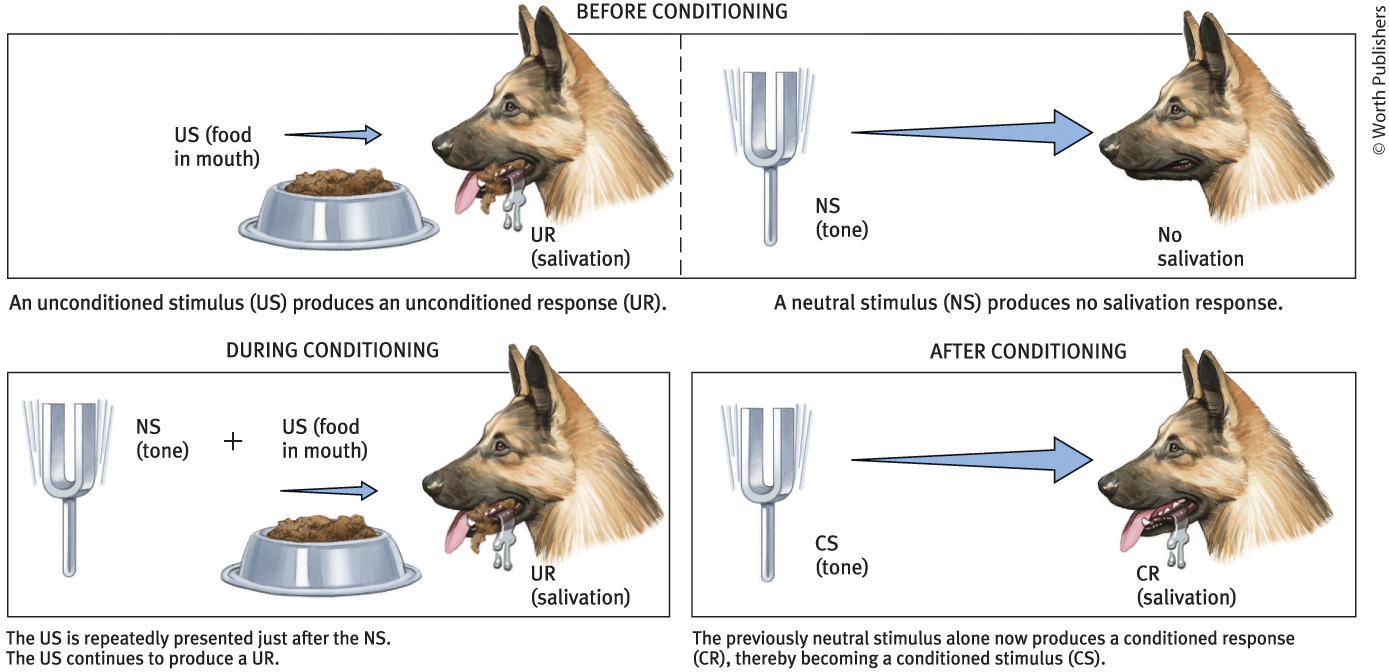
Unconditioned response
in classical conditioning, an unlearned, naturally occurring response (such as salivation) to an unconditioned stimulus (US) (such as food in the mouth).

unconditioned stimulus
in classical conditioning, a stimulus that unconditionally — naturally and automatically — triggers a response (UR)

Neutral stimulus
in classical conditioning, a stimulus that evokes no response before conditioning
Conditioned response
in classical conditioning, a learned response to a previously neutral (but now conditioned) stimulus (CS)

Conditioned stimulus
in classical conditioning, an originally neutral stimulus that, after association with an unconditioned stimulus (US), comes to trigger a conditioned response (CR). Example) stimulus that used to be neutral (in this case, a previously meaningless tone that now triggers drooling) is the ____.
Acquisition
in classical conditioning, the initial stage — when we link a neutral stimulus and an unconditioned stimulus so that the neutral stimulus begins triggering the conditioned response.
Extinction
the weakening of a conditioned response — when an unconditioned stimulus does not follow a conditioned stimulus
Spontaneous recovery
the reappearance, after a pause, of a weakened conditioned response. Example: extinction suppressing a conditioned response rather than eliminating it completely is called ___.
Generalization
to respond similarly to stimuli that resemble the conditioned stimulus
Discrimination
learned ability to distinguish between a conditioned stimulus (which predicts the US) and other irrelevant stimuli.
Why is Pavlov’s research on classical conditioning important?
1. Many other responses to many other stimuli can be classically conditioned in many other creatures (Many other responses to many other stimuli can be classically conditioned in many other creatures). 2. Pavlov showed us how a process such as learning can be studied objectively.
Operant Conditioning (B. F Skinner)
a type of learning in which a behavior becomes more probable if followed by a reinforcer or less probable if followed by a punisher.
Positive reinforcement
increasing behaviors by presenting a pleasurable stimulus, such as food.
Negative reinforcement
strengthens a response by reducing or removing something undesirable or unpleasant. Ex) taking painkillers to end pain, fasten seat belt to end loud beeping
Positive punishment
Punishing by adding (administering) an unpleasant stimulus. Ex) The rat that is shocked after touching a forbidden object
Negative punishment
is punishing by subtracting (taking away) a rewarding stimulus. Ex) A child who has a favorite doll taken away after hitting the dog with it.
Fixed-ratio schedules
Reinforce behavior after a set number of responses. Ex) Coffee shops may reward us with a free coffee after every 10 purchased
Variable-ratio schedules
Provide reinforcers after an unpredictable number of responses. This unpredictable reinforcement is what slot-machine players experience or gambling.
Fixed-interval schedules
Reinforce a response after a fixed time period. Ex) People waiting for an important letter check more often as delivery time approaches.
Variable-interval schedules
reinforcement schedule that reinforces a response at unpredictable time intervals. Example) Longed-for message that finally rewards persistence in rechecking our phone,
Is reinforcement based on responses or time?
In general, response rates are higher when reinforcement is linked to the number of responses (a ratio schedule) rather than to time (an interval schedule).
Is reinforcement predictable or unpredictable?
Responding is more consistent when reinforcement is unpredictable (a variable schedule) than when it is predictable (a fixed schedule).
Cognitive maps
a mental image of the layout of one’s environment. Example) rats exploring a maze, given no obvious rewards, seem to develop a __.
Latent learning
Learning that is acquired without conscious effort or reinforcement and only revealed when it is needed. Example) Children may learn from watching or listening to a parent but demonstrate the learning much later, as needed.
Observational learning
___ is learning by observing others — also called social learning. A child who sees a sibling get burned on a hot stove learns not to touch it is an example of ____.
Model learning
We learn our native languages and other specific behaviors by observing and imitating others, a process called ___.
Memory processing
Encode - getting info from the brain, Store - retaining that info, Retrieval - later getting that info back out.
Sensory memory
the immediate, very brief recording of sensory information in the memory system. (visual, verbal, smell, taste, touch)
Short-term memory
briefly activated memory of a few items (such as digits of a phone number while calling) that is later stored or forgotten
Long-term memory
the relatively permanent and limitless archive of the memory system. Includes knowledge, skills, and experiences

Implicit memories (nondeclarative memories)
retention of learned skills, or classically conditioned associations, without conscious awareness. (Also called nondeclarative memory) formed through automatic processing
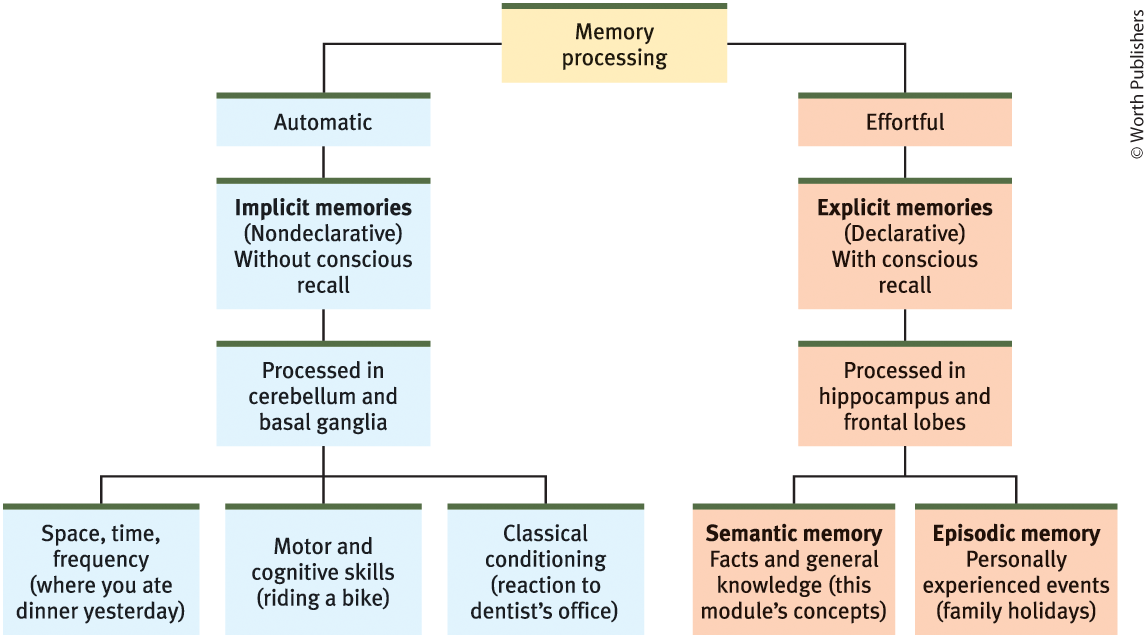
Automatic processing
unconscious encoding of everyday information, such as space, time, and frequency, and of familiar or well-learned information, such as sounds, smells, and word meanings (knowing how)

Explicit memory (declarative memories)
retention of facts and personal events we can consciously retrieve encoded through effortful processing. (knowing that)

Effortful processing
Encoding that requires attention and conscious effort.

Semantic memories (Explicit)
Facts and general knowledge
Episodic memories (Explicit)
Experienced events
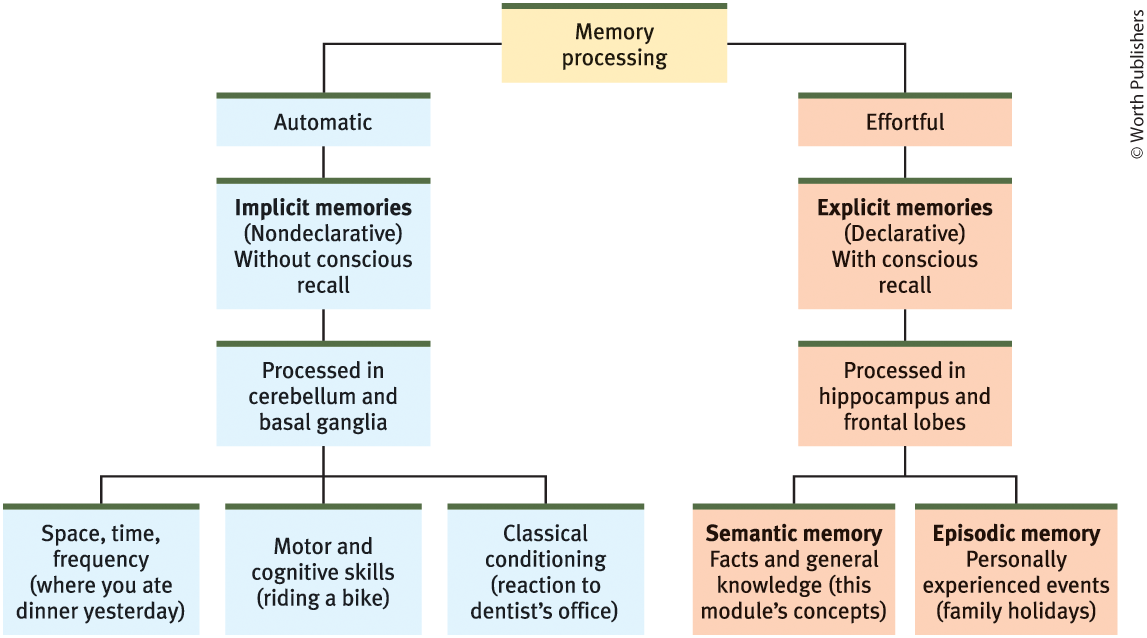
What kinds of information do we tend to encode automatically?
Implicit memories - because we react automatically and without conscious effort. Examples) space - encoding a place on a page where info occurred after reading it, time - your brain jotting down the sequence of your day’s events to recall where you have left something. frequency - recalling seeing someone multiple times throughout a day
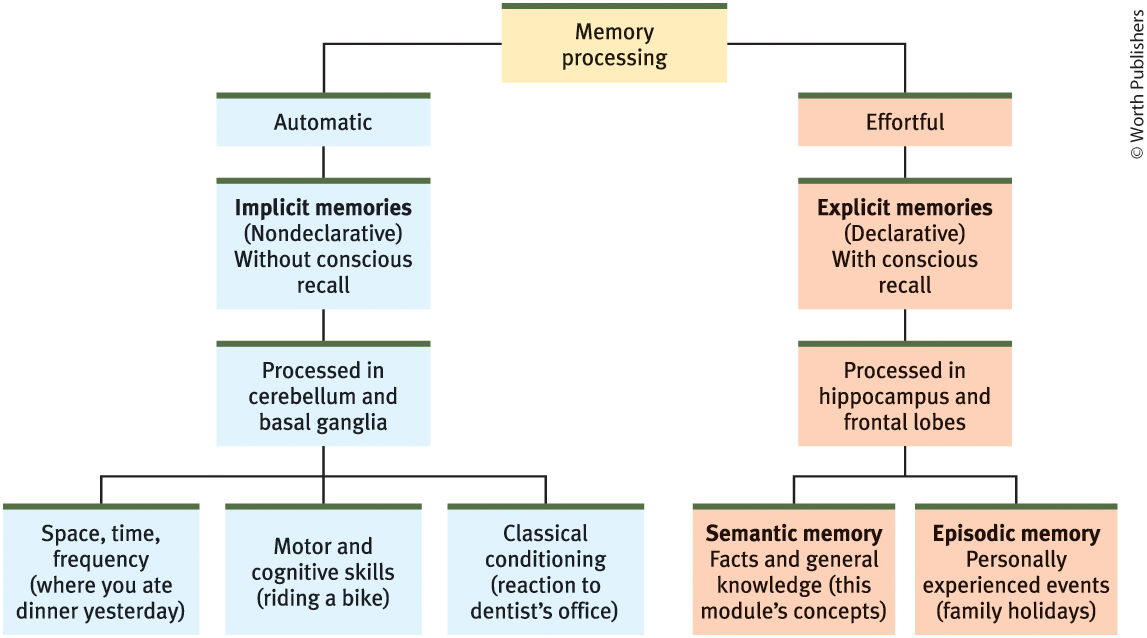
What kind of memories require conscious effort?
Explicit memories - form new explicit memories of a fact or experience by using specific effortful processing strategies, such as chunking and mnemonics.
Spacing effect
the tendency for distributed study or practice to yield better long-term retention than is achieved through massed study or practice. (distributed practicing)
Long-term potential
An increase in a nerve cell’s firing potential after brief, rapid stimulation. LTP is a neural basis for learning and memory
Context-Dependent memory
Putting yourself back in the context where you earlier experienced something can prime your memory retrieval. Our memories are ____-dependent and are affected by the cues we have associated with that context.
State-Dependent Memory
What we learn in one state — be it drunk or sober — may be more easily recalled when we are again in that state.
Mood-congruent memory
the tendency to recall experiences that are consistent with your current good or bad mood. Ex) Study found when teens were down, their parents seemed cruel. As moods brightened, those devil parents became angels.
Encoding failure
Much of what we sense we never notice, and what we fail to encode, we will never remember. Age can affect encoding ability.
Storage Decay
After encoding something well, we may later forget it. “You are already beginning to forget the material you just read.
Proactive Interference
Occurs when an older memory makes it more difficult to remember new information. Ex) If you buy a new combination lock, your well-rehearsed old combination may interfere with your retrieval of the new one