Animal Behavior and Welfare Exam 1
 Call Kai
 Learn
Learn Practice Test
 Spaced Repetition
 Match
Match Flashcards
 Knowt Play
1/176

Earn XP
Description and Tags
Gaab-Kuntzmann Fall 2026
Name | Mastery | Learn | Test | Matching | Spaced | Call with Kai | Chat |
|---|
No analytics yet
Send a link to your students to track their progress
177 Terms
Ethology
Observation and detailed description of behavior of animals, with the objective of finding out how biological mechanisms function
Behavior
Way in which an organism outwardly acts in response to an external or internal stimulus
Charles Darwin
On the Origin of Species
Evolution, basis of biology
Behavior in context of evolution and natural selection
George Romanes
Comparative Psychology
Animal Intelligence anecdotal essay, v anthropomorphic
Comparative Psychology
Animal behavior studied in the lens of human behavior
C. Lloyd Morgan
“Morgan’s Canon” - assume behavior is as simple as possible
Behaviorism
Behaviorism
Assume no higher reasoning until proven
Fixes anthropomorphism of comparative psych, but it assumes no reasoning capacity
Studies behavior independent of mental stage, only input and output
E.L. Thorndike
Comparative psych, v. scientific
Puzzle boxes + operative conditioning
Concluded animals solve puzzles by only trial and error
Operative conditioning
Animal learns that
neutral stimulus requires performing a task
reinforcement effect can be positive or negative
also called instrumental conditioning
Produce specific response as a result of an association with a stimulus that is intrinsically important
“The behavior is the instrument by which the reinforcement is obtained”
B.F. Skinner
“Skinner Boxes” to study operant conditioning
Ivan Pavlov
classical (Pavlovian) conditioning
actual piece of shit
Classical Conditioning
Neutral stimulus provokes biologically important stimulus → reflexive response
Eventually, neutral stimulus causes reflexive response through association
Neutral “conditioned stimulus” is immediately followed by an “unconditioned stimulus” that is important to the animal, resulting in a response.
Stimuli are associated long enough that the conditioned stimulus elicits the response without the unconditioned stimulus
What is the main difference between classical and operative conditioning?
Operative conditioning requires learning a task, classical conditioning does not
Who was one of the first individuals to use animal behavior as a way to better understand human behavior, by comparing subjective experiences and feelings?
George Romanes
Who is best known for utilizing puzzle boxes to conclude that animals learn by trial and error?
E.L. Thorndike
Why is Behaviorism referred to as the “black box” approach to studying behavior?
Because the mind of an animal was considered an empty, unimportant “black box”
Margaret Floy Washburne
1st woman to get psych PhD
“The Animal Mind”, collection of animal behavior research
motor theory of consciousness
Motor Theory of Consciousness
Compromise between behaviorism and consciousness
Karl Von Frisch
Honeybee waggle dance
More complicated thinking than just reactiveness
Konrad Lorenz
Sign stimulus
Fixed action pattern
Sign Stimulus
stimulus that elicits strong immediate behavioral responses
Fixed Action Pattern
Predictable behavior that occurs in response to sign stimulus
Nikolaas Tinbergen
4 Questions to understand behavior
Mechanism
Adaptive Function
Development (Ontogeny)
Evolutionary History (Phylogeny)
Standardized Method
Which of Tinbergen’s 4 Questions addresses HOW a behavior works on a physiological level as the animal is performing the behavior?
Mechanism
Mechanism
What mechanism(s) underly behavior?
What external stimuli elicit behavior?
What neural circuits are involved?
What hormones are involved?
Adaptive Function
How is the behavior useful to the animal today?
Selective advantage?
How does the behavior improve fitness now?
Development (Ontogeny)
How did behavior develop in the life of the animal?
When does the behavior show up?
What experiences shaped the behavior?
Evolutionary History (Phylogeny)
What normal, everyday activities do the behavior stem from?
Why is there a particular response from other animals to this behavior?
Why is the behavior evolutionarily favorable?
Which of the 4 questions is Proximate (how) and historical context?
Development (Ontogeny)
Which of the 4 questions is Ultimate (why) and Current context?
Adaptive Function
Which of the 4 questions is Ultimate (why) and Historical context?
Evolutionary History (Phylogeny)
Observational method of studying behavior
Just watch
Nature, lab, etc
Risk of assuming causation
Experimental method of studying behavior
Controlled for variables
Manipulate specific features
Allows causation assumption
Comparative method of studying behavior
Between species
Use phylogeny to trace how and why behavior exists
Can determine extinct species behavior by comparing to today
Presence/Absence of behavior
Is it happening or not?
Frequency of occurrence of behavior
How often does the behavior happen? Once a day? Once every 3 years? Is it repeated back-to-back?
Duration of activity
How long is the animal performing the behavior before stopping?
Intensity of activity
Are they performing the behavior with intense focus? Can they be easily interrupted?
Timing of behavior, related to other activities
What time of day does the behavior occur? Does it occur related to feeding, socializing, etc?
Latency of occurrence
How long before behavior occurs again, after the last time it happened?
How should you describe behavior?
Be objective, not interpretive
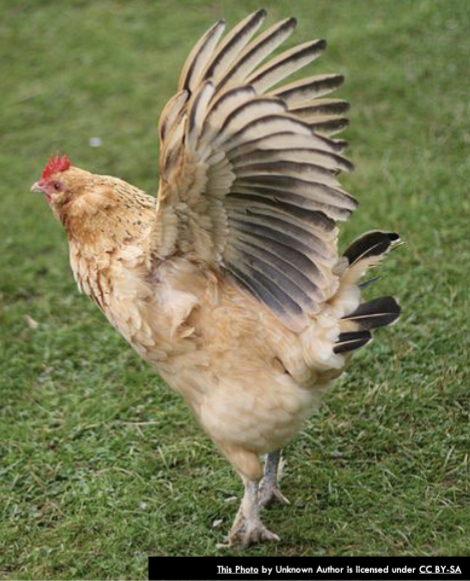
What is the correct way to describe this chicken’s behavior?
“The chicken is standing in place with an elongated neck and body position, with its wings up and its feet on the ground”
Ways to be descriptive
Individual muscle movements
Muscle group movements
Whole limb movements
Parts of body relative to other parts of body
Whole animal movements
Effect on environment
Effect on another individual
Ethogram
A list and description of the types of behaviors performed by particular individuals in a particular environment
State
Long duration with start and stop points
Event
Short duration with less clear start and stop points
Ad-Libitum Behavior Recording
Similar to AL feeding, as much as you can/want
Any behavior you feel is interesting
Good for early research stages
Not great for actual data collection
Behavior-based sampling
Behavior-based sampling
What you record is dependent on the behavior that you are seeing
Conspicuous/Continuous Behavior Recording
Continuous observation, but looking for certain kinds of behaviors and only recording those
Can also be recorded automatically
Used mostly for rare behaviors that may otherwise be missed
Miss other behaviors that may be important
Time-based sampling
What you record is based on timing
Point/Instantaneous/Scan Sampling
Observe @ regular predetermined points in time, recording behavior of interest if in that time
You may miss rare events
You have trouble recognizing behaviors that take a time to be certain of
You can do this when you have many animals and one person
Time-based
Period Occurrence/One-Zero Sampling
Whether or not behaviors were observed within a set time period are recorded as a “yes” or no”
1 if occurred, 0 if not occurred
You don’t miss rare events
You don’t get an accurate representation of the length of duration of each behavior
Must have short time between observation periods
Time-based
Domestication
Where we draw the line between natural selection and artificial selection; necessitates artificial selection
Adapting wild animals and plants to man and to the captive environment for human use by a combo of genetic changes and environmentally induced events, over the course of generations
Goal: to meet human-specific requirements
Can be domesticated for food/fiber, companionship, work
All tend to be more docile than wild counterparts
What is the term for a specific cue, often visual, that triggers a predictable behavioral response?
Sign Stimulus
What is the major difference between “taming” and “domesticating” animals?
Timeline: a lifetime vs. generations
True or false: there is NO proof that animals raised in isolation do any worse as adults than animals that are raised in social situations, and that is simply an anthropomorphic opinion.
False, there IS proof
Artificial Selection
Direct human intervention over what traits are passed down through generations
Taming
Behavioral modification of an individual; requires abolishing fear of humans, by habituation to humans and human-related things.
Doing this to an animal does not override its innate instincts; complicated species still have complicated thought processes and instincts
Feral animals
Captive animals that have escaped or have been placed into the wild
Revert back to wild behaviors and physiologies within relatively few generations
Have little/no dependence on humans
Not all wild animals that have been tamed can/should be released in to the wild
Development of a trait
Genotype + Environment, nature + nurture
A to G substitution in the DA D4 receptor gene results in?
More curious thoroughbreds
Foals fed a high fat/fiber diet were more what than foals fed high starch/sugar diets?
Curious
Heifer calves kept in individual pens over 8 months were what?
Socially Stunted, and calves raised in pairs fare better
(Rhesus Monkey Experiment) Infant monkeys given opportunity to spend times with others had what outcome in comparison to those isolated?
Social monkeys more normal
Sensitive Phase
Time @ which a small amount of experience can have a major effect on the animal’s later behavior
Timeline is behavior-specific
Can appropriate behavior be learned later in life, after the sensitive phase?
Yes, but it is more difficult
Behavioral Genetics
How genetics can influence an individual behavior, often a result of selective breeding and domestication
Individual gene identified as responsible behavior- feline
“A” form of a particular oxytocin receptor allele results in female spayed cat that tends to be more dominant/aggressive
Heritable trait
Passed from parent to offspring
Feline example of heritable trait
The ways in which cats respond to strangers, rats, and aggressive adult cat sounds (defensiveness vs submissiveness) is related to how their parents respond
Feline Genetic example: coat color
Sex-linked female orange cats, black & white cats, and gray & white cats are more frequently aggressive toward humans
Siamese & Tonkinese color patterned cats are more likely to have separation-related issues
Canine example of breed differences: ability to follow human pointing gesture
Border collies > Airedales > Andalusian shepherds
Canine examples of breed differences: Reaction to punishment (“no” + newspaper swat)
Basenjis do not gaf
Beagles listen and correct actions
Canine examples of breed differences: training to sit, heel, and stay/jump on command
Cocker spaniels excelled and learned quickly
Shelties got their leashes tangled
Canine examples in Heritability
Golden retrievers: Aggression highly heritable (0.9)
Police German Shepherds: Hyperactivity and impulsivity are heritable traits that have been traced to variants of the dopamine receptor allele
Equine examples: Breed Differences
Quarter horses are faster learners than Thoroughbreds when learning visual discrimination tasks
Equine examples: Coat differences
Tennessee waling horse: bay mares are more likely to exhibit separation anxiety vs black mares
Beef cattle breed differences
Angus more likely than Simmental to show maternal protectiveness
Cattle Hair Whorls
Cattle w/lower facial hair whorls calmer than those with whorls located higher on the face
Savaging in Sows
Attacking their own piglets; thought to be highly heritable
Breed differences in pigs
Yorkshires more aggressive than Berkshires
Male Hampshires assert more dominance over females than male durocs
Landrace ad more likely to have low libido
Breed differences in Sheep
Forest breeds are more likely to stay close together than mountain breeds
Merino sheep more likely to abandon a twin than Dorsets or Romneys
Tunis known to be uniquely calm and docile
Cognition
The mechanisms by which animals acquire, process, store, and act on info from the environment
Includes perception, learning and memory, decision making, navigation, communication, language, and reasoning
Is cognitive ability the same for every individual?
No, animals have different sensory and physical capabilities and different ways in which they process info
Umwelt
The specific way in which an animal experiences and interacts with their environment; highly individualistic
Cognitive Abilities
Increase with time and expertise; not always clear what is intentional vs innate, stimuli can also affect and alter components of the behavior
Cognitive representation of objects
Picture objects without the object being explicitly in front of them
Object permanence
Understanding that objects still exist when out of sight
Copying actions
Learning by observation requires significant level of cognitive ability, depends on action being copied and physical capability
Detour paradigm
Modifying information about the location of a resource in able to obtain it, like going around a fence or wall to get food
Other cognitive ability examples
Mirror, self, and object recognition
Time estimation/delayed gratification
Metacognition
To know what you do know and be aware that there are things that you dont know
Does brain size = Brain function?
No, brain : body weight ratio is the most important
it’s about what you need to do with your brain, larger brains are energy expensive
Brain Function vs. Anatomy
Different parts of the brain express complex analytical functions.
Some mammals: high lv. analysis in Cortex
Birds: comparable lv. of analysis in Striatum
Fish: Same basic function, but in different places, and have some structures that do not exist in mammals
Memory
The ability to store, retain, and retrieve learned information over time
Short-term memory
Seconds-minutes in animals
Long-term memory
Anything longer than seconds-minutes
Learning
A change in the brain, which results in behavior being modified for longer than a few seconds, as a consequence of info from outside the brain
Reinforcement of behavior
Perpetuating, or encouraging it to continue
Punishment of behavior
Reducing, or encouraging it to disappear