PYSCH Ch. 3 (Sensation and Perception Vocabulary Flashcards)
 Call Kai
 Learn
Learn Practice Test
 Spaced Repetition
 Match
Match Flashcards
 Knowt Play
1/41

Earn XP
Description and Tags
Vocabulary flashcards generated from lecture notes on Sensation and Perception (Chapter 3), covering foundational terms, theories, and visual systems.
Name | Mastery | Learn | Test | Matching | Spaced | Call with Kai | Chat |
|---|
No analytics yet
Send a link to your students to track their progress
42 Terms
Sensation
The process of receiving stimulus energies from the external environment and turning external stimuli into neural signals.
Perception
The process of organizing and interpreting sensory information.
Bottom-Up Processing
Processing that is initiated by sensory input, representing the outside world's influence on perception.
Top-Down Processing
Processing that is initiated by cognitive processing, representing the internal or mental world's influence on perception through expectations and prior understanding.
Sensory Receptors
Specialized cells that selectively detect and transmit sensory information to the brain via distinct neural pathways.
Synesthesia
A condition in which one sense induces an experience in another sense, such as lexical or grapheme synesthesia.
Absolute Threshold
The minimum amount of stimulus energy an organism can detect 50% of the time.
Difference Threshold
The degree of stimulus change necessary for detection, also known as the Just Noticeable Difference (JND).
Signal Detection Theory
An approach to perception focusing on decision-making about signals under uncertainty, involving information acquisition and criterion.
Hit
A correct outcome in signal detection theory where a signal is present and the observer responds "Yes, I see it".
Miss
An incorrect outcome in signal detection theory where a signal is present but the observer responds "No, I don't see it".
False Alarm
An incorrect outcome in signal detection theory where a signal is absent but the observer responds "Yes, I see it".
Correct Rejection
A correct outcome in signal detection theory where a signal is absent and the observer responds "No, I don't see it".
Attention
Focusing awareness on a narrowed aspect of the environment.
Cocktail Party Phenomenon
An example of selective attention where an individual focuses on a single conversation amidst a noisy environment.
Perceptual Set
A predisposition or readiness to perceive something in a particular way, driven by top-down processing.
Sensory Adaptation
A change in the responsiveness of the sensory system based on the level of surrounding stimulation.
Wavelength
The distance between peaks of a light wave, which is perceived as hue or color.
Amplitude
The height of a light wave, which is perceived as brightness.
Purity
The mixture of wavelengths in light, which is perceived as saturation.
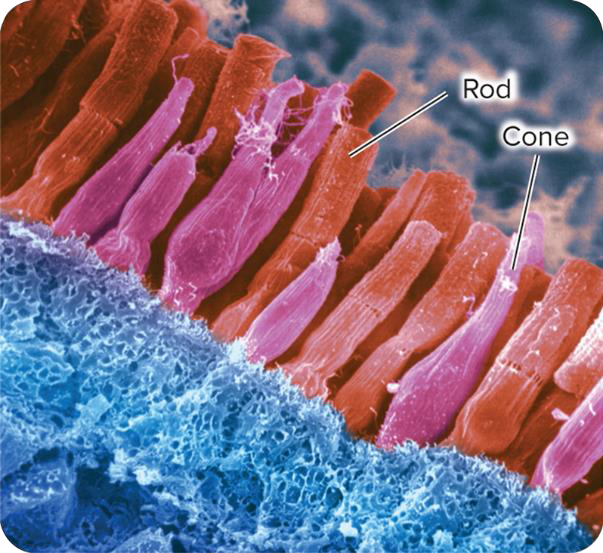
Rods
Photoreceptor cells in the retina that are sensitive to dim light, do not respond to color, function well in low illumination, and number approximately 120 million in humans.
Cones
Photoreceptor cells in the retina that respond to color, operate best under high illumination, and number approximately 6 million in humans.
Fovea
A tiny region in the center of the retina densely populated with cones that is vital to many visual tasks.
Blind Spot
The area on the retina where the optic nerve leaves the eyeball, containing no photoreceptors.
Optic Chiasm
The location in the visual processing pathway where optic nerve fibers divide.
Feature Detectors
Highly specialized cells in the visual cortex that respond to specific features of a stimulus, such as size, shape, color, movement, or combinations of these.
Parallel Processing
The simultaneous distribution of sensory information across different neural pathways to process who, what, and where at the same time.
Binding
The bringing together and integration of various neural signals into a coherent perceptual experience.

Dorsal Visual Stream
A visual pathway connected to the parietal lobe that determines spatial perception ("Where is it?").
Ventral Visual Stream
A visual pathway connected to the temporal lobe that determines visual pattern recognition ("What is it?").
Prosopagnosia
A specific type of visual agnosia characterized by the failure to recognize faces.
Trichromatic Theory
A theory of color vision stating that color perception is produced by three types of cone receptors sensitive to green, blue, and red.
Gestalt Psychology
A perspective in psychology holding that perceptions are naturally organized according to certain patterns, and that the whole is different from the sum of its parts.
Figure-Ground Relationship
A Gestalt principle describing the organization of the visual field into a main focal object (figure) and the surrounding environment (ground).
Closure
A Gestalt principle stating that individuals tend to fill in gaps to perceive a complete figure.
Proximity
A Gestalt principle stating that objects located physically close to one another are perceived as a group.
Similarity
A Gestalt principle stating that elements sharing similar visual attributes are perceived as belonging together.
Binocular Cues
Visual depth cues that require the combined use of both eyes, including disparity and convergence.
Disparity
A binocular depth cue based on the difference between the visual images projected onto each eye.
Convergence
A binocular depth cue based on feedback from eye muscle movements when focusing on nearby objects.
Monocular Cues
Depth cues available to either eye alone, including familiar size, height in field, overlap, shading, and texture gradients.
Perceptual Constancies
The recognition that objects remain physically unchanged in size, shape, and color despite changes in vantage point and viewing conditions.