Foundations of STR
 Call Kai
 Learn
Learn Practice Test
 Spaced Repetition
 Match
Match Flashcards
 Knowt Play
1/45

There's no tags or description
Looks like no tags are added yet.
Name | Mastery | Learn | Test | Matching | Spaced | Call with Kai | Chat |
|---|
No analytics yet
Send a link to your students to track their progress
46 Terms
Vocabulary / Vocabulary Development
the ability to effectively know and use words in their listening, speaking, reading, and writing
Instructional Interventions
additional focus on a specific skill in an effort to improve it
Example
A class struggles with focus, so the teacher incorporates more movement breaks into the daily lesson plan.
Reading Comprehension
the ability to read a text and understand its meaning
Example
Jessie read the book and was able to explain to me why the character lied in Chapter 3.
Asset / Strength-Based Approach
an educational approach, which builds learning around a student's strengths and existing knowledge, rather than focusing on what they lack
Example
When using an asset-based approach, teachers need to get to know students well to identify each child's academic assets and build on those strengths.
Complexity (Text Selection)
the level of difficulty appropriate for students on any given assignment
Example
the first assignment of the year for students of unknown reading ability might be of low complexity
Syntax
rules that govern the construction of words in order to make phrases, clauses, and sentences
Dysgraphia
language-based disorder, in which one struggles with the mechanics of writing resulting in impaired or illegible handwriting
Example
Messy handwriting (due to issues such as poor formation of letters, improper size, spacing between letters or words, or slant of words) is the main sign of dysgraphia.
Alphabetic Principle
the understanding that there is a logical/systematic relationship between the sounds of spoken English and the letters and letter–patterns of written English
Environmental Print
the print students encounter in their everyday surroundings
Example
signs, logos, labels
Phonemic Awareness / Sound Awareness
the ability to hear, identify, and re-create individual sounds in spoken words
Example
A student can hear that /b/ makes first sound in the word blue.
Dyslexia
a disorder manifested by a difficulty in learning to read, write, or spell, despite conventional instruction, adequate intelligence, and sociocultural opportunity
Cultural Sensitivity
the awareness, understanding, and respect for cultural differences, norms, and values, allowing individuals to effectively navigate and interact with diverse cultural contexts while minimizing misunderstandings and promoting inclusivity
Culturally Responsive Teaching
teaching that recognizes students' cultural references
Example
using culturally familiar examples to explain new concepts
Tiers of Accommodation
Tier 1 - universal tools available to all students
Tier 2 - designated supports for some students
Tier 3 - specialized accommodations for students with IEPs or 504 plans
Example
Examples:
Tier 1 - visual schedule
Tier 2 - breaks, calculators, screen readers
Tier 3 - paraprofessional support, speech-to-text software
Standards-Based Instruction
instruction designed to align with given standards
Example
The teacher consulted the state standards for her grade level in order to make sure she was using standards-based instruction when teaching her lessons.
Alphabetic Knowledge
the ability to recognize, name, and write letters
Attention Deficit Hyperactivity Disorder (ADHD)
a label applied to individuals who have great difficulty concentrating on what they are doing AND are extremely active, impulsive, distractible, and excitable
Appropriateness
whether the subject matter is appropriate for a student's maturity level
Instructional Flexibility
ability to modify instructional plans in response to student needs, unexpected events, or new insights gained during the unit
Print Concepts
general rules governing text
Example
A text is read from left to right and top to bottom.
Universal Theme
common ideas that appear in literature across all cultures
Example
Some common universal themes include love, courage, friendship, and good succeeding over evil.
Direct Instruction
a teacher-led approach to instruction in which the instructor provides information on a concept and is the sole expert in the room
Example
lectures and demonstrations
Morphology
the study of forms of words, including affixes, roots, stems, and parts of speech
Example
The word "bicycles" is made up of three individual morphemes. The prefix bi-, the stem cycle, and the suffix -s.
Literature Circles
strategy in which a teacher organizes students into small groups to discuss a common text
Learning Objectives
specific, measurable goals that define what learners are expected to know, understand, or be able to do as a result of instruction, guiding both teaching and assessment
Universal Design for Learning (UDL)
educational framework for diverse learning needs
Example
offering materials in multiple formats to support all learners
Differentiation - Pacing
how much content is presented and how fast the content is presented
Example
Teachers may need to adjust pacing to allow students time to comprehend difficult text.
Response to Intervention (RtI)
a process to monitor and measure student progress in the general education curriculum after instructional intervention is provided
Example
small group pull-out, tutoring
Phonics
the teaching of how phonemes connect to symbols
Formative Assessments
ongoing evaluations to monitor student progress
Example
using exit tickets to check understanding of the day's lesson
Differentiation - Complexity
how difficult the vocabulary, sentence structure and organization is to understand within a text
Example
When assessing the complexity of a task, a teacher should determine if the skill or content be broken down into more simple components.
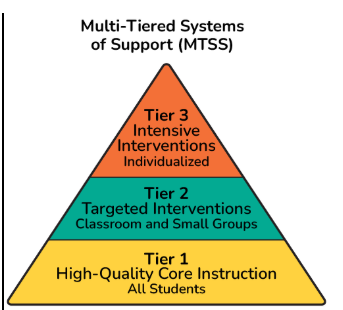
Multi-Tiered Systems of Support (MTSS)
a data-driven intervention approach with a layered framework to support the needs of every learner
Leveled Questions
a framework used to classify questions by complexity, moving from basic recall to higher-order thinking
Reading Fluency
ability to read with appropriate speed, accuracy, and prosody
Folktale
stories that are orally passed through generations
Example
"The Three Little Pigs" and "Little Red Riding Hood" are examples of folktales featuring animals.
Culturally Responsive Materials
educational content that respects students' cultural backgrounds
Example
including diverse perspectives in history lessons
Flexible Grouping
grouping students based on their learning needs or interests
Example
After reviewing the student test results, a teacher can use flexible grouping to organize groups based on students' areas of weakness.
Deficit-Based Approach
a traditional educational approach, which focuses on strengthening a student's weak areas
Example
When using a deficit-based approach, teachers try to identify problems and work to fix them.
Phonological Awareness
the understanding and ability to hear individual words, syllables, and sounds in spoken language apart from print
Scaffolded Learning
supporting students with gradually reduced assistance
Example
providing step-by-step guidance before encouraging independent work
Orthography
the standards present in a language's conventions
Example
spelling, capitalization, punctuation, emphasis
Multisensory Instruction
engages learners with different modalities
Example
hands-on activities, movement, auditory learning
Ongoing Assessment
an assessment that guides the pace and content of instruction
Example
Ongoing assessments are used to determine student knowledge and dictate whether the class is prepared to move on to a new skill.
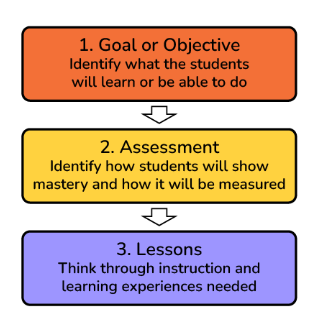
Backward Design / Planning
lesson planning that begins with the desired outcome in mind
Syllable Awareness / Syllabication / Syllable Segmentation
the ability to hear individual parts/syllables of words
Example
“Education” has four syllables “ed-u-ca-tion”