CBNS 108 Lectures 15-16
 Call Kai
 Learn
Learn Practice Test
 Spaced Repetition
 Match
Match Flashcards
 Knowt Play
1/62

Earn XP
Description and Tags
genuinely slime me out
Name | Mastery | Learn | Test | Matching | Spaced | Call with Kai | Chat |
|---|
No analytics yet
Send a link to your students to track their progress
63 Terms
Upon hatching, what larval stages do worms go through?
L1-L4
Cells behave differently in terms of division/differentiation depending on what variable?
Time
Explain the experimental strategy for identifying genes that control timing of developmental progression
Mutagenize worms
Look for mutant progeny in which lineage step does not match larval stage
Identify mutated genes
What is a heterochronic mutant?
Mutants in which a cell's lineage step or developmental stage does not match the overall larval stage of the worm
What are precocious mutants?
Developmental steps/events are skipped, causing cell lineages to differentiate or terminate earlier than normal.
What are retarded mutants?
Developmental steps/events are repeated, causing cell lineages to continue or terminate later than normal.
What type of protein does lin-14 encode, and what happens when it has a loss of function mutation?
Encodes a transcription factor.
Results in a precocious phenotype (skips L1 events and skips to L2 fates).
What type of protein does lin-4 encode, and what happens when it has a loss of function mutation?
Encodes a small non-coding microRNA (miRNA)
Results in a retarded phenotype (repeats L1 divisions and fails to transition to L2).
Lin-14 prevents transition of ___ to ___ in the L__ stage.
T; T.ap; L1
Lin 4 promotes transition of ___ to ___ identity after the L__ stage.
T; T.ap; L2
What is the relationship between lin-4 and lin-14?
lin-4 is a negative regulator of lin-14
Describe the levels of lin-14 mRNA, lin-14 protein, and lin-4 miRNA from L1-L4.
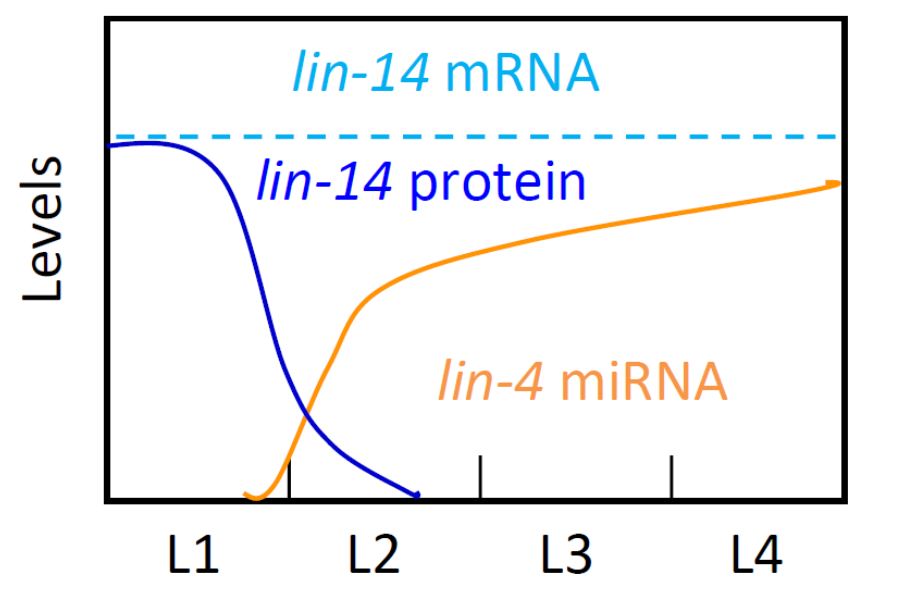
Describe the levels of lin-14 mRNA, lin-14 protein, and lin-4 miRNA from L1-L4 in a lin-14 mutant.
No lin-14 mRNA or protein, lin-4 miRNA levels remain normal
Describe the levels of lin-14 mRNA, lin-14 protein, and lin-4 miRNA from L1-L4 in a lin-4 mutant.
Lin-14mRNA and protein remain at high levels
How does miRNA lin-4 regulate the expression of lin-14?
lin-4 miRNA base-pairs with complementary target sequences located in the 3′ UTR (3′ untranslated region) of the lin-14 mRNA.
This binding leads to translational repression
What happens when miRNAs bind to mRNA targets with perfect complementarity?
Induce RNAi pathway
What happens when miRNAs bind to mRNA targets with imperfect complementarity?
Repress translation
What type of molecule is let-7?
microRNA(miRNA)
What role does let-7 play in C elegans development?
Regulates lin-41 during the L4 —>Adult transition
When let-7 miRNA levels are high, LIN-41 levels are _______.
Low
How did the discovery of lin-4 change our understanding of gene regulation?
Before lin-4: Gene regulation was believed to be driven almost entirely by proteins (e.g., transcription factors).
After lin-4: Revealed a new layer of post-transcriptional gene regulation mediated by small non-coding RNAs (miRNAs and RNAi pathways).
Received a Nobel prize for their discovery of miRNAs and their role in post-transcriptional gene regulation, through lin-4 and lin-14 in C elegans
Victor Ambros & Gary Ruvkun
Received a Nobel prize for discovery of RNA interference and gene silencing by dsRNA using C elegans
Andrew Fire & Craig Mello
what are adult stem cells?
Undifferentiated, multipotent cells found in many tissues that self renew and restore adult cells
What is a stem cell niche?
A microenvironment that supports and regulates stem cells
Describe 5 functions of the stem cell niche.
Secretes signals regulating self renewal
Secretes signals for stem cells to differentiate into specialized progenitors or cell types
Maintains stem cell position and polarity via cell-cell adhesion and cell-ECM adhesion components
guides stem cells to appropriate locations
Protection from pathogens and toxins
What 2 proteins signal for maintenance/activation in many niches?
Wnt and Hedgehog
What is stemness and what protein signals for it?
The ability to self-renew and differentiate; Wnt
What is the function of BMP in stem cell niches?
Often opposes Wnt; restricts stemness; promotes differentiation in many niches
What is the function of Notch in stem cell niches?
Lateral inhibition; controls fate choices and binary differentiation decisions
What is stem cell symmetric renewal?
Both daughter cells are equivalent to the mother
What is stem cell asymmetric renewal?
One daughter cell is identical to the mother, one is a differentiated cell
What is stem cell symmetric differentiation?
Stem cell daughter cells are both differentiated cells
Assign the following traits to either adult stem cells or progenitors:
Long term renewal vs. short term renewal
Oligo/unipotent vs. Multipotent
Divide symmetrically vs. asymmetrically
Used for tissue homeostasis and regeneration vs. expanding population of committed precursors
Stem cells: Long term renewal, multipotent, often divides asymmetrically, used for tissue homeostasis and regeneration.
Progenitors: Short term renewal, oligo/unipotent, often divide symmetrically, used for expanding population of committed precursors
What potency are most ADULT stem cells?
Multipotent or oligopotent
What potency are hematopoietic stem cells (HSCs)
Multipotent
What cells make up the HSC stem cell niche?
bone marrow stromal cells
What factor maintains HSCs?
SCF(stem cell factor)
What are the 3 lineages blood cells are classified into?
Erythroid, lymphoid, myeloid
Describe the hierarchy of progenitors that HSCs generate.
HSC—>multipotent progenitor—>oligopotent progenitor
Identify the 4 types of oligopotent progenitors.
MEP: megakaryocyte erythrocyte
EMP: eosinophil-mast cell
NMP: neutrophil monocyte
CLP: common lymphoid
What occurs during hemotopoiesis?
Hierarchical changes in gene expression
What two processes must occur when a cell becomes committed to a lineage?
Both gene activation (turning on lineage-specific genes) and gene repression (turning off non-lineage genes).
What is the purpose of cross-repression strategies in blood cell development?
To ensure that only the correct lineage-specific target genes are expressed while suppressing opposing lineage genes.
GATA-1 is a _____ factor that __________(activates/represses) transcription of PU.1, a _____ factor. What happens to MEP genes and EMP genes as a result?
MEP; represses; EMP; MEP genes are activated, EMP genes are not activated
What does PU.1 do to GATA-1? What happens to MEP genes and EMP genes as a result?
Represses transcription of GATA-1. EMP genes are activated, MEP genes are not activated
What is the function of Hematopoietic growth factors (also called colony-stimulating factors, or CSFs):
Regulates differentiation during hematopoiesis
How do growth factors regulate blood cell numbers?
By stimulating or inhibiting specific cell types based on the body's physiological needs.
How does bone marrow transplantation work?
patient’s hematopoietic system is ablated (chemo/radiation), HSCs (autologous or donor) are infused intravenously
Transplanted HSCs engraft and reconstitute all blood lineages within weeks
Where are the stem cells of the small intestine held?
The crypts
What is the function of Lgr5⁺ stem cells?
Divide to produce all 5 major intestinal cell types
Lgr5 is a target gene of the ____ pathway.
Wnt
What role do Paneth cells play in the crypt?
They form the stem cell niche by secreting signals (e.g., Wnt, Delta-like).
Loss of Paneth cells = Loss of stem cells.
What happens if Wnt is overactive?
Crypt overgrowth / tumors (adenomas).
What is an intestinal organoid (mini-gut)?
A 3D mini-gut grown in Matrigel from a single Lgr5⁺ stem cell using specific signals (EGF, Wnt, Noggin).
What are intestinal organoids used for in medicine?
Disease modeling (e.g., IBD)
Drug screening
Tissue transplantation research
What characterizes adult stem cells in poorly regenerating tissues (e.g., muscle, brain)?
They are:
Rare, quiescent (dormant), or absent
Hard to activate after an injury
Limited in normal homeostasis and cell types produced
How do poorly regenerating tissues heal, and what is prioritized?
Healing: Relies more on scarring than true regeneration.
Priority: Prioritizes long-term stability and function over replacing lost cells.
What are some possible reasons that aging diminishes stem cell function?
Accumulating DNA damage in stem cells, damage to the niche
What are Cancer Stem Cells (CSCs)?
Self-renewing, tumor-initiating cells that share features with adult stem cells but escape normal body controls.
What traits do Cancer Stem Cells (CSCs) share with normal stem cells?
Ability to self-renew and produce differentiated cells
Slow-cycling (quiescent) nature
Dependency on a specialized microenvironment (niche)
Overlapping signaling pathways (Wnt, Notch, Hedgehog)
How do Adult Stem Cells (ASCs) and Cancer Stem Cells (CSCs) differ in growth control?
Proliferation is tightly regulated to maintain/repair normal tissue.
CSCs: Self-renewal is deregulated, evading normal growth controls to drive tumor initiation.
How do Adult Stem Cells (ASCs) and Cancer Stem Cells (CSCs) differ in genetics and movement?
Maintain genomic stability and stay bound within tissue constraints.
CSCs: Accumulate DNA damage, lose cell adhesion, and can metastasize (spread).