Economics of Climate Change
 Call Kai
 Learn
Learn Practice Test
 Spaced Repetition
 Match
Match Flashcards
 Knowt Play
1/55

Earn XP
Description and Tags
Name | Mastery | Learn | Test | Matching | Spaced | Call with Kai | Chat |
|---|
No analytics yet
Send a link to your students to track their progress
56 Terms
Markets and Market Failure
Where resources and traded and where markets produce bad outcomes
Scarcity
Unlimited wants, limited resources
Externality
Cost/benefit to a third party
Gross Domestic Product (GDP)
Total value of a country's output
Opportunity Cost
The best alternative you gave up
Public Good
Non-excludable, non-rival (e.g. clean air)
Incentives
Rewards/penalties that shape behaviour
Sustainability
Meeting needs without harming future generations
Why can't we have everything we want?
Because all resources are scarce
MICROECONOMICS
Individual decisions:
Households, firms, markets.
How prices are set.
Why you buy what you buy.
MACROECONOMICS
Big-picture systems:
National GDP & growth.
Inflation & unemployment.
Global trade & policy.
Externality
An externality is a cost or benefit felt by someone NOT involved in a transaction.
NEGATIVE EXTERNALITY
A factory burns coal.
The pollution harms people
who never bought its product.
The cost is 'external' — not
paid by the factory.
MARKET FAILURE
Markets work on prices.
But if pollution is FREE,
too much gets produced.
The market 'fails' to account
for environmental damage.
THE CLIMATE CONNECTION
CO₂ emissions are the
world's biggest negative
externality. No single market
creates the right incentive
to stop emitting.
Public Good
Vaccination is a public good
PRIVATE SECTOR
Profit for owners/shareholders —Biggest emitters — but also biggest investors in green tech
PUBLIC SECTOR
Provide public services —Sets regulations, funds infrastructure, enforces carbon rules
NGOs / NON-PROFITS
Social or environmental mission—Hold businesses accountable, drive consumer awareness
THE TRIPLE BOTTOM LINE
PEOPLE, PLANET, PROFIT
Corporate Social Responsibility (CSR)
A business genuinely integrates social and environmental goals into its strategy, operations, and reporting.
GREENWASHING
Marketing sustainability claims that are misleading, exaggerated, or irrelevant.
When a company spends more on ADVERTISING its green credentials than on actually BEING green.
Environmental · Social · Governance (ESG)
A framework investors and regulators use to assess a company's sustainability performance.
Profit Motive
The drive to generate financial return
Stakeholders
Anyone affected by a business's decisions
The Invisible Hand (economics)
The unintended social benefits and self-regulation of the marketplace that result from individuals pursuing their own interests in a free economy.
Supply Chain
Environmental, Social, Governance — sustainability reporting framework
Climate Change
Long-term changes in temperature, precipitation, wind patterns, and other aspects of the Earth's climate system, both natural and human-induced.
Global Warming
The recent and ongoing rise in Earth’s average surface temperature, primarily due to increasing levels of greenhouse gases from human activities.
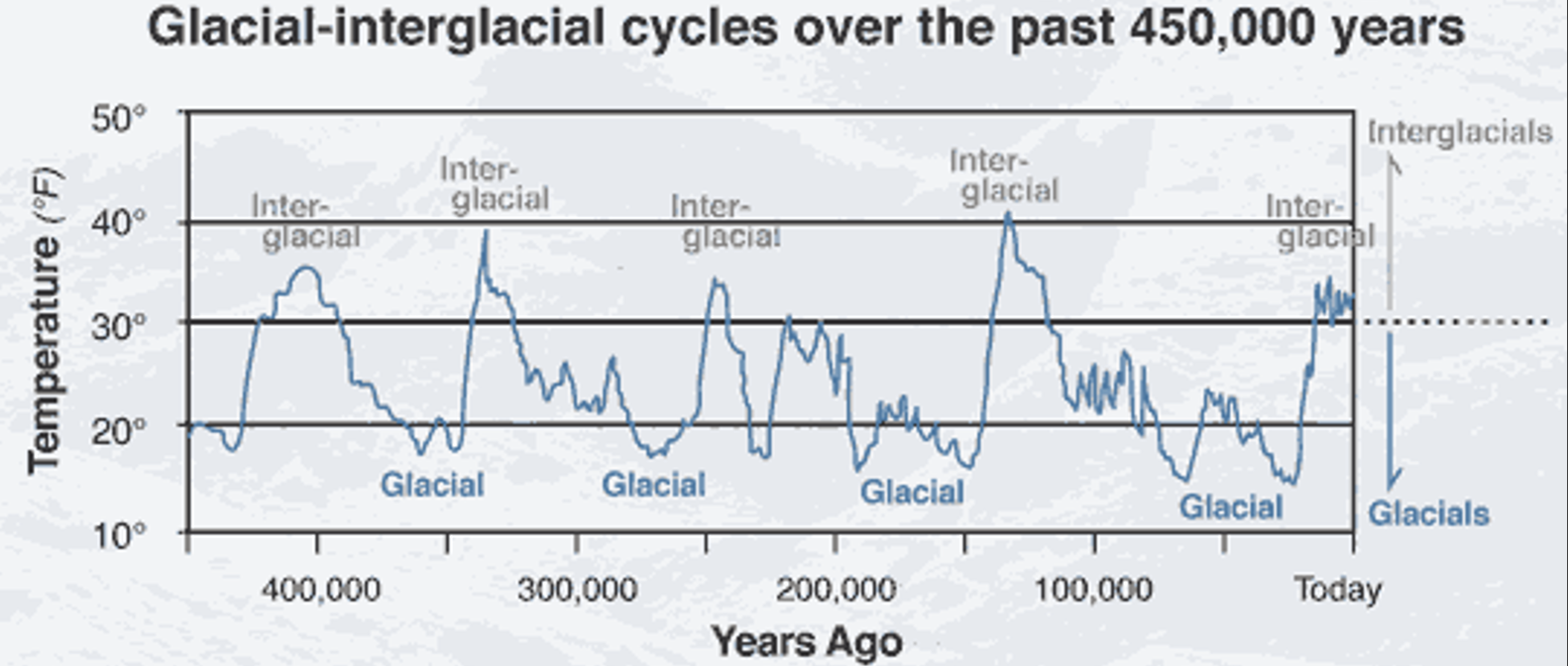
Glacial / Interglacial Periods
The role of volcanoes in natural climate change
Volcanic eruptions can release large amounts of sulphur dioxide (SO₂) and ash into the atmosphere. These particles reflect sunlight, causing short-term global cooling. In rare cases, very large eruptions can affect climate for longer periods. However, ash clouds may also trap some heat, contributing to localised warming.
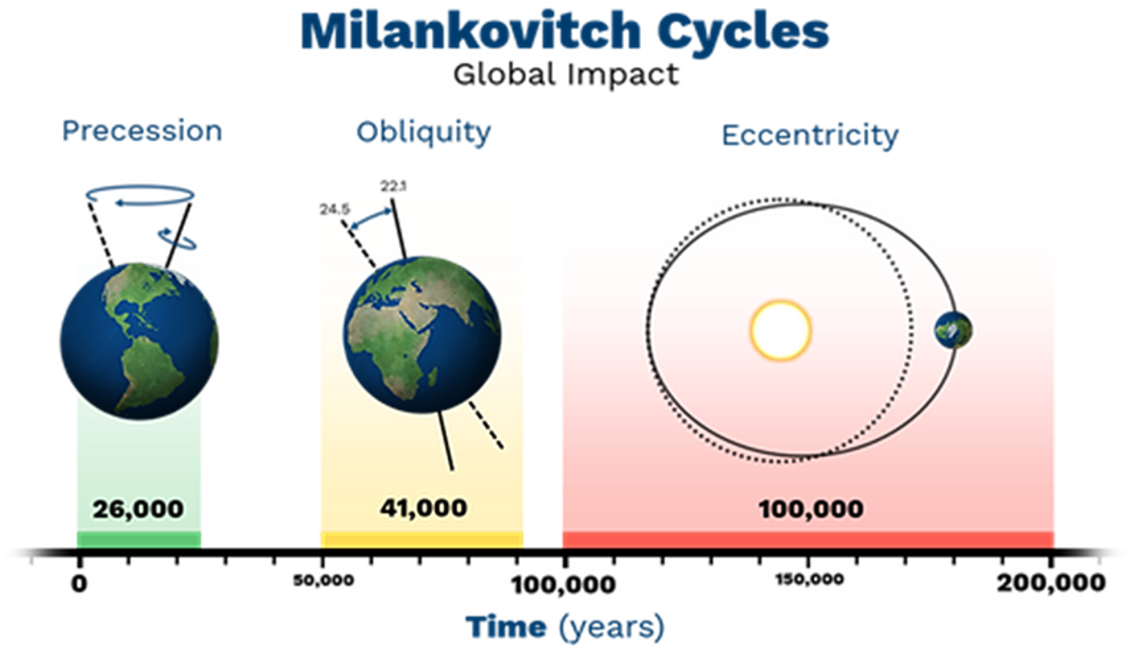
Milankovitch cycles
Over very long periods (10,000 to 100,000 years), Earth’s climate is mainly influenced by its position and movement around the Sun. The Earth orbits the Sun once a year, and this movement, combined with the tilt of the Earth, creates the seasons.
A Serbian scientist, Milutin Milankovitch, discovered that these movements are not always constant. He identified three key changes, now called the Milankovitch cycles:
§Eccentricity: The shape of Earth’s orbit changes from circular to oval (elliptical), taking about 100,000 years.
§Obliquity: The tilt of Earth’s axis shifts between 22.5° and 24.5° over about 42,000 years.
§Precession: Earth "wobbles" as it spins; a full wobble cycle takes about 21,000 years.
These three cycles combine to change how much solar energy Earth receives. Even small changes can trigger ice ages or warming periods.
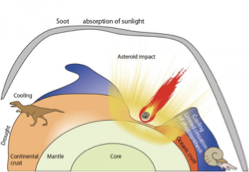
The role of meteors in natural climate change
The natural greenhouse effect
The natural greenhouse effect is a process that keeps Earth warm enough to support life. The Sun’s energy reaches the Earth; some is reflected back into space, while the rest is absorbed by the surface. The Earth then emits this energy as heat (long-wave radiation). Certain gases in the atmosphere - like carbon dioxide (CO₂), water vapour, and methane - trap some of this heat, preventing it from escaping into space.
In the natural system, this process stays in balance, keeping the Earth's temperature stable and suitable for life. Without the natural greenhouse effect, Earth’s average temperature would be about -18°C.
The enhanced greenhouse effect
The enhanced greenhouse effect happens when extra greenhouse gases build up in the atmosphere. This means more heat is trapped, causing global temperatures to rise. While the natural greenhouse effect kept the Earth’s temperature stable, the enhanced greenhouse effect is making the planet warm much faster than normal natural changes.
Methane (CH₄)
Produced by decaying organic matter, landfill, rice farming, and animal digestion (especially cows).
Nitrous Oxide (N₂O)
Released from burning fossil fuels and spreading fertilisers on farmland.
Chlorofluorocarbons (CFCs)
Used in fridges, air conditioners, and insulation. Also damage the ozone layer, increasing UV radiation.
Carbon Dioxide (CO₂)
Released by burning fossil fuels and wood. Deforestation reduces the number of trees absorbing CO₂, so more remains in the atmosphere.
INCENTIVES
Incentives are rewards or stimuli provided to encourage specific actions or behaviors. They are designed to motivate individuals to achieve desired outcomes or increase performance. Their effectiveness often relies on how well they align with the desires or values of the individual or group they target.
Government Intervention
When a government deliberately acts to change the outcome that a free market would produce.
Governments intervene when markets fail — producing too much pollution, too little of a good thing, or outcomes that are unfair. They can use taxes, subsidies, regulations, or bans.
The EU banning single-use plastics is a government intervention — the free market was producing too much plastic waste.
Price Cap
A maximum price set by the government — sellers cannot legally charge more than this amount.
Price caps are designed to protect consumers from being charged too much for essential goods. But if set too low, they can cause shortages because suppliers produce less.
The UK government set an energy price cap to protect households from soaring gas and electricity prices after 2021.
Subsidy
A payment from the government to producers or consumers to lower the cost of a good or encourage more of it to be produced.
Subsidies are used to support industries the government wants to grow — like renewable energy. But they can also distort markets and support industries that cause harm.
Many governments subsidise electric vehicles to make them cheaper and encourage people to switch from petrol cars.
Voucher
A government-issued token that gives individuals the right to spend money on a specific good or service.
Vouchers give people choice while still directing spending towards a goal. They are often used in housing, education, or energy efficiency — but they can be hard to administer.
The UK's Boiler Upgrade Scheme gave households a voucher worth £7,500 towards buying a heat pump instead of a gas boiler.
Regulation
Rules or laws set by the government that businesses and individuals must follow.
Regulations set the minimum standards for environmental or social behaviour. They can be powerful but also complex and costly to enforce. Industries often lobby against strict regulation.
Regulation in Delhi to reduce traffic pollution
Unintended Consequences
Outcomes of an intervention that were not planned or expected — often making things worse in a new way.
Complex systems like economies and environments are hard to predict. A policy that fixes one problem can create another. This is why economists study policy impacts very carefully — and why a pre-mortem is so useful.
Subsidising diesel cars as 'low carbon' (lower CO₂ than petrol) in the early 2000s turned out to cause an air quality crisis in cities — NOₓ and particulate pollution surged.
Efficiency
Getting the maximum output from available resources — achieving a goal at the lowest possible cost.
Economists measure whether a policy achieves its objective without wasting resources. A policy might succeed (e.g. reduce emissions) but be very costly — that makes it inefficient.
Carbon trading schemes are considered efficient because they let the cheapest emissions cuts happen first — wherever they are in the economy.
Equity
Fairness in how costs and benefits are distributed across different groups in society.
A policy can be efficient (achieves its goal at low cost) but still be inequitable — hitting poorer people hardest. Good policy considers both. For example, a carbon tax raises prices for everyone, but the poor spend a larger share of their income on energy.
Energy price caps are designed with equity in mind — ensuring low-income households are not priced out of heating their homes.
PRE-MORTEM?
A post-mortem looks at what went wrong AFTER something has failed. A pre-mortem imagines that failure in advance.
Before implementing a policy, you ask: "Imagine it is 5 years from now and this policy has failed spectacularly. What went wrong?" Then you use that answer to design a better policy now.

PRODUCT — 4P
What are you selling?
•The good or service the brand provides
•Its quality, features, design, and uniqueness
•What problem does it solve for the customer?
PLACE
Where do customers get it?
•Physical stores, online, direct delivery
•Which markets and countries?
•How does distribution affect the brand image?
PRICE
What does it cost?
•Premium, mid-range, or budget pricing?
•Price signals quality to the customer
•How does price affect who can access it?
PROMOTION
How do people find out?
•Advertising, social media, influencers
•Brand story and values communication
•How does marketing shape perceptions?
MISSION STATEMENT
A short, public declaration of WHY the business exists — its core purpose beyond profit.
VALUES
The principles and beliefs that guide HOW the business behaves — its ethical commitments.
OBJECTIVES
Specific, measurable goals the business sets — including social and environmental targets.