Microbiology Exam #1!
 Call Kai
 Learn
Learn Practice Test
 Spaced Repetition
 Match
Match Flashcards
 Knowt Play
1/146

There's no tags or description
Looks like no tags are added yet.
Name | Mastery | Learn | Test | Matching | Spaced | Call with Kai | Chat |
|---|
No analytics yet
Send a link to your students to track their progress
147 Terms
Define biology
study of life
define microbiology
the study of microorganisms
define microorganisms (microbes)
miniature, living things that are difficult to
see individually with the unaided eye
Know the different types of living organisms
organisms made of one or more cells
Prokaryotes- (bacteria, archaea)
Eukaryotes- (protozoa, fungi, algae)
Know the different types of non-living organisms
viruses, viroids, prions
Be able to differentiate between a living organism and non-living particles
-living things are made of cells, use energy, grow and develop, homeostasis, reproduce, DNA/RNA
-non living things do not carry out characteristics of life
Know the two major forms microbes can exist in nature
unicellular- single cells that float and swim independently
Biofilms – a complex aggregation of microbes that can attach to each other or to solid surfaces.
What are some benefits of biofilms?
Protect mucous membranes from pathogenic bacteria
How can biofilms be harmful to humans?
-Clog water pipes or prostheses and catheters
-Endocarditis (inflammation of the heart)
-Resistant to antibiotics
Know and be able to define the subfields of microbiology
• Bacteriology- the study of bacteria
• Mycology- the study of mushrooms, yeasts and molds
• Protozoology- the study of protozoa and parasitic worm
• Phycology/algology- the study of algae
• Virology- the study of viruses
• Microbial genetics- (mechanisms by which microorganisms inherit traits).
Define microbiome
microbes that live in and on the human body
• Our health depends on these cells
Two types of microbiota
-Normal microbiota-live on or inside the human body (beneficial and harmless)
-Transient microbiota- only live there for a few days and can sometimes cause disease
E. coli in intestines
• Aid with digestion
• Prevent the growth of pathogenic species
• May train the immune system to attack invaders
benefits of microorganisms
• Maintain the balance of life in our environment
• Photosynthesis
• Food networks in oceans, lakes, and rivers
Why is recycling of vital elements important and what is the role of microbes in this process?
• Decompose organic waste and recycling chemical elements
• Food industry (bread, vinegar, soy sauce, cheese, yogurt, sauerkraut,
alcoholic beverages)
• Commercial applications (vitamins, organic acids, enzymes, alcohols, and
many drugs)
Define biotechnology
-is the commercial use of microorganisms to
produce common foods and chemicals
Microbes and microbial enzymes can be modified for manufacturing (e.g., cellulase),
and disease treatments and prevention ( e.g., insulin and vaccines).
recombinant DNA technology
Bacteria, viruses, yeasts, and other fungi can be made into miniature biochemical factories
• Produce natural proteins, vaccines, and enzymes
• Gene therapy – inserting a missing gene or replacing a defective gene in human cells.
How are microbes involved in sewage treatment,
wastewater composed of household washing and bathing water,
toilet waste, business/industrial waste, and stormwater runoff.
• Microbes can be used in biological processes to convert liquid and organic materials
to less harmful by-products.
How are microbes involved in bioremediation
the use of microbes to remove environmental pollutants.
• Pollutants may be sources of energy for microbes
• Microbial enzymes break down toxins into harmless substances
How are microbes involved in insect pest control?
Some bacteria are incorporated into a dusting powder that insects eat.
• Bacillus thuringiensis produce crystals that are damaging to the insect’s digestive tract.
• The gene coding for the crystal can be genetically engineered into the plants so the plants themselves can produce the crystal. Other Uses of Microbes (crop dusting plane- harmful to insects not to us)
Define resistance
the ability of the body to ward off disease.
• Natural
• Supplemental
• Antibiotics or other drugs
How is resistance acquired by the human body?
naturally (skin, hair, ear wax, tears, IS) or artificially (shots, medicine, antibiotics)
Define pathogen
carry out at least part of their life cycles inside the host, which results in disease states.
• Not disappearing.
• Examples:
• Malaria
• Pertussis (Whooping cough)
• Cholera
Know the broad categories of diseases related to pathogenic microbes
-infectious diseases- diseases in which pathogens invade susceptible hosts (animals & humans)
-Emerging infectious diseases- new and changing diseases that are increasing or have the potential to increase in incidence soon
- Antibiotic-resistant diseases- Overuse and misuse of antibiotics leads to the selection of antibiotic-resistant bacteria.
-The antibiotic-resistant bacteria can withstand the antibiotics and outcompete the susceptible bacteria
Define infectious diseases and know common examples
diseases in which pathogens invade susceptible hosts (animals & humans).
Why are emerging infectious diseases so important?
Emerging diseases are important because they can appear or spread quickly and become major threats to public health.
What are the major factors contributing to the prevalence of emerging infectious diseases?
• Evolutionary changes in existing organisms (e.g., Vibrio cholerae)
• Spread of known diseases to new geographic areas by modern transportation.
• Increased human exposure to unusual infection agents via deforestation & construction.
Define antibiotics
medications that are critical in treating bacterial infection
Know the two major factors contributing to antibiotic-resistant infections
• Overuse and misuse of antibiotics leads to the selection of antibiotic-resistant bacteria.
• The antibiotic-resistant bacteria can withstand the antibiotics and outcompete the susceptible
bacteria.
• Random mutations in bacterial genes can code for resistance
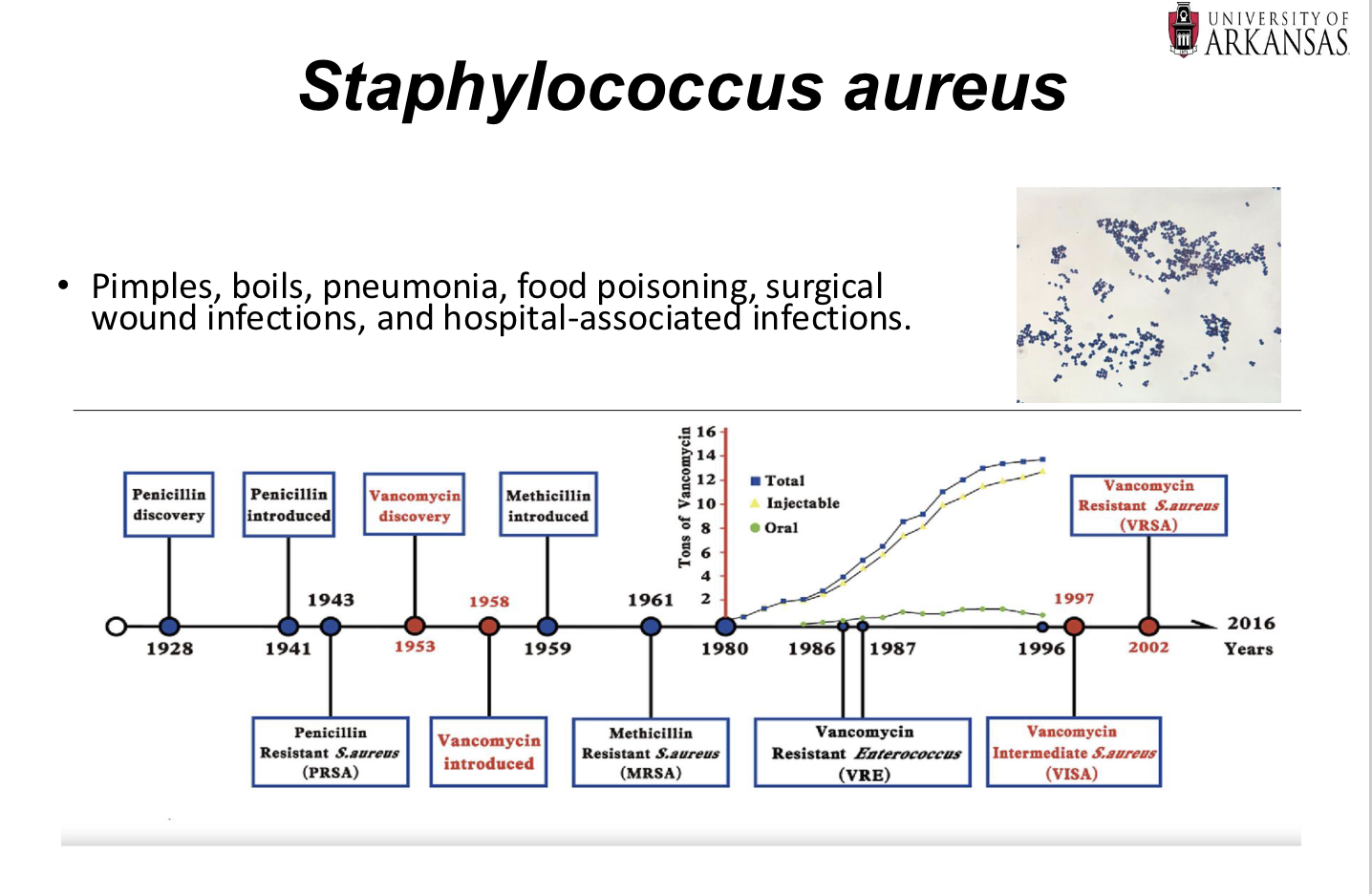
Know the Staphylococcus aureus antibiotic-resistance story of the last 100 years.
bacterial species residing on human skin and
responsible for several human diseases.
Know the scientific contributions of Carolus Linnaeus
1735) established the
system of nomenclature (naming) for organisms.
• Only two kingdoms: Animalia and Plantae
Know the rules of scientific names
-Latin or Latinized
Define binomial system
-each organism has two names.
-the first name and always capitalized.
-species name after genus and not capitalized.
-Both names are underlined or italicized
-The genus is abbreviated after the full name has been used once
-living organisms are referred to by both names
Staphylococcus aureus
Staphylo – clustered arrangement of the cells (genus)
Coccus – spherical cells (genus)
aureus – Latin for golden (the color of the colonies (species)
Homo sapiens
Homo - Latin word for “human” or “man.” (genus)
Sapiens - Latin word for “wise” (species)
How are scientific names chosen for newly discovered species
Scientific names use two parts: Genus + specific epithet, and follow internationally established naming rules.
Define taxonomy
is the science of using the similarities between
organisms to identify, describe, name, and classify
organisms.
define taxa
subdivisions to classify organisms based
on similarities
fossils
Bones, shells, and plant stems that contain matter or imprints on rocks
At the time of Carolus Linneaus, there was only the
Kingdom taxa
-Animalia
-Plantae
Charles Darwin (1859)
Proposed the theory of evolution – species change over
generations, but they descend from a common ancestor.
Natural selection – the process by which organisms better adapted
to their environment tend to survive and produce more organisms.
• Adaptation through mutations
• Migration
theory of evolution
species change over
generations, but they descend from a common ancestor.
What factors affect the evolution of species?
mutation and natural selection
Define phylogeny
the study of phylogenetic relationships and similarities between organisms
phylogenetic tree
groups organisms according to common
properties, implying that they evolved from a common ancestor.

Be able to read a phylogenetic tree and determine the following:
i. Which species are younger?
ii. Which species are older?
iii. Which species are most closely related?
iv. Which species are distantly related?
What are the three major scientific facts that support the existence of the last universal common ancestor (LUCA)?
• All organisms are composed of cells surrounded by a plasma membrane.
• All cells use ATP for energy.
• All cells store their genetic information in DNA
Ribosomes
are cellular structures composed of proteins and RNA
molecules (Ribosomes are present in ALL cells but are not the same in all cells)
Ribosomal RNA
-sequencing analysis demonstrated that the ribosomes differed in all cells
• Mutations accumulate in genomes at constant rates
• rRNA genes have very few mutations and are conserved
3 major types of cells?
-one eukaryotic cell
-two prokaryotic cells (bacteria and archaea)
What is the three-domain classification system and who proposed it?
Carl R. Woese (1978)- Proposed elevating the three cell types to a level above the kingdom called Domain. (archaea, bacteria, eukaryotic)
What is the major difference between the 3 domains?
Bacteria + Archaea = prokaryotes → NO nucleus
Eukarya = eukaryotes → HAS a nucleus
What happened 3.5 billion years ago according to the 3-domain phylogenetic tree?
a nucleoplasmic cell was created very similar
to the prokaryotic cell
What happened 2.5 billion years ago according to the 3-domain phylogenetic tree?
eukaryotic cells arose.
endosymbiotic theory
states that eukaryotic cells evolved from prokaryotic cells living inside one another as endosymbionts
What is the relationship between different prokaryotic cells according to the endosymbiotic theory?
Endosymbiotic theory states that certain organelles in eukaryotic cells originated as free-living prokaryotic cells that were engulfed by larger cells and eventually formed a mutually beneficial relationship.
Prokaryotic cells → symbiosis/engulfment → eukaryotic cells with mitochondria and chloroplasts.
What is the relationship between prokaryotic cells and eukaryotic cells according to the endosymbiotic theory?
Eukaryotic cells contain organelles that originated from free-living prokaryotic cells that were engulfed by an ancestral cell.
What is the major evidence that supports the endosymbiotic theory?
The major evidence supporting the endosymbiotic theory is that mitochondria and chloroplasts have characteristics similar to prokaryotic cells.
Know the hierarchy (groups) of taxonomy
• Which domains don’t have any kingdoms?
• Which domain has kingdoms?
domain
kingdom
phylum
class
order
family
genus
species
which domains don’t have kingdoms- bacteria and archaea
which domain has kingdoms- eukarya
Know the major contributions to the field of microbiology by the following scientists
-Robert Hooke
-Antonie van Leeuwenhoek
Robert Hokke (1665)
First to see individual cells.
• Life’s smallest structural units were “little boxes”
or “cells.”
• Marked the beginning of the cell theory.
Antonie van Leeuwenhoek (1673-1723)
First to observe live microorganisms
• “Animacules” = a microscopic animal
Organisms from:
• Feces
• Rainwater
• Material from scraped teeth
(biofilm)
• Identified as bacteria and protozoa
• Discovered the “invisible” world of
microorganisms
• Interest in the origin of these microbes
What are the three tenets of the cell theory
1. The cell is the basic unit of life (Robert Hooke).
2. All living organisms are composed of cells.
3. All cells arise from preexisting cells (Louis Pasteur).
What is the revolutionary (at the time) instrument used by Hooke and Van Leeuwenhoek
to view microbes? Why was this instrument necessary for their important observations to
be made?
microscope, necessary because microbes where too small to be seen with the naked eye
Define spontaneous generation and know one of its biggest proponents
the scientific and philosophical
belief that some forms of life arise from non-living matter.
• Toads, snakes, and mices → moist soil
• Flies → manure
• Maggots → decaying corpses
John Needham 1745
This observation was claimed to support spontaneous generation as
microorganisms “appear” to develop spontaneously from the liquids
he heated meat broth and then put lids on after so there was contamination, so he though that spontaneous generation occurred
Lazaro Spallanzan 1765
Criticized for the “vital force” being destroyed by the heat, and for not having enough oxygen in the sealed flask to support life
he realized that oiled seal broth no microorganisms grew, but boiled and then sealed they grew so disproved spontaneous generation
Rudolf Virchow
discovered that cells come from pre existing cells
The theory of biogenesis proposes that
new living organisms can only emerge from
other previously existing living organisms.
but he had no scientific proof
Louis Pasteur
full rejection of spontaneous generation
In 1861, Pasteur performed his famous swan-neck flask experiment.
He boiled nutrient broth to kill existing microorganisms.
The curved neck of the flask allowed air in but prevented dust and microorganisms from reaching the broth.
No microorganisms grew in the broth.
When the flask was tilted or the neck was broken, microorganisms entered and growth occurred.
Conclusion: Microorganisms come from other microorganisms, not from nonliving material.
Define theory of biogenesis
Biogenesis is the idea that living organisms can only come from other pre-existing living organisms.
Know the contributions by Edward Jenner to the early ideas of vaccines/immunology
identify a way to protect people from smallpox
-Immunity was provided against smallpox after contracting the milder disease
caused by cowpox
The first golden age of microbiology
1857-1914
Define fermentation and who discovered it
Fermentation is a process in which microorganisms, such as yeast or bacteria, break down sugars to produce energy, often producing products like alcohol, acids, or gases- Louis Pasteur
What is the end-product of alcohol fermentation?
sugars are broken down into alcohol and co2
What organism carries out alcohol fermentation?
yeast
in which condition does alcohol fermentation occur?
anaerobic- without o2
What is the end-product of acetic fermentation?
acetic acid, which gives vinegar its sour taste
What organisms carries our acetic fermentation?
acetic acid bacteria
In which condition does acetic fermentation occur?
aerobic condition- when o2 is present
Define pasteurization
heat the beer and wine just enough to kill most bacteria
and prevent the alcohol from changing into vinegar- kill harmful or unwanted bacteria
How is pasteurization used in the modern food industry?
used to heat food or beverages to a specific temperature for a certain amount of time to kill harmful microorganisms without significantly changing the product.- extending shelf life
define the germ theory of disease and know three of the major scientists whose work help established this theory
Germ theory of disease states that many diseases are caused by microorganisms (germs), such as bacteria, viruses, fungi, and parasites, that enter or affect the body.
Louis Pasteur
showed that microorganisms cause fermentation and provided evidence that microbes come from existing microbes. (swan neck)
Robert Koch
demonstrated that specific microorganisms cause specific diseases and developed Koch’s postulates
Joseph Lister
applied germ theory to surgery by using antiseptic techniques to prevent infections.
Define the “magic bullet”
Paul Ehrlich (1910) – speculated about a “magic bullet” that could hunt
down and destroy a pathogen without harming the host. “drug targets pathogen but leave patient unharmed”
Alexander Fleming and the “discovery” of penicillin (first antibiotic)
Fleming was studying Staphylococcus bacteria.
He noticed that a mold accidentally contaminated one of his Petri dishes.
Around the mold, there was a clear area where the bacteria had been killed or stopped from growing.
He identified the mold as Penicillium and called the antibacterial substance penicillin.
Penicillin later became an important treatment for bacterial infections.
Know the subfields of microbiology that were established during the second
golden age of microbiology
i. Bacteriology
ii. Mycology
iii. Parasitology
iv. Immunology
Bacteriology – the study of bacteria.
• Mycology – the study of fungi (molds, yeasts and mushrooms).
• Parasitology – the study of protozoa and parasitic worms.
Rebecca Lancefield and serotypes
Streptococci can be classified according to serotypes (variants
within a species) based on polysaccharides in their cell walls.
• Streptococcus pyogenes
• Sore throat (strep throat)
• Scarlet fever
• Septicemia (blood poisoning)
Many Subfields of Microbiology
were Established
What is the typical size of a bacterial cell?
-0.2 to 2.0 μm in diameter
-2 to 8 μm length
coccus
spherical or oval cells
Bacillus
rod-shaped cells
Spiral
a cell with one or more twists
monomorphic
one bacterial shape only
Pleomorphic
several shapes in the colony/culture
Diplococcii
pairs
Streptococci
chains
Tetrad
group of four cocci cells
Sarcinae
cubelike group of eight cocci cells.
Staphylococci
clusters of cocci cells
Vibrio
genus of Gram-negative, curved/comma-shaped bacteria.
Spirillum
Spirillum is a type of spiral-shaped bacterium.