♡ Approaches ♡
 Call Kai
 Learn
Learn Practice Test
 Spaced Repetition
 Match
Match Flashcards
 Knowt Play
1/99

There's no tags or description
Looks like no tags are added yet.
Name | Mastery | Learn | Test | Matching | Spaced | Call with Kai | Chat |
|---|
No analytics yet
Send a link to your students to track their progress
100 Terms
What are the assumptions of the behaviourist approach? (3)
All behaviour is learned from experience and therefore can be changed.
Only measurable and observable behaviour should be considered.
It is useful to study animals to understand behaviour as the same processes produce learning for both humans and other animals.
What is the theory of Classical Conditioning? (2)
This is learning through association
Two stimuli are paired to produce the same response
Explain what happens before learning in Classical Conditioning (3)
An unconditioned stimulus (UCS) produces a reflex response
called an unconditioned response (UCR)
A stimulus that produces no response is called a neutral stimulus (NS)
Explain what happens during learning in Classical Conditioning (2)
A neutral stimulus (NS) is paired with an unconditioned stimulus (UCS) i.e. they both occur together.
The unconditioned response (UCR) occurs in response to the UCS.
Explain what happens after learning in Classical Conditioning (2)
Through associating the NS with the UCS, the NS now elicits (produces) the same response
This response is now referred to as the conditioned response (CR)
The NS is now called the conditioned stimulus (CS).
Draw the diagram of Classical Conditioning

Evaluate Pavlov’s Research into Classical Conditioning
Aim (3)
researching digestion in dogs
wanted to research why, when he entered the room the dog’s salivation increased
whereas initially the dog would only salivate at the presence of food.
Evaluate Pavlov’s Research into Classical Conditioning
Procedure (2)
designed apparatus to measure salivation
ringing a bell (NS) at the same time as presenting food to the dog (UCS)
Evaluate Pavlov’s Research into Classical Conditioning
Findings (5)
Dog would salivate in response to the food (UCR)
Following repeated ‘pairings’ of the bell (NS) and food (UCS), when he rang the bell without any food being present (CS),the dog still salivated (CR)
He was able to show that through the learning of an ‘association’ between two stimuli (NS + UCS)
A ‘conditioned response’ (CR) can be produced
Pavlov’s findings led to the theory of classical conditioning.
Explain the process of stimulus generalisation (3)
Once an animal has been conditioned
They will also respond to other stimuli that are similar to the CS.
This is known as stimulus generalisation.
Explain the process of extinction (4)
Extinction can also take place
Unlike the UCR, the CR does not become permanently established as a response
After a few presentations of the CS in the absence of the UCS
It loses its ability to produce the CR
What is the theory of Operant Conditioning? (3)
Learning by consequence
Reinforcement is one way in which ‘learning by consequence’ occurs
Reinforcement strengthens learning, increasing the frequency of behaviour
What are the two types of reinforcement?
Positive reinforcement
Negative reinforcement
Explain Positive Reinforcement (4)
Something rewarding is gained as a result of performing a behaviour
So the frequency of the behaviour increases
For example, as a consequence of doing well in a test a student gains a sense of pride
This increases the frequency of revising well in future.
Explain Negative Reinforcement (4)
Something unpleasant is removed or avoided as a result of performing a behaviour
So the frequency of the behaviour increases
For example, hitting the button on an alarm clock stops the unpleasant ringing
This increases the frequency of hitting the button in future when the alarm clock rings.
What was the Skinner Box? (2)
Piece of equipment used to investigate operant conditioning
It supported the theory that learning by consequence can occur through positive and negative reinforcement
Explain the evidence for Positive Reinforcement in Skinner’s Research (5)
Every time the rat activated a lever within the box it was rewarded with a food pellet
The rat would be positively reinforced for pressing the lever (by receiving food)
So this behaviour is likely to be repeated
And becomes a learned behaviour
The food pellets act as a positive reinforcer for pressing the lever
Explain the evidence for Negative Reinforcement in Skinner’s Research (5)
Rats could be conditioned to perform the same behaviour to avoid an unpleasant stimulus, for example an electric shock
Rat was electrocuted through the use of an electric grid in the box.
However, when the rat pressed the lever, the electric shocks stopped
Through negative reinforcement the rat learned that by pressing the lever in order to avoid the electric shock
And so the lever-pressing behaviour is likely to be repeated.
What are the strengths and limitations of the Behaviourist Approach?
Strengths:
Scientific methodology
Practical applications
Limitations:
Extrapolation of animal research
It is reductionist
Evaluate ‘Scientific Methodology’ as a strength of the Behaviourist Approach (10)
It uses scientific methodology
It studies observable and measurable behaviours
It is objective
Free from researcher bias
Findings will not be affected by personal judgement
Because of having objective research improves validity of the findings
The research is usually carried out using very well controlled laboratory-based studies and is therefore replicable
Meaning it can be repeated and the results can then be checked for consistency, known as reliability
Is a strength cos there have been hundreds of such studies supporting the success of classical and operant conditioning
And so it is seen to be a reliable explanation for behaviour
Evaluate ‘Practical Applications’ as a strength of the Behaviourist Approach (7)
Has practical applications
Many studies show how behaviour can be changed using conditioning and this knowledge has been used to modify behaviour in the real world
Systematic desensitisation is effective in treating phobias and is structured from the principles of classical conditioning
Token economy uses the principles of operant conditioning and is widely used in institutions to encourage certain behaviours
Token economy involves reinforcing desirable behaviour with a token that can then be exchanged for some kind of reward
Within the walls of the prison, desirable behaviour may take many forms such as avoiding conflict, following prison rules, keeping one’s cell orderly etc
Is a strength cos classical and operant conditioning have been used in a practical way to help modify maladaptive behaviour.
Evaluate ‘Extrapolation of animal research’ as a limitation of the Behaviourist Approach (7)
Limitation of extrapolation of animal research
Using animal research and then applying the findings to humans is a limitation
Some psychologists argue that humans are qualitatively different to other animals
Humans have very complex behaviours such as language acquisition and abstract cognitions
This means we are not the same as rats and pigeons
However, the behaviourists justify using animals, as humans and animals both learn through conditioning techniques
Limiting to use findings of animal studies to explain human behaviour cos of the differences that exist
Evaluate ‘It is reductionist’ as a limitation of the Behaviourist Approach (5)
It is reductionist
It simplifies very complex behaviour to simple ‘stimulus-response’ connections
Limitation as human behaviour is better explained by looking at entire behaviours and not just the bits that make it up
Reductionism could result in a partial understanding of the behaviour being studied
Reductionism leads to over-simplistic and incomplete explanations being offered for very complex behaviours.
What are the assumptions of the Social Learning Theory? (5)
Is an extension of the behaviourist approach
But there is an interaction between the environment, behaviour and cognitive processes.
Behaviour can be learned from observing and imitating role models.
Four mediational processes are involved in learning (attention, retention, reproduction and motivation)
Which are mental processes that occur between the role model displaying a behaviour and the behaviour being imitated by the observer.
What is the Social Learning Theory?
Learning takes places in a social context
What are the several key features of the Social Learning Theory? (8)
Identification
Modelling
Imitation
Vicarious Reinforcement
Mediational Processes (ARRM)
Attention
Retention
Reproduction
Motivation
Explain ‘Identification’ as a feature of the Social Learning Theory (3)
This is when an individual is influenced by another because they are in some way similar to them, they want to be like them, or they want to associate themselves with a person or group.
‘The model’ is the person with whom they identify.
Factors that influence the choice of model include having the same gender and ethnicity, higher status, celebrity status, physical attractiveness and greater expertise. Identification results in a more general adaptation of behaviours from the model rather than imitation of one or two specific behaviours.
Explain ‘Modelling’ as a feature of the Social Learning Theory (2)
Learning that occurs whilst observing a role model.
An individual learns a particular behaviour by observing another individual performing that behaviour.
Explain ‘Imitation’ as a feature of the Social Learning Theory (2)
The action of using someone/something as a role model and copying their behaviour.
It describes how an individual observes the behaviour of a role model and duplicates exactly the behaviour displayed
Explain ‘Vicarious Reinforcement(INDIRECT reinforcement)’ as a feature of the Social Learning Theory (3)
Learning occurs via observation of the behaviour of a role model and viewing the rewards or punishments they receive for their behaviour.
An observer doesn’t receive reinforcement directly; they see someone else receiving it. For example, a younger sister observing an older sister being rewarded for a particular behaviour is more likely to repeat that behaviour herself.
If the model is observed being reinforced for their behaviour, such as obtaining a reward; it increases the likelihood that a behaviour is imitated by the observer; whereas, if the model is observed being punished, it decreases the likelihood that a behaviour is imitated
Explain ‘Mediational Process’ as a feature of the Social Learning Theory (2)
Despite a behaviour of a role model being observed; it is not automatically imitated.
There is some thought that takes place prior to imitation – this consideration involves mediational processes which occur between observing the behaviour (stimulus) and imitating it or not (response).
Explain the 4 key mediational processes (ARRM)
Attention – For a behaviour to be imitated it must capture our interest so we notice it. We observe many behaviours on a daily basis and many of these are not noteworthy. Attention is therefore pivotal for a behaviour to be processed.
Retention – A behaviour must be memorable otherwise it will be forgotten. As much of social learning is not immediate, it is important that we form a memory of a behaviour for it to be performed later by the observer. Retention of a behaviour can be strengthened through repeated observation or if it triggers strong emotions.
Reproduction - We observe many behaviours and make a mental assessment of whether we have the ability to imitate this. E.g. a 90-year-old lady (who struggles to walk) watching Dancing on Ice may desire to ice skate but she will not attempt to imitate the behaviour because she knows she is not physically capable.
Motivation – The rewards and punishments that follow a behaviour will be considered by the observer. If the perceived rewards outweigh any costs then the behaviour will be more likely to be imitated by the observer. If the reward is not seen to be important enough to the observer is less likely they will imitate the behaviour. Reproduction and motivation are concerned with the PERFORMANCE of behaviour.
Evaluate Bandura’s Research into the Social Learning Theory
Aim (2)
To investigate whether children imitate role models even when they are no longer present.
To investigate whether children are more likely to imitate the aggressive behaviour of the same sex models or opposite-sex models.
Evaluate Bandura’s Research into the Social Learning Theory
Procedure (6)
72 children, aged between three and six years old (mean age 4 years), observed an adult model behaving either aggressively or non-aggressively toward an inflatable doll known as a Bobo doll.
The children were divided into groups, initially by whether they would watch an aggressive or non-aggressive model, then further divided based on their gender, and whether they would watch a same sex or opposite sex model.
The model was in a room with the Bobo doll, a hammer and various toys. One by one the participants watched the model’s behaviour for ten minutes from the opposite corner of the room.
The model, besides physically punching and kicking the doll, would also shout abuse, such as ‘Punch him on the nose’ and ‘Pow’.
The participants then had a delay before finally being allowed to go into a room with toys including a Bobo doll, toy guns, and farm sets, i.e. both aggressive and non-aggressive toys. Researchers observed the children for twenty minutes.
Their behaviour was rated on a scale for aggression by multiple observers and inter-rater reliability was found.
Evaluate Bandura’s Research into the Social Learning Theory
Findings (3)
Children who observed an adult being aggressive were more likely to imitate the aggressive behaviour than children who didn’t observe aggressive behaviour.
Children were more likely to imitate the behaviour of the adult with the same gender.
Boys were more likely to imitate the aggressive behaviour of the adult than the girls.
Evaluate Bandura’s Research into the Social Learning Theory
Conclusion (2)
Observing aggressive role models can lead to aggressive behaviour being imitated.
Imitation is more likely if an observer identifies with the role model. Imitation can be seen even after a delay from the learning
What are the strengths and limitations of the Social Learning Theory?
Strengths:
Acknowledges mental processing
Practical Applications
Limitations:
Underestimates the influence of biological factors
Methodology and issues with validity
Evaluate ‘Acknowledges mental processing’ as a strength of the Social learning Theory (4)
One strength of SLT over the behaviourist approach is that it acknowledges key mediational processes.
Humans store information about the behaviour of others and use this to make judgements about when it is appropriate to perform certain actions.
SLT accounts for this by considering the combination of behaviour and cognitions.
This is a strength because by recognising the role of these mediational processes SLT uses a more holistic approach and therefore offers a more complete explanation of human learning than traditional classical and operant conditioning
Evaluate ‘Practical Applications’ as a strength of the Social learning Theory (3)
One strength is that the principles of SLT have been usefully applied to increase our understanding of many areas of human behaviour, including the initiation of criminal behaviour through differential association theory.
For example, Akers (1998) suggests that the probability of someone engaging in criminal behaviour increases when they are exposed to models who commit criminal behaviour, identify with these models and develop the expectations of positive consequences for their own criminal behaviour e.g. wealth and status.
This is a strength because we can use the principles of SLT to prevent and reduce undesirable behaviours.
Evaluate ‘Underestimates the influence of biological factors’ as a limitation of the Social learning Theory (4)
One limitation of SLT is that it makes little reference to the impact of biological factors on social learning.
A consistent finding in the Bobo doll experiment was that boys were often more aggressive than girls regardless of the specifics of the experimental situation.
This may be explained by hormonal factors, for example differences in levels of testosterone, which is present in greater quantities in boys and is linked to increased aggressive behaviour.
This is a limitation because the influence of important biological factors is not accounted for in SLT therefore questioning the validity of the theory.
Evaluate ‘Methodology and issues with validity’ as a limitation of the Social learning Theory (5)
One limitation of social learning theory is that the research on which the theory was based had methodological flaws.
Many of the concepts within social learning theory were developed through observation of young children’s behaviour in laboratory settings, this can reduce both the internal validity and external validity.
In addition, their contrived nature means that many participants may respond to demand characteristics.
For example, in relation to Bandura’s Bobo doll research, because the main purpose of the doll is to strike it, the children were simply behaving in a way that they thought was expected.
This is a limitation because the theory may tell us little about how children actually learn aggression in everyday life (lacks ecological validity).
What are the assumptions of the cognitive approach? (4)
Behaviour is the result of internal mental processes, such as memory and perception.
Internal mental processes can and should be studied scientifically.
Internal mental processes cannot be observed directly so they are studied indirectly by making inferences based on behaviour which can be observed.
An information processing approach is used to explain human thinking and behaviour.
Explain the study of internal mental processing (3)
Cognitive psychologists study what they can observe and measure (e.g. behaviour) and then make inferences (assumptions) about the internal mental processes that may have caused what they observed.
The development of computers in the 1950s gave cognitive psychology the terminology it needed to study human internal mental processing.
An information processing approach was adopted to model how human thought works – information is received as an input; the information is processed within the system; and an output is produced.
Draw the diagram for the Study of Internal Mental Processing

What does the cognitive approach use computer models for?
The cognitive approach uses computer models and theoretical models to study and make inferences about the human mind and behaviour.
Draw the diagram for Theoretical Models and Computer Models
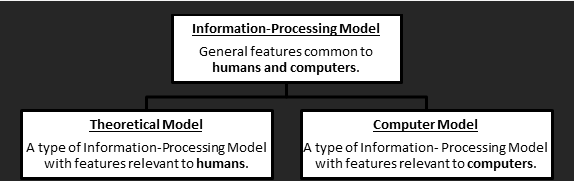
Explain Theoretical Models (7)
Theoretical models explain specific mental processes and are characterised by a series of steps, usually illustrated by a diagram.
They are used to make inferences about unseen mental processes that are causing a particular behaviour.
Experimental findings provide the basis for the construction of theoretical models.
Further experimental findings can support the model or indicate if revisions are needed.
Theoretical models can also be used to make predictions, which are then tested empirically.
One example of a theoretical model is the multi-store model of memory.
The MSM explains internal mental processes in human memory by depicting key storage components (e.g. STM and LTM) as boxes and key processes (e.g. attention and rehearsal) as arrows.
Explain Computer Models (5)
Computer scientists construct computer models to simulate human internal mental processing.
A computer is programmed with an algorithm, which is a step-by-step set of instructions about how to process information.
Input is provided to the computer programme (likened to environmental stimuli); this information is processed according to the algorithm (likened to internal mental processes); which results in an output (likened to behaviour).
One example of a computer model used in virtual relationships is the mobile dating App Tinder, which attempts to simulate the processes a human would go through when deciding on a potential romantic partner.
The app uses an algorithm that accepts inputs such as a person’s personal interests, processes this information by matching users with similar interests and provides an output which returns a selection of potential partner matches.
Name the differences between theoretical and computer models (2)
Differences between theoretical and computer models | ||
THEORETICAL MODELS |
| COMPUTER MODELS |
Diagrams of internal mental processing | Whereas | Simulations of internal mental processing |
Processes are developed naturally through experience | Processes requires direct programming through algorithms | |
Name the Similarities between theoretical and computer models (2)
Similarities between theoretical and computer models |
Both are used to make inferences about internal mental processes |
Both adopt an information processing approach |
Explain the Roles of Schemas (6)
A schema is a cognitive framework that helps organise and interpret information.
They are ‘packages’ of knowledge developed through experience.
They are useful because they allow us to take quick shortcuts when interpreting the huge amounts of information we have to deal with every day.
Schemas (schemata) allow us to fill in the gaps in information, inform our expectations and enable us to behave ‘appropriately’ in a situation.
However, schemas also mean that we will ignore or minimise evidence that does not fit with our existing schema leading to distortion, bias and stereotyping.
In these situations we will look for information to confirm pre-existing beliefs and ideas. For example, negative self-schemas in depression.
What are the strengths and limitations of the Cognitive Approach?
Strengths:
Supports Psychology as a scientific discipline
Successful and diverse applications
Limitations:
Methodology and issues with validity
Mechanistic approach
Evaluate ‘Supports Psychology as a scientific discipline’ as a strength of the Cognitive Approach (5)
One strength of the cognitive approach is that is supports psychology as a scientific discipline.
The cognitive approach has contributed towards the credible scientific basis of Psychology.
For example, the approach employs highly controlled and rigorous empirical methods to enable researchers to infer cognitive processes at work.
This has involved the use of laboratory experiments to produce reliable, objective data. In addition, the emergence of cognitive neuroscience has enabled the two fields of biology and cognitive psychology to come together.
This is a strength because unseen mental processes can be studied in a scientific and objective manner contributing to the credibility of psychology as a scientific discipline.
Evaluate ‘Successful and diverse applications’ as a strength of the Cognitive Approach (6)
One strength of the cognitive approach is that it has a number of successful applications in many areas of psychology.
For example, cognitive psychology has expanded our understanding of Psychopathology by offering explanation for dysfunctional behaviour like depression, suggesting it is underpinned by faulty thought processes.
This has led to many successful cognitive based therapies for depression, OCD and eating disorders.
In addition, cognitive psychology has been used within Eyewitness Testimony research through the development of the cognitive interview.
This interview technique is used to improve the accuracy of Eyewitness testimony through increasing the accessibility of stored information.
Therefore, demonstrating that the principles of the cognitive approach have applied to a number of settings.
Evaluate ‘Methodology and issues with validity’ as a limitation of the Cognitive Approach (5)
One limitation of the cognitive approach is the methodology used leading to issues with validity.
The laboratory environment used within cognitive research can reduce both the internal (whether the study measures what it claims to measure) and ecological validity (whether the findings of the study can be generalised to real-life settings) of the study.
For example, in cognitive neuroscience, participants in fMRI studies are lay on their back, in a claustrophobic and noisy environment, whist trying to complete tasks.
Whilst in other experiments, participants may be asked to ‘verbalise’ their thoughts (which are very difficult to articulate honestly).
This is a limitation because the techniques used can reduce both the internal and ecological validity of the findings.
Evaluate ‘Mechanistic approach’ as a limitation of the Cognitive Approach (5)
One limitation of the cognitive approach is that it has been accused of having an over simplistic, mechanistic view of human behaviour.
Unlike humans, computers do not forget, make mistakes or ignore available information.
Furthermore, researchers have not been able to reliably create algorithms for ‘mood’ and ‘feeling’, for example, computers do not get stressed, therefore although many inferences about human behaviour can be suggested, a complete replication of human behaviour is unlikely.
This might be one reason why although many computer models can test existing experimental data, many are unable to make future predictions.
Therefore, this questions the usefulness of the approach as an explanation of human behaviour.
What are the assumptions of the Biological Approach? (4)
Everything psychological has a biological basis.
Our biology is determined by evolution and genetics.
To investigate the mind, we must investigate the physical brain.
To understand human thoughts and behaviour we must investigate biological structures (physiology) and processes (e.g. biochemistry) within the brain and body.
Explain The Influence of Genes on Behaviour (4)
The genetic basis of behaviour refers to the idea that specific genes can be responsible for our behaviour.
For example, compulsive behaviour, as seen in people with obsessive-compulsive disorder, has been linked to the SERT gene.
A faulty SERT gene affects the transport of serotonin, which can create lower levels of this neurotransmitter.
If this occurs in certain networks of the brain, it can lead to unwanted thoughts and repetitive behaviours, which are key symptoms of the condition.
Define Genotype and Phenotype
Genotype refers to the genetic makeup of an individual that is inherited.
Phenotype refers to the observable characteristics of an individual that are expressed and is a result of the interaction between their genotype and their environment.
Explain how a faulty SERT gene causes OCD to be expressed in terms of a genotype and a phenotype (3)
An individual inherits a faulty SERT gene as part of their genotype which makes them vulnerable to developing anxiety.
They also experience high levels of stress during a particular period of their life.
The interaction between their genotype (genetic vulnerability) and environment (stress) leads to OCD being expressed as their phenotype.
Explain Method of Investigating the Influence of Genes: Twin Studies (7)
Twin studies are often used to investigate the genetic basis of behaviour.
These involve the calculation of a concordance rate – the chance that two individuals share a characteristic.
For example, if 10 pairs of twins are investigated and in 9 of the pairs, they both have symptoms of schizophrenia, the concordance rate would be 90% (or 0.9 as a decimal). Twin studies usually compare the concordance rates of monozygotic (MZ) twins (who share 100% of their DNA) and dizygotic (DZ) twins (who share 50% of their DNA).
If a characteristic is purely genetic, we would therefore expect the concordance rate for MZ twins to be 100% and 50% for DZ twins.
If the concordance rate is significantly higher for MZ twins this suggests a characteristic is mainly genetic.
If the concordance rate for MZ and DZ is similar this suggests a characteristic is determined by the environment.
Twin study example
Gottesman (1991) reviewed over 40 twin studies and found the average concordance rate was 48% for MZ twins and 17% for DZ twins, suggesting schizophrenia is partly genetic.
Explain the influence of Biological Structures on Behaviour (Lobes) (7)
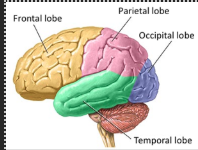
The brain also influences human behaviour. Specific areas of the brain have different functions relating to behaviour:
Frontal Lobe – associated with reasoning, emotions and decision making
Parietal Lobe – associated with perception of stimuli and attention
Occipital Lobe – associated with visual processing
Temporal Lobe – associated with memory and speech
The relationship between biological structures and behaviour has been shown in individuals that suffer with schizophrenia.
Enlarged ventricles (fluid-filled gaps between brain areas) in central brain areas and the prefrontal cortex of the frontal lobe have been linked to negative symptoms of schizophrenia.
Draw the diagram of the Brain
Explain the influence of Neurochemistry on Behaviour (3)
Neurotransmitters are chemical messengers that travel across the synaptic gap during the process of synaptic transmission allowing neurons to communicate.
Imbalances in neurotransmitter levels are often associated with atypical behaviour. For example, too little serotonin has been found in patients with OCD, suggesting that serotonin has a role in preventing the repetition of tasks.
A lack of serotonin appears to result in the loss of a mechanism that inhibits task repetition
Explain Cognitive Neuroscience (7)
Cognitive neuroscience is the scientific study of the biological basis for mental processing, especially how neurons behave during those processes.
Cognitive neuroscience was formally labelled by Miller and Gazzaniga (1971) and has grown considerably alongside the advancement of technology.
Brain imaging techniques such as functional magnetic resonance imaging (fMRI) and positron emission tomography (PET) are used whilst participants perform cognitive tasks.
This allows cognitive neuroscientists to systematically observe and describe the neurological basis of mental processing.
The brain activity of participants experiencing functional differences is often compared to neurotypical participants as a baseline.
An example of cognitive neuroscience applied in the field of memory is PET scans that revealed a neurobiological basis for separate components of the working memory model.
Verbal rehearsal activated Broca’s area, relating to the phonological loop; whereas visual tasks activated regions of the occipital lobe, relating to the visuospatial sketchpad.
Explain Evolution (8)
Evolution is the process by which successive generations of organisms change.
The process of natural selection proposed by Charles Darwin, suggests that if an organism is able to adapt to its environment, it will be more able to survive and therefore have a greater chance to reproduce.
This adaptive characteristic may occur due to mutation (random variation) when genes are copied from the parents.
When the offspring reproduces itself, the adaptive characteristic will then be genetically transmitted to its own offspring which will then benefit from the same characteristic. This continues for each successive generation.
Over time, an adaptive characteristic will become more common throughout a species.
Although this adaptive characteristic is biological, it may underlie a particular way of behaving which helps the organism to survive.
Those without the adaptive characteristic (behaviour) will gradually die out.
For example, attachment is an adaptive behaviour. Human infants are helpless and require adult assistance for a number of years in order to ensure survival. Creating an emotional bond to an adult who will subsequently care for it therefore confers a survival advantage.
What are the strengths and limitations of the biological approach?
Strengths:
Supports psychology as a scientific discipline
practical applications within the biological approach
Limitations:
limitation of reductionism within in the biological approach
limitation of determinism within the biological approach
Evaluate ‘supports psychology as a scientific study’ as a strength of the biological approach (5)
A strength of the biological approach is that the methodology on which it is based supports psychology as a scientific discipline.
Brain scans are commonly used to make scientific measurements of neural structures and neural activity.
These scans provide objective data that enable researchers to investigate the biological basis of our behaviour in an unbiased way.
For example, Milev et al. (2003) used MRI scans with schizophrenic patients and found that temporal lobe grey matter volume was negatively correlated with hallucinations.
Such research demonstrates how brain activity can be empirically measured to identify biological aspects of dysfunctional behaviour.
Evaluate ‘practical applications of neurochemical explanations’ as a strength of the biological approach (4)
A limitation of the biological approach is that purely genetic or neural explanations can be considered biologically reductionistic as they simplify the cause of human behaviour down to specific components.
For example, a malfunctioning caudate nucleus can be linked to an inability to suppress obsessive thoughts and compulsive behaviours in OCD.
Such reductionist explanations may do not account for the interaction of singular biological factors with other contributing factors.
For example, a malfunctioning caudate nucleus may make a person vulnerable to develop OCD; but it is only when combined with certain triggers, such as environmental stressors that the condition develops as suggested by the diathesis-stress model.
Evaluate ‘limitation of reductionism within the biological approach’ as a limitation of the biological approach (4)
One advantage of neurochemical explanations is they can provide a clear understanding of biological processes underlying mental health conditions.
Simplifying complex conditions to a singular neurotransmitter has led to the development of psychoactive drugs that alter the activity of the targeted chemicals.
For example, knowing that depressed patients have lower levels of serotonin has led to the development of antidepressants (e.g. SSRIs) that increase serotonin activity which decreases depressive symptoms.
This shows how biologically reductionist explanations can be practically applied to improve people’s’ lives.
Evaluate ‘limitation of determinism within the biological approach’ as a limitation of the biological approach (5)
A further limitation of the biological approach involves implications of biologically deterministic explanations.
Due to an individual having no control over abnormal brain structures, levels of neurochemicals or atypical genes that have been inherited, it is questionable as to whether they are fully responsible for their own thoughts and behaviours.
For example, if an individual inherits a faulty MAOA gene which increases the activity of serotonin, this can predispose them to perform impulsive criminal behaviours.
This has moral, ethical and legal implications because if an individual unable to exercise free will, it is difficult to hold them to account for carrying out criminal acts such as assault.
Deterministic aspects of the biological approach therefore pose serious complications for the criminal justice system.
Evaluate ‘twin study support’ as an evaluation of the genetic basis of human behaviour (5)
The genetic explanation of human behaviour is supported by evidence from twin studies.
If a particular characteristic has genetic basis, studies expect to find a higher concordance rate for MZ twins (who share 100% of their DNA) compared to DZ twins (who share 50% of their DNA).
McGuffin conducted a twin study on depression and found concordance rates of 46% for MZ twins and 20% for DZ twins.
The MZ concordance rate is more than double that of DZ twins, so the findings support a genetic basis of depression.
As with many twin studies, this offers partial rather than full support because the concordance rates are lower than the amount of DNA shared.
Evaluate ‘successful and diverse applications’ as an evaluation of cognitive neuroscience (5)
A strength of cognitive neuroscience is that it has a number of successful applications.
By identifying specific dysfunctional areas of the brain neuropsychologists can apply appropriate occupational therapies that target these areas to help individuals cope in their daily lives.
For example, knowing that stroke patients with movement difficulties often suffer damage to the motor cortex has led to developments in neuro-rehabilitation.
This requires patients to complete gradually more challenging physical activities to help their brain readapt and restore fine motor skills and coordination.
Neuro-rehabilitation has been found to be successful in response to a range of brain traumas in different areas of brain, demonstrating that the principles of cognitive neuroscience can be applied to help improve the skills, independence and wellbeing of many patients.
Evaluate ‘difficulty establishing causality’ as an evaluation of evolution (4)
A limitation regarding evolutionary explanations within the biological approach is that assumptions are made about adaptive behaviours of our distant ancestors.
Although it is possible to trace ancestors DNA in the genes of modern humans, it is impossible to directly observe the behaviours controlled by these genes in our evolutionary past.
For example, it is suggested that early humans evolved biological preparedness which innately predisposed them to fear dangerous stimuli and this has been passed down through generations to modern humans.
However, the inability to obtain empirical data relating to such evolutionary explanations makes them unfalsifiable as they cannot be disproved, which means they cannot be improved
What are the assumptions of the psychodynamic approach? (4)
Unconscious activity is the key determinant of how we behave.
Our psyche which controls our personality – is comprised of the id, ego and superego.
We possess innate ‘drives’ (or ‘instincts’) that motivate behaviour throughout our lives.
Childhood experiences determine our personality when we reach adulthood.
What is the role of the unconscious? (6)
Freud suggested the existence of the unconscious mind which is inaccessible to our conscious awareness.
The unconscious is made up of our biological drives and instincts as well as threatening and disturbing memories that have been repressed or forgotten.
The role of the unconscious is to act as a driving force behind our everyday actions, behaviours and our personality.
For example, the Psychodynamic approach believes that children who have been abused or neglected, repress the early trauma but that it will eventually resurface in adulthood in the form of depression and anxiety.
The unconscious also protects the conscious self from anxiety, fear, trauma and conflict.
For example, a smoker might unconsciously use a defence mechanism such as denial, to reduce the anxiety associated with admitting that smoking is bad for their health.
What did Freud describe personality as?
Tripartite
What is the structure of Personality?
Id | Ego | Superego |
Present from birth. | Formed around 2 years old. | Formed around 5 years old. |
Acts according to the pleasure principle. | Acts according to the reality principle. | Acts according to the morality principle. |
Entirely selfish and demands immediate gratification. It is irrational and emotional.
| It strives to satisfy the id’s desires in realistic and socially acceptable ways. It uses defence mechanisms to reduce conflict between impulsive demands of the id and moralistic demands of the superego. | Our internalised sense of right and wrong and is determined by parental standards of good behaviour. It determines which behaviours are permitted and causes guilt when rules are broken. |
Unconscious part of the mind. | Mostly in the conscious part of the mind. | Mostly in the unconscious part of the mind. |
What are the defence mechanisms? (4)
The ego has a difficult job balancing the conflicting demands of the id and superego (known as an intrapsychic conflict) and this can cause anxiety.
If an individual is unable to deal with a situation rationally, then defence mechanisms may be triggered in order to reduce this anxiety.
Defence mechanisms tend to operate unconsciously to ensure that the ego is able to prevent us from being overwhelmed by temporary threats or trauma.
However, they often involve some form of distortion of reality and therefore as a long-term solution are regarded as psychologically unhealthy and undesirable.
Give Examples of defence mechanisms
REPRESSION | DISPLACEMENT | DENIAL |
Burying an unpleasant thought or desire in the unconscious. | Emotions are directed away from their source or target, towards other things. | A threatening thought is ignored or treated as if it was not true. |
Repressed thoughts and impulses continue to influence behaviour without the individuals being aware of the reasons behind their behaviour. | This gives their hostile feelings a route for expression, even though they are misapplied to an innocent person or object. | This allows the individual to deal with painful feelings that may be associated with the situation and reduce their anxiety. |
e.g. traumatic childhood experiences may be repressed and so forgotten but individuals may have trouble forming relationships. | e.g. slamming a door instead of hitting a person, arguing at your partner when you are angry with your boss at work. | e.g. a wife might find evidence that her husband is cheating on her, but explain it away using other reasons. |
Explain what Freud believed with the Psychosexual Stages? (4)
Freud believed that personality develops through a sequence of five stages (oral, anal, phallic, latency and genital) in which the libido (pleasure-seeking energy of the id) becomes focused on particular erogenous zones (part of the body that are sensitive to touch).
The extent to which a child is able to express their libido influences their behaviour.
A child can become fixated (‘stuck’) at a psychosexual stage if they are unable to resolve specific unconscious conflicts or if the particular erogenous zone is given too little or too much stimulation.
Fixation at a particular stage can result in behaviour associated with that stage appearing in adult life
What are the psychosexual stages? (5)
Stage and Age | Primary focus of the libido (pleasure) | Example cause of conflict/fixation | Example effect of fixation on later personality |
Oral stage (0-1 year) | Satisfaction is derived from the mouth (sucking, eating, etc). Focus is on the mother’s breast. | Neglecting a child's feeding needs (lack of stimulation). | Oral aggressive (frustrated): Aggressive, dominating, pessimistic, envious, suspicious, etc. |
Anal stage (1-3 years) | Satisfaction is derived from the anal region. Focus is on withholding and/or expelling faeces. | Overly strict potty training may cause a child to focus on withholding faeces. | Anal retentive (frustrated): Mean, stubborn, tidy, etc. May result in obsessive-compulsive disorder. |
Phallic stage (3-6 years) | Satisfaction is derived from the genitals. Children discover physical differences between males and females as they form their own sexual identity. | Boys undergo the Oedipus complex which involves an unconscious desire for their mother and hatred of their father as a rival. To resolve this conflict, boys need to repress their feelings for their mother and identify with their father, taking on his gender role and moral values. | Self-assured, vain, impulsive, etc. Conflicts may result in homosexuality, authority problems and rejection of appropriate gender roles. |
Latency stage (6-12 years) | Sexual impulses are strongly repressed and so are reduced. |
| The individual does not actively engage with the opposite sex. Avoids emotional involvement. |
Genital stage (12 years/ Puberty – adulthood) | Satisfaction is again derived from the genitals but as adult sexual expression. |
| Genital personality type: Well-adjusted, mature, able to love and be loved. |
What are the strengths and limitations of the psychodynamic approach?
Strenghts:
Pioneering approach
Practical Application
Limitations:
Case study methodology
Untestable concepts
Psychic determinism
Evaluate ‘pioneering approach’ as a strength of the psychodynamic approach (3)
A strength of the psychodynamic approach is that it has had a huge influence on psychological thinking and can explain a wide range of behaviours such as aggression, anxiety and eating disorders.
It drew attention to the connection between experiences in childhood (such as our relationship with our parents) and later development and played a major role in establishing developmental psychology and other theorists such as Bowlby.
This is a strength as his pioneering work had a major influence on psychology and Western contemporary thought.
Evaluate ‘practical application’ as a strength of the psychodynamic approach (5)
One major contribution that the psychodynamic approach has made to psychology is the introduction of therapies used to access the unconscious.
Psychoanalysis (including dream analysis and free association) is used to find and treat unconscious conflicts.
Freud and his followers were also the first to demonstrate the potential of psychological, rather than biological explanations for behaviours.
This led to the formation of psychological treatments, rather than biological therapies, which have been found to be successful in treating patients with a wide range of disorders.
This is a strength as it illustrates the useful practical applications of the approach.
Evaluate ‘case study methodology’ as a limitation of the psychodynamic approach (4)
Freud’s psychoanalytic theory was based on case studies e.g. he used Little Hans to support the existence of the Oedipus complex.
This is a strength as the idiographic approach, is an in-depth qualitative method of investigation using, in this case detailed, carefully recorded observations.
However, critics have suggested that it is not possible to make such universal laws of behaviour and personality development based on studies of such a small number of individuals who were psychologically abnormal.
This therefore questions whether the conclusions drawn from these case studies lack population validity and whether they can be used to explain the personality of the population as a whole
Evaluate ‘untestable concepts’ as a limitation of the psychodynamic approach (5)
Popper argued that the psychodynamic approach does not meet the scientific criterion of falsification, as its major features cannot be empirically tested.
For instance, defence mechanisms and psychosexual development are said to occur at an unconscious level, making them difficult, if not impossible, to test.
For example, when trying to explain offender behaviour, there is the difficulty associated with testing concepts such as an inadequate superego, which is not measurable using objective, scientific methods.
This means that applications to crime cannot be tested empirically and can only be judged at face value.
This therefore questions whether it fulfils the criteria of psychology as a science.
Evaluate ‘psychic determinism’ as a limitation of the psychodynamic approach (4)
The psychodynamic approach can be seen as being overly deterministic, leaving little room for the idea of free will.
It suggests that adult behaviour is determined by a combination of innate drives and early experiences and that any free will we may think we have is an illusion
For example, according to this approach, if someone was overindulged or deprived at a psychosexual stage then they may develop an abnormality in adult life, for example in offending behaviour, the belief that unconscious conflicts, rooted in early childhood and determined by interactions with parents, would drive future criminal behaviour.
This is a weakness because the approach suggests that all behaviour is driven by unconscious forces only, ignoring the possibility of free will, which may also govern behaviour.
What are the assumptions of the humanistic approach? (3)
Human beings have free will and even though we are affected by internal and external influences, we are active agents who have the ability to determine our own behaviour.
The humanistic approach is an idiographic approach as it suggests that we are all unique, therefore psychology should focus on the study of subjective experience, rather than general laws. This is referred to as the person-centred approach in psychology.
Reaching self-actualisation is the main motivation of the human organism.
What is freewill?
Freewill is the idea that humans are free to choose their own thoughts and actions therefore having an active role in controlling their behaviour.
It views humans as self-governing therefore they are not acting in response to any external or internal pressures
What is Maslow’s Hierarchy of Needs?
Maslow created a hierarchy of needs which explains what motivates people.
Our most basic need is for physical survival, and this will be the first thing that motivates our behaviour.
Once this need is satisfied we can move on to the next level. Moving up the hierarchy, the next level is safety and security, followed by love and belongingness, self-esteem and finally self-actualisation.
A person is only able to progress through the hierarchy once the current need has been met
Draw the diagram for Maslow’s hierarchies of needs

What is self actualisation? (4)
Self-actualisation is a ‘growth need’ and represents the uppermost level of Maslow’s hierarchy of needs.
It is the desire to grow psychologically and fulfil one’s full potential.
This is where a person is creative, accepting of other people and has an accurate perception of the world.
Maslow believed that self-actualisation is the aim of most people, but not everyone will manage this due to important psychological barriers that may prevent a person from reaching their true potential (e.g. the ability to accept themselves and other people)
What is congruence? (5)
Rogers believed that for a person to achieve self-actualisation they must be in a state of congruence.
This is when a person's ideal self (who they would like to be) is consistent (in line with) with their actual experiences and self-image (how they see themselves).
Rarely, if ever, does a total state of congruence exist; everyone experiences a certain amount of incongruence.
This is when a person’s ideal self may not be consistent with what actually happens in life and experiences of the person.
This can act as a barrier to personal growth and can explain the symptoms of depression or anxiety.
What is the role of conditions of worth? (8)
Conditions of worth are the requirements we think we must meet for other people to accept us as worthy of their love.
Conditions of worth are a result of receiving conditional positive regard from others.
As children, we learn that there are certain things we do that please our parents or caregivers, and we strive to do those things.
As we grow up, we also learn what our teachers, friends, and society in general seem to expect from us.
Eventually, we may internalise the conditions of worth imposed upon us and live our life according to those conditions.
This may result in unhappiness and a lack of self-worth as we strive to satisfy conditions that may be unrealistic.
In contrast, unconditional positive regard is needed to reach self-actualisation. No requirements need to be met for other people to accept and love us.
A person feels free to try things out and make mistakes, even though this may lead to getting it wrong at times as there is a total acceptance by others.
What are the strengths and limitations of the humanistic approach?
Strengths:
Research support for conditions of worth
Holistic approach:
Limitations:
Psychology as science
Cultural bias
Evaluate ‘research support for conditions of worth’ as a strength of the humanistic approach (3)
Research with adolescents has shown evidence consistent with Rogers view, i.e. those individuals who experience conditional positive regard are likely to do things to meet others expectations even when they clash with their own values.
For example, Harter et al (1996) found that teenagers who feel that they have to fulfil certain conditions in order to gain their parents approval create a ‘false self’.
By pretending to be the kind of person his or her parents would love, and going against their own values, they are more likely to develop depression and a tendency to lose touch with their own true self.
Evaluate the ‘Holistic approach’ as a strength of the humanistic approach (4)
A strength of the humanistic approach is that it takes a holistic approach and rejects any attempt to simplify behaviour and experiences into smaller components (reductionism).
It considers all aspects of human behaviour, for example Maslow’s hierarchy of needs considers a number of differing factors including physiological needs (e.g. food), social needs (e.g. love and belonging) and psychological needs (e.g. esteem).
This is in contrast to the biological approach which would only focus on physiological needs.
This is a strength because the humanistic approach uses the highest level of explanation incorporating biological, social and psychological factors to explain the complexity of human behaviour.
Evaluate ‘psychology as science’ as a limitation of the humanistic approach (8)
A limitation of the humanistic approach to psychology is that it is difficult to test empirically with objective measures.
For example, the concept of self-actualisation is an abstract idea which would be difficult to test under experimental conditions.
However, Rogers did attempt to introduce more rigour by introducing the Q-sort as a more objective measure of progress in therapy of the self-concept, ideal self and their relationship.
The client is asked to arrange the cards (which contain statements on each) into an order ranging from ‘very characteristic of me’ to ‘not at all characteristic of me’.
This is done to measure the self-image and then again for the ideal self.
The Q-sorts are then correlated to determine the discrepancy between self-image and ideal-self. This is repeated at various points throughout the therapy.
However, the approach and application in therapy still lacks empirical evidence to support its claims.
This means that the theory can’t be falsified through scientific measures.
Evaluate ‘cultural bias’ as a limitation of the humanistic approach (4)
Many of the ideas that are central to humanistic psychology (such as the ‘self’ and self-actualisation), are only relevant to individualistic cultures in the western world.
Many studies have confirmed that Europeans and Americans (individualist cultures) focus more on personal identity in defining the ‘self-concept’, whereas Chinese, Japanese and Koreans (collectivist cultures) define self-concept more in terms of social relationships.
Nevis (1983) carried out a study in China and found that belongingness needs are seen as more fundamental than physiological needs and that self-actualisation is defined more in terms of contributions to the community than in terms of individual development.
Therefore, it is possible that some of the concepts of the humanistic approach are culturally biased and should only be understood within their cultural context.