CONTRACT DEFENSES, THIRD PARTY RIGHTS AND DISCHARGE, AND BREACH/REMEDIES (CH. 13, 14, and 15)
 Studied by 0 people
 Call Kai
 Learn
Learn Practice Test
 Spaced Repetition
 Match
Match Flashcards
 Knowt Play
1/47

There's no tags or description
Looks like no tags are added yet.
Name | Mastery | Learn | Test | Matching | Spaced |
|---|
No study sessions yet.
48 Terms
Unilateral Mistake
Only one side is mistaken unless it was clearly a math mistake or the other side knew/should have known about and took advantage of the mistake. Taking advantage of others is not allowed!
A book dealer approaches a homeowner at an estate sale and offers $50 for what appears to be an old, worn book. The homeowner accepts, thinking it's just an old book worth maybe $10-20. However, the book dealer recognized it as a first edition worth $5,000. The homeowner was genuinely mistaken about its value, while the dealer knew exactly what they were buying. Is this contract enforceable?
This contract is enforceabale, because only one party (the homeowner) was mistaken, while the dealer had accurate knowledge. The dealer had no duty to educate the seller about the book's true value.
Bilateral Mistake
Both sides are mistaken as the contract can be voidable by both sides.
voidable
One specific party has the legal right to cancel or avoid the contract
Duress
Agreements made under threats of violence are not enforceable contracts
Undue Influence
Unfair advantage by one party over the other due to imbalance of power/influence/ education/knowledge/expertise etc…”brainwashing”
Legal Fraud
When you are intentionally lying about something that may impact the other side’s reliance and response
Subjective Impossibility
the specific person who made the contract cannot perform their obligation, even though someone else could.
Example of Subjective Impossibility
A contractor agrees to build your deck but their company goes bankrupt - they can't do it, but other contractors could.
Objective Impossibility
No body can do it at this current time due to an unforeseen circumstance.
Example of Objective Impossibility
You contract to buy my specific house, but it burns down before the sale - nobody can deliver that particular house.
Third Party Rights
When a party not in the contract is affected by the contract
Assignment
You transfer your right to receive something by giving away what someone owes you. What you OWED.
Delegation
You transfer your duty to perform something by having someone doing what you owe.
Example of Assignment. Original contract: I agree to paint your house for $1,000.
Assignment: I transfer my right to collect the $1,000 to my creditor
Now my creditor can collect the money from you
I "assigned" my right to payment
Example of Delegation. Original contract: I agree to paint your house for $1,000.
Delegation: I have my employee actually paint your house
My employee does the work I promised to do
I "delegated" my duty to paint
Assignor
One who assigns rights to another person
Assignee
One to whom those rights are assigned
Delegator
One who delegates obligations to another person
Delegatee
One to whom obligations are delegated
Contract (K) Performance
The fulfillment of k duties
Complete Performance
100% total as expected performance
Substantial Performance
You completed the main purpose of the contract even though some small details aren't perfect.
Material Breach
A major breach which allows a party ( or all parties) to walk away because it violates the basic K purpose
Contract (K) discharge
the termination of K obligations
Anticipatory Breach
You cannot backout a contract halfway or else the other parties will sue you when the contract is due or could sue you right now. The other parties can also encourage you to finish the job.
Condition
If a certain event does or does not happen, it could affect what people are required to do or what rights they have.
Precedent
you must do x before your rights are created
Concurrent
you must do x while your rights are created
Subsequent
if you do not do or have not done x, your rights can be taken away
Personal Satisfaction Condition
a condition where payment (or performance) depends entirely on whether specific people subjectively approve of or are satisfied with the work - regardless of objective quality or expert opinions.
Is “Expert Testimony” Useful in Personal Satisfaction Cases?
No, because cases like these are very subjective from person to person. What matters is the party's personal taste as indicated in the condition.
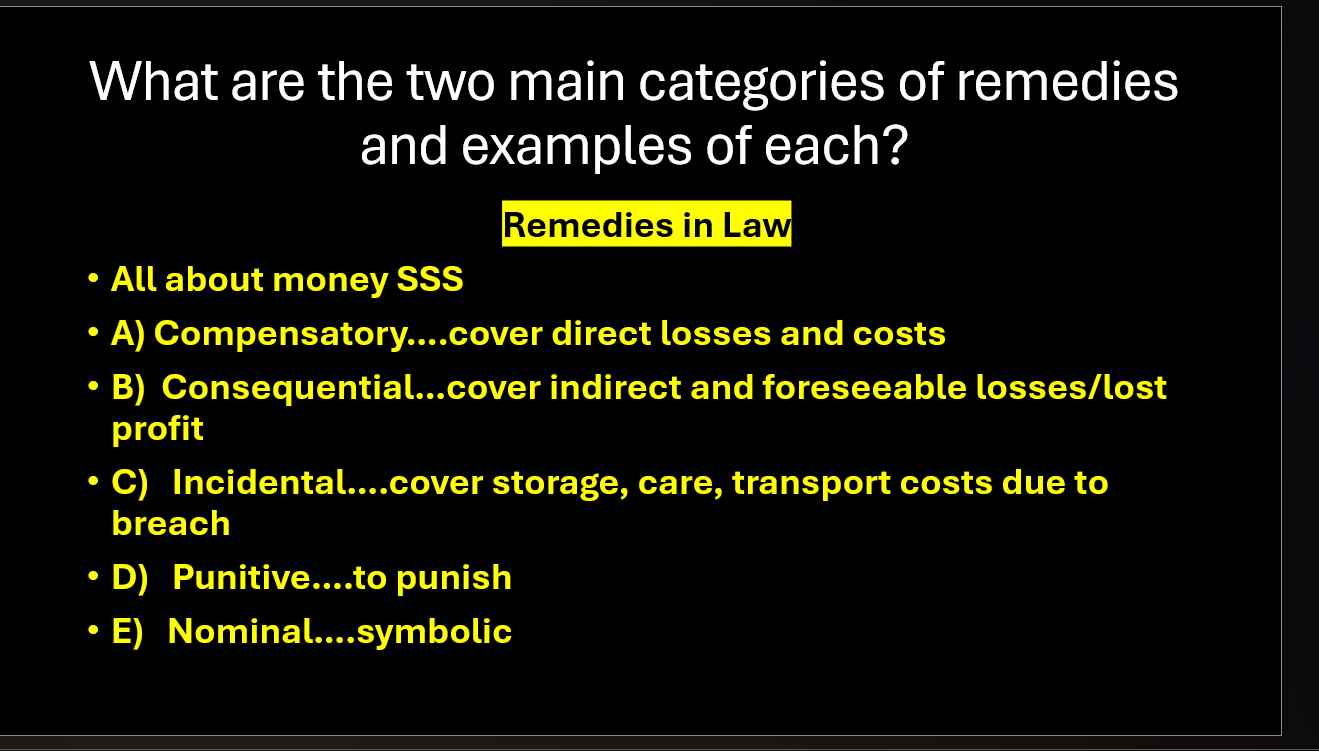
Remedies in Law
The solutions or relief that courts provide to someone who has been wronged or suffered harm due to another party's breach of contract, tort, or other legal violation.
Compensatory Remedies (Monetary)
To compensate/reimburse the injured party for actual losses
Consequential damages
cover indirect and foreseeable losses/lost profits
Incidental damages
cover storage, care, transport costs due to breach
Punitive damages
to punish the wrongdoer (though these are still monetary, they serve a non-compensatory purpose)
Nominal damages
symbolic amount when there's a legal wrong but no actual financial harm
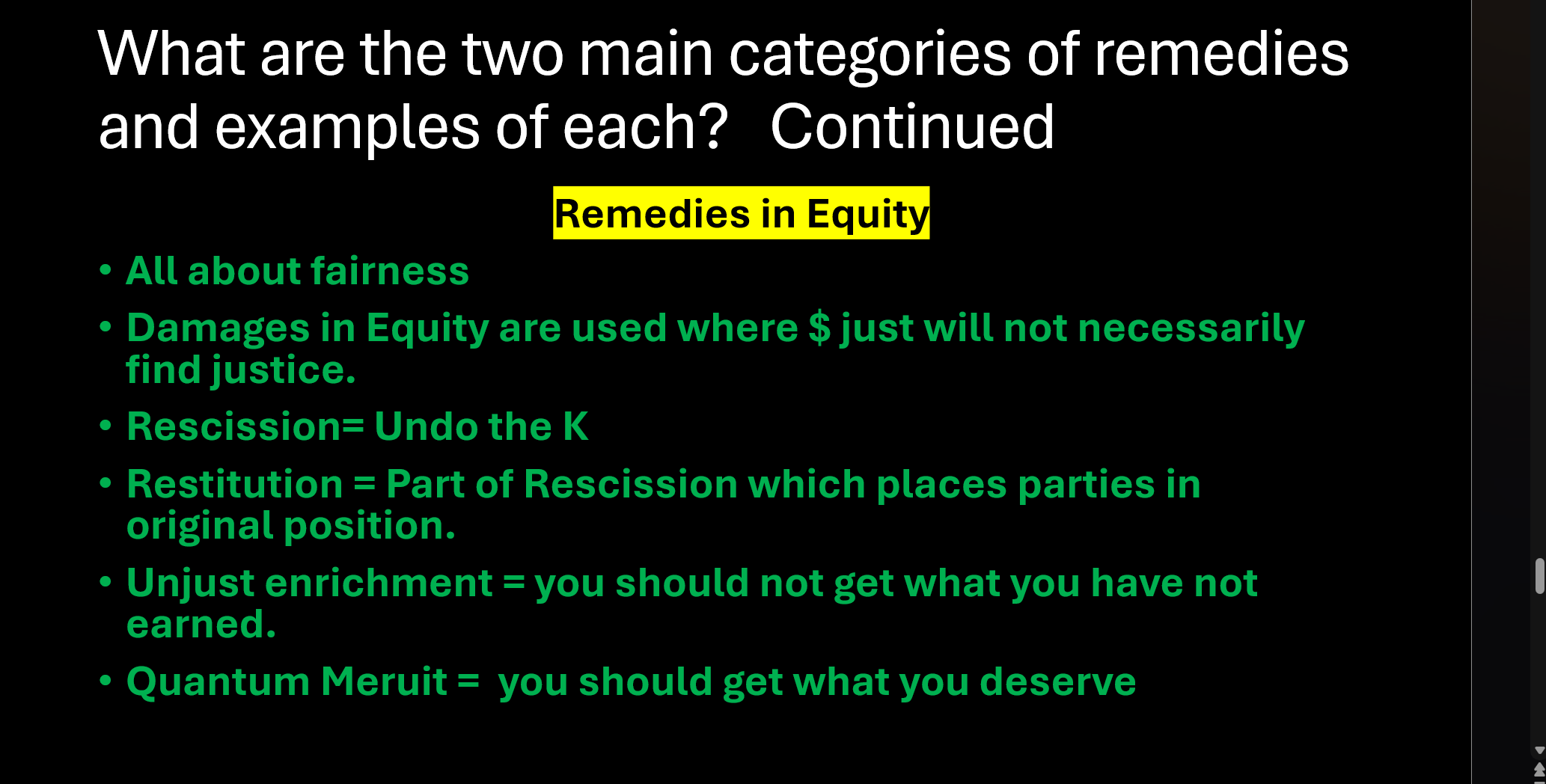
Remedies in Equity
They are non-monetary solutions that courts provide when money damages alone won't adequately fix the problem or achieve fairness.
Mitigation of Damages
your duty to minimize your own losses after someone breaches a contract with you.
Mitigation Damages
The legal duty of the injured party to take reasonable steps to reduce or minimize their losses after the other party breaches the contract.
Liquidated Damages Clause
a contract provision that specifies in advance the exact amount of money one party must pay if they breach the contract.
Specific Performance
Court order to complete performance. Cannot be used for service Ks (slavery) and must be used for unique items ( not easily replaced).
Injunction
Court order to stop doing something. Cannot be extreme or unreasonable
What happens to the mitigation damage you have to pay more due to breach? Joe agrees to sell Mary a jacket for $ 800 but backs out of the deal forcing her to pay $ 1,000 for the same jacket.
Mary can sue Joe for $ 200 mitigation damages because she was forced to pay $ 200 because of Joe’s breach.
What happens to mitigation damages when you end up with less dueto breach? Suppose instead that Mary was the one who backed out and Joe was forced to sell the jacket to Hilda for $ 500.
Joe could sue Mary for $ 300 mitigation damages because he got $300 less for the jacket due to Mary’s breach.
Compensatory damages
The person who did not fulfill their promise is held liable to cover the victim’s financial loss.