Aerobic Gram Negative Cocci
 Call Kai
 Learn
Learn Practice Test
 Spaced Repetition
 Match
Match Flashcards
 Knowt Play
1/75

There's no tags or description
Looks like no tags are added yet.
Name | Mastery | Learn | Test | Matching | Spaced | Call with Kai | Chat |
|---|
No analytics yet
Send a link to your students to track their progress
76 Terms
what genus is related to eikenella, kingella, simmonsiella, and moraxella spp.?
neisseria
many ____ is part of normal flora of the upper respiratory tract of animals.
neisseria
which species of neisseria is never a normal flora organism?
neisseria gonorrhoeae
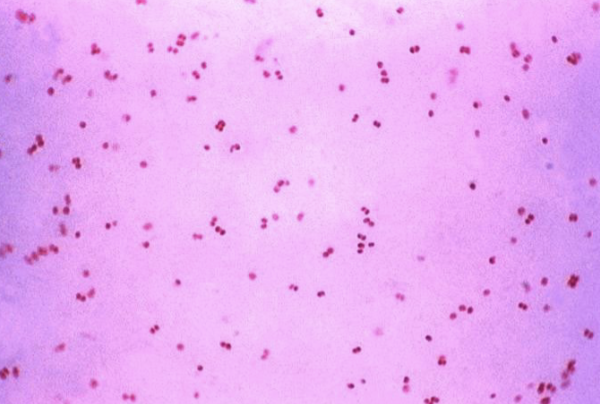
which bacterial genus is a kidney/coffee bean shaped gram negative diplococci or coccobacilli?
neisseria
which species of neisseria is rod-shaped?
neisseria elongate
all neisseria are oxidase ____.
positive
all neisseria are non-motile. true or false?
true
all neisseria are catalase ____.
positive
all neisseria are nitrate ____.
negative
neisseria are not fastidious. true or false?
false
which bacterial genus grow best in 5-10% CO2 at 37°C?
neisseria
which bacterial genus hates the cold and media should be at room temperature before plating for culture?
neisseria
which neisseria species require enriched media (CHOC)?
neisseria gonorrhoeae
which bacteria is also known as gonococcus, GC, clap, or drip?
neisseria gonorrhoeae
neisseria gonorrhoeae will appear as gram negative diplococci often appearing _____ on gram stains (within PMNs).
intracellular
____ urethral specimens with intracellular gram negative diplococci is diagnostic for neisseria gonorrhoeae.
male
____ urethral specimens are not as sensitive via gram stain and thus diagnosis for neisseria gonorrhoeae is made on culture results.
female
____ specimens for neisseria gonorrhoeae contain many normal flora so culture is necessary to diagnose.
rectal
____ specimens with a gram stain alone are not accurate because a patient may be colonized with commensal neisseria species, so culture is needed to diagnose neisseria gonorrhoeae.
pharyngeal
neisseria gonorrhoeae is fastidious and does not survive long outside the host. true or false?
true
the following is associated with culturing _____:
Must culture immediately
Swabs, if used, should be of Dacron or rayon (some cotton and calcium alginate swabs may inhibit gonococci)
Transport media
Non-nutrient:
Amies medium
Can be held at room temp for up to 12 hours before inoculation onto culture media
Nutrient
Transgrow, JEMBEC, Bio-Bag, Gon-Pak
Clinical material must be free of lubricants/spermicides
Do not use cold media, if possible
neisseria gonorrhoeae
neisseria gonorrhoeae will grow on SBA. true or false?
false
the performance of nucleic acid amplification tests (NAATs) with respect to overall sensitivity, and ease of specimen transport is better than that of any of the other tests available for the diagnosis of chlamydial and gonococcal infections. true or false?
true
laboratories should use NAATs to detect chlamydia and gonorrhea except in the cases of ____ involving boys and rectal and oropharyngeal infections in prepubescent girls.
child sexual assault
laboratories should use not use NAATs when evaluating a potential gonorrhea treatment failure because cultures are necessary for _____ testing.
susceptibility
_____ refers to inflammation of the urethra; pus-containing urethral discharge and dysuria.
acute urethritis
neisseria gonorrhoeae in _____ is associated with the following:
acute urethritis
prostatis
epididymitis
males
neisseria gonorrhoeae in _____ is associated with the following:
urethral infections
cervicitis
pelvic inflammatory disease (PID)
females
____ refers to an asymptomatic (usually inititally) or produce cervical discharge, fever, acute pain, dysuria.
cervicitis
pelvic inflammatory disease (PID) can lead to ____.
sterility
neisseria gonorrhoeae in _____ is associated with the following:
can become infected during vaginal delivery → gonococcal opthalmia neonatorum
neonates
what refers to a severe conjunctivitis leading to blindness in neonates that become infected with neisseria gonorrhoeae during vaginal delivery?
gonococcal opthalmia neonatorum
to prevent gonococcal opthalmia neonatorum, _____ eye drops are administered to all infants at birth.
erythromycin
for medicolegal cases (e.g., suspected child abuse), how many confirmatory tests of different methodologies must be used?
two
which complication of neisseria gonorrhoeae refers to bacteria have spread and colonized the heart’s endocardium → inflammation?
gonorrheal endocarditis
which complication of neisseria gonorrhoeae refers to when bacteria colonizes the membranes that surround the brain (meninges)?
gonorrheal meningitis
which complication of neisseria gonorrhoeae refers to infection within the joints?
gonorrheal arthritis
which complication of neisseria gonorrhoeae refers to colonization of the pharynx?
pharyngeal gonorrhea
which complication of neisseria gonorrhoeae refers to colonization of the anus?
anal gonorrhea
which complication of neisseria gonorrhoeae refers to untreated infections that may result in the bacteria entering the bloodstream → distributed throughout the body?
disseminated gonococcal infection (DGI)
which complication of neisseria gonorrhoeae include the usual symptoms: septic arthritis and skin lesions, although numerous parts of the body can become infected?
disseminated gonococcal infection (DGI)
emerging antibiotic resistance has reduced treatment options for gonorhea infection. true or false?
true
there are increasing cases of neisseria gonorrhoeae infections that are untreatable by all known antibiotics. ____ are the only antibiotics that stand between treatment and complete resistance.
cephalosporins
serogroups of ____ are differentiated via their polysaccharide capsules.
neisseria meningitidis
neisseria meningitidis are possibly part of normal flora of the upper respiratory tract but are spread by ____.
respiratory droplets
usually those in close contact with those with neisseria meningitidis should be given prophylaxis, usually ____.
ciprofloxacin
the most common serogroups of ____ in the U.S. include A, B, C, Y, and W135.
neisseria meningitidis
_____ includes disseminated intravascular coagulation (DIC) and waterhouse-friderichsen syndrome.
meningococcemia
which disease associated neisseria meningitidis includes the following:
petechiae (hemorrhagic skin lesions) common
shock
internal bleeding
can be rapidly fatal (death can occur hours after first symptoms appear
waterhouse-friderichsen syndrome
neisseria meningitidis is vaccine preventable (strains A, B, C, Y, W135). true or false?
true
which species of neisseria is associated with the following information:
Appropriate specimens for culture:
CSF
Blood
Petechial aspirates
Nasopharyngeal swabs
Get it to the lab quick!
Harmed by drying and temperature extremes
Direct detection: g-stain specimens
Examined for intra and extracellular gram negative diplococci
Latex agglutination & coagglutination antigen detection tests: test for meningococcal antigens
CSF
Urine
Serum
neisseria meningitidis
neisseria meningitidis do not grow on BAP. true or false?
false
neisseria meningitidis should be incubated in _____ CO2 and humidity (like neisseria gonorrhoeae).
increased
which type(s) of meningitis are associated with the following:
glucose: decreased
protein: increased
color: cloudy
WBC/PMNs: increased / increased
bacterial
which type(s) of meningitis are associated with the following:
glucose: normal; decreased
protein: normal; increased
color: clear / hazy
WBC/PMNs: normal to increased monos / lymphs
fungal; viral
which type(s) of meningitis are associated with the following:
glucose: decreased; very decreased
protein: increased
color: N/A
WBC/PMNs: lymphs
TB
other neisseria species include all neisseria except which two species?
neisseria gonorrhoeae; neisseria meningitidis
other neisseria species are normal flora of the ____.
respiratory tract
most "other neisseria species” grow on nutrient agar and are not fastidious. true or false?
true
____ is normal flora of the upper respiratory tract but can cause a number diseases including:
respiratory tract infections
bacteremia
endocarditis
otitis media
sinusitis
moraxella catarrhalis
which bacteria is associated with the following:
grows on BAP, CHOC, most nutrient agars; some strains can grow on gonococcal selective media
“hockey puck” or “scoots” when colony pushed on agar surface
gram stain: gram negative cocci/coccobacilli
moraxella catarrhalis
other than moraxella catarrhalis, other moraxella are ____ shaped.
rod
moraxella catarrhalis is ____ for the following:
catalase
oxidase
DNAse
nitrate
butyrate
esterase
positive
moraxella catarrhalis is assachrolytic so all carbohydrate tests are ____.
negative
what bacteria is associated with the following:
glucose: positive
maltose: negative
lactose: negative
sucrose: negative
neisseria gonorrhoeae
what bacteria is associated with the following:
glucose: positive
maltose: positive
lactose: negative
sucrose: negative
neisseria meningitidis
what bacteria is associated with the following:
glucose: positive
maltose: positive
lactose: positive
sucrose: negative
neisseria lactamica
what bacteria is associated with the following:
glucose: negative
maltose: negative
lactose: negative
sucrose: negative
moraxella catarrhalis
which bacteria is the only one that is nitrate and DNAse positive in this powerpoint?
moraxella catarrhalis
which testing is the traditional method for ID of neisseria (no longer recommended)?
cystine tripticase agar (CTA)
which testing uses heavy inoculum and high concentration of carbohydrate and the result is ready in 1-4 hours?
rapid carbohydrate test
which test is associated with the following:
detect preformed enzymes
colored end product formed when a specific substrate is hydrolyzed by the appropriate bacterial enzyme
enzymes analyzed for neisseria species:
beta galactosidase
gamma-glutamylaminopeptidase
hydroxyprothylaminopeptidase
can be used to ID: N. gonorrhoeae, N. meningitidis, N. lactamica (and presumptive M. catarrhalis)
chromogenic substrate tests
which bacteria is associated with the following results:
beta-galactosidase: negative
gamma-glutamylaminopeptidase: negative
hydroxyprothylaminopeptidase: positive
neisseria gonorrhoeae
which bacteria is associated with the following results:
beta-galactosidase: negative
gamma-glutamylaminopeptidase: positive
hydroxyprothylaminopeptidase: negative
neisseria meningitidis
which bacteria is associated with the following results:
beta-galactosidase: positive
gamma-glutamylaminopeptidase: negative
hydroxyprothylaminopeptidase: positive
neisseria lactamica
which bacteria is associated with the following results:
beta-galactosidase: negative
gamma-glutamylaminopeptidase: negative
hydroxyprothylaminopeptidase: negative
moraxella catarrhalis