Mutations and germ pools
 Call Kai
 Learn
Learn Practice Test
 Spaced Repetition
 Match
Match Flashcards
 Knowt Play
1/59

There's no tags or description
Looks like no tags are added yet.
Name | Mastery | Learn | Test | Matching | Spaced | Call with Kai | Chat |
|---|
No analytics yet
Send a link to your students to track their progress
60 Terms
What is evolution
· Evolution describes the change in the characteristics of a species over time
· It is a theory that explains the mechanisms that drive species to change over time
· Change is gradual, occurs over many generations (thousands and millions of years)
What is genes, alleles, genotypes, phenotypes
• Gene: A segment of DNA made up of a sequence of nucleotides that code afor the production of a specific protein
• Alleles: The variations of a particular gene that can be inherited
• Genotypes: The combination of alleles inherited from parents (mother & father) for a particular gene
• Phenotypes: The observable characteristic that is the result of a genotype
Mutations
· A new variation, resembling neither parent, that occurs quite suddenly and purely by chance.
· Permanent structural alterations in the DNA.
· Occur through changes to genes or chromosomes.
· In some cases, changes to the DNA have little effect or cause no harm.
· Occasionally a mutation can improve an organism’s chance of surviving.
· Mutant – an organism with a characteristic resulting from a mutation.
Mutations can be classified as either:
Gene mutations – changes in a single gene.
Chromosomal mutations - all or part of a chromosome is affected.
extra info
· If a mistake occurs spontaneously when the DNA molecule is copied during cell division, or when chromosomes are separated during meiosis creates significant effects on the functioning of the cell.
· Many mutations are repaired by the body.
· If a mutation remains, when the cell divides, the mutated DNA is copied and passed onto daughter cells.
· If daughter cells are gametes – mutation will be passed on from one generation to the next.
· Relatively few mutations exists amongst humans given the extremely large number of cell divisions that occur.
o Usually if a mutation occurs, it results in a trait that is better suited to the environment and contributes to a greater chance of survival
Mutagens/Mutagenic Agents
• Any agent that increases the rate at which mutations occur.
• Examples include X-rays, mustard gas, UV radiation, cosmic rays, radiation from radioactive waste, fallout from atomic and nuclear explosions.
Mutagens also affect developing embryos/foetuses:
• If pregnant women are exposed to mutagens (eg: large doses of X-rays), then their child may be born with intellectual disabilities
Causes of Mutations
• Induced mutations: Mutations caused by mutagens in the environment.
• Spontaneous mutations: Mutations that occur due to a random error during cell division (mitosis or meiosis)
Heritability of mutations
Somatic mutations – mutations that occur in body/somatic cells.
• ONLY the individual with the somatic mutation is affected.
• Involved in many cancerous growths resulting from a mutagenic agent.
Germline mutations – mutations that occur in the reproductive cells/gametes.
• individual is not usually affected.
• may be passed on to the next generation and subsequent generations.
Effects of Mutations
Silent mutations: does not cause a change in the amino acid produced by the mutated codon
Eg: GAG (Glu) GAA (Glu)
2. Neutral mutations: causes a change in the amino acid produced by the mutated codon, but the structure of the protein produced does not change enough for its function to change
Eg: GAG (Glu) GAC (Asp)
3. Missense mutations: causes a change in the amino acid produced and therefore the protein
Eg: GAG (Glu) AAG (Lys)
4. Nonsense mutations: changes the codon to STOP, producing a shorter protein
Eg: GAG (Glu) UAG (STOP)
Point mutation
A change in just one base is known as a point mutation (SNV)
Point mutations can form:
Substitution of a base for another base.
Insertion of a base.
Deletion of a base.
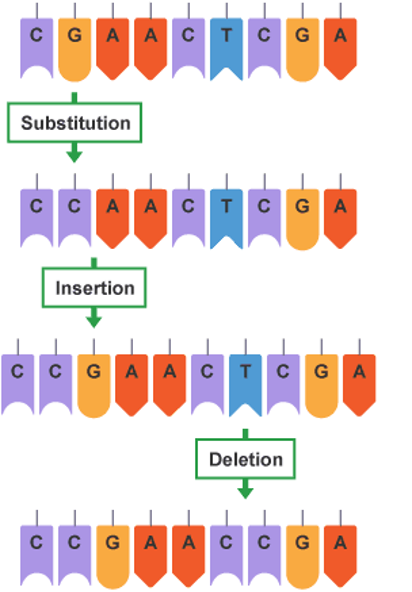
Frame Shift Mutations – Insertion/ Deletion
• Inserting or deleting one or more nucleotides changes the “reading frame” of the DNA sequence (similar to changing how a sentence is read).
• Alters how the codons are read during protein synthesis and therefore results in proteins being built incorrectly – has huge impact on organisms
cont
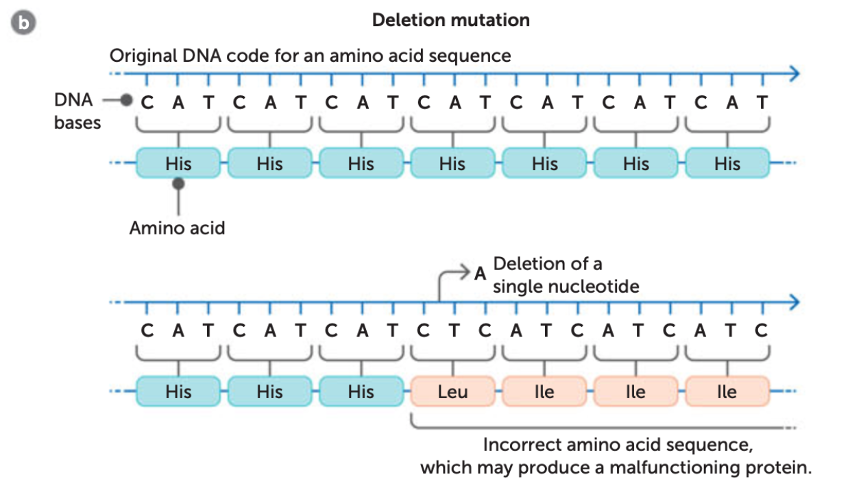
Effect of Point Mutations (SNV
• No effect on protein, abnormal protein – may be non-functional or missing protein.
• Proteins include enzymes, antibodies, structural proteins, membrane transport channels etc.
• Just one missing or abnormal protein can have an enormous effect on the entire body.
Albinism
· Albinism, is the result of one missing protein, tyrosinase. (enzyme involved in melanin production)
· Partial or complete absence of pigment from the hair, skin, and eyes.
· Prone to skin cancers.
Duchenne Muscular Dystrophy
- Affects boys due to germline mutation in the mother, which can then be inherited by her sons.
- May also occur in a male zygote so that the child develops the disease.
- It’s a wasting of the leg muscles and later the arms, shoulders and chest
- Apparent around the age of 3 to 5 years, when muscle weakness becomes evident.
- Young boys may stumble easily and have difficulty in climbing and frequently have to push their hands down on their legs to stand.
- As a boy gets older muscle tissue is replaced by fat.
- By around 12 to 14 years of age the child is unable to walk and later becomes bed-ridden.
- Death occurs due to failure of the respiratory muscles.
- Boys with the Duchenne form of muscular dystrophy are unlikely to live for more than 20 to 25 years.
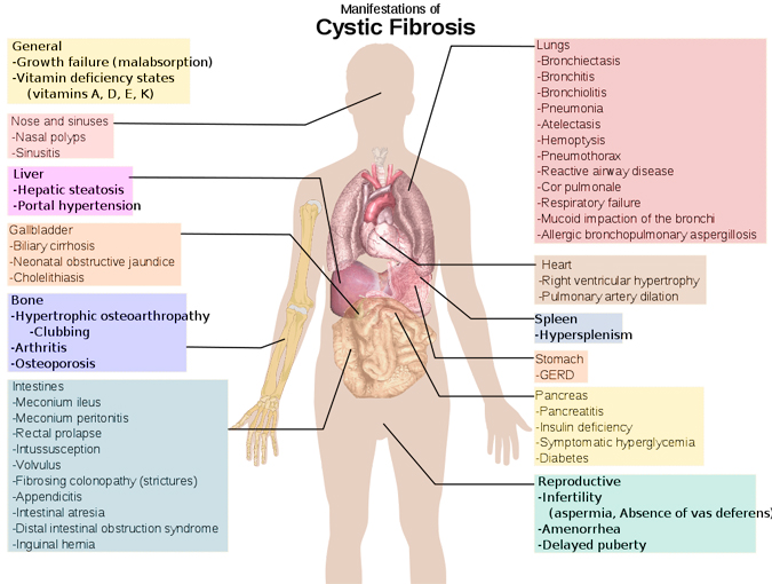
Cystic fibrosis
- Occurs in a huge gene (CFTR) which is found on Chromosome 7
- It is inherited as autosomal recessive.
- Over 500 different recessive mutations of the CFTR gene have been identified including deletions, missense, nonsense, terminator codon.
- The gene has the code for 1480 amino acids that make up a protein that regulates the passage of chloride ions across the cell membrane.
- Secretions dry because water usually follows chloride by osmosis.
- Common in Caucasians (1 in 26 carriers) – more resistant to cholera check.
Cystic Fibrosis – Treatment
- Drainage of lungs – lie on side to move secretions to other side.
- Chest physiotherapy - up to a few times a day.
- Deep breathing exercises.
- Nebuliser mask – saline mist to moisten secretions.
- Lung transplant can help.
- A modified diet – high fat diet.
- Supplementary pancreatic enzymes
- The use of antibiotics including (Tobramycin solution for Inhalation) to control lung infections.
Future:
Gene therapy inserting normal CFTR gene using adenoviral vectors and liposomes.
What is chromosomal mutation
· Involves all or part of a chromosome being mutated
· Consequently, a number of gene are affected
· Occurs due to errors during cell division especially in egg and sperm cells, therefore offspring are affected by mutation.
Types of chromosomal mutations
o Deletions
o Duplications
o inversions
o Translocations
o Non-disjunctions
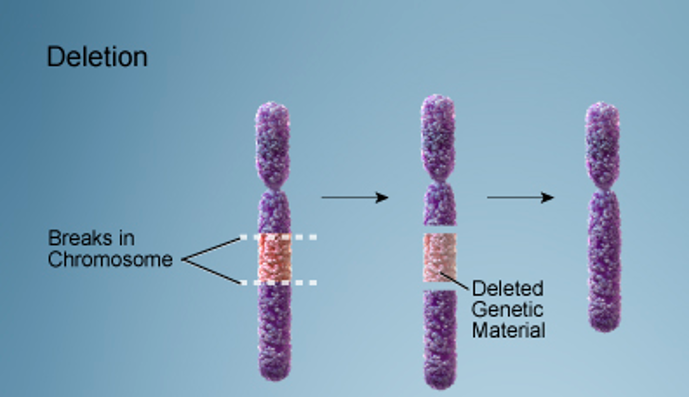
Deletion
• Due to breakage; a piece of a chromosome is lost.
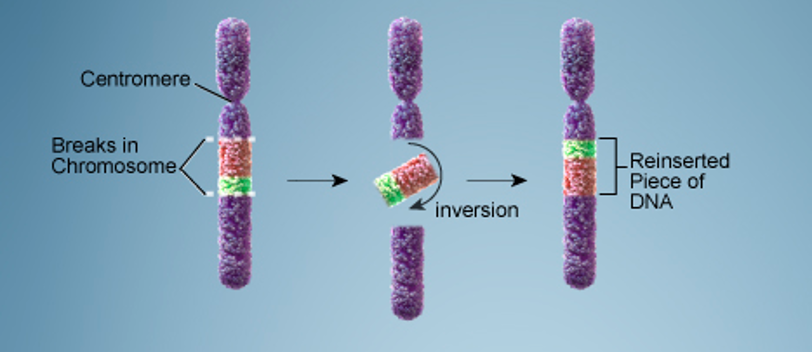
Inversion
• Chromosome segment breaks off; segment flips around backwards; segment reattaches.
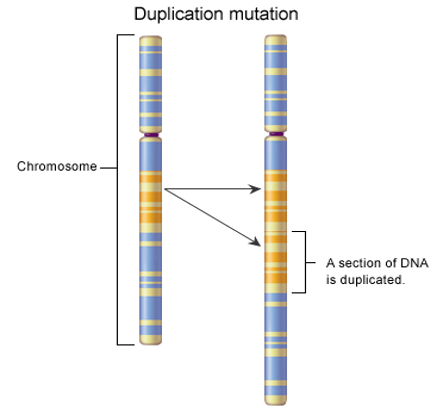
Duplication
• Occurs when a gene sequence is repeated.
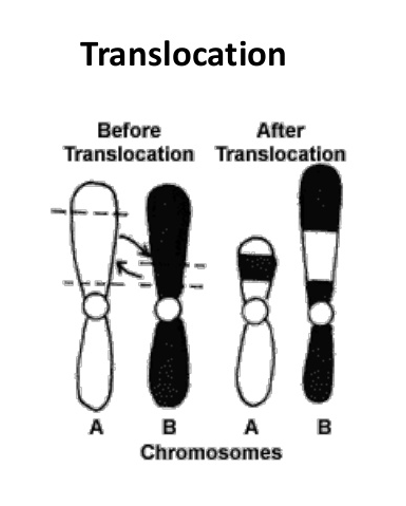
Translocation
• Involves two chromosomes that aren’t homologous.
• Part of one chromosome is transferred to another chromosomes.
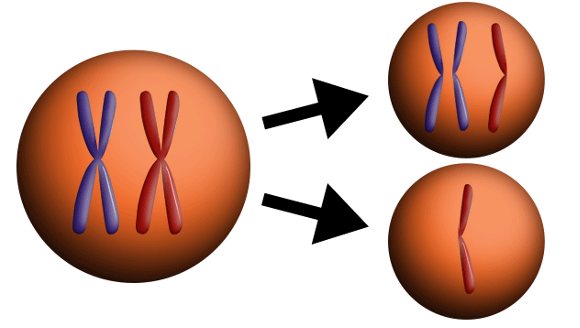
Non-disjunction
• Failure of chromosomes to separate during meiosis.
Causes gametes to have too many or too few chromosomes.
Effects of deletions, inversions, duplication and translocations depend on their locus (genes involved).
Deletions – gametes missing genes are often inviable (can’t survive) or result in miscarriage early in the pregnancy. Known to cause Wolf-Hirschhorn syndrome, Jacobsen syndrome,
Inversions – all genes are still present therefore offspring is unaffected, however, unusual order causes difficulties in crossing over during meiosis infertility.
Duplication – extra DNA can cause symptoms. Known conditions include Charcot-Marie-Tooth disease type 1A
Translocation – All DNA is still present so the organism has no symptoms, however, gametes will receive chromosomes with extra or missing DNA infertile.
terminology
Aneuploidy= a change in the chromosome number.
Disomy = 2 copies of each chromosome. Normal for human somatic cells.
Trisomy = 3 copies of a chromosome.
Monosomy = 1 copy of a chromosome.
• One extra (trisomy) or one missing (monosomy) chromosome has major consequences as there are many extra genes and therefore extra proteins being produced usually fatal miscarriage.
Aneuploidy
Aneuploidy may involve autosomes:
- Patau syndrome: Chromosome 13
- Edward syndrome: Chromosome 18
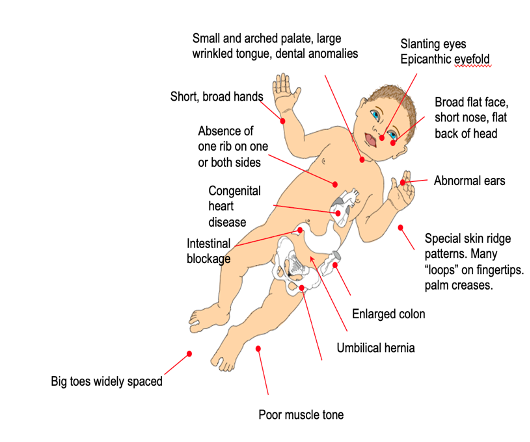
- Down syndrome: Chromosome 21
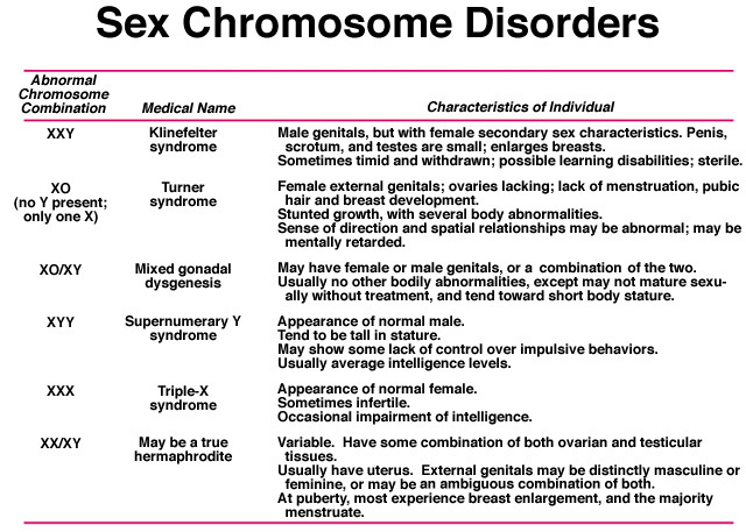
Aneuploidy may involve sex chromosomes:
- Klinefelter syndrome: XXY
- Turner syndrome: XO
Why are they called syndromes?
• When a disease causes multiple effects, it is called a syndrome.
• Virtually all chromosome abnormalities are in this category.
Partial Monosomy 5 – Cri du Chat
• From the French for ‘cry of the cat’,
• A rare genetic disorder due to a missing portion of chromosome 5.
• The infant sounds just like a meowing kitten, due to problems with the larynx and nervous system. About one third of children lose the cry by age 2.
• Other symptoms may include feeding problems because of difficulty swallowing and sucking, low birth weight and poor growth, and unusual facial features which may change over time.
• Varying levels of mental handicaps.
· Edward Syndrome - Trisomy 18
o The next most common trisomy after Down syndrome but much more severe.
o Incidence rate of 1 in 6 000 live births (with a
weak maternal age effect).
o Females are affected more than males (ratio of 1:2 of males: females.
o Commonly a result of non-disjunction in meiosis I or II or, more rarely translocation.
o Mosaicism also occurs where mutation occurs in infant only some cells affected.
Down Syndrome - Trisomy 21
• This is the most common form of aneuploidy in human newborns that remain viable at birth.
• Incidence rate of 1 in 800 births in women giving birth at 30 to 31 years of age. Relatively frequent in children of older mothers.
Causes
• There are three causes of Down syndrome, each producing a different severity of the syndrome.
• 95% of all cases result from non-disjunction of chromosome 21 during meiosis (see the karyotype right).
• 3-4% result from translocation of chromosome 21 (usually on to chromosome 14).
• 1-2% arise from a failure during mitosis (non-disjunction of chromosome 21) in a cell of a very early embryo. The resulting individual is a ‘mosaic’ of normal and Down syndrome cells.
Sex chromosome disorders
Lethal Recessive mutation
· Some recessive mutations are lethal if they are not masked by a dominant normal allele.
· These lethal recessives cause the death of the embryo or foetus (a miscarriage or spontaneous abortion) or the early death of the child.
· Lethal recessives – inheritance of two recessive alleles for particular mutations/disorders
· eg: Tay-sachs; Cystic fibrosis; sickle-cell anaemia; achnondroplasia – bone disorder causing disproportionate dwarfism; short limbs, normal sized torso – one from each parent – is fatal (causes death)
· If only one of the lethal recessives allele is inherited – usually not fatal
Tay-Sachs Disease (TSD)
· Tay-Sachs disease (TSD) is a disorder of lipid metabolism that is inherited in an autosomal recessive pattern.
· It occurs most frequently in individuals of Jewish descent from eastern Europe (the Ashkenazi Jewish population).
· This is a lethal recessive condition as the missing enzyme results in the accumulation of a fatty substance in the nervous system.
· A baby with two recessive alleles for TSD develops normally for the first few months, and then deterioration causing mental and physical disabilities begins.
· Death usually occurs in early childhood.
population, gene pool, gene frequency definition
• Population: A group of organisms of the same species that live in the same place at the same time and are reproductively isolated and breed with each other (i.e. humans can only breed with humans)
• Gene pool: Total sum (amount) of alleles within a population
• Allele frequency: How often an allele of a gene is present within a gene pool.
Allele frequency
· Frequency of a particular allele can differ between populations
· Eg 1: Scandinavians commonly have blue eyes, whereas Sub-Saharan Africans commonly have brown eyes.
o Frequency of blue eye allele in Scandinavian population is greater than in Sub-Saharan African population
· Allele frequencies also differ over time and are not usually constant
· Eg 2: Frequency of lighter skin colour in Australia
o In 1700, the frequency of lighter skin individuals was 0%
o In 2016, the frequency of light skin individuals was approx. 89%
cont
· Over time, the frequency of alleles changes and can be affected by:
§ Mutation of an allele
§ Migration & gene flow
· When an individual of same species migrates from one population to another population in a different area, - gene flow is occurring.
o Immigration of individuals - Movement into a population – May add new alleles
o Emigration of individuals - Movement out of a population – May completely remove some alleles
o Reproduction rate of various individuals - Number of offspring born that year
Migration Lesson 6 - terminiology, for population, gene pool, allele frequency, gene flow
• Population - a group of organisms of the same species living together in a particular place at a particular time.
• Gene Pool - Sum of all the alleles in a given population.
• Allele Frequency - How often each allele of a gene occurs in a population.
• GENE FLOW – the movement of genetic material from one population to another
Allele Frequency in Populations
• Populations that differ in the characteristics they possess, are likely to be different in the frequencies of the various alleles of a gene in their respective gene pools.
• Any two populations having differing characteristics are likely to have different gene pools.
• Over time, frequency of alleles in a population may change.
• Changes may be due to:
i. chance events
ii. Natural means where changes in the environment may result in variations to the allele frequencies.
Variation in Populations
Variations that exist between individuals within a species are due to:
• Mutations (new alleles)
• Random Assortment
• Crossing Over
• Non-disjunction
• Random Fertilisation
Changing Allele Frequency – Migration
Ø Gene flow from one population to another.
Ø How does migration affect allele frequencies within a gene pool?
Immigrants to a certain country can bring alleles that may not already be present in that population, resulting in frequencies for those alleles of that gene to be altered
Example 2: Arrival of Europeans in Australia
• Prior to colonisation by the British in 1788, indigenous population of Australia had no contact with European disease and very little genetic resistance that Europeans had developed over time
• Chickenpox, smallpox, influenza and measles spread throughout the Aboriginal population
• Approx. 90% of the decline in Aboriginal population was a result of disease
• Allele frequency of the surviving population changed
Barriers to Gene Flow
Barriers to gene flow affect the allele frequency of a population…..
• Populations are kept apart by barriers that inhibit the amount of interbreeding between them.
• As no two environments are exactly the same, environmental pressures on one population will be different from the pressures on the other.
• This results in slightly different characteristics being favoured in one population compared to the other.
• Over time, allele frequencies of each gene pool will change depending on which characteristics are favoured for survival.
Changing Allele Frequency
• These changes in each population over many generations result in populations becoming less alike as they develop characteristics better suited in the development of separate gene pools.
• For early human populations, most common barriers to interbreeding were geographical barriers…… oceans, rivers, mountain ranges, lakes, deserts, ice sheets etc.
• Sociocultural barriers – e.g language barriers
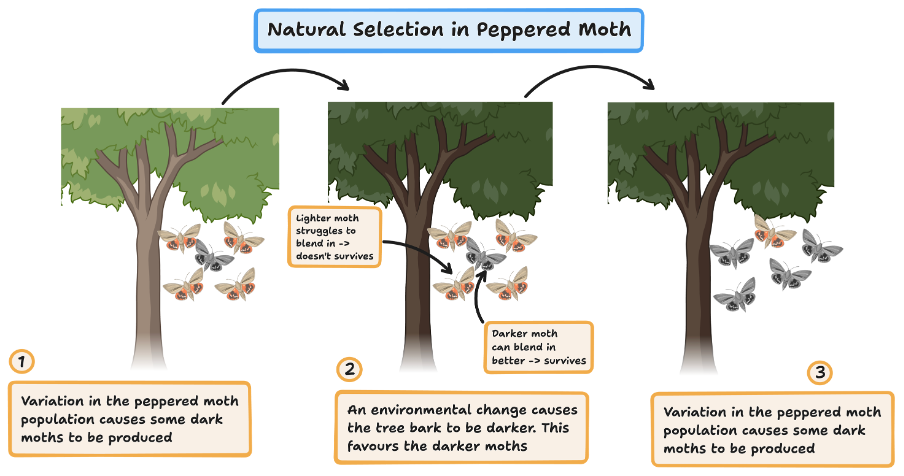
Natural Selection
• Process by which a species becomes better adapted to its environment.
• Those individuals with favourable characteristics have a survival advantage and so pass those characteristics on to subsequent generations.
Darwin’s Observations
• Evolution - Gradual change in the characteristics of a species over time
Darwin’s theory of natural selection was based on three observations:
o Variation
• All members of a species vary
• Variations are passed on from one generation to the next, characteristics being displayed by the parents are passed on to their offspring
o Birth Rate
• All living organisms reproduce at a far greater rate than that at which the available food supply and other resources increase
o Nature’s Balance
• Although the birth rate of organisms was very high, each species tended to maintain its numbers at a relatively constant level
Darwin’s Conclusions
• From these observations, Darwin concluded:
1. Excessive birth rate and limited resources meant that there must be a struggle for existence.
2. Range of variations in any species meant that those with characteristics best suited to their environment were the ones that were more likely to survive
o = SURVIVAL OF THE FITTEST.
Individual organisms do not adapt, the species adapts to its environment by natural selection and the process of adaptation takes many generations.
Principle of Natural Selection
There is variation of characteristics within a species.
More offspring of a species are produced than can possibly survive to maturity.
Due to excessive birth rate and limited resources, there is a struggle for existence – competition for survival.
Individuals with characteristics best suited to the environment have more chance of surviving and reproducing – survival of the fittest.
Favourable characteristics are passed onto the next generation.
Reproductive isolation ensures that there is no interbreeding between populations, so the frequency of the allele increases in the population
Body Stature
• Body Stature can be correlated with resistance to cold and heat.
• Initially human gene pool would have contained alleles for a whole range of statures from the short bodied, long limbed physique of present day Africans, to the long-bodies, short-limbed stature of the Inuit of today.
Hot Climate
• Individuals who have short bodies and long limbs have a larger surface area to body volume
• Lose more heat – survival advantage in hot climates
Cold Climate
• Individuals who have long bodies and short limbs have a smaller surface area to body volume
• Lose less heat – survival advantage in cold climates
Principles for marks
V=Variation
R=Reproduction rates
S=Struggle for existance
A=Advantageous trait = selection = selective advantage
R=Reproduction of allele of allele more likely = pass on to offspring
F=Allele freq changes to selected trait
Example 2: Sickle Cell
• Anopheles mosquito transmit the malarial parasite.
• Requires quiet, stagnant pools of water for breeding sites, which is more often found in open areas.
• Not normally found in tropical forests.
• As humans began to clear the forests for agriculture, the environment changed which created a breeding area for the Anopheles mosquito.
• The increased food supply from agricultural production allowed human population to increase, providing more bodies for mosquitoes to feed on = incidence of malaria increased.
Example 2: Sickle Cell
• What is the relationship between the distribution of malaria and the distribution of sickle-cell anaemia throughout the world?
Homozygous Dominant HSHS = normal blood cells
• Individuals can reproduce and pass their alleles onto subsequent generations
Homozygous Recessive HsHs = suffer from sickle cell anaemia
• Fatal, individuals usually die before reproducing
• Sickle-cell allele tends to be higher in regions where risk of malaria is high
• Individuals with one sickle-cell allele are more resistant to malaria than those with normal haemoglobin in their red blood cells
• Sickle-cell example shows how natural selections occurs in human populations.
• A favourable mutation established a new allele in the population.
• Having one of these alleles gave individuals living in malaria-prone areas a survival advantage.
• Presence of malaria acted as a selective agent for the sickle-cell allele.
Homozygous Dominant HSHS = normal blood cells
• Individuals can reproduce and pass their alleles onto subsequent generations - More susceptible to malaria – can die
Homozygous Recessive HsHs = suffer from sickle cell anaemia
• Fatal, individuals usually die before reproducing.
Heterozygous HSHs = sickle cell trait
• Individuals can reproduce and pass their alleles onto subsequent generations - Resistant to malaria.
Genetic drift
• Random, non-directional change in allele frequencies.
• Occurs in small populations.
The Founder Effect
• Type of genetic drift that occurs when a new population is formed by a small number of individuals over time
• Small sample size can cause marked deviations in allele frequencies
Example 1
• Pitcairn Island, small island in the Pacific, was inhabited in 1790 by the descendants of nine mutaneers from the Bounty together with 6 men and 12 women Polynesians from Tahiti
• Due to their isolation, there has been very few newcomers to the population and so few alleles have been introduced from outside
• Descendants from the original Pitcairn Island show less genetic diversity than the original parent population because they all descended from the small number of original settlers
Example 2
• Finland’s current population is believed to have come from a small group of individuals who settled in the south-western part of the country approx. 2000 years ago
• Since the initial migration, the population has remained relatively isolated with little immigration
• Gene pool of the Finn’s is quite different from gene pools of neighbouring European countries
Example 3: Dunker Population
• Dunker’s live in Pennsylvania, but originally came from Hesse, Germany.
• They descend from Old German Baptist Brethren who came to the US in early 18th Century.
• Their religion does not allow them to marry outside their group and thus they constitute an isolated breeding population within the total population of the US.
• Studies investigated a number of easily measureable physical traits including frequency of ABO, Rh and MN blood groups, mid-digital hair, left or right-handedness, attached or free earlobes.
• For most of the traits studied, Dunker’s varied in allele frequency from the present day population and also from the surrounding American population.
• Environment for both the Dunkers and the surrounding American population is essentially the same so natural selection would not account for differences in allele frequencies.
Example 4: Isolated population of Australian Aborigines
• Isolated population of the islands of the Bentinck and Mornington in Gulf of Carpenteria
• Originally these islands were part of the mainland. Rising sea levels cut them off and populations they contained became isolated
• Mornington Islanders maintained some contact with the mainland by using smaller islands to ‘hop’ from island to mainland
• Blood group frequencies of the islanders have been studied and compared with those of the population occupying Bayley Point on mainland
• Occupants of Bentick Island show allele frequencies for blood groups that fall outside the range for Aborigines in the rest of Australia
• There is a high proportion of IB and complete absence of IA unlike mainland which has high proportion of IA and low IB
Bottleneck effect
• Another extreme example of genetic drift
• An event such as a natural disaster severely reduces the size of a population.
• The allele frequency after the disaster may, by chance, be different from before the event.
• Surviving trait – purely by chance
Example 1 – Pingelap
• A typhoon in 1775 reduced the population of Pingelap, an island in Micronesia, to 20.
• Survivors formed the founding population for the current inhabitants
• Among the survivors was a person heterozygous for achromatopsia – an inherited form of total colour blindness.
• Allele for achromatopsia is recessive.
• Today the incidence of achromatopsia in Pingelap is 5%, in other parts of the world it is 0.0033%
• 30% of the Pingelap population are carriers for the allele.
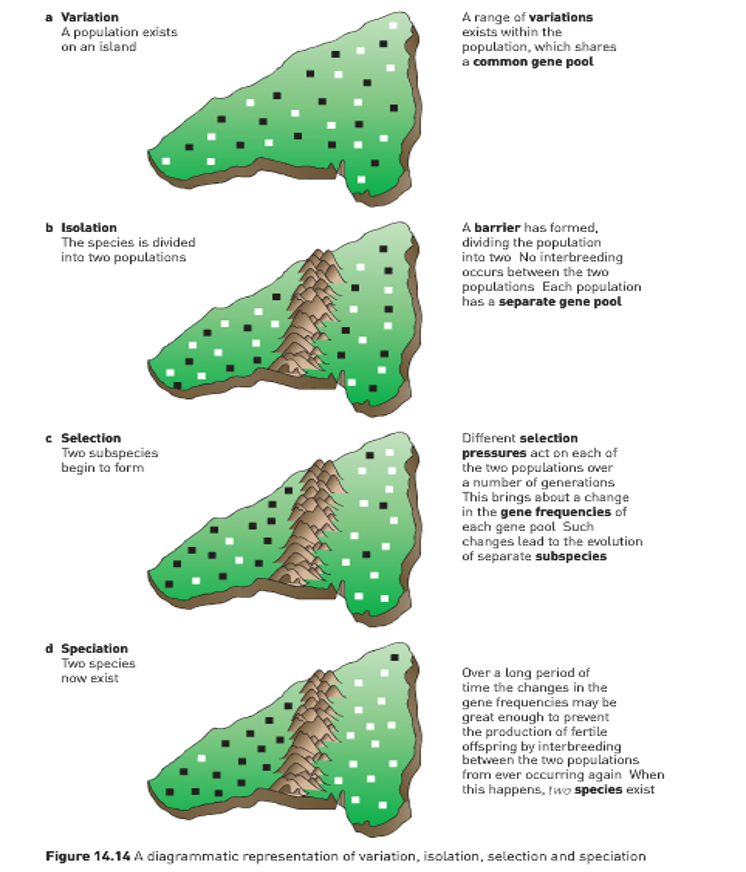
Speciation
• There is variation of characteristics within a species.
• Isolated population – no gene flow
• More offspring of a species are produced than can possibly survive to maturity.
• Due to excessive birth rate and limited resources, there is a struggle for existence – competition for survival.
• Individuals with characteristics best suited to the environment have more chance of surviving and reproducing – survival of the fittest
• Favourable characteristics are passed onto the next generation.
• In the gene pool, the proportion of alleles that produce favourable characteristics gradually increases – Significantly different to adjoining population
• Accumulation of enough change so Interbreeding no longer able to occur between overlapping/adjoining populations…speciation has occurred