Biochem 508 Lec 5: DNA Replication Elongation
 Call Kai
 Learn
Learn Practice Test
 Spaced Repetition
 Match
Match Flashcards
 Knowt Play
1/40

There's no tags or description
Looks like no tags are added yet.
Name | Mastery | Learn | Test | Matching | Spaced | Call with Kai | Chat |
|---|
No analytics yet
Send a link to your students to track their progress
41 Terms
E. Coli DNA Pol III has amazing ___. This is facilitated by binding of a __-__ protein that fully encircles the DNA.
Processivity, B-Clamp protein
What is the eukaryotic homolog to the bacterial B-clamp protein?
PCNA
How are B-Clamps loaded onto the DNA?
By a clamp loader complex

Loading the B-clamp onto DNA via the clamp loader complex is an __ dependent process.
ATP
How does a B-clamp of PCNA improve processivity of the replicative polymerase?
By preventing the polymerase from falling off.
What’s the correct order of proteins loaded involved in bacterial DNA replication?
DnaA, DnaC, DnaB, DnaG, DNA Pol III
DNA replication is ____. That means we need two forks moving in __ directions with a polymerase working on each.
Bidirectional, opposite
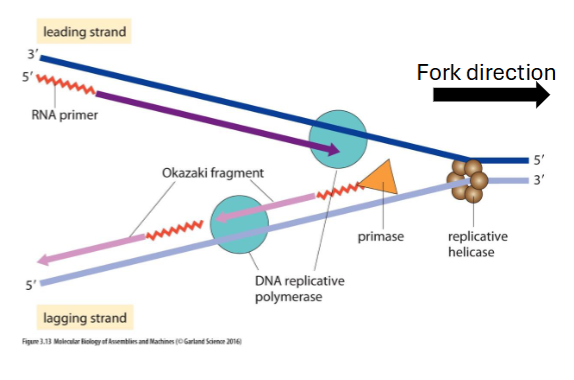
Because DNA replication is bidirectional, we have a __ and __ strand.
Leading, lagging
Leading strand synthesis requires a __ RNA primer. Lagging strand synthesis requires __.
Single, multiple
What are the short DNA fragments made by the lagging strand DNA polymerase called?
Okazaki fragments
Where does DnaG hang out during synthesis?
Near the replication fork, so that it can synthesize new RNA primers.
Describe Okazaki fragment synthesis
DnaB helicase unwinds strands at fork
DnaG primase hangs out near the fork synthesizing short RNA primers for the lagging strand
RNA primers are extended by Pol III, which continues until Pol encounters the previous okazaki fragment
Is DNA Pol III really just one protein?
No, it’s a complex of core polymerase subunits, clamps, and clamp loaders
Dna__ binds to Dna__ to create a short RNA primer at the fork on the lagging strand as Pol III nears the previous okazaki fragment
DnaG, DnaB
After DnaG has made its new primer, the clamp loader loads a ___ onto the template near the RNA primer
B-Clamp
After loading of a new clamp, the core Pol III subunits are moved to the ___ and ___ on the lagging strand
RNA primer and B-clamp
After the core Pol III subunits are relocated, a new ___ ___ is synthesized. As this happens, a new ___ is loaded onto the __ __ __.
Okazaki fragment, B-clamp, clamp loading complex
What is the significance of ss DNA BPs? Where do they bind?
They prevent ss regions of DNA during replication from forming hairpins, which could slow or block synthesis.
They bind on regions os ss DNA, particularly the region temporarily looped out due to DnaB activity.
DNA unwinding via DnaB results in extreme ___ of DNA ahead of DnaB
overwinding.
If enough overwinding is accumulated during replication, what can happen?
Synthesis may halt
How is overwinding relieved during DNA replication?
DNA gyrase, a topoisomerase, runs ahead of the replication fork. It relieves torsional strain that arises form DNA replication machinery
Dna gyrase induces a transient ds break, and then subsequently repairs it.
DNA Gyrase is a Type ___ Toposisomerase. This means…
Changes Lk in increments of -2 (induces negative supercoils)
ATP driven
What enzyme removes the RNA primers left over after synthesis is complete in bacteria?
DNA Pol I, 5’ to 3’ exonuclease activity
Describe what DNA Pol I does when it’s time to remove the RNA primers.
As is removed the RNA primers in a 5’ to 3’ fashion, it synthesizes new DNA 5’ to 3’. But there is still a ss break between okazaki fragments.
DNA Ligase requires energy because…
Making phosphodiester bonds is not thermodynamically favorable
Describe how DNA Ligase works
DNA Ligase transfers an AMP group to the 5’ phosphate of the nick. When the nucleophilic attack of the 3’ hydroxyl occurs, AMP is a good high energy LG.
Where does the AMP for activation of the 5’ phosphate for DNA Ligase come from in bacteria vs eukaryotes
Bacteria - NAD+
Eukaryotes- ATP
What is the replicative helicase for eukaryotes?
MCM
Both DnaB and MCM are helicases that run on the __ strand.
Lagging
What is the primase protein called in eukaryotes?
Pol alpha
Describe the action of Pol alpha
Synthesizes a short RNA (10-12 nt) and then switches to adding dNTPs for another 25 nt.
Low fidelity
How does the activity of the eukaryotic clamp loader differ from the bacterial clamp loader?
Eukaryotic clamp loader comes and goes from the replisome as needed, unlike the bacterial one.
What is the eukaryotic homolog for the bacterial B-clamp protein?
PCNA
What are the eukaryotic polymerases for leading and lagging strand synthesis?
Leading- Pol Epsilon
Lagging- Pol Delta
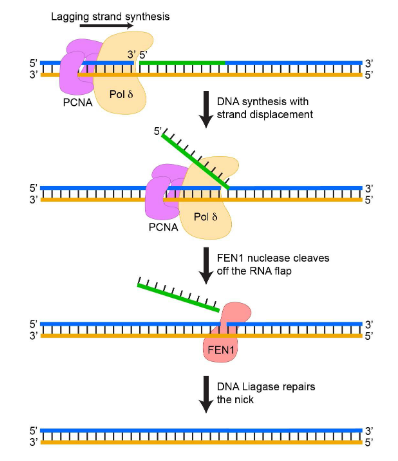
How is the primer removed in eukaryotic synthesis?
Pol delta, the lagging strand Pol, displaces the primer as it synthesizes from a free 3’ end
The displaces flap is then removed by FEN1
The leading strand primer is synthesized during the __ phase of replication, while the lagging strand primers are continuously synthesized.
Initiation
What are the sequences called which bacteria use to terminate DNA synthesis?
Ter sites
What protein binds the ter DNA sequences in bacteria?
TUS
TUS acts as…
a one-way block to the progression of the replication fork.
TUS/ter ensure that the replication forks meet at the same region each replication cycle.

When the counterclockwise replisome encounters the ___ trap, the replisome terminates and disassembles. The clockwise fork then catches up and finishes elongation.
counterclockwise
Upon completion, the two circular DNA products (in bacteria) are ___. We use what protein to separate the chromosomes?
concatenated, Topoisomerase IV