Organic Spectroscopy
 Call Kai
 Learn
Learn Practice Test
 Spaced Repetition
 Match
Match Flashcards
 Knowt Play
1/79

There's no tags or description
Looks like no tags are added yet.
Name | Mastery | Learn | Test | Matching | Spaced | Call with Kai | Chat |
|---|
No analytics yet
Send a link to your students to track their progress
80 Terms
What spectroscopy must be used when the molecular formula is not known?
mass spectrometry
Infrared is absorbed by molecules causing them to
move to excited vibrational states
What is an IR spectrum useful for?
determining presence of functional groups
What is the difference between wavenumber and frequency?
the speed of light (1/lambda vs c/lambda)
What are the units of wavenumbers
cm-1
what are the axes of IR plots
x = wavenumber/wavelength y=%transmission
What is the approximate frequency of an O-H or N-H stretch
3400 cm-1
What is the approximate frequency of an C-H (sp3) stretch
3000-2850 cm-1
What is the approximate frequency of an C-H (sp2) stretch
3100-3000 cm-1
What is the approximate frequency of an C-H (sp) stretch
3300
What is the approximate frequency of a C≡C and C≡N stretch
2100 - 2260
What is the approximate frequency of a C=O
1700 cm-1
What is the approximate frequency of a C=C, aromatic C-C
1600 cm-1
What is the approximate frequency of a aromatic C-C
1500 cm-1
When a nuclei has magnetic moment, in a strong magnetic field it will
absorb electromagnetic radiation in the radio frequency range
1H NMR spectra, given the integration of areas under signals in a spectrum provides
relative number of equivalent protons producing each signal
What is the n+1 rule?
if a proton is coupled to neighboring protons it will split into n+1 peaks
What is the chemical shift for an H attached to a sp3 C
1 ppm
What is the chemical shift for an H attached to a C atom attached to a pi-system
2 ppm
What is the chemical shift for an H attached to a C atom attached to an X atom (where X= O, F, Cl, Br, I)
3-4 ppm
What is the chemical shift for an H attached to an sp2 C atom
4-6 ppm
What is the chemical shift for an H attached to an aromatic C atom
7-8 ppm
What is the chemical shift for an H attached to an aldehyde C atom
10 ppm
What is the chemical shift for an H attached to a carboxylic acid C atom
11-12 ppm
the number of lines in a 13C spectra correspond to what
number of different types of carbon atoms in a molecule
What is the chemical shift for an sp3 alkyl C atom
10-30 ppm
What is the chemical shift for an sp3 C atom attached to an O, N, or X
50-70 ppm
What is the chemical shift for an sp C atom
75-90 ppm
What is the chemical shift for an sp2 C atom
100-150 ppm
What is the chemical shift for an ester, amide, carboxyl C=O
160-180 ppm
What is the chemical shift for an aldehyde and ketone C=O
190-220 ppm
Measuring ion deflections yields a mass spectrum where ions are arranged according to
mass to charge (m/z) ratio
Molecular ions have the same mass as
the molecule
Molecular ions often fragment into
smaller ions and neutral components (radicals)
Fragmentation patters provide clues as to
structure of molecule
Abundances of fragment ions reflect
carbocation and radical stabilities
Resonance introduces single bonded character and therefore
reduces wavenumber
the carbonyl band for amides lies around
1650 cm-1
bonding to electronegative atoms with a max seperation of 2 atoms will shift the NMR signal
downfield
resonance will increase electron density therefore shifting the NMR signal
upfield
increasing substitution shifts NMR signal
downfield
What is the significance of electron density with regard to chemical shift?
electron density results in shielding/deshielding effects, so different protons present in different ranges of chemical shifts
Why does bonding to an electronegative atom increase chemical shift?
electronegative atoms decrease electron density on the proton leading to deshielding
chemical shift of an amine
1-5 ppm
chemical shift of an alcohol
1-5.5 ppm
chemical shift of a ketone
2-2.7 ppm
chemical shift of an ether
3.4-4.5 ppm
chemical shift of an alkene
4.5-7.5 ppm
chemical shift of an aromatic proton
6-9 ppm
chemical shift of an aldehydic proton
9-10 ppm
If there is symmetry in the molecule, this implies what about the protons?
there will be equivalent protons with the same signal
the peak at 0 ppm on a proton nmr spectra is BLANK to analyzed molecule, and is representative of BLANK
not relevant, reference compound tetramethylsilane
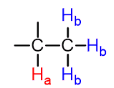
what would be the multiplicity of proton a
quartet
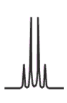
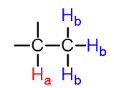
what would be the mutliplicity of proton b
doublet

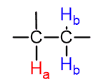
what would be the mutliplicity of proton a
triplet

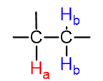
what would be the multiplicity of proton b
doublet

Resonance involving a carbonyl group moves the chemical shift
downfield (increased)
The most likely major fragment of a molecule will also be the
most stable carbocation
The major fragmentation of the molecular ion of ketones is
either alkyl group attached to carbonyl carbon atom to be lost as an alkyl radical to generate corresponding acyl cation
what the major type of fragmentation for alcohols, amines, and all types of carbonyl compounds?
alpha-cleavage
quaternary carbons produce BLANK in C NMR spectra
low signals
IR freq of terminal alkynes
3330-3270 cm-1
IR freq of aldehydes
2700 cm-1
IR freq of nitriles
2250 cm-1
IR freq of non-terminal alkynes
2260-2100 cm-1
IR freq of alkenes
1680-1640 cm-1
IR frequency of C-O stretch of alcohols, carboxylic acids, esters, and ethers
1320-1000 cm-1
IR freq of O-H bend of carboxylic acids
950-910 cm-1
IR freq of n-H bend of primary amines
1650-1580 cm-1
Low field in NMR corresponds to a BLANK ppm value
high
If all proton nmr signals lie in the under 3 ppm range, what can be assumed is not a characteristic of the molecule?
A carbon singly bonded to an electronegative atom (O, N, X)
Aldehydes that can participate in resonance will have C=O stretches closer to BLANK and non conjugated will have stretches close to BLANK
1705 cm-1, 1730 cm-1
cyclic ketones will have a C=O stretch at
1750 cm-1
conjugated ketones will have a C=O stretch at
1690 cm-1
non cyclic non conjugated ketones will have a C=O stretch at
1715 cm-1
conjugated esters will have a C=O stretch at
1715 cm-1
non conjugated esters will have a C=O stretch at
1735 cm-1
trisubstituted alkenes will have a medium sized stretch at
850 - 790 cm-1
What is the s, d, t, q rule for C NMR?
the #protons + 1 = the splitting (ie. 0 protons = singlet)
In C NMR, where will a C-N signal lie?
30-60 ppm