GN 311: Module 1
 Call Kai
 Learn
Learn Practice Test
 Spaced Repetition
 Match
Match Flashcards
 Knowt Play
1/168

There's no tags or description
Looks like no tags are added yet.
Name | Mastery | Learn | Test | Matching | Spaced | Call with Kai | Chat |
|---|
No analytics yet
Send a link to your students to track their progress
169 Terms
G1, S, G2, M
What are the four phases of the eukaryotic cell cycle?
G1; DNA replication
What is this phase of the eukaryotic cell cycle?
The first growth phase, where the cell increases in size, produces proteins and organelles, and prepares for ___ _________.
S (Synthesis); DNA; doubling
What is this phase of the eukaryotic cell cycle?
The cell replicates its ___, _______ its chromosome content.
G2
What is this phase of the eukaryotic cell cycle?
A second growth phase where the cell continues to grow and produces proteins needed for division, while also checking that DNA replication was completed correctly.
M (Mitosis); two; mitosis; cytokinesis
What is this phase of the eukaryotic cell cycle?
The cell divides its duplicated genetic material and splits into ___ daughter cells, encompassing both ______ (nuclear division) and _________ (division of the cytoplasm).
Interphase
What are G1, S, and G2 collectively known as?
It is a period between cell divisions when the cell spends most of its life.
G0
Some cells also exit the cycle into a resting state called ___ when they're not actively preparing to divide.
Sister chromatids
Two identical copies of a single chromosome, joined together at the centromere. They're created when a chromosome replicates during S phase, and they contain the exact same genetic information because one is literally a copy of the other.
They exist only temporarily, from the end of S phase until they get pulled apart during anaphase (of mitosis or meiosis II), at which point each chromatid becomes its own chromosome.
Homologous chromosomes
A pair of chromosomes, one inherited from your mother and one from your father, that carry genes for the same traits at the same locations, but aren't necessarily identical since they can carry different versions (alleles) of those genes.
A human cell has 23 pairs of these. Are present throughout the cell's life, not just after replication, and they only pair up physically during prophase I of meiosis, in a process called synapsis.
G1 of interphase
What does this image show?

Prophase
What is this phase of mitosis?

Metaphase
What is this phase of mitosis?

Anaphase
What is this phase of mitosis?

Telophase
What is this phase of mitosis?
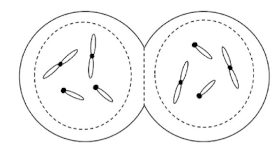
Two daughter cells, each 2n
What does this image show as a result of mitosis?

Meiosis I
What stage of meiosis is this describing?
Reductional Division (I)
Number of chromosomes in the daughter cells is half the number in the original cell. One of each homologous pair is in each daughter cell.
Separation of HOMOLOGS!
Meiosis II
What stage of meiosis is this describing?
Equational Division (II)
The number of chromosomes at the beginning and end of the division cycle is the same, but the daughter cells only have one chromatid.
Separation of CHROMATIDS!
Meiosis
Process by which gamete-producing cells divides to produce 4 meiotic products each with half of the original chromosome number.
Prophase I
What is this phase of meiosis?

Metaphase I
What is this phase of meiosis?
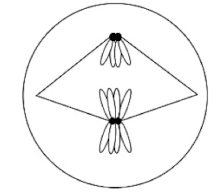
Anaphase I
What is this phase of meiosis?

Telophase I
What is this phase of meiosis?

Prophase II
What is this phase of meiosis?

Metaphase II
What is this phase of meiosis?
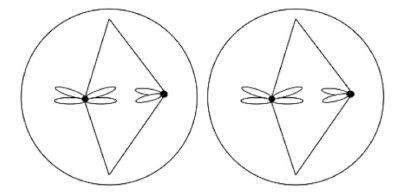
Anaphase II
What is this phase of meiosis?
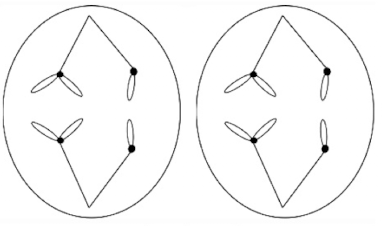
Telophase II
What is this phase of meiosis?
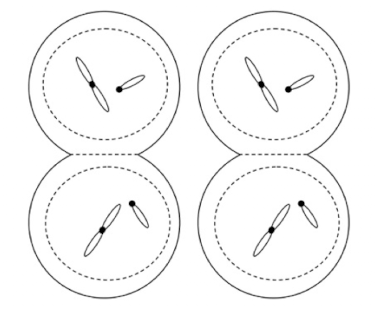
Four daughter cells, each n
What does this image show as a result of meiosis?
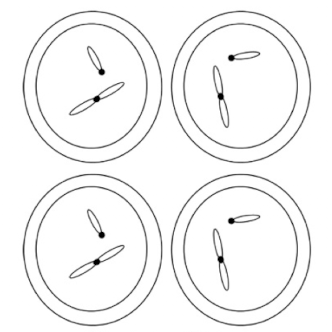
2n
What do the parent cells of mitosis and meiosis consist of?
4 chromosomes; 4 chromatids
In Mitosis (2n = 4), how many chromosomes and chromatids are in G1?
4 chromosomes; 8 chromatids
In Mitosis (2n = 4), how many chromosomes and chromatids are in S phase (after replication)?
4 chromosomes; 8 chromatids
In Mitosis (2n = 4), how many chromosomes and chromatids are in G2?
4 chromosomes; 8 chromatids
In Mitosis (2n = 4), how many chromosomes and chromatids are in prophase?
4 chromosomes; 8 chromatids
In Mitosis (2n = 4), how many chromosomes and chromatids are in metaphase?
8 chromosomes; 8 chromatids
In Mitosis (2n = 4), how many chromosomes and chromatids are in anaphase?
4 chromosomes; 4 chromatids
In Mitosis (2n = 4), how many chromosomes and chromatids are in each daughter cell for telophase?
4 chromosomes; 4 chromatids
In Meiosis (2n = 4) per cell, how many chromosomes and chromatids are in G1?
4 chromosomes; 8 chromatids
In Meiosis (2n = 4) per cell, how many chromosomes and chromatids are in S phase (after replication)?
4 chromosomes; 8 chromatids
In Meiosis (2n = 4) per cell, how many chromosomes and chromatids are in G2?
4 chromosomes; 8 chromatids
In Meiosis (2n = 4) per cell, how many chromosomes and chromatids are in prophase I?
4 chromosomes; 8 chromatids
In Meiosis (2n = 4) per cell, how many chromosomes and chromatids are in metaphase I?
4 chromosomes; 8 chromatids
In Meiosis (2n = 4) per cell, how many chromosomes and chromatids are in anaphase I?
2 chromosomes; 4 chromatids
In Meiosis (2n = 4) per cell, how many chromosomes and chromatids are in each cell for telophase I?
2 chromosomes; 4 chromatids
In Meiosis (2n = 4) per cell, how many chromosomes and chromatids are in prophase II?
2 chromosomes; 4 chromatids
In Meiosis (2n = 4) per cell, how many chromosomes and chromatids are in metaphase II?
4 chromosomes; 4 chromatids
In Meiosis (2n = 4) per cell, how many chromosomes and chromatids are in anaphase II?
2 chromosomes; 2 chromatids
In Meiosis (2n = 4) per cell, how many chromosomes and chromatids are in in each of the four final daughter cells in telophase II?
Separation of homologous chromosomes at anaphase I.
What event physically causes segregation of alleles?
The random orientation of each homologous pair (at the metaphase I plate, independent of how other pairs orient.)
What event causes independent assortment?
2^n
How many possible chromosome combinations can independent assortment alone produce, for an organism with n chromosome pairs?
No (Not by itself — genes on the same chromosome tend to be inherited together unless separated by crossing over, which is a different mechanism.)
Does independent assortment apply to genes on the same chromosome?
Random segregation
What does this describe?
Each gene exists as two alleles, one on each chromosome of a homologous pair, one inherited from each parent. During prophase I and metaphase I, that homologous pair lines up together at the metaphase plate. Then at anaphase I, the two homologs are pulled apart to opposite poles, physically splitting the two alleles from each other so that each resulting gamete gets only one of them, never both. Which specific homolog ends up at which pole is a matter of chance.
Independent assortment
What does this describe?
When an organism has more than one gene, particularly genes located on different chromosome pairs, each homologous pair lines up at the metaphase I plate independently of every other pair. One pair might position its maternally-inherited chromosome toward one pole while another pair, in that same cell, orients its chromosomes the opposite way or the same way, purely by chance and with no relationship between the two pairs. Because each pair's orientation is decided separately, the mix of maternally- and paternally-inherited chromosomes that ends up in any one gamete is randomized across all the different pairs. For an organism with n chromosome pairs, this alone can generate 2^n possible chromosome combinations in the gametes.
So offspring’s chromosome number is restored to diploid (when two gametes fuse during fertilization, the offspring's chromosome number is restored to diploid, instead of doubling every generation)
Why does meiosis reduce chromosome number from diploid to haploid?
Genetic variation among offspring (through independent assortment and crossing over…raw material natural selection acts on).
Besides keeping chromosome number stable, what's the other major importance of meiosis?
1; 2
How many divisions occur in mitosis? Meiosis?
Two daughter cells
How many daughter cells result from mitosis?
Four daughter cells
How many daughter cells result from meiosis?
Diploid, 2n (same as the parent cell)
What is the chromosome number of the resulting daughter cells in mitosis?
Haploid, n (half of the parent cell)
What is the chromosome number of the resulting daughter cells in meiosis?
Only meiosis (specifically during prophase I. Mitosis NEVER pairs homologs)
Does homologous chromosome pairing (synapsis) occur in mitosis, meiosis, or both?
Growth, tissue repair, and asexual reproduction in some organisms
What is the functional purpose of mitosis in the body?
Production of gametes for sexual reproduction
What is the functional purpose of meiosis in the body?
Cohesin
What holds sister chromatids together in mitosis and meiosis? It also acts at chiasmata in meiosis to hold homologs together.
Different forms of this protein in mitosis and meiosis.
Shugoshin
Protects cohesin at the centromere in anaphase I of meiosis, but is degraded by anaphase II. This allows homologs to separate in anaphase I, but keeps the sister chromatids together.
Nondisjunction
What is this describing?
The failure of chromosomes to separate properly during meiosis, resulting in gametes with too many or too few chromosomes.
Meiosis I
Where is this nondisjunction occurring?
A pair of homologous chromosomes fails to separate at anaphase I, so both homologs move to the same pole. After meiosis II proceeds normally, all four resulting gametes are abnormal: two gametes end up with an extra chromosome (n+1) and two end up missing that chromosome (n−1).
Meiosis II
Where is this nondisjunction occurring?
Homologs separate normally in meiosis I, but sister chromatids fail to separate at anaphase II in one of the two secondary cells. This produces two normal gametes (n) from the unaffected cell, plus one gamete with an extra chromosome (n+1) and one missing a chromosome (n−1) from the affected cell.
Meiosis I = all abnormal gametes; Meiosis II = mix of normal and abnormal gametes.
(Meiosis I nondisjunction produces only abnormal gametes (all four are either n+1 or n−1). Meiosis II nondisjunction produces a mix: two normal gametes and two abnormal ones (one n+1, one n−1).)
How can you tell nondisjunction in meiosis I apart from nondisjunction in meiosis II by looking at the gamete outcomes?
An individual with one extra copy of a chromosome (written as 2n+1, resulting from a nondisjunction gamete fertilizing a normal gamete)
What is a trisomic individual?
An individual missing one copy of a chromosome (written as 2n−1, resulting from a nondisjunction gamete (missing a chromosome) fertilizing a normal gamete)
What is a monosomic individual?
Down syndrome (Trisomy 21 — an individual with three copies of chromosome 21, caused by nondisjunction during egg or sperm formation)
What is a well-known example of a condition caused by nondisjunction?
It disrupts gene dosage (the genes on that chromosome are present in the wrong ratio relative to the rest of the genome, throwing off the balance of proteins needed for normal development)
Why can having an extra or missing chromosome be harmful, even though the DNA sequence itself isn't mutated?
The gene dosage imbalance is severe enough to disrupt development that most aneuploid embryos aren’t viable.
(The gene dosage imbalance is severe enough to disrupt development so critically that most aneuploid embryos aren't viable; only a few, generally involving the smallest chromosomes (like 21) or the sex chromosomes, are compatible with survival to birth)
Why are most aneuploidies (trisomies and monosomies) associated with miscarriage rather than live birth?
RY, Ry, rY, ry (each equally likely)
A parent has genotype RrYy, where R and Y are inherited together on one chromosome and r and y together on the homologous chromosome (R/r and Y/y are on different, unlinked chromosome pairs). What are the 4 possible gamete genotypes from independent assortment?
Ry and rY (these only exist because the R/r pair and the Y/y pair assort independently of each other, since they're on different chromosomes)
Which of those four gametes are "new" combinations that weren't paired together on either of the parent's original chromosomes?
Environmental sex determination
What is this describing?
Sex is determined by environmental factors during development (e.g. temperature) rather than by sex chromosomes.
Haplodiploidy
What is this describing?
A system (seen in bees and wasps) where males develop from unfertilized haploid eggs and females are diploid.
Protenor
What is this describing?
XX/XO chromosomal sex determination system. EX: In grasshoppers, the sexes have different chromosome numbers (one sex is missing a chromosome).
Lygaeus
What is this describing?
XX/XY chromosomal sex determination system. EX: In humans, both sexes have the same chromosome number, but one pair isn’t homologous.
Heterogametic
____________ sex produces two different gamete types (e.g., XY → X or Y sperm).
Homogametic
____________ sex produces only one gamete type (e.g., XX → X eggs only).
Males (XY); Females (ZW)
Which sex is heterogametic in humans, and which is heterogametic in birds/butterflies (ZZ/ZW system)?
Hemizygous
What does this describe?
Having only one copy of a gene, as males do for X-linked genes since they have only one X.
SRY gene; encodes testis-determining factor (TDF… triggering undifferentiated gonadal tissue to become testes).
What gene on the Y chromosome triggers male development, and what does it encode?
Develops phenotypically as a male
What happens if an XX individual inherits the SRY gene?
Develops phenotypically as a female
What happens if an XY individual lacks the SRY gene?
Pseudoautosomal
What is this region called?
A region of homology between the X and Y chromosomes that allows them to pair and cross over during meiosis.
Lyon hypothesis
What does this describe?
In each somatic cell of a female mammal, one of the two X chromosomes is randomly inactivated early in development, and all descendant cells retain that same inactivation, making females mosaics for X-linked traits.
Barr body
What does this describe?
The inactivated, condensed X chromosome visible in a female somatic cell's nucleus.
To determine the number of ____ _____, you do: # of chromosomes — 1.
1
How many Barr bodies does a normal female (XX) have?
0
How many Barr bodies does a normal male (XY) have?
0
How many Barr bodies does a Turner (XO) individual have?
1
How many Barr bodies does a Klinefelter (XXY) individual have?
X-linked
In tortoiseshell cats, what causes the patchy black/orange coat?
The __-______ coat color gene has a black allele (B) and an orange allele (b). In a heterozygous female (XBXb), random X-inactivation means some cells silence the B-carrying X (producing orange patches) and others silence the b-carrying X (producing black patches).
Requires heterozygosity at the X-linked locus (XBXb… So needs two different X chromosomes — a male would need an extra X chromosome (Klinefelter syndrome, XXY) to be tortoiseshell)
Why is tortoiseshell almost only seen in female cats?
No (X-inactivation is random, so even a genetically identical clone would show a different patch pattern)
Would a clone of a tortoiseshell cat have the same coat pattern?
Autosomal
For _______ traits, it doesn't matter which parent carries which allele — reciprocal crosses give the same results.
X-linked
For __-______ traits, reciprocal crosses give different results, since sons get their only X from their mother and daughters get one X from each parent.
½ (all daughters are carriers with normal vision (XBXb), and all sons are colorblind (XbY))
A color-blind female (XbXb) mates with a normal-vision male (XBY). What's the probability their first child has normal vision?
0 (every son gets his only X (Xb) from his colorblind mother, so all sons are XbY (colorblind))
A color-blind female (XbXb) mates with a normal-vision male (XBY). What's the probability their first child is a male with normal vision?