Chapter 6: Reaction Kinetics
 Call Kai
 Learn
Learn Practice Test
 Spaced Repetition
 Match
Match Flashcards
 Knowt Play
1/5

There's no tags or description
Looks like no tags are added yet.
Name | Mastery | Learn | Test | Matching | Spaced | Call with Kai | Chat |
|---|
No analytics yet
Send a link to your students to track their progress
6 Terms
Rate of Reaction
Definition:
The rate of a reaction is defined as the change in concentration of a reactant or a product per unit time
Units of Rate:
mol dm−3s−1
mol dm−3min−1 (other units of time)
Example: H2 + I2 → 2HI
Change in concentrations of H2 and I2 are the same
Change in concentration of HI 2x faster
Rate of [H2] = ½ rate of [HI]
![<p>Definition:</p><ul><li><p>The rate of a reaction is defined as the <strong>change in concentration</strong> of a <strong>reactant or a product</strong> <u>per unit time</u></p></li></ul><p></p><p>Units of Rate: </p><ul><li><p>mol dm<sup>−3</sup>s<sup>−1</sup></p></li><li><p>mol dm<sup>−3</sup>min<sup>−1 </sup>(other units of time)</p></li></ul><p></p><p>Example: H<sub>2</sub> + I<sub>2</sub> → 2HI</p><ul><li><p>Change in concentrations of H<sub>2</sub> and I<sub>2</sub> are the same</p></li><li><p>Change in concentration of HI 2x faster</p></li><li><p>Rate of [H<sub>2</sub>] = ½ rate of [HI]</p></li></ul><p></p>](https://assets.knowt.com/user-attachments/6a19b3a2-4d1f-4101-87fc-575bda751e89.png)
Concentration-Time Graph
Rate of Reaction = Gradient of the tangent of a concentration-time graph
y1-y2 / x1-x2
Draw a tangent at t = x to find the gradient
Initial Rate of Reaction:
When t = 0
Instantaneous Rate of Reaction:
Specified time t
Average Rate of Reaction:
The change in concentration of a reactant or a product over a specified time interval
Negative Gradient:
It indicates a decrease in concentration
Usually for reactants
Positive Gradient:
It indicates an increase in concentration
Usually for products
Gradients:
Steeper the gradient = Faster the rate of reaction
When gradient =0 , there is no change in concentration
This means rate of reaction is zero
The reaction has stopped
Rate Equation
Definition:
The rate equation is an experimentally determined equation that relates the rate of reaction to the concentrations of the reactants raised to appropriate powers
Rate Equation:
rate (mol dm-3s-1) = k [A]m [B]n (mol dm-3)
m and n are the orders of reaction with respect to [A] and [B] respectively
k is the rate constant
Order of Reaction
Definition:
The order of reaction with respect to a reactant is the power on its concentration term in the rate equation. The order of reaction must be determined experimentally.
Overall / Total Order of Reaction:
It is the sum of the individual orders
Order of Reaction & Reaction Rate:
The order of reaction with respect to a reactant, A, tells us how the concentration of that reactant affects the reaction rate
The order of reaction are usually positive integers
Although they can also be fractional or even negative
Conditions:
If rate of reaction is independent of the concentration of A (changes in [A] do not change the rate of reaction):
Rate ∝ [A]0
Order of reaction is 0 order with respect to [A]
Usually can just remove [A]0 from the rate equation
If rate of reaction directly proportional to [A] (when [A] doubles, rate doubles)
Rate ∝ [A]1
Order of reaction is first order with respect to [A]
Usually can just be written without the 1
If rate of reaction directly proportional to [A]2 (when [A] doubles, rate quadruples [increases 4 times])
Rate ∝ [A]2
Order of reaction is second order with respect to [A]
Examples:
2NO(g) + 2H2(g) → N2(g) + 2H2O(g)
Given: rate = k[NO]2[H2]
The reaction is second order with respect to [NO]
The reaction is first order with respect to [H2].
Overall order: Third order (2 + 1 = 3)
Rate Constant (k)
Definition:
The rate constant, k, is the proportionality constant in the experimentally-determined rate equation.
It is a constant at a given temperature.
k:
Temperature and presence of catalysts are included in the rate constant, k.
As these factors also affect the rate of a reaction
Arrhenius Equation: k = A e−Ea/RT
A = Pre-exponential factor
Ea = Activation energy of the reaction
R = Molar gas constant
T = Absolute temperature
From k = A e−Ea/RT:
k increases with increase in temperature
k increases with decrease in activation energy (due to presence of catalyst)
k is unaffected by changes in concentration (there is no concentration term)
k & Rate of Reaction:
Larger k, the faster is the rate of reaction
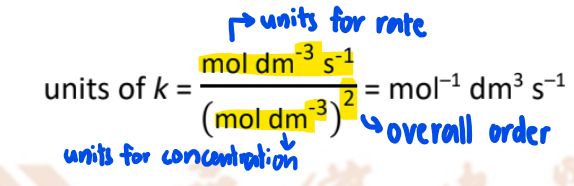
Units for Rate Constant, k:
Depend on the overall order of the reaction
(see image)
Half-life
Definition:
The half-life, t1⁄2, of a reaction is the time taken for the concentration of a reactant to decrease to half its initial value.