P2.2.2 Melting, boiling and evaporation
 Call Kai
 Learn
Learn Practice Test
 Spaced Repetition
 Match
Match Flashcards
 Knowt Play
1/6

There's no tags or description
Looks like no tags are added yet.
Name | Mastery | Learn | Test | Matching | Spaced | Call with Kai | Chat |
|---|
No analytics yet
Send a link to your students to track their progress
7 Terms
What are the melting and boiling points in celsius for water?
Melting: 0°
Boiling: 100°
Describe condensation in terms of particles
Gas particles lose kinetic energy and therefore move slower, moving closer together and the intermolecular forces of attraction become strong enough to hold the particles close together
The particles are closer together but can still move over each other
Describe solidification (freezing) in terms of particles
As a liquid cools, particles lose kinetic energy and slow down, moving closer together and the intermolecular forces of attraction become strong enough and hold the particles closer together
The particles then are arranged in a fixed, regular position
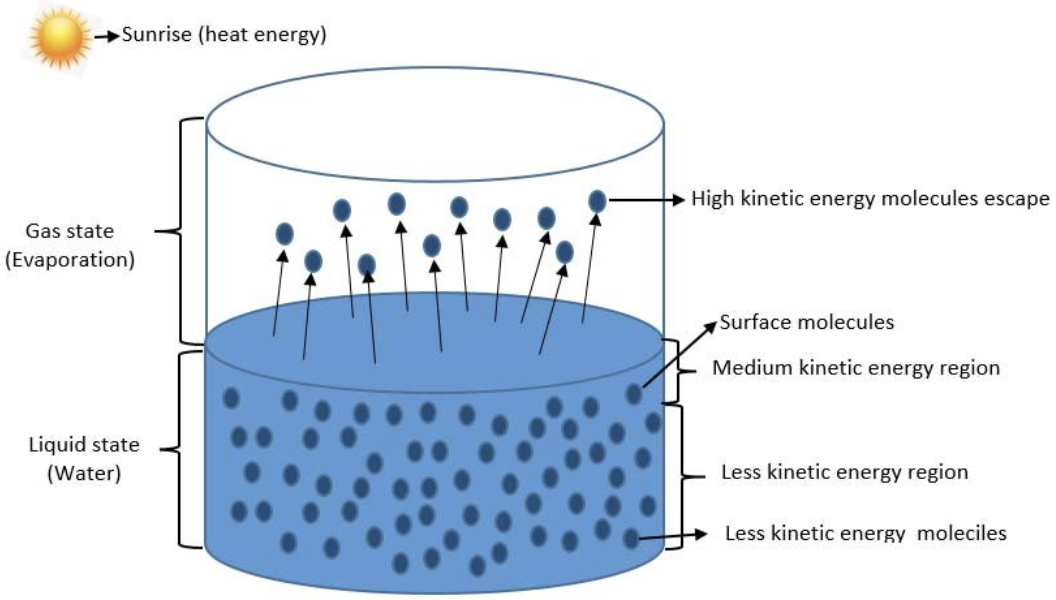
Describe evaporation in terms of particles
Evaporation is when the more energetic particles within the surface of a liquid escape to form a vapour
Only the more energetic particles escape first, which reduces the average energy of the molecules in the liquid since it contains less high energy particles
The overall temperature of the liquid drops since only the less energetic particles are left behind
Describe melting and boiling in terms of energy input without a change in temperature
When a substance is changing state (melting or boiling), the energy is not used to make particles move faster (it does not change temperature)
The energy is only used to weaken or break intermolecular forces of attraction holding the particles together
Describe the differences between boiling and evaporation
Boiling:
Occurs throughout the entire liquid
Only at a specific temperature
Happens fast
Evaporation:
Occurs only at the surface of the liquid
Happens at any temperature
Happens slowly
Describe factors affecting rate of evaporation
Temperature: higher temperature means more kinetic energy for the particles, meaning more can escape (higher rate)
Surface area: more surface area means more high energy particles can escape the surface at the same time (higher rate)
Air movement: strong flow of air means high energy particles can be carried away faster (higher rate)