DF
 Call Kai
 Learn
Learn Practice Test
 Spaced Repetition
 Match
Match Flashcards
 Knowt Play
1/183

There's no tags or description
Looks like no tags are added yet.
Name | Mastery | Learn | Test | Matching | Spaced | Call with Kai | Chat |
|---|
No analytics yet
Send a link to your students to track their progress
184 Terms
Thermochemistry
the study of the energy and heat associated with chemical reactions
EXOthermic
gives out energy
ENDOthermic
takes in energy
Enthalpy Change
amount of energy transferred to and from the surroundings
negative enthalpy change
exothermic
positive enthalpy change
endothermic
What is enthalpy change affected by?
temperature
pressure
concentration
Standard Conditions
298K (25 C)
100kPa
1 mol dm-3
How to convert from Celsius to Kelvin?
add 273
Standard enthalpy change of reaction
The enthalpy change when molar quantities of reactants as stated in the equation react together under standard conditions.
specific heat capacity
The amount of energy needed to raise the temperature of 1 kg of substance by 1°C
q= mc/T
Standard enthalpy change of combustion
when one mole of substance in burned completely in oxygen under standard conditions in standard states
Standard enthalpy change of formation
when one mole of compound is formed from its elements under standard conditions in standard states
Standard enthalpy change of neutralisation
when one mole of hydrogen ions react with one mole of hydroxide ions under standard conditions and in solution containing 1 mol dm-3
How is crude oil separated by fractional distillation?
Crude oil is heated to vaporise
Vapour passed into fractionating column
Top is cooler than bottom for negative temperature gradient
fractions separated by bpt so condense at different temperatures
Why does carbon form so many different structures?
shares electrons to form stable covalent bonds
Catenation.
Forms 4 bonds, allowing endless shapes (straight, branched, rings)
Easily bonds with other atoms for variety.
Catenation
the self-linking of atoms to form chains and rings
Hydrocarbons
compounds containing only hydrogen and carbon atoms
Aromatic compounds
contain benzene rings
Aliphatic compounds
do not contain benzene rings
Functional group
modifiers that are responsible for the characteristic chemical reactions of molecules
Alkanes
saturated hydrocarbons
general formula of Alkanes
CnH2n+2
Homologous series
a series of compounds in which all members have the same general formula
Structural isomer
compounds with the same molecular formula but different structural formula
general formula for an alkyl group
CnH2n+1
cycloaklanes general formula
CnH2n
How to name an alkane?
Location of side chain
comma
number of side chain (di, tri, tetra)
name of side chain
hyphen
name of longest chain
Properties of alkanes
n=1-4 are colourless gases in rtp
n=5-16 are colourless liquids
n=17+ are white waxy solids
Why are alkanes insoluble in water?
alkanes contain non-polar molecules
but water contains polar molecules which attract each other and prevent alkane molecules mixing with them
What is energy density?
The amount of energy released per unit mass of a fuel during combustion
How to calculate energy density
Energy density = Energy released during combustion ÷ Mass of fuel
Bond enthalpy
The energy required to break one mole of a bond in a gaseous molecule under standard conditions
Why is bond enthalpy always positive?
Because breaking bonds requires energy input
How do you calculate the energy change in a reaction using bond enthalpies?
∆H = ∑(Bond enthalpies of bonds broken) - ∑(Bond enthalpies of bonds formed)
What is the relationship between bond length and bond strength?
Shorter bonds are generally stronger than longer bonds
Why might bond enthalpy values differ from experimental results?
Bond enthalpies are averages over several compounds
Breaking bonds is
endothermic and requires energy
Making bonds is
exothermic and releases energy
Why is measuring enthalpy changes in reactions like combustion challenging?
Heat losses to the surroundings and incomplete combustion can affect the results
What is the significance of the table listing bond enthalpies?
It provides average values for different types of bonds
What is the role of fuel molecules in energy production?
Their chemical bonds store energy
What is the standard enthalpy change of combustion?
The enthalpy change when one mole of a substance burns completely in oxygen under standard conditions
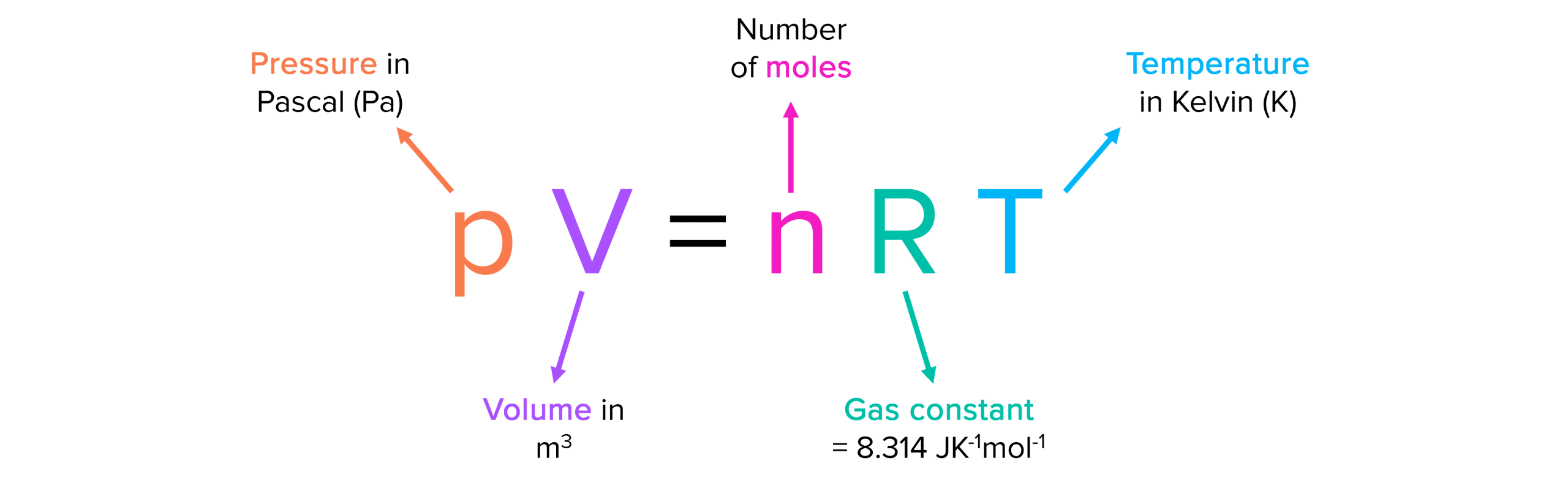
What is the ideal gas equation?
pV = nRT
How do you calculate the volume of gas produced in a reaction?
Use the balanced chemical equation to find the moles of gas produced.
Multiply the moles by the molar gas volume at RTP (24 dm³ mol⁻¹)
How do you calculate the mass of gas from its volume?
Calculate the moles using moles = volume ÷ molar gas volume.
Use mass = moles × molar mass
What is the molar gas volume at standard temperature and pressure?
At STP
What are polymers
Polymers are large molecules made up of many smaller repeating units called monomers
What is addition polymerization
Addition polymerization involves the linking of monomers with a carbon-carbon double bond (alkenes)
What is condensation polymerization
Condensation polymerization involves the linking of monomers by eliminating small molecules such as water or hydrogen chloride
What is the difference between addition and condensation polymerization
Addition polymerization uses monomers with C=C bonds and produces no byproducts
What is poly(ethene)
a polymer made from ethene monomers and is widely used for making plastic bags and bottles
What is polychloroethene (PVC)
PVC is a polymer made from chloroethene monomers and is used for making pipes
What is poly(propene)
Poly(propene) is a polymer made from propene monomers and is used for making packaging
What is PTFE
PTFE (polytetrafluoroethene) is a polymer with high chemical resistance and non-stick properties
What are elastomers
Elastomers are polymers with elasticity
What are plastics
Plastics are synthetic polymers that can be molded into different shapes and have diverse applications
What are fibres
Fibres are polymers with high tensile strength and flexibility
What are the conditions for addition polymerisation
Addition polymerisation often requires high temperatures
What are the conditions for condensation polymerisation
Condensation polymerisation usually occurs at lower temperatures and may require a catalyst or acid/base conditions
Who developed nylon
Nylon was developed in the 1930s by Wallace Carothers and his team at DuPont
Why was the discovery of synthetic polymers significant
The discovery of synthetic polymers revolutionized industries by providing materials that are lightweight
What happens during addition polymerisation
The double bond in a monomer breaks to form a single bond. The monomers link together to form a long chain polymer
What is a repeating unit in a polymer
simplest sequence of atoms that repeats throughout the polymer chain
Properties of Polymers What determines the properties of a polymer
The properties of a polymer are determined by the type of monomers used
What are cross-linked polymers
Cross-linked polymers have covalent bonds between different polymer chains
What is ethene
Ethene (C₂H₄) is a simple alkene used as a monomer in addition polymerisation to make poly(ethene)
What is chloroethene
Chloroethene (C₂H₃Cl) is the monomer used to make poly(chloroethene) (PVC)
What is propene
Propene (C₃H₆) is a monomer used in addition polymerisation to make poly(propene)
What is tetrafluoroethene
Tetrafluoroethene (C₂F₄) is the monomer used to make PTFE
Why are synthetic polymers an environmental concern
Synthetic polymers are non-biodegradable and contribute to plastic pollution in the environment
How can polymer waste be managed
Polymer waste can be managed through recycling
What is an alkene?
unsaturated hydrocarbon
How are alkenes named?
1. Identify the longest chain and use the appropriate prefix to indicate the number of carbon atoms.
2. Follow the prefix with 'ene' to indicate the compound is an alkene.
3. For alkenes with longer chains or branched chains, indicate the position of the double bond using the lowest number possible.
4. For cyclic alkenes, use the prefix cyclo- (e.g., cyclohexene).
What is the general formula of alkenes?
CnH2n
what are electrophiles?
positive ion or molecule with partial positive charge that is attracted to a negatively charged region and will react by accepting a lone pair of electrons to form a covalent bond
What is electrophilic addition?
reaction where an electrophile reacts with an alkene's electron-rich double bond to form a single larger molecule
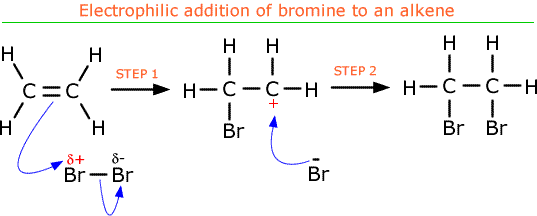
Describe the reaction of ethene with bromine.
Bromine becomes polarised as electrons are repelled by double bond
Bromine atom nearest double bond becomes slightly positive, the other slightly negative
How many pi/sigma bonds in a single bond?
1 sigma bond
sigma bonds form in
an area of increased electron density
How are sigma bonds formed?
overlap of s orbitals
What kind of bonds in a double bond?
one sigma
one pi
one pi bond consists of ___ areas of negative charge
one ______ one _________
2
above
below
What is cracking
process of breaking large hydrocarbon molecules into smaller ones
What is the purpose of cracking
To match the supply of long-chain hydrocarbons with the demand for shorter-chain hydrocarbons like petrol
What are the two main types of cracking
Thermal cracking and catalytic cracking
What are the conditions for thermal cracking
High temperature
high pressure
What is a free radical
A molecule or atom with an unpaired electron
What are the products of thermal cracking
Alkenes and sometimes smaller alkanes
What are the conditions for catalytic cracking
Lower temperatures (720 K) and pressures with a zeolite catalyst
What are the products of catalytic cracking
Branched alkanes
What is a catalyst
A substance that speeds up a chemical reaction by providing an alternative pathway with a lower activation energy
What are zeolites
Zeolites are minerals with a porous structure
Describe the stages of heterogeneous catalysis
Reactants get adsorbed onto the catalyst surface. Bonds are weakened.
Bonds in the reactants break.
New bonds form to create the products.
The second bond forms, and the product diffuses away from the catalyst surface, leaving it free to adsorb fresh reactants.
What is catalyst poisoning
when impurities bind to the surface of a catalyst and stop it functioning