unit 4 test history primary sources
 Studied by 0 people
 Call Kai
 Learn
Learn Practice Test
 Spaced Repetition
 Match
Match Flashcards
 Knowt Play
1/39

Earn XP
Description and Tags
*only from our class (7-8 reports we did)*
Name | Mastery | Learn | Test | Matching | Spaced |
|---|
No study sessions yet.
40 Terms
John C. Calhoun Slavery a Positive Good Speech 1837
“But I take higher ground. I hold that in the present state of civilization, where two races of different origin, and distinguished by color, and other physical differences, as well as intellectual, are brought together, the relation now existing in the slaveholding States between the two, is, instead of an evil, a good—a positive good. I feel myself called upon to speak freely upon the subject where the honor and interests of those I represent are involved. I hold then, that there never has yet existed a wealthy and civilized society in which one portion of the community did not, in point of fact, live on the labor of the other. Broad and general as is this assertion, it is fully borne out by history.”
Historical Situation: During 1837, the North’s abolitionist movement was growing stronger while the South’s plantation economy was booming with the backbone of slavery. Both sides were trying to justify and advocate for their beliefs and this is Calhoun’s pro-slavery interpretation.
Purpose: The purpose of this document is for Calhoun to justify his pro-slavery position. He says that slavery is not evil, but a positive good. This means that slavery benefits the whole society, white landowners and black slaves. He also mentions that whites are superior and have owned slaves all throughout history, further justifying his point.
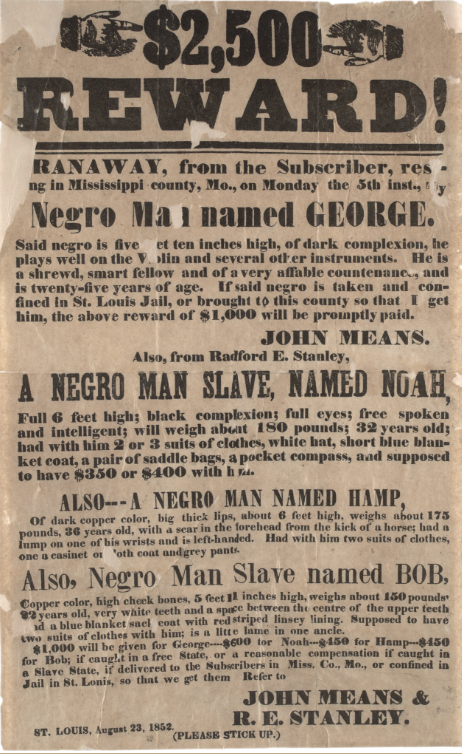
Runaway slave ad - 1852
Purpose: The purpose of this ad is so that slave owners can gain their runaway slaves back who have escaped. The slave owners say “$2,500 Reward” for anyone who brings back the slaves.
Intended audience: The intended audience is everyone who lives in Mississippi County. This ad highlights the southerner’s slave society because it shows how slavery impacted everyone’s lives. Typical citizens were involved by getting bribed to catch escaped slaves and also creating more industry surrounding slavery like publication of runaway slave ads.
Transcript of a Slave Patrol Contract 1856
“You are hereby appointed Captain of the 1st Class of Patrol for the month of
January, 1856. It is your duty to summon your company to meet at such time and place as you may direct, and perform Patrol duty at least two nights in each week; and on the Sabbath day to disperse all collections of negroes or boys violating the Ordinances of the Town. On all slaves found off their owner’s premises, without written permission from some person legally authorized to give such permission, you will inflict not more than fifteen lashes; no slave to be whipped except in presence of the Captain. You will arrest and carry before the Intendant of Police, all free colored men found associating with slaves in the night, or on the Sabbath day, in any kitchen, out-house, or place other than his own premises.”
Purpose: The purpose of this document is to inform the slave patrol officers of their duties. It shows the strict tolerances and punishments for the slaves. It also highlights the role of religion in Southern society. They specifically mention the “Sabbath day” or day of rest, as an important day that requires consequences if rules are broken on it.
Point of view: The point of view is coming from the higher, elite slave owners or patrols. The direct, explicit guidelines laid out indicate that they are very serious about their slaves.
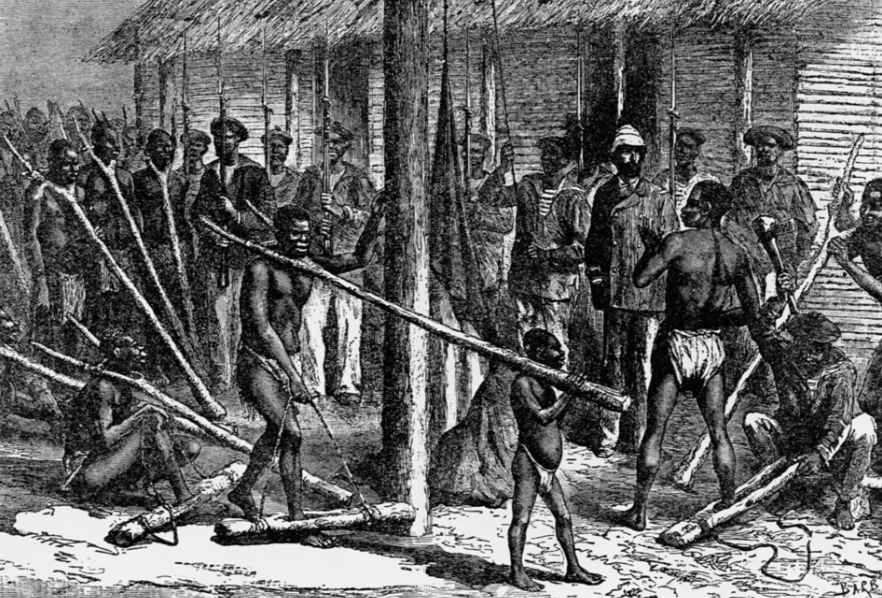
Slaves at the market
Historical Situation: The historical situation is pre-civil war because the slave market is still occurring. The imagery depicts harsh conditions for blacks of all ages, as they are wearing spears around their necks, entrapping them.
Purpose: The purpose is to show the harsh realities and conditions of slavery and the slave market. The slaves were put up for auction like commodities. They were not treated with human decency.

Class conflict in the Confederate States of America:
Purpose: The purpose of this image is to show the rising conflict between the poorer whites without land and the wealthy white planters. During this time, economic power was in the hands of those who owned slaves, because their labor allowed the landowners to generate large amounts of cotton, which could be sold/exported for profit. Even though landowners made up only a small portion of the white population, they controlled between 90-95% of the South’s wealth. Landowners also had much more influence, which allowed their interests to control things such as churches and schools. Additionally, it was very difficult for the landless to afford land because of low wages and unpredictable crop prices.
Receipt for land purchased from the Six Nations, 1769 (PS): “Received from the honorable Thomas and Richard Penn Esqrs… the sum of ten thousand Dollars being the full consideration of the Lands lately sold to them by the Indians of the six Nations…”
Analysis: This quote adds a nuance to the idea of solely White vs. Black, showing that there were tensions within the white population itself. The Penn family’s capacity to purchase vast regions of land from Native Americans demonstrates their wealth and privilege, which limited opportunities for landless whites to gain rights and economic footholds for themselves in this time period. This mirrors the broader logic of classical republicanism, where social and economic hierarchies were justified through dominance of property.
Lowell Mill Girls and the factory system, 1840
“Whom has Mr. Brownson slandered? . . . girls who generally come from quiet country homes, where their minds and manners have been formed under the eyes of the worthy sons of the Pilgrims, and their virtuous partners, and who return again to become the wives of the free intelligent yeomanry of New England and the mothers of quite a proportion of our future republicans.”
Point of View: The POV of this document is the women who are working the textile factories. Many of these women came from rural, working-class farm families, who could no longer make a stable living from their land. By describing their harsh working conditions, long hours, and low pay, they wanted to expose how factory labor exploited the daughters of poor farmers while enriching factory owners and investors.
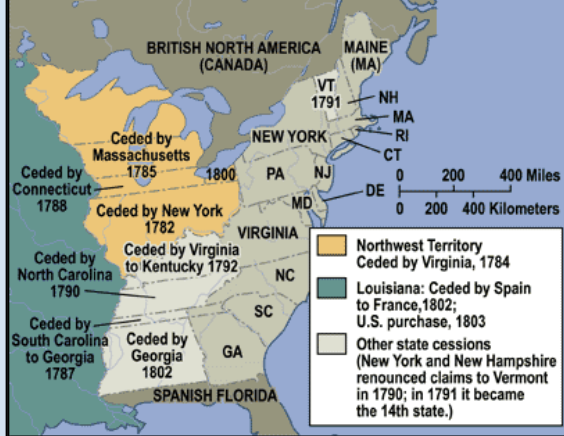
map of west
Historical context: After the American revolution several states ceded their western land claims to the federal government to help unify the nation and pay off their war debts. The land was then sold back to the american people.
The map of western land ceded by states between 1781 and 1802 shows a large area in the Ohio river valley being transferred to the federal government. The land was a prime opportunity for Yeomen farmers to expand their farms on secure land. However, access to these farms reflects the economic hierarchy of the time since wealthy elites could afford to buy large pieces of this land at a time while Yeomen farmers fought to purchase smaller parcels. The map illustrates how land distribution caused tensions in white class relations, with Yeomen farmers striving to maintain independence while wealthy landowners sought monopolies over the new land.
“I Love you, but hate Slavery” by Frederick Douglass 1857: Quote: “They were dear to me – and are still – indeed I feel nothing but kindness for you all – I love you, but hate Slavery”
Intended Audience: This letter was written by Frederick Douglass to his former master, Hugh Auld. In the letter, Frederick Douglass discusses the relationship between freed Black individuals and those who were still enslaved. Douglass’s emphasis on education and self-improvement shows how freed African Americans wanted to assert their independence and maintain their dignity while still sustaining their connections with both free and enslaved Black communities. This letter reveals the deep emotional conflict of the era, as Douglass expresses compassion towards individuals while condemning the institution that upheld their oppression.
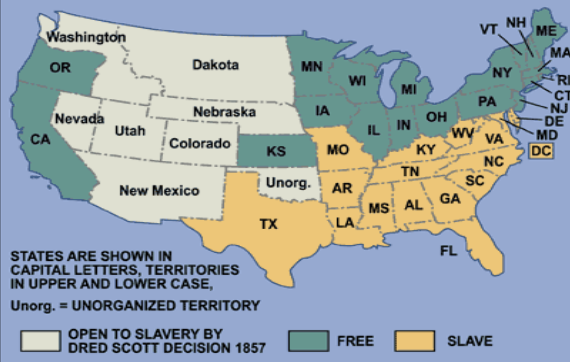
Slave States and Free States, 1861
!
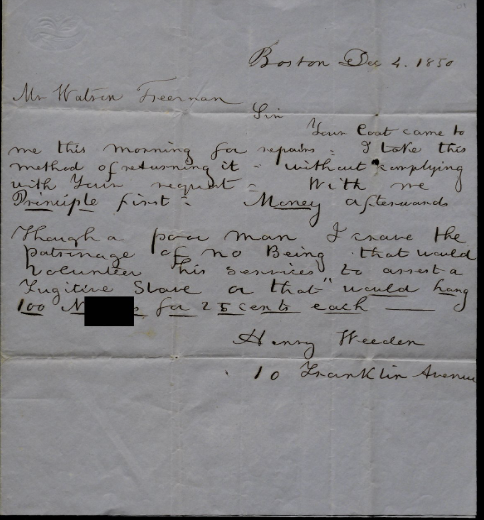
An African American protests the Fugitive Slave Law, 1850:
Historical Context: The Fugitive Slave Act required that escaped enslaved people found in free states be returned. Anyone who helped the slaves was penalized. This law made abolitionists and free Black communities upset because it was extending slavery into the Northern states. The letter was written in 1850 by Henry Weeden, who is a free African American. He was one of Boston’s leading abolitionists, he advocated for the integration of Boston’s schools.
Transcript of a Slave Patrol Contract January 1856
“It is your duty to summon your company to meet at such time and place as you may direct, and perform Patrol duty at least two nights in each week; and on the Sabbath day to disperse all collections of negroes or boys violating the Ordinances of the Town. On all slaves found off their owner’s premises, without written permission from some person legally authorized to give such permission, you will inflict not more than fifteen lashes; no slave to be whipped except in presence of the Captain. You will arrest and carry before the Intendant of Police, all free colored men found associating with slaves in the night, or on the Sabbath day, in any kitchen, out-house, or place other than his own premises.”
Intended Audience: The intended audience of this letter is the new Captain of the 1st Class Patrol, explaining the necessity of keeping the slaves in line and punishing ones who try to escape. The letter talks about the jobs the captain must perform all of which regarded the surveillance and discipline of enslaved and free black people. The document works to show the extremes that the white class goes to to racialize and reinforce their power on the black population as a whole. The audience is important because it shows how white people interacted with black slaves and treated them as property.
“The Whole Land is full of blood” letter
“My constant trouble of mind is the evils now pressing on my nation and people. What the end is to no eye human can foresee & we are naturally inclined when suffering bad to fear worse. The mail which arrived yesterday the Baltic gives [2] an account of the termination of the last Boston case- Thomas Sims has been given over to his Claimant and has been taken back into Slavery- These cases are enough to break one’s heart- It is difficult to see how the enormous evil and crime of Slavery can be carried to a greater extent. The whole land is full of blood. The cry of [3] the poor is going up from every part of the country into the ears of the Lord of Sabbath Will he not soon hear and answer; “Lord give us help from trouble” Yours Truly J.W.C. Pennington
Historical Situation: The letter was written in the time period of the Fugitive Slave Act of 1850, which stated that escaped slaves found in free states must be returned to their enslaver. Around the same time, the Thomas Sims case became a nationally known case. Sims, a runaway slave from Georgia was captured in Boston and forced back into slavery. The north and south were very divided over slavery and the system that the South had created in order to support their agricultural economy.
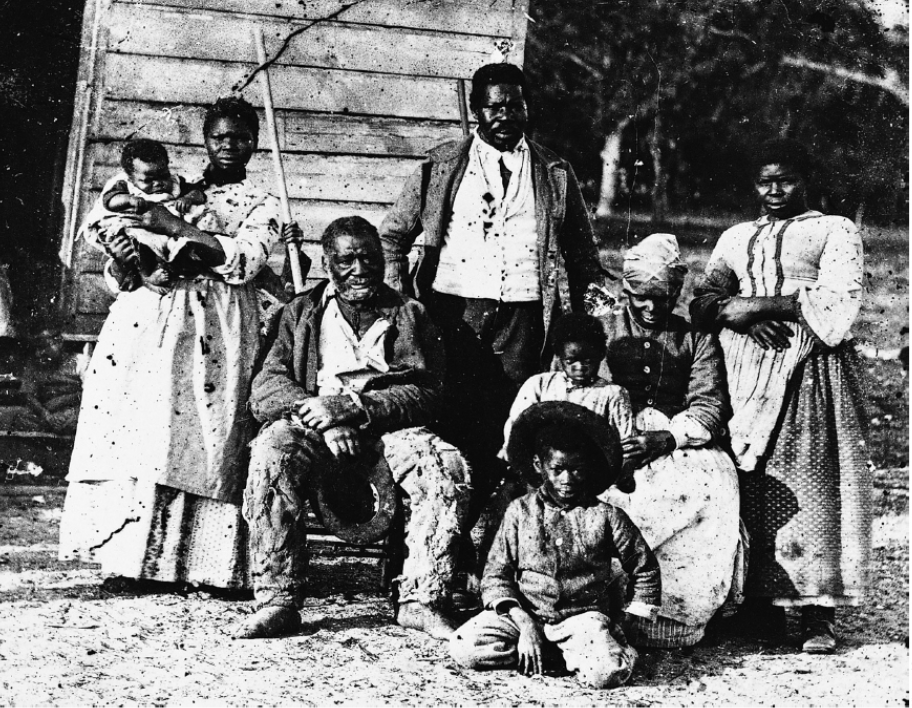
This photograph of five generations of an enslaved family, taken in Beaufort, South Carolina, in 1862, is silent but powerful testimony to the importance that enslaved African Americans placed on their ever-threatened family ties.
Purpose: The Purpose of this photo is to show the importance of familial unity across generations of enslaved blacks. As the international slave trade ended, more generations of slaves were born in America. By showing multiple generations together the image shows how race based slavery has shaped entire family lines, solidifying the South’s hierarchical system over time. It is also significant because families were often separated through the slave trade so it is profound that this family was able to stay together for that long.
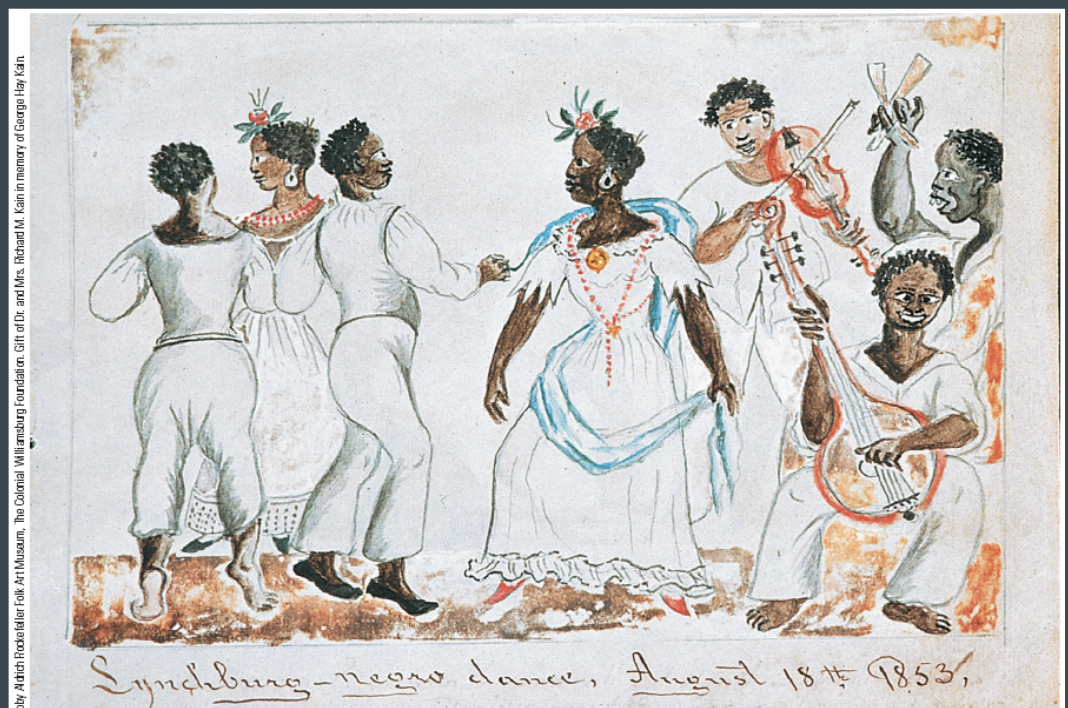
A drawing captures slave men and women dancing and playing a violin, banjo, and bone instruments. The women wearing ankle-length gowns and jewelry, and the men wear full-sleeved shirts, pants, and shoes.
Point of View: The point of view of the document is from Lewis Miller a white man. He is depicting enslaved people from an outward lens. It shows how enslaved people have created a shared culture unifying them against the oppression of the upper class that excludes them from the democracy in the country they work in.
1836 Strike - Factory Girls' Association
“Skilled factory laborers led the landmark 1836 strike. Workers correctly assumed that if the most central workers in the factory walked out, the factory would be forced to close. Between 1,200 and 1,500 women and girls marched through town in protest, singing songs as they went. At a time when women rarely spoke in public, Lowell women made speeches against their employers' decision to reduce wages. The strike lasted for two weeks, and the Factory Girls' Association was founded with 2,500
Purpose: This excerpt is meant to demonstrate the increasing role of women in the workplace and politics of the antebellum North. These strikes provided a platform for not only associations of female workers, but also public protests and speeches, showcasing a general rise of female empowerment amidst their mistreatment in factories and mills. It also demonstrates the power of the group and community over the individual in the North concerning these labor unions.
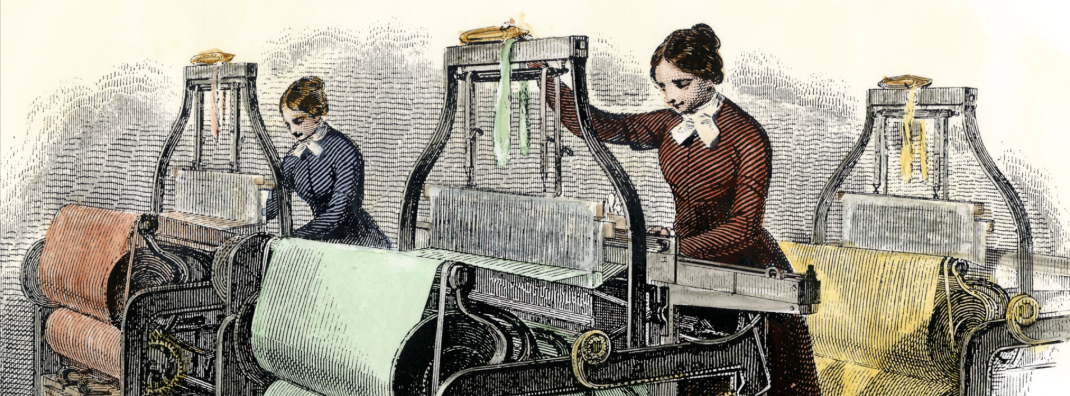
Power Loom at Lowell Mills, 1850
Historical situation: The power looms used in 1850 greatly accelerated the processes of the clothing industry, allowing for market expansion and mass production. This image in particular displays young women working the power loom, using reorganization of labor to sew one clothing part for hours on end. While these technological shortcuts created opportunities for female mill workers and affordability for textiles, they also led to decreased wages and child labor.
Orestes Brownson, The Laboring Classes: An Article from the Boston Quarterly Review, Boston: Benjamin H. Greene, 1840
“The operatives are well dressed, and we are told, well paid. They are said to be healthy, contented, and happy. This is the fair side of the picture . . . There is a dark side, moral as well as physical. Of the common operatives, few, if any, by their wages, acquire a competence . . . the great mass wear out their health, spirits, and morals, without becoming one whit better off than when they commenced labor. [...] “She has worked in a Factory,” is almost enough to damn to infamy the most worthy and virtuous girl.”
Point of View: The author of this document is Orestes Brownson, a Christian socialist activist, which influences this document to reflect an emphasis on a woman’s traditional role and criticism of capitalism. In particular, he calls the girls’ wages unfairly low and critiques the impact of factory work on their health and reputations.
Commercial Specialization: Norton Quote
“Commercial specialization transformed some traders in big cities, especially New York, into virtual merchant princes. After the Erie Canal opened, New York City became a stop on every major trade route from Europe, southern ports, and the West. New York traders were the intermediaries for southern cotton and western grain. Merchants in other cities played a similar role. Traders in turn sometimes invested their profits in factories, further stimulating urban manufacturing. Some cities specialized: Rochester became a milling center (“The Flour City”), and Cincinnati (“Porkopolis”) became the first meatpacking center. Merchants who engaged in complex commercial transactions required large office staffs, mostly all male. At the bottom of the hierarchy were messenger boys, often preteens, who delivered documents. Above them were copyists, who handcopied documents. Clerks processed documents and shipping papers, and did translations. Above them were the bookkeeper and the confidential chief clerk. Those seeking employment in such an office, called a countinghouse, often studied under a writing master to acquire a “good hand.” Most hoped to become partners, but their chances of success grew increasingly slim.”
Purpose: The purpose of this quote from the textbook is to explain how commercial specialization positively impacted traders’ revenues, especially in New York, Rochester, and Cincinnati. This gave rise to more complicated commercial transactions, which opened new employment opportunities, mostly for men. This quote also shows how hierarchies in the workplace began to emerge, influencing the commercialization of capitalist America.
Levi Strauss & Company
“With a small amount of capital, he opened a shop on Sacramento Street near the waterfront and sold dry goods to the burgeoning population. By 1856, Strauss had experienced phenomenal growth and moved to a larger shop. The dry goods business was booming, and he increasingly sold shipments of goods from the East Coast. Sometimes he packed samples in large trunks, loaded them on a wagon, and peddled them to stores located in the gold mining towns. A decade after opening his dry goods shop, Levi Strauss renamed his fledgling company, Levi Strauss & Company.”
Historical Situation: By the early 1850s, manufacturing had caused commerce to expand and specialize. For example, Rochester became known as “The Flour City,” and Cincinnati, “Porkopolis.” This document, detailing the founding of the Levi Strauss company, is historically contextualized by the specialization of San Francisco’s economy of gold miners, mining supplies, and dry goods. This period also marks the emergence of heavy consumption in the garment industry, with advancing transportation technologies to allow for fully-fledged commercial enterprises, such as Levi Strauss & Company.
Ten-Hour Movement p
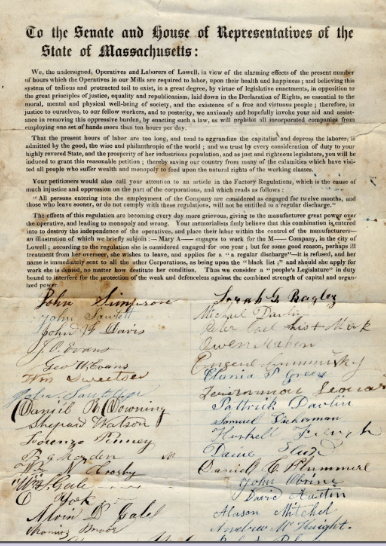
etition (1845)
Intended Audience: The Ten-Hour Movement petition was written by the Lowell Female Reform Association in Lowell, Massachusetts, to persuade the Massachusetts legislature to regulate a ten-hour workday. This audience, the Senate and House of Representatives of Massachusetts, is largely comprised of elite merchants and manufacturers who would desire to cut wages and deregulate factories for revenue, rather than reform the labor industry for marginalized workers. Particularly during the economic depression of 1837 to 1840s, these legislatures would have capitalistic desires to control labor for the benefit of manufacturers.
Dorothea Dix: Report on the
Insane (1843)
“Injustice is also done to the convicts. It is certainly very wrong that they should be doomed day after day and night after night to listen to the ravings of madmen and madwomen. This is a kind of punishment that is not recognized by our statutes, and is what the criminal ought not to be called upon to undergo. The confinement of the criminal and of the insane in the same building is subversive of the good order and discipline which should be observed in every well-regulated prison. . . .”
Purpose: Dorothea Dix writes this report, specifically calling out the brutality and unhygienic conditions in the prisons. The writing of the letter demonstrates the corrupt systems that were being fought against and eventually reformed during the Era.
Charles Finney on revival (2nd Great Awakening, 1835)
“A revival is nothing else than a new beginning of obedience to God. Just as the case of a converted sinner, the first step is a deep repentance, a breaking down of heart, a getting down into the dust before God, with deep humility, and forsaking of sin.”
“A revival is nothing else than a new beginning of obedience to God. Just as the case of a converted sinner, the first step is a deep repentance, a breaking down of heart, a getting down into the dust before God, with deep humility, and forsaking of sin.”

Second Great Awakening, 1790-1830
Purpose - The Second Great Awakening revitalized religion, introduced social reforms, and spread Christianity in communities. This was essentially a Protestant movement which was a direct response to declining church membership as well as a way to democratize religion. The revivalists felt the need to improve societies especially through the correction of institutions and citizen alcohol abuse.
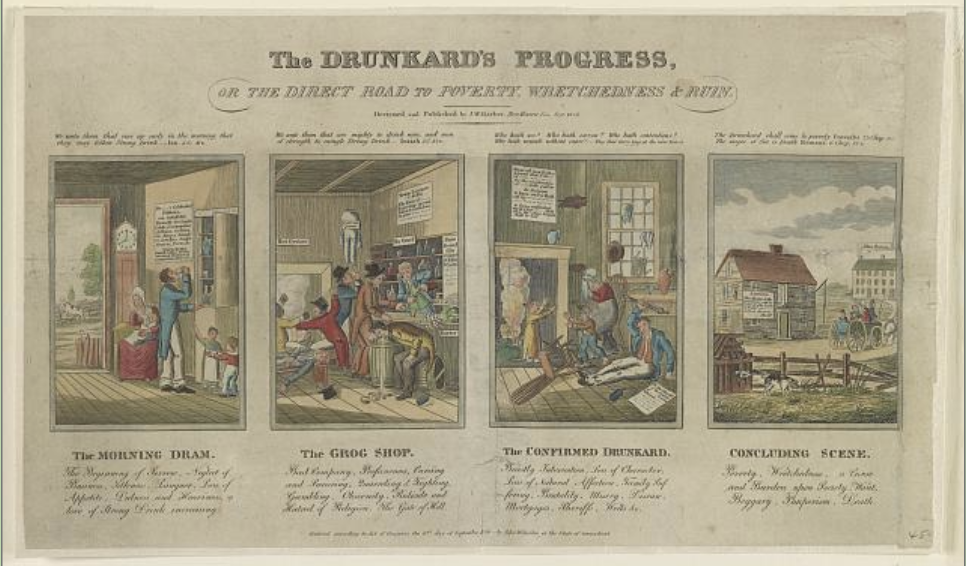
Temperance movement cartoon: The Drunkard’s Progress, 1826
Historical Situation: This was written during the temperance movement, which was when reformers were advocating for the abstinence of alcohol in communities, especially the working class. The movement was pushed into a political context due to its propagandistic tone. It showcases how, after one drink, a man would lose all sensibility. The cartoons were popular with women who wanted community and individual improvement, and to improve the moral climate of their country. This relates to the social reform aspect of society because of the advocacy of the working class to improve their health and overall well-being.
Horace Mann: Report of Massachusetts Board of Education (1848)
“The establishment of a republican government, without well-appointed and efficient means for the universal education of the people, is the most rash and foolhardy experiment ever tried by man. . . . It may be an easy thing to make a republic, but is a very laborious thing to make republicans; and woe to the republic that rests upon no better foundations than ignorance, selfishness, and passion! . . .”
Intended Audience: Mann writes this to the state legislature to advocate for public schools. He enhanced the intellectual reforms through his advocacy of education, especially by seeking the younger generation to use their knowledge to be productive future leaders of the government.
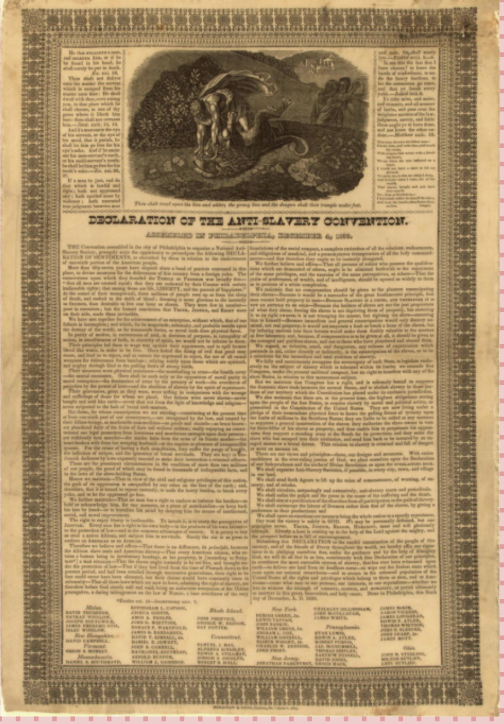
Photo of Declaration of the American Anti-Slavery Convention
Intended Audience: The Intended Audience for this source is to/for other abolitionists to come and participate in the convention, to help with the movement of ending slavery, and invite others who may be interested in the cause to join in as well.
Purpose: The purpose of this document is to provide news that a convention about slavery and the banning of slavery is happening. This is important because this source shows how people began to create organizations/conventions against slavery, eventually leading to movements and other groups fighting for anti-slavery.

Protest Ad against slavery
Purpose: The purpose of this image is to support how citizens were uniting together to support the cause of anti-slavery, and represent examples of how they were beginning to play roles in spreading word about this movement
Intended Audience: The intended Audience for this piece is other evangelical abolitionists or others who want to join together and help support the movement.
William Llyod Garrison: The Liberator (1831)
“During my recent tour for the purpose of exciting the minds of the people by a series of discourses on the subject of slavery, every place that I visited gave fresh evidence of the fact that a great revolution in public sentiment was to be effected in the free states– and particularly in New England– than at the South. I find contempt more bitter, opposition more active, detraction more relentless, prejudice more stubborn, and apathy more frozen, than among slaveowners themselves. Of course, there were individual exceptions to the contrary.”
Point of View: This piece is written from the perspective of William Lloyd Garrison, in the first publication of his newspaper, “The Liberator”. This paper argued against slavery. This newspaper provides a point of view on a white abolitionist.
Purpose: The purpose for this newspaper is to show readers a difference between the slave culture in the South and North, and get others (readers) to think about their own roles in this society, and bring awareness to the harsh slave culture of the South.
Southern Evangelism and Reform
"Southern white Christians did not embrace the popular reform movements of the North. Although postmillennialism was popular among them, it did not necessarily challenge the status quo. As Jack Maddex has argued: "The deepest faith they could invest in their social system was to believe that God was shaping it into the form of the future millennial society"—with slavery intact."
Historical Context: This historical context for this piece is that in the South, Slavery was still very popular and a large part of their society. This text also shows a quote from Jack Maddex, who critiques the culture of the South, and how the Southerners believe that God will create a society that preserves slavery.
Purpose : The purpose of this document is to show the different points of view regarding slavery in the same religion, but the thoughts on slavery being different because of the region.
David Crockett to Charles Schultz
“This is Vanburen principles, there is more Slaves in New York and
Pennsylvania then there is in Virginia and South Carolina, and they are the meanest kind of Slaves they are – Volunteer Slaves. Our Southern Slaves is of Some use to the owner. They will make Support for their masters, and those others is of no other use than to make mischief”
Purpose: David Crockett is writing to Charles Shultz about the state of the United States government/presidency. He also talks about his opinion on slavery, making the case that slavery in the North is actually worse because people don’t even realize they are being enslaved by doing such cheap labor when free whereas in the South they know their master and what they are doing. Crockett hopes for a better future after describing the current reality. Although we see Crocket’s motives, we don’t know exactly who Charles Shultz is as there is no record of him until the cartoonist in the later 1900s.
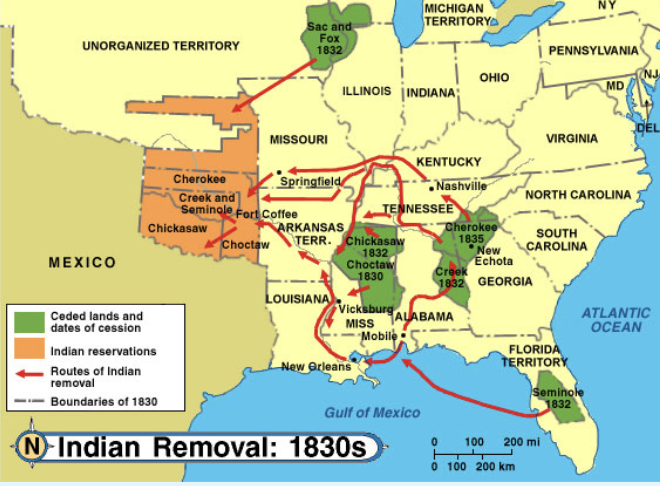
map of indian removal act (trail of tears)
Historical Context: The Americans were moving West in hopes of economic gains and when populating the new land they were taking over land where indigenous Americans were living. The Americans forced them to go further West and leave their homeland.
Isaac Stephens to Henry Mackey 1814
“the Battle of the horse Shoe which was fought on the 27th March by the Tennessee malitia & 39 Regt
of Regulars and the Creek Indians when The Indians were finally Defeated by the unequaled Bravery of the Tennessee malitia Commanded By Maj: Genl. Jackson. I wish you woud wright to me I not
heard from you since I saw you I am your affectionate Nephew”
POV: The letter is written by Isaac Stephens to his Uncle Henry Mackey. Stephens is updating Mackey about the battle fought between Americans and indigenous peoples in the West and informing him that the American state militias won. He also says that he wishes his Uncle would write more meaning that he can critique him to an extent which shows that they see each other as equals.
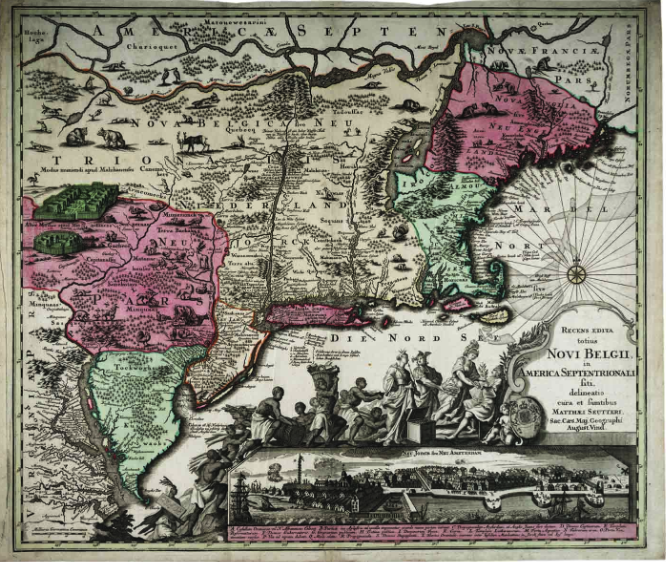
Map of the New World, with European settlements and American Indian tribes
Historical Context: Europeans had come to the Americas thinking that they were not inhabited. Once they discovered the Native Americans they formed land agreements with them to divide their territory setting the precedents for native american policies in the future.
Lewis and Clark’s Journals
“and I dare say with quite as much anxiety for their safety and preservation. we were now about to penetrate a country at least two thousand miles in width, on which the foot of civilized man had never trodden; the good or evil it had in store for us was for experiment yet to determine, and these little vessells contained every article by which we were to expect to subsist or defend ourselves . . . enterta[in]ing as I do, the most confident hope of succeeding in a voyage which had formed a da[r]ling project of mine for the last ten years, I could but esteem this moment of my departure as among the most happy of my life.”
Intended Audience:
Since this is their own journal it was written for only them resulting in a more honest document because they are not trying to please anybody. So they are honest in their milage and their opinions, meaning that they were confident and optimistic about the success of their mission
Indian Removal Act 1830
Ten years after passage of the Indian Removal Act, its impact was clear. As white settlers pushed westward, federal officials negotiated scores of treaties and worked to arrange for the westward journeys of thousands of men, women, and children. In both the Northwest Territory and the southeast, American Indian leaders by choice, force, and fraud signed these treaties, gave up their lands, and relocated to territories west of the Mississippi River. They traveled on foot, by wagon, by horse, by boat, and, in many cases, at gunpoint.
Historical Situation:
The act had roots in Jefferson’s ideal of a farming nation which meant that everyone had to have enough land. White Americans wanted more land so the pressure built up to move West. The Native Americans occupying the Western Lands were forced further and further west and coerced into signing treaties that pushed their people back and gave up their territories.
Stephen F. Austin’s Second colony contract with permission to settle 500 Catholic families, 4 June 1825 “The families which are to compose this Colony besides being industrious as he offers in his petition must be Cat[ho]lics, and of good morals proving these qualifications by the documents required by the 5th Article of the said Law of Colonization of the 24th March.”
This document is best understood when considering the point of view of the Mexican government. The government of the state of Cuahuila and Texas hoped to settle white farmers and ranchers in the region to both bring wealth and business to the region, as well as in the hopes of creating a political buffer state between Mexico the United States and certain native peoples. The documents stipulation that these families must be “Catholics and of good morals” brought forth the issue of serious cultural differences between the locals and the incoming settlers, leading to increasing conflict of values, especially in part because of the overwhelming majority of white settlers.
Texas Declaration of Independence San Felipe de Austin, Texas, March 2, 1836
“The Mexican Government, by its colonization laws, invited and induced the Anglo
American population of Texas to colonize its wilderness under the pledged faith of a written
constitution, that they should continue to enjoy that constitutional liberty and republican
government to which they had been habituated in the land of their birth, the United States of
America.”
The intended audience of this document is the most significant aspect of the Texas Declaration of Independence. Not only was this document intended to to be read by their former rulers, the Mexicans, but it was also meant to be read by American citizens and political figures. This was meant to demonstrate how much similar the peoples of Texas were to their coastal counterparts and to depict how similar their values were. This would go on to help them on their ultimate goal of admission to the Union.
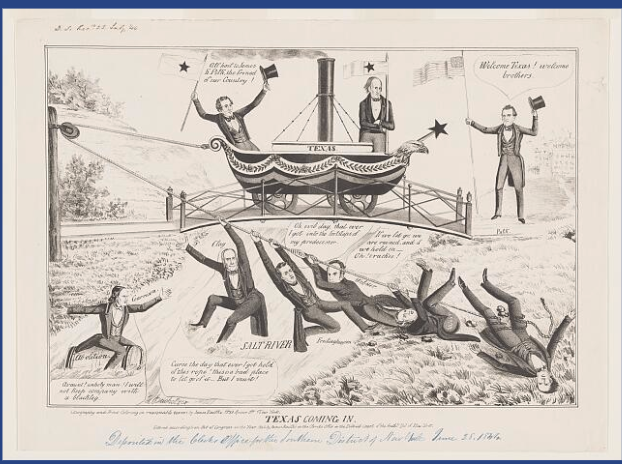
“Texas Coming In” - Texas Political Cartoon - Courtesy of the Library of Congress
The purpose of the “Texas Coming In” political cartoon is to demonstrate the divide in the United States regarding the annexation of Texas. On the bottom of the cartoon, the leaders of southern slave states are depicted as pulling Texas across the Salt river. This demonstrates how the southern Slave states were the primary instigators in the annexation of Texas. This was because the southern leaders wanted to have Yeoman farmers settle and exploit the fertile lands of texas for agriculture.
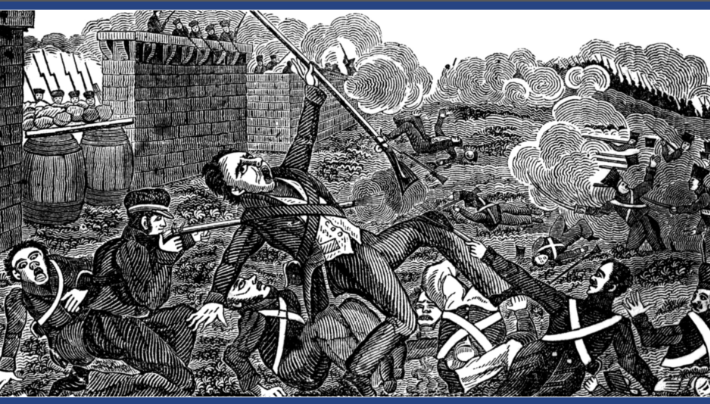
“Davy Crockett falls at Battle of the Alamo” - Courtesy of ABC Clio
The historical situation of the illustration of “Davy Crockett falls at Battle of the Alamo” is the most notable aspect of the document. The illustration depicts the death of Davy Crockett, a now almost mythical figure in American history, during the battle of the Alamo. The Alamo was a catholic church that the Mexicans turned into a fort. The Texans valiantly defended this fort against an onslaught of Mexican soldiers and artillery. This battle demonstrates the culmination of the Texas independence movement and galvanized the state to pursue the battle for their independence. As well as the effect the squatters had on the area.