AP Econ Unit 1 terms
 Call Kai
 Learn
Learn Practice Test
 Spaced Repetition
 Match
Match Flashcards
 Knowt Play
1/33

There's no tags or description
Looks like no tags are added yet.
Name | Mastery | Learn | Test | Matching | Spaced | Call with Kai | Chat |
|---|
No analytics yet
Send a link to your students to track their progress
34 Terms
Scarcity
The limited nature of society’s resources.
Economics
The study of how society manages its scarce resources.
Efficiency
The property of society getting the most it can from its scarce resources.
Equity
The property of distributing economic prosperity fairly among the members of society.
Opportunity cost
Whatever must be given up to obtain some item
Marginal changes
Small incremental adjustments to a plan of action.
Market economy
An economy that allocates resources through the decentralized decisions of many firms and households as they interact in markets for goods and services.
Market failure
A situation in which a market left on its own fails to allocate resources efficiently.
Externality
The impact of one person’s actions on the well-being of a bystander.
Market power
The ability of a single economic actor (or small group of actors) to have a substantial influence on market prices.
Productivity
The quantity of goods and services produced from each hour of a worker’s time.
Inflation
An increase in the overall level of prices in the economy.
Phillips curve
A curve that shows the short-run tradeoff between inflation and unemployment.
Business cycle
Fluctuations in economic activity, such as employment and production.
Circular-flow diagram
A visual model of the economy that shows how dollars flow through markets among households and firms.
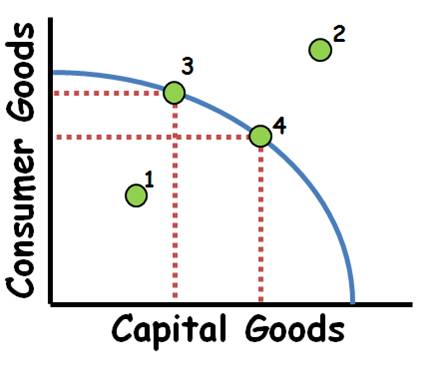
Production possibilities frontier
A graph that shows the combinations of output that the economy can possibly produce given the available factors of production and the available production technology.
Microeconomics
The study of how households and firms make decisions and how they interact in markets.
Macroeconomics
The study of economy-wide phenomena, including inflation, unemployment, and economic growth.
Positive statements
Claims that attempt to describe the world as it is.
Normative statements
Claims that attempt to prescribe how the world should be.
Absolute advantage
The comparison among producers of a good according to their productivity.
Comparative advantage
The comparison among producers of a good according to their opportunity cost.
Imports
Goods produced abroad and sold domestically.
Exports
Goods produced domestically and sold abroad.
Principle #1
People Face Tradeoffs
Principle #2
The Cost of Something Is What You Give Up to Get It
Principle #3
Rational People Think at the Margin
Principle #4
People Respond to Incentives
Principle #5
Trade Can Make Everyone Better Off
Principle #6
Markets Are Usually a Good Way to Organize Economic Activity
Principle #7
Governments Can Sometimes Improve Market Outcomes
Principle #8
A Country’s Standard of Living Depends on Its Ability to Produce Goods and Services
Principle #9
Prices Rise When the Government Prints Too Much Money
Principle #10
Society Faces a Short-Run Tradeoff between Inflation and Unemployment