unit 4 aos 2 defs for bio
 Call Kai
 Learn
Learn Practice Test
 Spaced Repetition
 Match
Match Flashcards
 Knowt Play
1/53

There's no tags or description
Looks like no tags are added yet.
Name | Mastery | Learn | Test | Matching | Spaced | Call with Kai | Chat |
|---|
No analytics yet
Send a link to your students to track their progress
54 Terms
Trait and Allele
t- A characteristic or feature of an organism, e.g. eye colour.
a- A different version of a particular gene.
Genotype and Phenotype
G- The genes/alleles an organism has for a trait.
P- The observable characteristics of an organism, e.g. brown eyes.
Monogenic and Polygenic
m- : A trait controlled by one gene.
p-: A trait controlled by many genes.
Discontinuous variation and Continuous variation
D: Variation with clear, separate categories (blood group (A, B, AB, O).
C: Variation with a range of values (height).
Homozygous and Heterozygous and Trisomy
Homozygous: Having two identical alleles for a gene (BB), matching pair of chromosomes.
Heterozygous: Having two different alleles for a gene (Bb).
Trisomy: Having three copies of one chromosome instead of two.
Haploid and Diploid
Haploid: A cell with one set of chromosomes (n), (a sperm or egg cell).
Diploid: A cell with two sets of chromosomes (2n), (most body cells).
Non-disjunction:
When chromosomes fail to separate properly during cell division.
Gene pool:
All alleles possessed by an entire population of organisms, potentially be passed onto next generation. Expressed in terms of the relative frequencies (proportions) of various alleles in the population.
Allele frequency:
When all genotypes in a population are known, the number of each kind of allele can be counted and allele frequencies calculated (as a percentage/decimal (e.g. 25% or 0.25)). Equation is used to calculate allele frequencies.

Mutation:
Are changes in DNA that can occur randomly during DNA replication. Ultimate source of all genetic variation within and between species. Most detected and repaired by DNA repair enzymes.
Most: neutral: no effect on survival (eye color, birth marks).
Some: harmful: Decrease likelihood of survival (Sickle Cell Anaemia, Down Syndrome).
Some: beneficial: Increase likelihood of survival (Sickle Cell Anaemia providing ‘immunity’ to Malaria, immunity to HIV).
Can affect a single gene, multiple genes/whole chromosomes.
Can occur spontaneously during DNA replication or be caused by mutagens (factors that increase the rate of mutation (e.g. UV radiation).
Somatic mutations (occur in body cells and affect only individual in which they occur) and Germline mutations (in organism's reproductive cells, are heritable (passed to offspring)), allowing new alleles to enter the gene pool).

Point Mutations (single base mutations):
Affect (alteration, insertion or deletion) a single nucleotide in DNA sequence and may alter one codon in the genetic code. Can be:
Substitution: one nucleotide is replaced by another, result in a silent, missense or nonsense mutations.
Frameshift: one or two nucleotides are inserted or deleted, shifting the reading frame and altering every codon from that point onwards. Often have significant effects on polypeptide because change amino acid sequence from point of mutation onwards. Result in protein becoming non-functional/greatly reduced function. May create a premature stop codon (producing a shortened (truncated) protein).
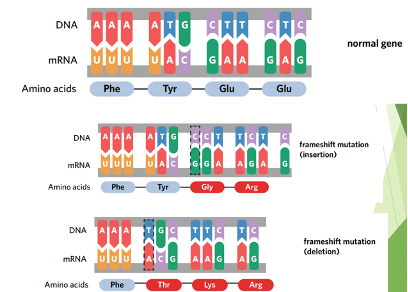
Silent vs Missense vs Nonsense mutation:
S: result in a new codon that codes for the same amino acid.
M: mutations result in an amino acid replacement.
N: result in the formation of a premature stop codon.
Block mutation (Sometimes chromosomal mutations):
Involve large sections of chromosomes, typically affecting multiple genes. Large sections of chromosomes are generally represented by letters (E.g. A, B, C etc.). Usually occur during meiosis due to errors (chromosome breakage, incorrect rejoining), and their frequency can be increased by mutagens.
Block mutations come in five main forms: Duplication, Deletion, Inversion, Insertion, Translocation.

Block Mutations: Duplication:
Section of a chromosome is copied, resulting in multiple copies of same genes being present on that chromosome. (can be thousands of repeats). Can alter gene expression (amount of gene product produced), which may be harmful, neutral or beneficial depending on gene involved.

Block Mutations: Deletion mutation:
section of a chromosome is removed, which may result in loss of one or more genes. Can disrupt gene function and may affect growth, development and survival. The effects depend on the size of deleted region and genes affected. Large deletions are often severe and may be lethal.

Block Mutations: Inversion:
Section of chromosome breaks off, rotates 180° and reattaches to same chromosome. The amount of DNA is unchanged; order of genes or DNA sequences is reversed. Can involve small sections of a chromosome or several genes. May disrupt gene function if the break occurs within an important gene/regulatory region.
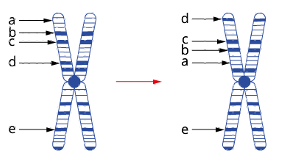
Block Mutations: Insertion:
Section of DNA is inserted into a chromosome, adding extra genetic material. May disrupt genes or alter gene expression depending on where the inserted DNA is located.

Block Mutations: Translocation:
Section of a chromosome breaks off and attaches to a different chromosome, or section of two chromosomes are exchanged. Often occurs between non-homologous chromosomes, where chromosome segments are swapped. Gene regulation or gene function is interrupted, and some forms of cancer can result.

Chromosomal abnormality:
Changes to number of chromosomes/structure of whole chromosomes. Karyotypes can be used to detect chromosomal abnormalities by arranging stained and photographed chromosomes into pairs to analyse their number and structure. Two main forms of chromosomal abnormalities:
Aneuploidy; an extra or missing chromosome.
Polyploidy; having more than two full sets of chromosomes (more than diploid).
Aneuploidy:
Addition or loss of chromosomes (trisomy (three copies of one chromosome)).
Usually caused by non-disjunction (chromosomes fail to separate correctly during meiosis). If non-disjunction occurs in meiosis I, homologous chromosomes fail to separate. If non-disjunction occurs in meiosis II, sister chromatids fail to separate.
Gametes get an incorrect haploid number, and zygote will have an incorrect diploid number. Often results in miscarriages in humans, although some conditions (e.g. trisomy 21) are viable. Aneuploidy in plants can affect fertility and may result in reduced reproductive success.
Aneuploidy can occur in autosomes: Down syndrome (trisomy 21), Patau syndrome (trisomy 13). Aneuploidy can also occur in sex chromosomes: Triple X syndrome, Turner syndrome, Klinefelter syndrome, XXXY syndrome, XYY syndrome.

Polyploidy:
When an organism has more than two complete sets of chromosomes.
It can occur when diploid games (2n) are produced due to errors in meiosis and fuse with another gamete, producing offspring with extra chromosome sets (triploid, 3n). Also occur through errors in mitosis, producing groups of polyploid cells within an organism.
Rare in animals and usually not viable in humans. Common in plants and can contribute to increased size, genetic variation and formation of a new species. (peanuts (4n), sugar cane (8n) and wheat (6n)).
If a polyploid organism is viable and can reproduce with other polyploid individuals, but cannot successfully reproduce with the original population, reproductive isolation can occur. This can result in the formation of a new species without geographic isolation.
Sympatric Speciation Through Polyploidy: Sympatric speciation arising from genetic abnormalities is nearly exclusively seen in plants. (Diploid organisms (2n) create diploid gametes (instead of haploid) through meiosis error). If two diploid gametes fuse together, they produce a tetraploid organism.
Environmental selection pressure:
Selection pressures are conditions that influence allele frequency in a population. They are environmental factors (create conditions that affect survival and reproduction) or artificial selection pressures brought about by humans. They remove unsuited individuals (unsuited alleles/phenotypes). Selection pressures and mutations are driving forces of evolution.
Pressures can be things such as: Over population, Changing environments (natural disasters or slow changes), Predators, Disease, Boundaries, Food shortages, Breeding competition, Selective breeding.
Natural selection
Influence of environmental pressures on allele frequencies in a population. Mechanism of evolution.

Adaptive value:
Is measure of how well a specific trait helps an organism survive and have babies in its environment.
Gene flow vs Genetic drift:
f- movement of alleles between individuals of different populations. Gene pools can change when new individuals join a population from a different gene pool (immigration), or some leave a population (migration). If gene flow continues between two populations, the gene pools may remain similar. If gene flow stops between two populations, the populations become genetically isolated (key factor in evolution).
d- Random changes to allele frequencies in gene pool, result of a chance event. More pronounced in small populations with little to no gene flow (random death of one individual can significantly alter allele frequencies). Generally, this leads to loss of genetic diversity. There are two main kinds of genetic drift: Bottleneck effect (populations decrease for a period), Founder effect (small founding populations).
When chance effects operate, the direction of the change is unpredictable and can vary from one generation to the next. Influence is greatest in small, isolated populations.
Bottleneck effect:
A severe reduction in the size of a population and therefore genetic diversity / allele frequencies due to a catastrophe or chance event (disease, natural disaster, sudden loss of habitat). The phenotype of an individual is unlikely to significantly increase its chances of surviving a natural disaster.
Few survivors reproduce = high levels of inbreeding, results in reduced genetic variation and increased numbers of homozygous individuals. Alleles/gene pool of new population will be unrepresentative of the original population.
Population bottlenecks increase genetic drift. The rate of drift is inversely proportional to the population size (drift operates quickly in small populations and vice versa).

Founder effect:
A small number of individuals of a species colonise a new area; a new population is founded. (Captive breeding programs in zoos)
The gene pool of the smaller founder population is unlikely to represent allele frequency of original population. Environmental pressures in new environment are likely to be different to original environment – drives changes in allele frequencies, and evolution. Care must be taken to avoid inbreeding to maximize genetic diversity. (humans – the Amish community and SCID).

Antibiotics:
Drugs that kill bacteria or prevent their reproduction by disrupting essential cell structures/processes. Prescribed to treat bacterial infections. Will generally destroy all bacteria inside an individual; some bacteria have become resistant to antibiotics, antibiotic resistance, ability to survive with antibiotic that would normally kill.
Antibiotic resistance:
ability of bacteria to survive in the presence of an antibiotic that would normally kill them or stop their growth (that they were once susceptible to). Random mutations can produce bacteria with antibiotic resistance. Antibiotic-resistance bacteria occur because of natural selection:
Antibiotics = selection pressure.
Resistant bacteria have selective advantage and survive antibiotic.
Susceptible bacteria are killed or inhibited.
Resistant bacteria survive and reproduce, increasing frequency of resistance alleles in the population.
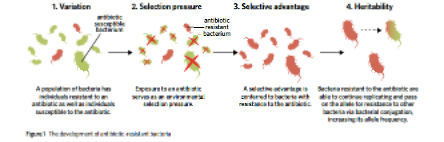
Bacterial conjugation or Horizontal gene transfer:
Bacteria can transfer genes directly to other bacteria. Plasmids may contain genes that give the bacteria resistance to one or more antibiotics. Resistant bacteria can share these plasmids with the same or closely related species, allows antibiotic resistance to spread rapidly through a bacterial population.

Vertical gene transfer:
Resistant bacteria survive antibiotic exposure, reproduce and pass resistance allele to their offspring. Over generations, frequency of antibiotic resistance increases in population.

Selection advantage:
A trait that helps an organism survive or reproduce more successfully than others.
Heritability:
How much of differences in a trait between individuals is due to genetic differences that can be passed on.
Normal flora:
The microorganisms that normally live on or in the body without causing disease.
Bacteria:
Prokaryotic, single-celled organisms with a singular circular chromosome, reproduce rapidly by binary fission (asexual reproduction, don’t need mare, clone). Random mutations can occur, spread quickly through a population. Mutations may alter surface antigens, making bacteria harder for the immune system to recognize. Mutations can give bacteria a selective advantage, increasing their survival and reproduction.
Virus:
Non-cellular pathogens that replicate inside host cells. Take over the host cell’s protein synthesis processes to reproduce and spread. Have antigens on their surface which allows immune system to recognise them as non-self (foreign). Mutate rapidly, which can change their surface antigens. Changes to antigens can help viruses evade immune response and many increase their virulence or resistance to antiviral treatments.
Viral surface antigens can change through: Antigenic drift, Antigenic shift.
Antigenic drift and Antigenic shift:
Antigenic drift: Slow and gradual changes that occur in the genes that code for viral surface antigens. Mutations during replication cause small changes to viral antigens. Initially, memory cells may still recognize the slightly altered antigens. As mutations accumulate over time, antigens become significantly difference and a new subtype of virus can form. New subtype can no longer be recognized by existing memory cells.
Antigenic shift: Sudden, major, rapid changes in the genes coding for viral surface antigens. Occurs when two or more different viral strains infect the same host cell and exchange genetic material. Process known as viral reassortment/recombination, producing a new viral subtype with different characteristics. Existing immunity is usually limited because new antigens are significantly different. The new virus may spread rapidly and cause epidemics or pandemics.
Many cases of antigenic shift are zoonotic (disease that can spread from animals to humans) in origin: 1918 Spanish flu: genetic reassortment involving avian and human influenza viruses, 2009 Swine flu: genetic reassortment involving pig, avian and human influenza viruses over time.

Virulence:
How harmful or severe a disease-causing organism is.
Epidemic and Pandemic
Epidemic: A sudden increase in disease cases in a specific area or population.
Pandemic: An epidemic that spreads across many countries or continents.
Defining Species:
A species is a group of individuals that can interbreed to produce fertile viable offspring. Shares a gene pool that is isolated from other species’ gene pools.
Speciation: is the evolution of a new species from an ancestral species. Reproductive isolation can occur in two ways: Prezygotic – before reproduction, postzygotic – after reproduction.
Adaptive Radiation (connected to Darwins finches)
The rapid divergent evolution of many related species from a single common ancestor (Darwin's finches)
Results from rapid speciation after organisms evolve different adaptations in response to new conditions and opportunities.
Extinction, competitors, colonisation of new environment where vacant ecological niches are available (Darwin’s finches).
Over time, this can produce a large diversity of species, each with distinctive adaptations to their environment.
Geological Time Scale:
Way of representing Earth’s history as a chronological “calendar”. Spans billions of years and is divided into distinct periods and eras. Calendar shows chronological events; it is constructed using order of rocks laid down in a sedimentary rock sequence - with oldest rocks at bottom creating a relative time scale. Fossilized remains of plants and animals are also found within the rock strata.
Extinction and Mass Extinctions:
Extinction: when no individuals of that species remain alive, can occur when a species is unable to survive and reproduce under changing environmental conditions. Possible contributing factors include: Environmental change, competition, predation, disease, loss of habitat, reduced genetic diversity. Extinction is therefore an important part of the history of life on Earth.
Mass Extinctions: when many species become extinct over a relatively short period of geological time, have dramatically changed biodiversity. Cause biodiversity to decrease and create evolutionary opportunities.

The Fossil Record:
is a substantial, but incomplete, record of evolutionary history. Modern species can be traced through fossil relatives to distant origins. Fossil species are often similar to, but usually differ from, today's species. Fossil types often differ between sedimentary rock layers. Fossils can be dated to establish their approximate absolute age. New fossil types of mark changes in the past environmental conditions on the Earth. Rates of evolution can vary, with bursts of species formation followed by stable periods.
Fossils:
preserved remains, impressions or traces of organisms found in rocks, amber (fossilized tree sap), coal deposits, ice or soil. Provides information about the history of life on Earth. Require certain conditions to be created and to last over time.
Form best when organisms are buried by sediment quickly in conditions that slow the process of decay or decomposition. Fossils are most found in sedimentary rock. Mineral-rich hard parts (bones, teeth, shells) may remain as fossils, or minerals dissolved in water, may seep into tissues and replace the organic matter of the organism. On rare occasions, fossils retain organic material, as when plant material is compressed between layers of shale or sandstone.
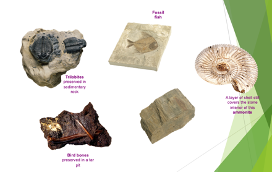
Relative dating and Relative age:
d: dating technique used to determine relative age of a fossil. Is based on stratigraphy which is the study of the relative positions of layers of rock (strata), which contain fossils. The position of one fossil is compared to other fossils or rock in surrounding rock strata (layers).
a: The oldest layer is at the bottom, the youngest layer at the top. The rock layers are laid down in order of oldest to youngest. Fossils found in the same layer of rock have same relative age (existed at same time as when that rock layer was first laid down). (older or youngest than another fossil).
Stratigraphy: By assembling all these layers together, scientists have worked out what is known as the stratigraphic column or record of various ages of rock. This record spans the 4.6-billion-year record of Earth's history.

Absolute Dating:
The relative age of fossils is useful, but fossils provide reliable historical data only if we can determine their absolute age. Number of different methods. A scientific method used to find the exact numerical age or date range (in years) of a fossil, rock, or archaeological artifact
Radiometric Dating
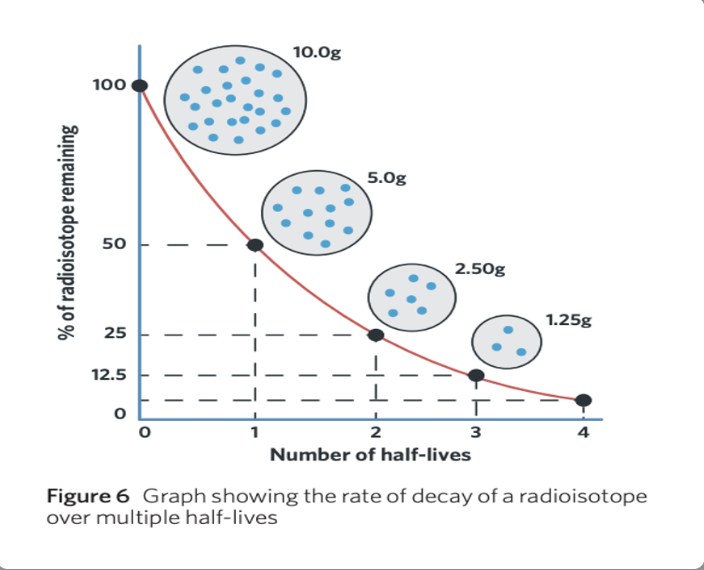
is a quantitative technique used to determine the proportion of radioactive elements, (isotopes), within rocks around fossil/within the fossil. Radioactive isotopes (‘parent’ elements) are unstable and emit radiation, they break down to form more stable products (‘daughter’ elements).
The rate of decay is specific for each radioactive isotope and is measured in terms of half-life (time taken for half element to decay, and can be used to calculate the age of the rock/fossil). Measuring the proportion of a daughter element compared to the parent element.
Isotopes are used depending on the time scale involved, for example: Carbon-14 is only useful for dating fossils or samples (that contain carbon) that are not older than 60,000 years old, as carbon-14 (14 C) has a relatively short half-life of 5730 years (KNOW).
(Older examples) Potassium-40 (decay to argon), Uranium-235 and Uranium-238 are not commonly found in living things and they have longer half-lives, so they’re mainly used to date older rock samples.

Structural Morphology:
study of similarities and differences in structures (body parts) between animals of different species (fossils of extinct animals as evidence of relatedness).
These include the study of: Homologous structures, vestigial structures, analogous structures.
Divergent Evolution:
occurs when different groups of organisms with a common ancestor evolve and accumulate differences (due to different selection pressures) resulting in the formation of new species (descendant species). This is speciation.
Adaptive radiation is a form of divergent evolution where a single species rapidly diversifies into multiple species (usually results in increased biodiversity; occurs in ecosystems with lots of unfilled niches). (Finches on the Galapagos Islands evolved into many different species to eat different foods and occupy different niches).
Key Point: DIFFERENT SELECTION PRESSURES will lead to variations of traits that are the most “fit” (successful). Divergent evolution leads to the development of homologous or vestigial structures.

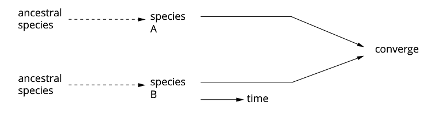
Convergent Evolution:
occurs when two or more unrelated species with no recent common ancestors evolve structures, traits, or morphological features that have similar functions (due to similar selection pressures). (Dolphins and sharks have very different internal structures, but both have evolved flippers because they live and compete in the sea).
Key Point: SIMILAR SELECTION PRESSURES lead to the development of structures with similar functions. Convergent evolution leads to the development of analogous structures.
Molecular Homology:
Study of the similarities between organisms at a DNA and amino acid level. These include the study of: DNA sequences, Amino acid sequences
Cladograms:
Unscaled phylogenetic trees.
The branch lengths are NOT proportional to the amount of evolutionary divergence (nucleotide changes) between taxa.
If a timescale is included, the evolutionary time that the lineages diverged from one another can be read. Used to display the time each species diverged, but not how different they are.

Phylograms:
Scaled phylogenetic trees.
Branch lengths are proportional to the number of nucleotide changes that have occurred in the lineage during divergence from the common ancestor.
The total length of all the branches connecting two taxa is equal to the evolutionary divergence between them. Used to display how different each species is.
