Chapter 3 - test focus
 Call Kai
 Learn
Learn Practice Test
 Spaced Repetition
 Match
Match Flashcards
 Knowt Play
1/286

There's no tags or description
Looks like no tags are added yet.
Name | Mastery | Learn | Test | Matching | Spaced | Call with Kai | Chat |
|---|
No analytics yet
Send a link to your students to track their progress
287 Terms
Q. In maintaining homeostasis, which of the following is a behavioural adaptation?
J. Skin flushing red as more blood flows to surface.
K. Sweat released on skin to cool down.
L. Increasing or decreasing cell metabolism.
M. Curling up in a ball to keep warm.
M. Curling up in a ball to keep warm.
reduces your exposed body surface area, minimizing heat loss to the environment
What is the definition of homeostasis?
The maintenance of the ‘steady state’ in response to changes, in both the external and internal environments
The ability to maintain a relatively stable internal environment, independent of any changes happening in the external environment
What must organisms keep in a relatively stable state to function and and carry out life’s processes?
The composition and temperature of the internal environment
What mechanisms is homeostasis achieved through?
Structural
Physiological
Behavioural
What is the structural mechanism?
Particular physical features which assist in tolerating changes
What is the physiological mechanism?
The myriad of internal processes and mechanisms that detect and respond to changing conditions
What is the behavioural mechanism?
The particular behaviours or actions that help organisms survive in their environment
What variable factors in the internal environment must be kept at optimum or desired levels for cell functioning?
Temperature
CO2 levels
pH
Ion concentration
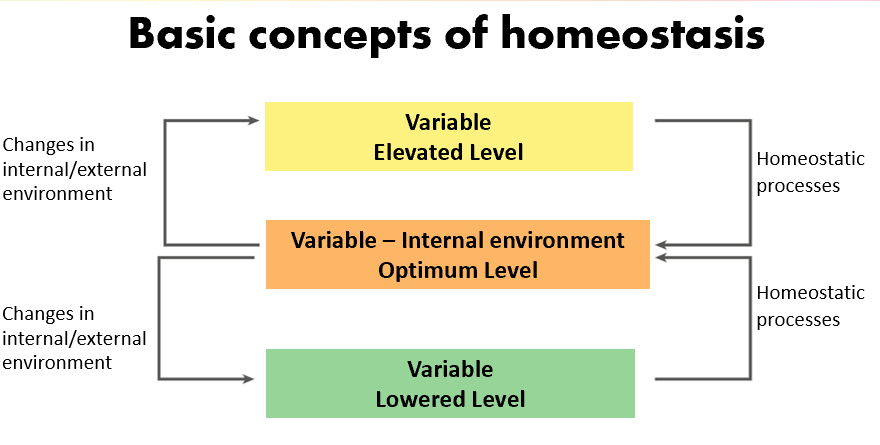
What are some human tolerance limits?
Body Heat - at a core temperature of 42 degrees, heatstroke can’t be reversed
Cold water - humans would last barely 30 mins in a 4 degree sea
Hot air - (burning building or deep mine) adults can take 10 minutes at 149C, kids succumb in a 120C car
Blood loss - can survive after spilling 30%, at 40% an immediate blood transfusion is required
Starvation - lost 30% body weight = death, however disease will probably kill you before that
Dehydration - Replace the litre or so you lost daily, or you won’t last more than a week
Why do factors need to be kept within particular tolerance limits?
So organisms can operate most efficiently
What is a limiting factor?
If any of the variables are outside of the tolerance levels then poor functioning of the organism will result, even if all other limits are in perfect tolerance limits.
What are the variable factors kept constant in the internal environment called?
Thermoregulation
Osmoregulation
Chemoregulation blood co2 concentration
Glucoregulation blood glucose level
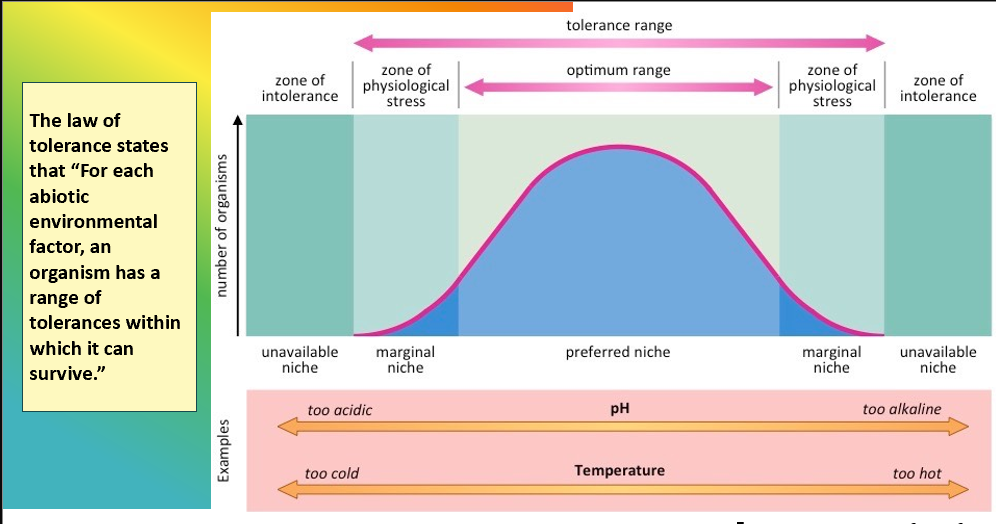
Blah blah not important tolerance limits (sorry future me <3)
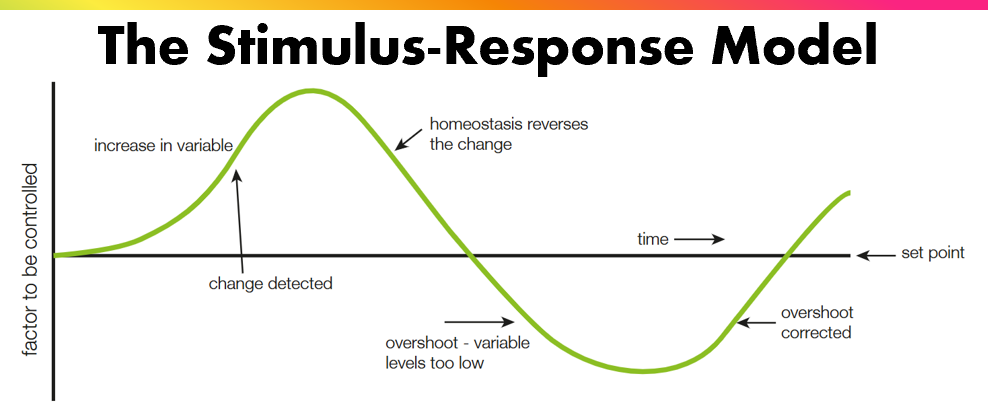
Describe what is happening
Factors in the environment cause either an increase or a decrease in the variable(s)
Homeostatic responses work in the opposite way to reverse the changes
What is a stimulus?
A variable factor in the internal or external environment that can be detected by the organism
What is a receptor?
The cells or tissues that can detect a change in the external or internal environment (a stimulus)
What is transmission?
The relay of the information via nerves and/or hormones to an effector
What is an effector?
A gland or muscle that brings about a response after receiving the information
Any tissue or organ that receives information from the control centre and facilitates the response required to maintain homeostasis
What is a response?
An action which occurs due to the initial stimulus
What is feedback?
Impact of the response on the initial stimulus. May be positive or negative
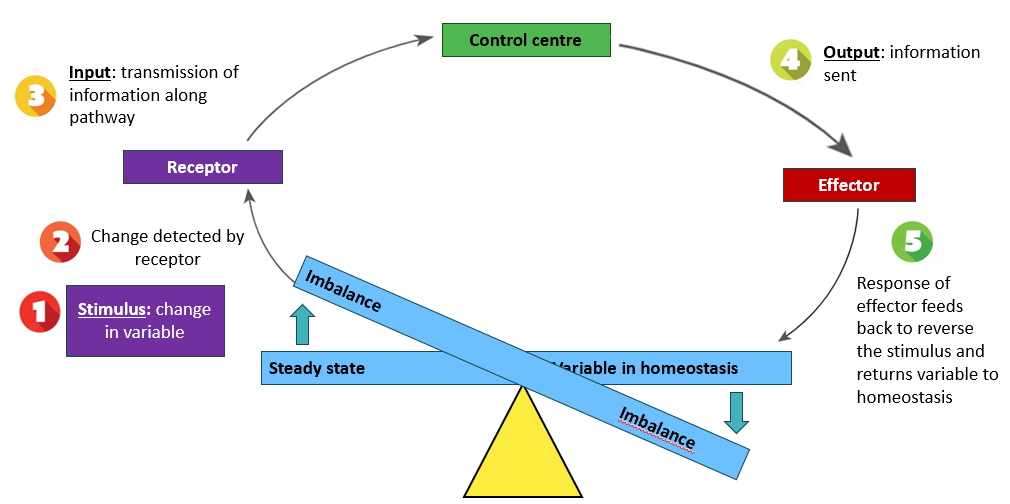
How does the stimulus-response model work?
Stimulus: change in variable
Change detected by receptor
Input: Transmission of information along pathway
Output: Information sent
Response of effector feeds back to reverse the stimulus and returns variable to homeostasis
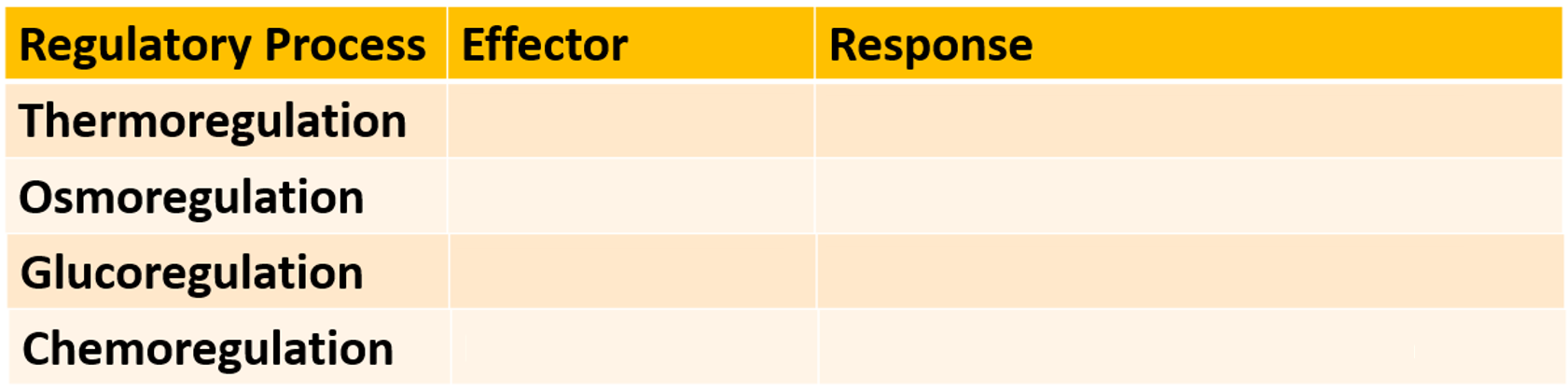
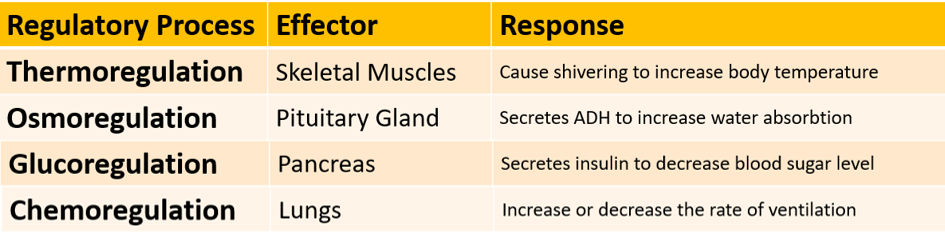
What is the effector and response of these regulatory processes?
(Thermo is for when it’s cold)
(Glucose is high)
What is negative feedback?
Occurs when the response diminishes or reverses the original stimulus
E.g.
Increase in exercise raises metabolic activity → increasing blood temperature
Receptors in tissues detect this change and effectors reverse the original stimulus and lower the temperature
Is homeostasis negative or positive feedback?
Negative - as it is this mechanism that returns to the original variable factor that was changed, back to its steady state
What is positive feedback?
Occurs when the response reinforces or brings about an increase in the initial stimulus
Less common
E.g. Baby‘s head pushes against cervix → cervix stretches and thins
This stretching activates stretch receptors (mechanoreceptors) in the cervix → sends nerve signals to brain
Brain signals pituitary gland to release oxytocin hormone into bloodstream
Oxytocin travels to uterus, causing its smooth muscles to contract
Contractions push baby down → increase initial pressure (stimulus)
Cycle repeats and intensifies:
More pressure → more oxytocin → stronger more frequent contractions → more pressure..
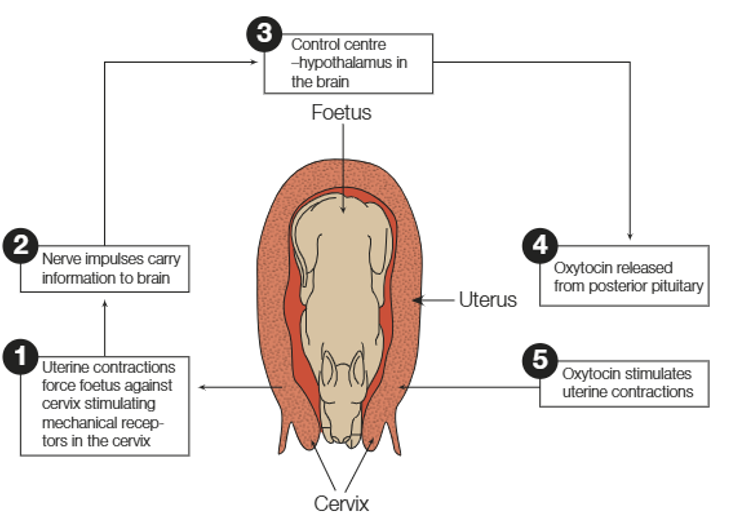
Diagram shows effect of oxytocin on the uterus during the birth of a mammal
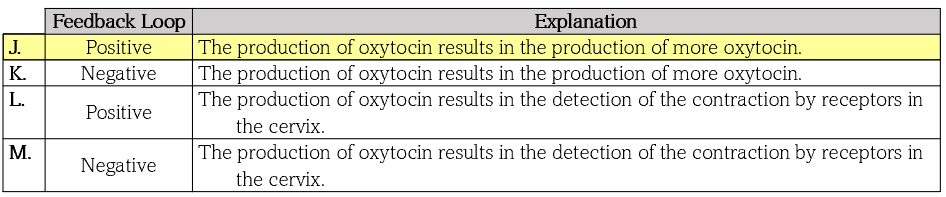
Which is correct?
J. Feedback loop: Positive - The production of oxytocin results in the production of more oxytocin
K. Feedback loop: Negative- The production of oxytocin results in the production of more oxytocin
L. Feedback loop: Positive - The production of oxytocin results in the detection of the contraction by receptors in the cervix
M. Feedback loop: Negative- The production of oxytocin results in the detection of the contraction by receptors in the cervix
J.
What is an example (not pregnancy) of positive feedback?
Blood clotting:
Once a blood vessel is damaged, platelets start to cling to the injured site
The platelets release chemicals that attract more platelets
The platelets continue to pile up and release chemicals until a clot is formed
What is the difference between negative and positive feedback?
Negative: A change is detected by receptors, and then effectors return the system to its original state
Positive: The corrective mechanism stays on, which causes the system to deviate even more from the original level
Homeostatic response mechanisms require the transfer and recognition of information from a sensory receptor and an effector. The transmission of this information:
J. is under control of the central nervous system only.
K. is usually a conscious process.
L. may involve both the endocrine and nervous systems.
M. relies only on hormones for short-term responses.
L.
How does the body maintain homeostasis of factors outside of chapter 3.2 and 3.3?
The homeostatic control of other factors involved both nervous and endocrine systems working together
E.g.
‘Fight of flight’ response and the role of adrenaline
Body temperature regulation
How do the nervous and endocrine systems function independently? What do they do that’s different?
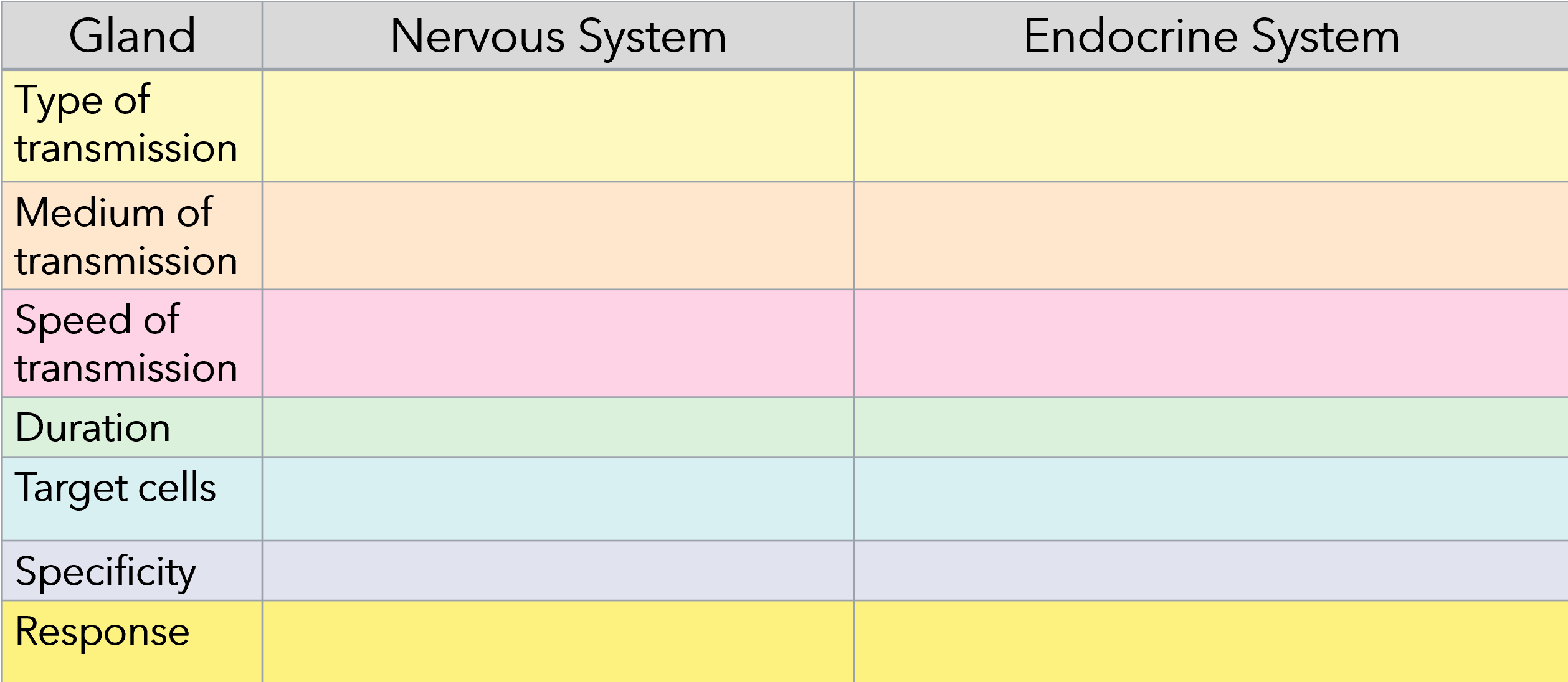
Nervous system - transmits electrical signals called nerve impulses that travel along the axons of specific nerve pathways to localised target cells
Nerve impulses are fast acting and their effects are generally short lived
Endocrine system - transmits chemical signals called hormones that travel in the blood to target cells
Hormones are reactively slow acting, but can have long lasting, widespread effects in the body.
What connects the nervous and endocrine systems?
The hypothalamus
What is the difference between nervous and endocrine system?
The nervous receives signals via afferent nerves and sends impulses via autonomic nerves.
The endocrine secretes hormones via a neural tube that controls the secretion of hormones by the pituitary gland.
What is the ‘fight or flight’ response?
Response of animals (mostly mammals) to stress
Protective mechanism enabling organisms to react quickly and be able to respond to life-threatening situations
Allows organisms to:
Fight for survival or
Take flight (quickly move away)
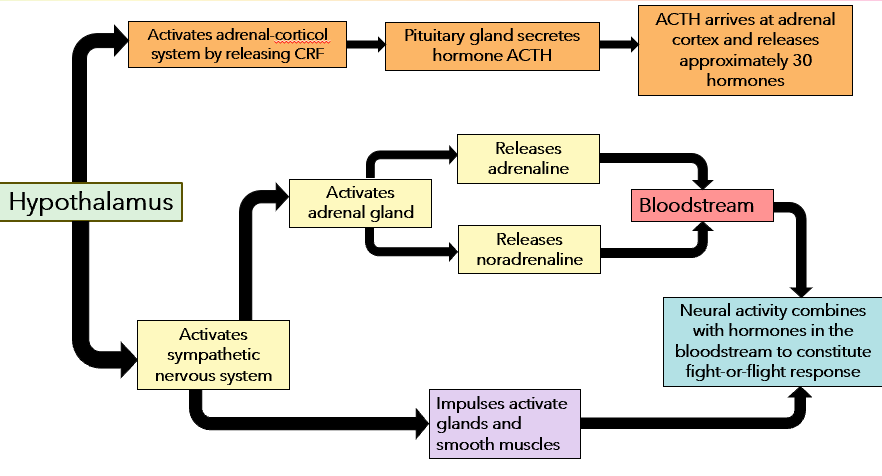
How does the ‘fight or flight’ response work?
Sensory receptors in eyes/ears transmit information to the hypothalamus
The hypothalamus communicates via the nervous system to set up the fight of flight response
Slide 9 ?
What role does adrenaline play in the ‘fight or flight’ response?
Hypothalamus initiates its actions via the autonomic nervous system (breathing, blood pressure, heart rate - involuntary)
The sympathetic nervous system is activated and prepares the body to respond to danger
Hormones usually slow acting - adrenaline is the exception
What is the process of ‘fight or flight’ response using adrenaline?
Adrenaline releases due to danger, stress, shock, excitement, etc.
These emotions cause hypothalamus to activate sympathetic nervous pathways which causes the release of adrenaline from the adrenal medulla (top of kidneys) into bloodstream
Adrenaline overrides the normal homeostatic control - inhibits secretion of insulin and binds to specific protein receptors on the surface of liver cells → activates steps to convert glycogen to glucose → increase blood glucose levels
Glucose is transported to cells to be used for energy which is required for the ‘fight or flight’ response
Adrenaline increases alertness and prepares to fight or run from danger to increase chance of survival
What physiological changes are caused by adrenaline?
Increased heart rate
Beats faster
Pumps more blood
Increase blood pressure
Increased blood flow to muscles
Blood decreases to organs
Dilation of bronchial tubes in lungs
Breathing becomes faster and shallower - take in more O2, expel more CO2
Dilation of pupils
Increased metabolic rate
Pancreas
More glucagon
Less insulin
Rising blood sugar
How does the body react to stress hormones?
Pupils dilate
Intestinal muscles relax
Breathing rate increases
Blood flow to skeletal muscles increases
Heart rate increases
Blood sugar levels increases
Blood pressure in arteries increases
Which one of the following is not one of the physiological changes associated with the ‘fight or flight’ response?
J. Increased heart rate.
K. Increased blood pressure.
L. Dilation of bronchial tubes in the lungs.
M. Decreased metabolic rate.
M.
Which one of the following combinations correctly identifies a hormone, the site of its release and the effector?
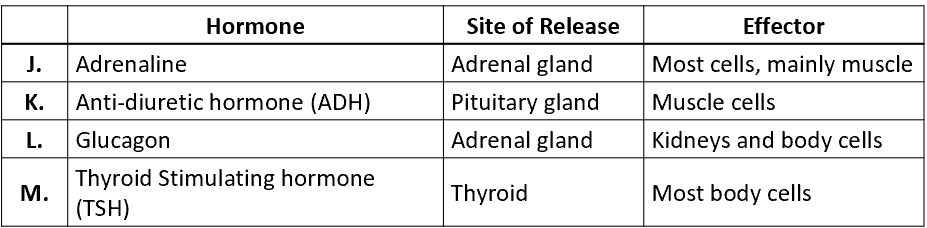
When faced with a sudden and unexpected threat, the human body will often react by releasing adrenaline into the blood.
Adrenaline is a
J. neurotransmitter that increases the speed of nerve impulses.
K. catalyst that increases the breakdown of glucose.
L. hormone that increases blood pressure and breathing rate.
M. protein that is a source of instant energy for muscle cells.
L.
Which of the following physiological changes is not associated with the ‘fight or flight’ response?
J. Decreased metabolic rate.
K. Dilation of bronchial tubes in the lungs.
L. Increased heart rate.
M. Increased blood pressure.
J.
In the ‘fight or flight’ response, adrenaline provides a
J. hormonal response stimulated by hormones.
K. nervous response stimulated only by hormones.
L. hormonal response stimulated by the nervous system.
M. nervous response stimulated by both the nervous and hormonal systems.
L.
How does the body control blood temperature?
In humans, normal temp of blood and tissue fluids is 37C
The control of blood temp involves both nervous and hormonal transmissions
Coordinated by the hypothalamus
When environment is less than 37, individuals lose more heat when not wearing suitable clothes
Heat is lost through the skin - vital organ in regulating the transfer of heat to and from the environment
What role does body hair/feathers play in temperature control?
Mechanism that helps produce and conserve heat in animals
The erection of hairs/feathers on the skin helps to trap a layer of air close to the body which provides an insulating barrier to reduce heat loss
In cold conditions, nervous signals are sent to the small muscles called erector pili, just below the surface of the skin, causing them to contract.
Results in goosebumps
Humans have too little hair for this to be effective - mostly effective for mammals and birds
What role does blood flow to the skin (arterioles) play in temperature control?
Mechanism that helps produce and conserve heat in animals
Restricting the flow of blood to the surface of the skin reduces heat loss by conduction and radiation to the external environment
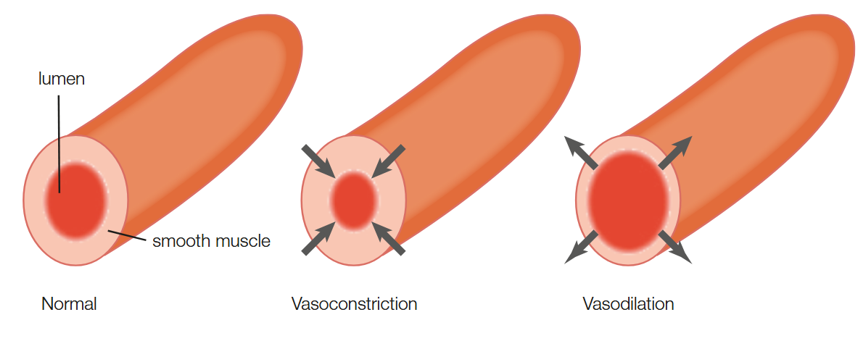
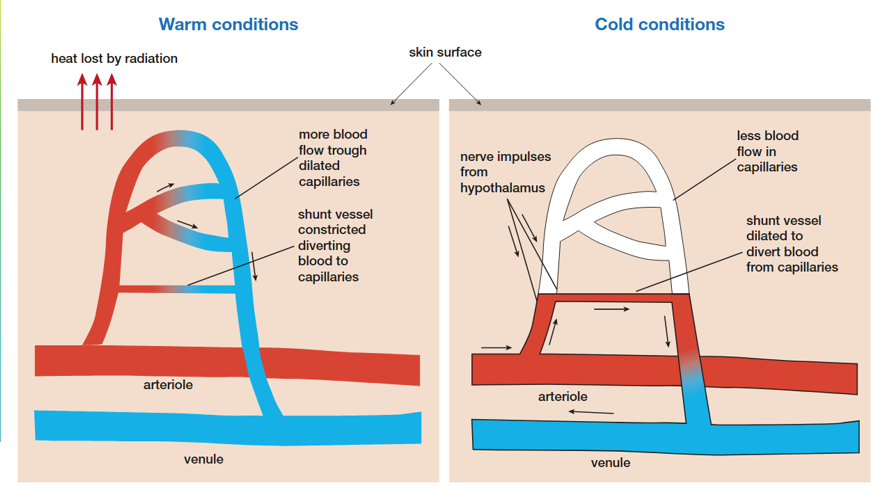
Arterioles supply blood to skin have smooth muscle (thin elastic) that has the ability to dilate/constrict
When arterioles dilate they increase blood flow → vasodilation
When arterioles constrict they decrease blood flow → vasoconstriction
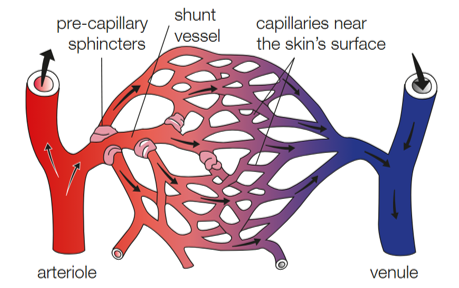
What role does blood flow to the skin (capillaries) play in temperature control?
When pre-capillary sphincters (small rings of muscle tissue) constrict, blood is diverted away from the surface of the skin and through the shunt vessel (not capillary network near skin’s surface)
This reduces heat loss by conduction and radiation
What role does shivering play in temperature control?
Shivering involves minor contractions and relaxations of the skeletal muscles
Requires energy from aerobic respiration
Heat released as a result of this metabolic activity warms the blood
Warmed blood → warm body (circulation)
What role does the metabolic rate play in temperature control?
Increasing the levels of the hormone thyroxine and adrenaline increase the rate of metabolism → helps generate more heat to raise blood temperature
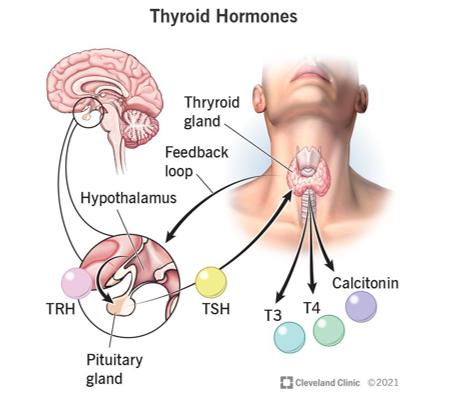
If the body temperature of a healthy person falls below the normal setting of 37˚C.
J. an increased amount of the hormone thyroxine is released, resulting in a decrease in heat loss.
K. a decrease amount of sweating occurs, resulting in an increase in heat production.
L. vasodilation occurs, resulting in an increase in heat production.
M. vasoconstriction occurs, resulting in a decrease in heat loss.
M
Thyroxine is a hormone that is involved in the regulation of body temperature in human beings.
Which one of the following responses will result from a decrease in body temperature?
J. An increased release of thyroxine, resulting in a decreased cell metabolism.
K. An increased release of thyroxine, resulting in an increased cell metabolism.
L. A decreased release of thyroxine, resulting in an increased cell metabolism.
M. A decreased release of thyroxine, resulting in a decreased cell metabolism.
K.
What are some mechanisms that help reduce heat production and help lose heat in animals?
Body hair/feathers - flattened hair or feathers to not trap a layer of air near the skin
Blood flow to the skin - arterioles are vasodilated to increase blood flow to the skin
Blood flow to the skin - the pre-capillary sphincters are relaxed, increasing blood flow to the skin to maximise heat loss
Metabolic rate - reduced → minimises heat production
Sweat glands - release moisture onto the skin surface and evaporative cooling causes heat loss
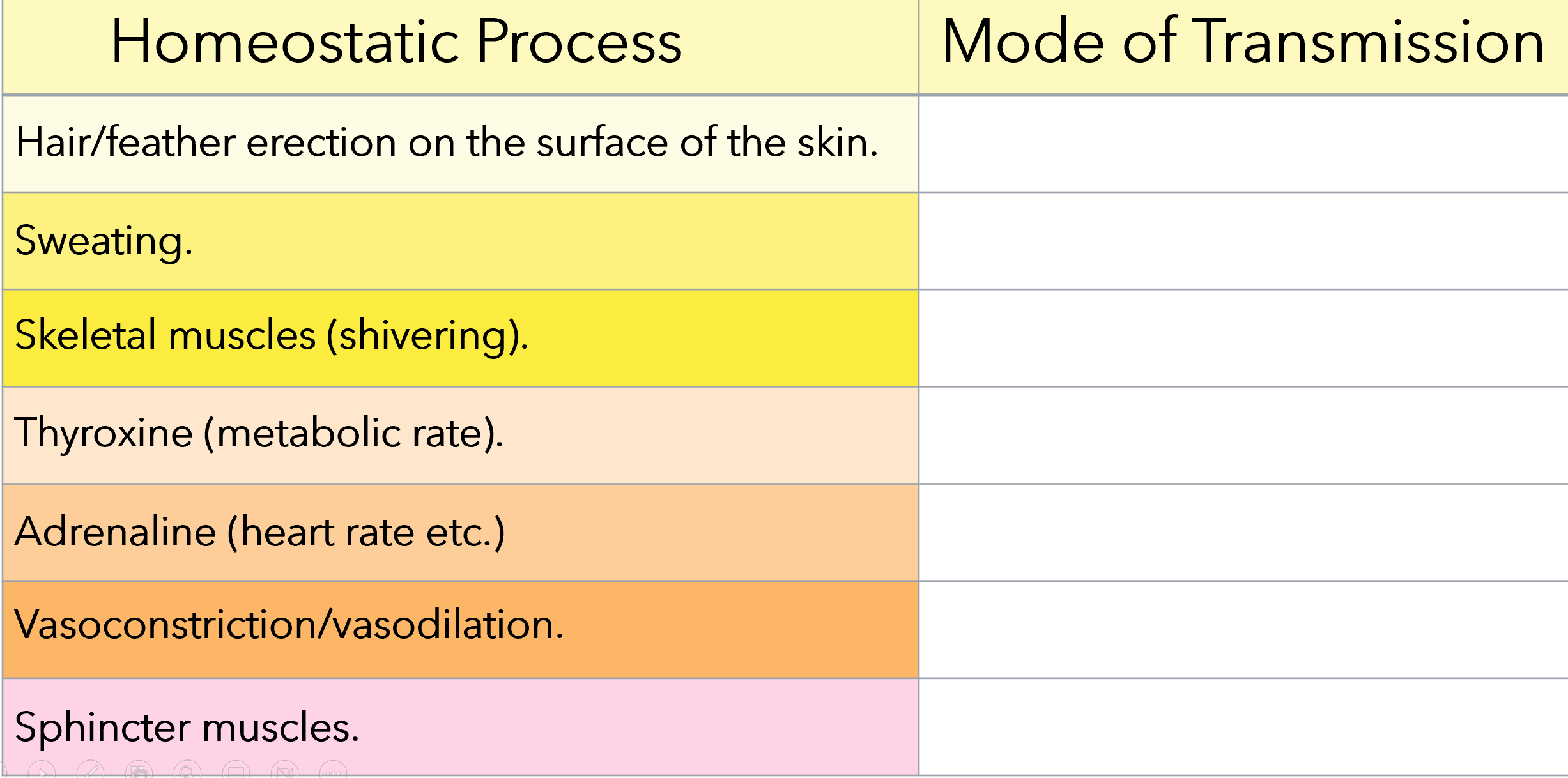
What are the effects of vasoconstriction and vasodilation on blood flow to capillaries close to the skin surface?
Which of the following options corresponds with how the hypothalamus responds to a very high body temperature?
J. Stops receiving sensory input.
K. Causes dilation of skin arterioles.
L. Slows the heart rate.
M. Increases muscle contraction.
K.
Which of the following actions will restore core temperature after strenuous exercise?
J. decreasing metabolic rate by decreasing the amount of thyroxine in the blood.
K. increasing sweat production.
L. increasing muscle contractions in skeletal muscles.
M. decreasing the flow of blood in the capillaries close to the skin.
J.
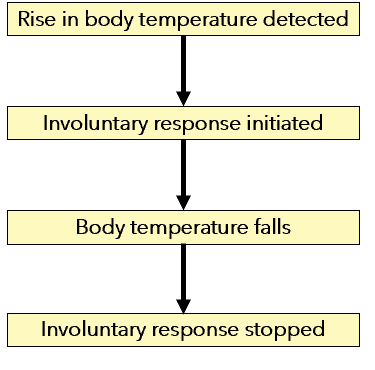
Refer to the flow diagram, which displays some stages in the control of human body temperature.
Which of the following options is an involuntary response that could be initiated as a result of a rise in body temperature?
J. Reduced sweating.
K. Increased secretion of thyroxine.
L. Increased vasodilation.
M. Erection of the hairs on skin.
J.
A person’s core body temperature increases as a result of exercise. To restore the core temperature to normal, the body responds by
J. increasing sweat production as a result of hormonal control.
K. increasing blood flow to surface capillaries as a result of nervous control.
L. increasing metabolic rate as a result of hormonal control by the thyroid gland.
M. rapidly relaxing and contracting muscles as a result of nervous control.
K.
In 1877 the American biologist Joel Allen observed that the length of arms, legs, and other appendages of warm-blooded animals affected the rate at which they lost heat to the environment.
Allen observed a consistent difference in the limb length of individuals in populations of the same species living in warm climates near the equator, in comparison with those living in cold climates further from the equator.
Which one of the following statements is consistent with Allen’s observations?
J. In cold climates, animals need to conserve as much heat as possible and therefore have longer limbs.
K. In warm climates, the larger the surface area of the limbs, the faster the animals lose heat to the environment.
L. In warm climates, animals have longer limbs that increase their surface area and minimise heat loss.
M. In cold climates, animals have shorter limbs and a larger surface area-to-volume ratio.
K.
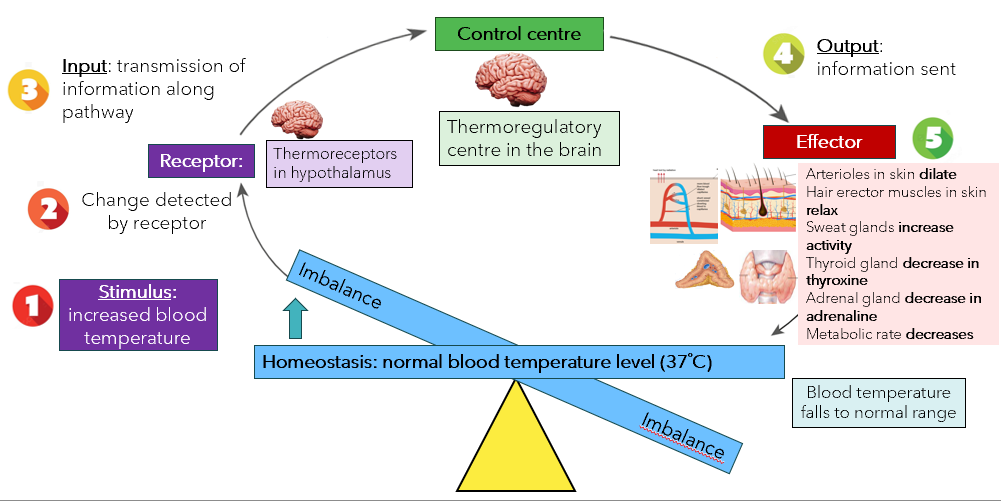
What process occurs when there is an increase in blood temperature?
Stimulus: Increase in blood temperature
Blood temp monitored by thermoregulators in hypothalamus
Receptor: Thermoreceptors in hypothalamus detect increase in blood temp
A variety of nervous and hormonal transmissions are activated
Nervous messages sent to sweat glands → sweat releases onto surface of skin → evaporative cooling (sweat evaporates, taking heat with it)
Decreased nervous messages sent to smooth muscle cells in arterioles and pre-capillary sphincters that supply blood to skin surface → vasodilation → increase blood flow to body surface → increase loss of heat
Decreased secretion of thyroxine and adrenaline from thyroid and adrenal glands → decreased metabolic rate → decreased heat production
Decreased nervous messages sent to erector-pili muscles → hair lay flat → increase heat loss (as insulating layer of trapped air is not present)
These responses decrease heat production and increased heat loss from body → decrease in blood temperature
Thermoreceptors detect blood temperature is back to normal → transmissions decrease temperature are terminated → negative feedback
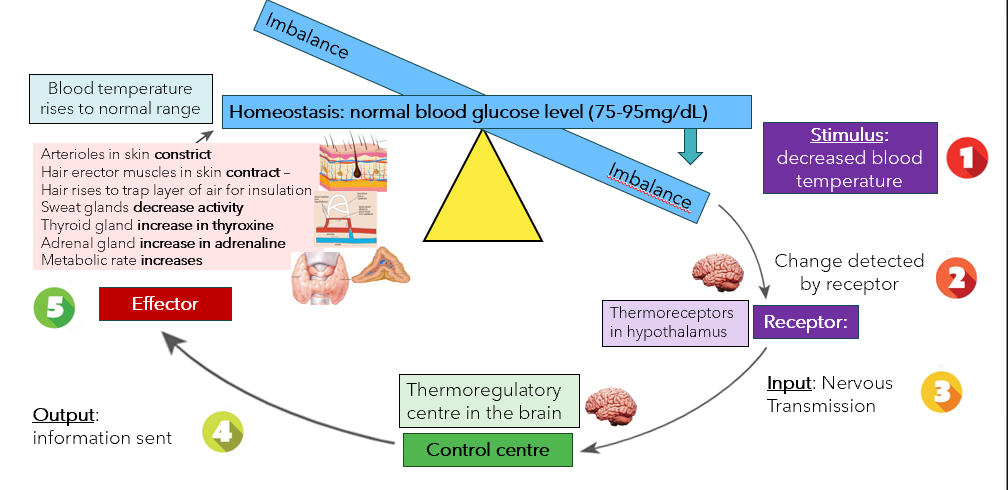
What process occurs when there is a decrease in blood temperature?
Stimulus: Decrease in blood temp
Blood temp monitored by thermoregulators in hypothalamus
Receptor: Thermoreceptors in hypothalamus detect decrease in blood temp
A variety of nervous and hormonal transmissions are activated
Nervous messages sent to skeletal muscles → contract (shivering) → burning energy and creating heat as by-product
Increased nervous messages sent to smooth muscle cells in arterioles and pre-capillary sphincters that supply blood to skin surface → vasoconstriction → decreases blood flow to surface → reduce loss of heat
Increased secretion of thyroxine and adrenaline occurs from thyroid and adrenal glands → increased metabolic rate → increased heat production
Increased nervous messages sent to erector-pili muscles in skin → contract → piloerection ‘goosebumps’
These responses increase heat production and retain heat in body → increase blood temp
Thermoreceptors detect blood temperature is back to normal → transmissions decrease temperature are terminated → negative feedback
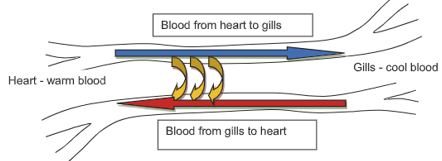
Refer to the diagram below to answer the question that follows. The diagram shows the process of the Counter Current Heat exchange in a fish.
As warm blood travels from the heart to the gills an exchange takes place which enables blood returning to the heart from the gills to be warmed.
The most likely reason that this process increases the chance of survival in cold environments is:
J. An increase in metabolic rate which warms the blood.
K. An increase in vasoconstriction to reduce blood flow to the extremities.
L. A reduction in the exposure of blood vessels to the extreme cold thus limiting heat loss.
M. A reduction in heat loss to the environment by maintaining a low blood temperature flowing to the extremities.
M
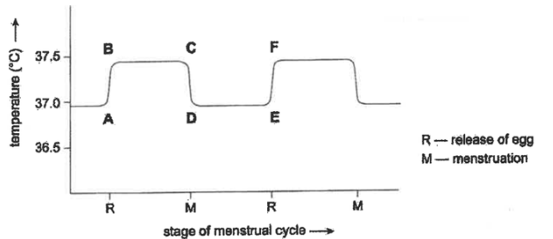
In human beings, body temperature changes during the menstrual cycle. The day after an egg is released from an ovary, the body temperature rises by approximately 0.5˚C and remains at this temperature until the beginning of menstruation. Refer to the following graph, which shows the variation in body temperature during two menstrual cycles:
Which one of the following statements is consistent with the information in the graph above?
The temperature change between
J. A and B could result from an increase in metabolic rate.
K. E and F could result from an increase in sweating.
L. C and D could result from a decrease in the flow of blood to the skin.
M. A and B could result from a decrease in shivering.
J.
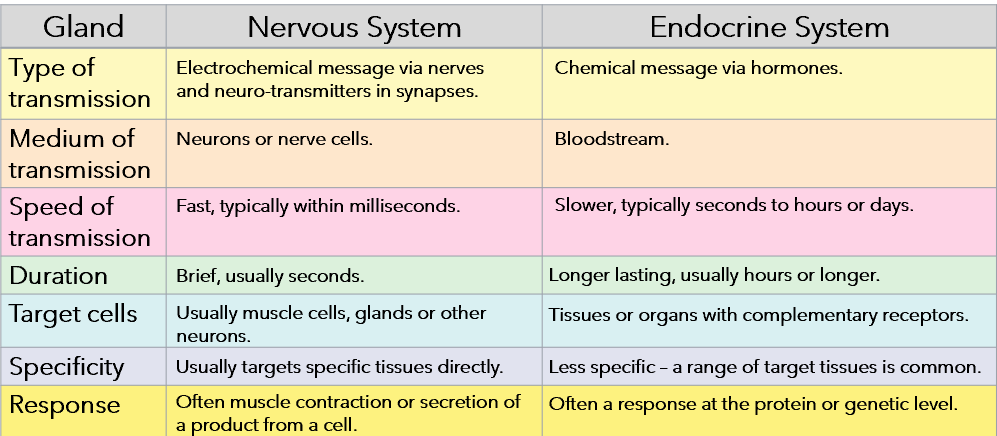
When compared to hormones, nervous impulses generally have a:
J. short duration and a short response time and are involved in short-term adjustments.
K. short duration and a short response time and are involved in long-term adjustments.
L. long duration and a short response time and are involved in short-term adjustments.
M. long duration and a long response time and are involved in short-term adjustments.
J.
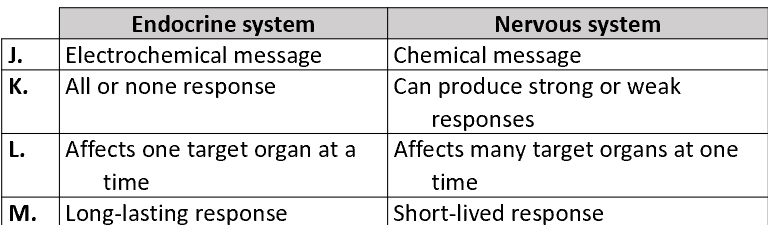
Which of the following options correctly identifies a difference between the endocrine and nervous systems?
L.
Which one of the following is true concerning the action of nerves and/or hormones?
J. Nerves produce longer lasting effects than hormones.
K. Hormones are faster than nerves when responding to stimuli.
L. Hormones may work together with nerves in managing some body processes.
M. Nervous responses are less specific in their target organs.
L.
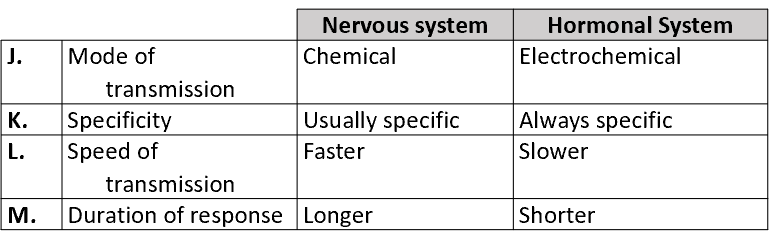
The nervous system and the hormonal system work together in the human body. The table below compares aspects of the nervous system and the hormonal system.
Which one of the following comparisons is correct?
K.
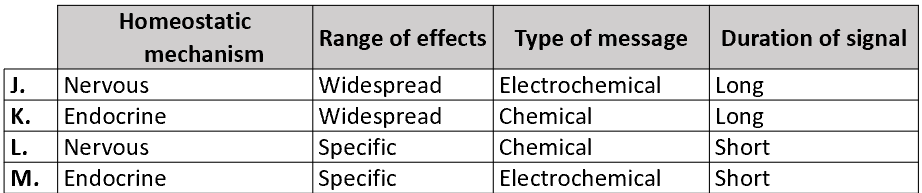
The table below shows combinations of a homeostatic mechanism, the range of effects, the type of message, and the duration of the signal.
Which one of the combinations in the table is correct?
J.
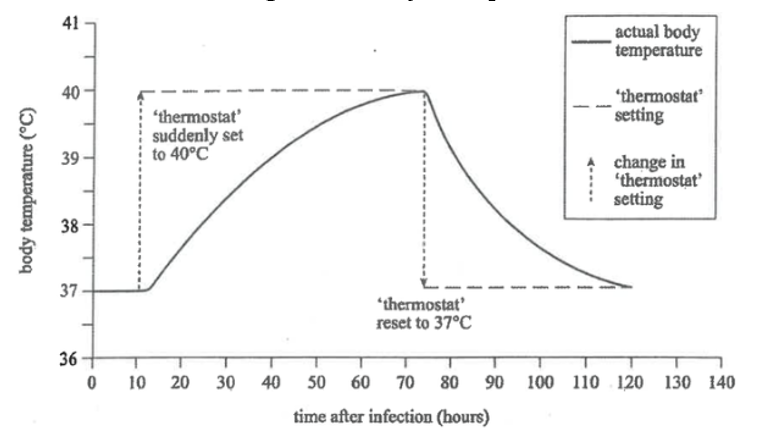
Refer to the following graph, which shows the changes in body temperature of a human being during the first 120 hours of a bacterial infection.
During a bacterial infection, white blood cells release a protein that changes the set point of the brain ‘thermostat’ from 37˚C to 40˚C.
When this protein breaks down after about 3 days, the brain ‘thermostat’ is reset to 37˚C.
Which one of the following responses is most likely to occur?
J. A decrease in thyroxine production between 10 and 70 hours after the onset of the infection.
K. A decrease in metabolic activity between 10 and 70 hours after the onset of the infection.
L. Shivering at 40 hours after the onset of the infection, when the body temperature is about 39˚C.
M. A decrease in sweating at 80 hours after the onset of the infection, when the body temperature is about 39˚C.
L.
Scientists at Washington University have recently discovered that odour receptors are found not only in the nose, but also in the lungs. When odour receptors in the nose detect chemicals such as cigarette smoke, they send a nerve impulse to the brain and the smell of the cigarette smoke is then sensed.
Odour receptors in the lungs are called pulmonary neuroendocrine cells (PNECs). When PNECs detect chemicals such as cigarette smoke, they release hormones that cause the airways to constrict. In some people constriction of the airways results in an asthma attack. It is thought that people with asthma may have hypersensitive PNECs.
Which one of the following statements is not consistent with this information?
J. The airways of people with asthma would be constricted before they sense the smell of cigarette smoke.
K. Hormones released by PNECs would travel through the bloodstream.
L. Drugs that block hormone receptors in the airways could be used to treat asthma.
M. The constricted airways will not return to normal until the smell can no longer be sensed.
J.
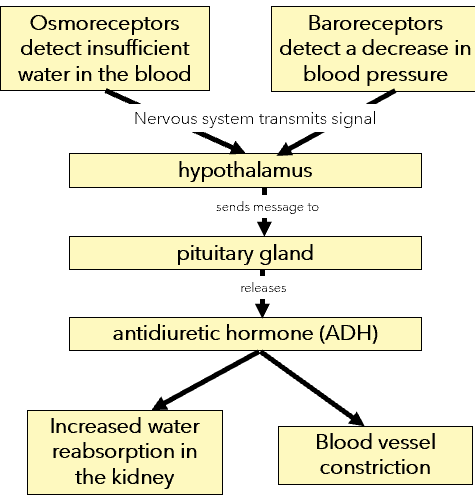
Refer to the following flow chart, which shows part of a human being’s response to a change in water in the blood and a change in blood pressure.
Which one of the following statements is consistent with the information in the flow chart?
J. ADH causes an increase in blood pressure.
K. ADH causes a decrease in blood volume.
L. Both the nervous system and the endocrine system are involved in the detection of stimuli.
M. The response to increased blood pressure is the release of ADH.
J.
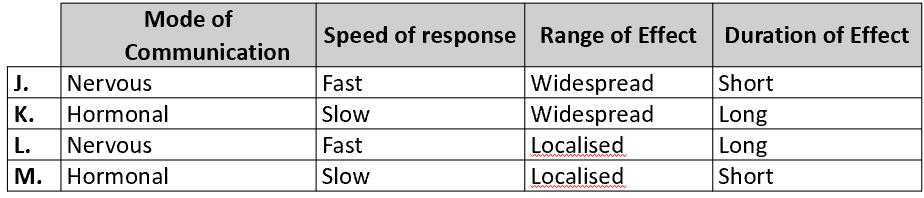
Human cells use two modes of communication.
Which one of the following combinations correctly matches a mode of communication with the speed or response, the range of effect, and the duration of effect?
J.
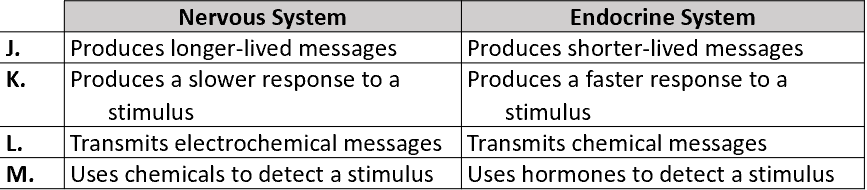
Which one of the following combinations correctly compares a feature of the nervous system with a feature of the endocrine system?
K.
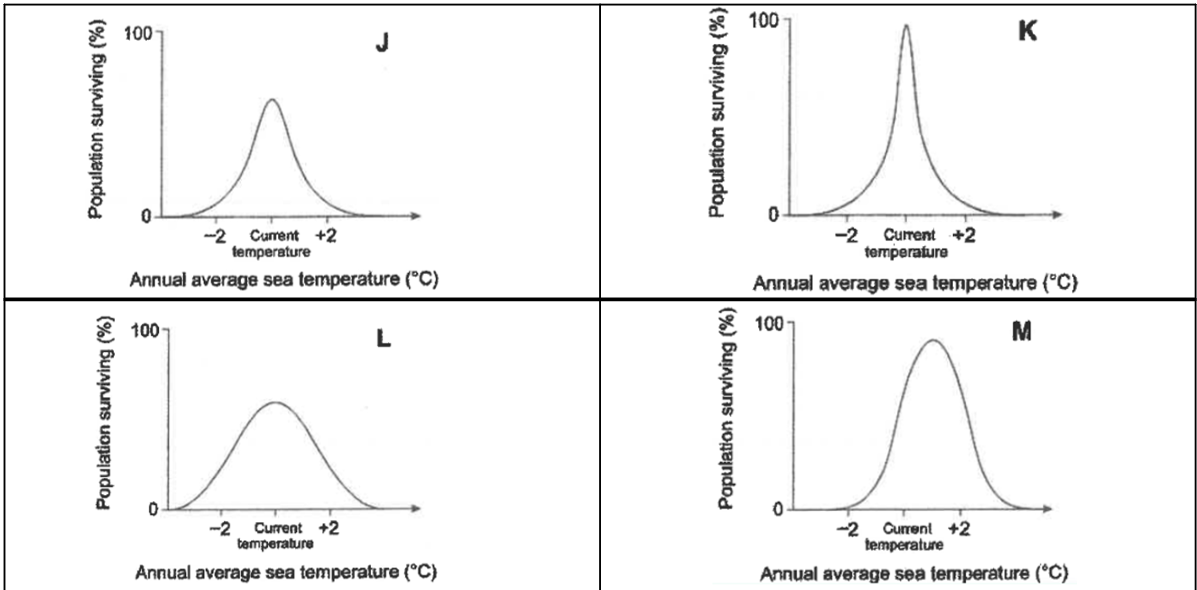
Some scientists predict that climate change will increase the annual average sea temperature by 2˚C or more.
The graphs below represent the percentage of the population of four different species of coral (J, K, L, M) that survive at different annual average sea temperatures.
Which one of the graphs below represents a species of coral that would have the best survival rate if the annual average sea temperature increased by 2˚C?
M.
People who spend extended periods of time in very cold
conditions, such as Antarctica, can experience a
lower-than-normal body temperature.
Human body temperature is under homeostatic control.
(a) State the location in the human body where changes in body temperature are detected.
Hypothalamus OR brain OR thermoregulatory centre.
People who spend extended periods of time in very cold
conditions, such as Antarctica, can experience a
lower-than-normal body temperature.
Human body temperature is under homeostatic control.
Explain the impacts on human body cells when the body temperature changes to above or below its tolerance limits
Enzymes denature at high temperatures and therefore no longer function as they change shape, they cannot bind to specific substrates, leading to reduced cellular processes in the cell
Reduced collision of substrates at low temperatures lead enzymes and reactions proceeding too slowly within cells, leading to slower chemical reactions in the cell
People who spend extended periods of time in very cold
conditions, such as Antarctica, can experience a
lower-than-normal body temperature.
Human body temperature is under homeostatic control.
Identify one nervous response to low body temperature, and explain how it causes an increase in blood pressure.
Reduced sweating, resulting in less water loss from body and an increase in volume of blood, leading to increased blood pressure
Vasoconstriction occurs and blood is shunted away from the surface of the skin, this increased volume of blood forced through narrowed blood vessels leads to increased blood pressure
Extended exposure to cold temperatures results in an increase
in the production of urine – a condition known as ‘cold diuresis’.
This increased production of urine triggers the release of a
hormone to regulate loss of water.
Name this hormone.
ADH
Extended exposure to cold temperatures results in an increase in the production of urine – a condition known as ‘cold diuresis’. This increased production of urine triggers the release of a hormone to regulate loss of water.
Describe how this hormone regulates loss of water from the body
ADH travels in the blood from the pituitary of the collecting ducts of the nephrons in the kidney. It inserts more aquaporins into the walls of the collecting ducts or tubules, increasing permeability of the tubule walls. This leads to an increase in the reabsorption of water into the blood, decreasing the volume of urine produced
Extended exposure to cold temperatures results in an increase in the production of urine – a condition known as ‘cold diuresis’. This increased production of urine triggers the release of a hormone to regulate loss of water.
Explain the link between the onset of cold diuresis and a change in blood pressure that occurs before the release of the hormone to regulate loss of water
Decrease in blood volume results in a decrease in blood pressure
Extended exposure to cold temperatures results in an increase in the production of urine – a condition known as ‘cold diuresis’. This increased production of urine triggers the release of a hormone to regulate loss of water.
The hormone that regulates loss of water from the body is a peptide hormone.
Name one other type of chemical that acts as a hormone in the human body.
Protein, amino acid derivative, steroid
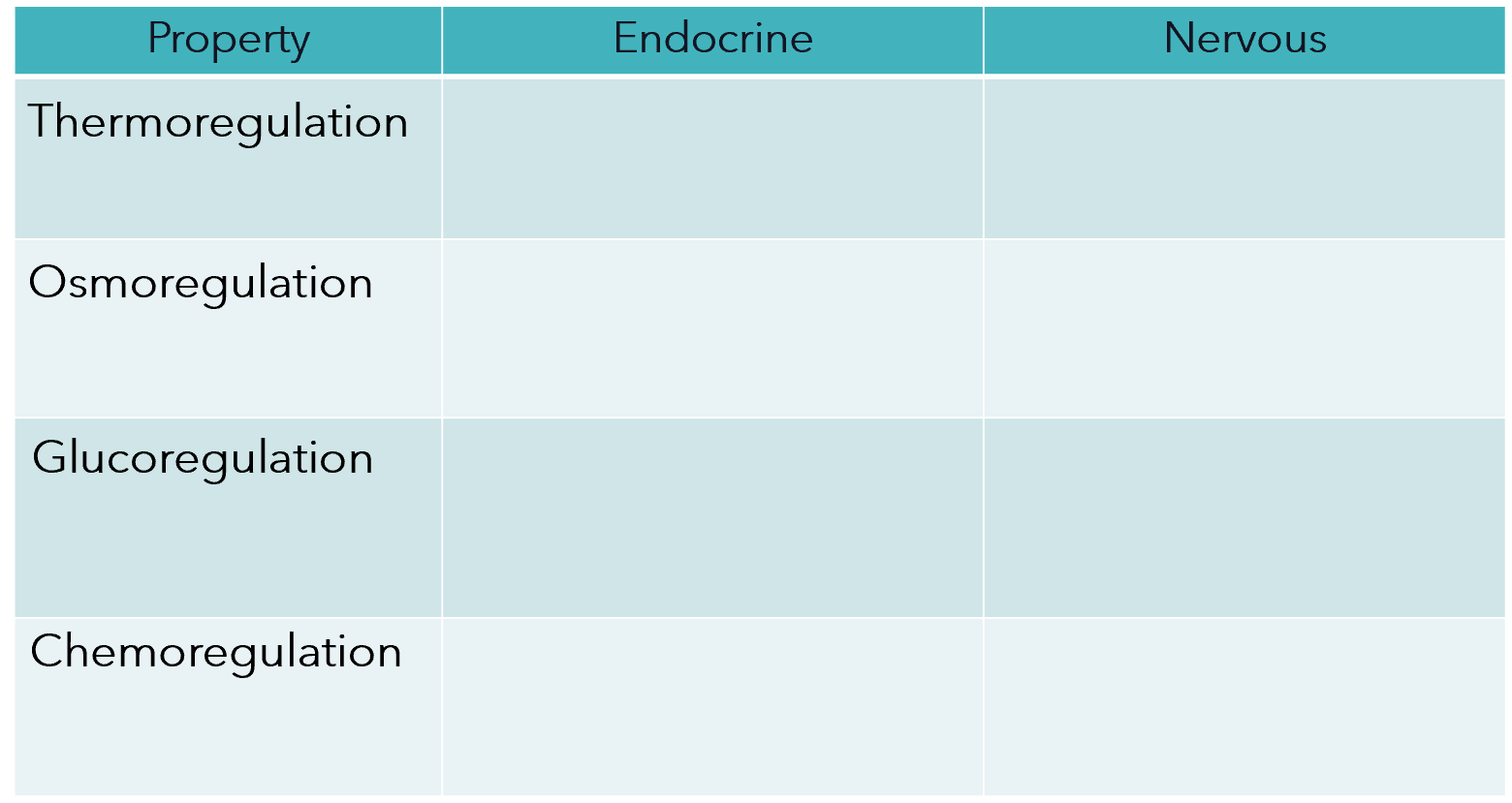
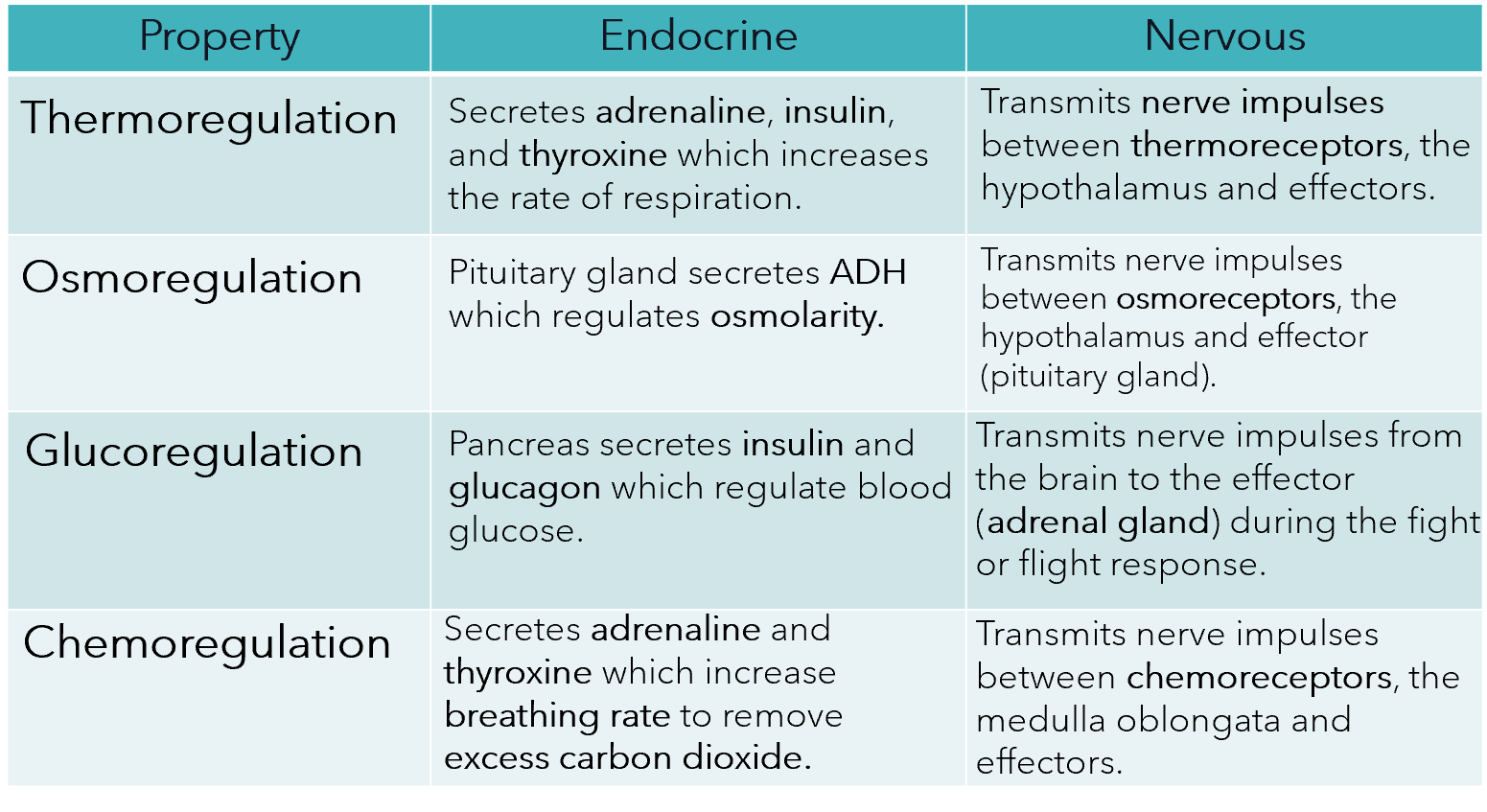
Summarise this
What is the endocrine system?
Composed of glands that secrete hormones directly into the bloodstream
Effects are slower than nervous system but act for longer
What is a target organ?
The organ a particular hormone acts on
What is the pituitary gland?
The ‘master gland’ which secretes several hormones into the blood in response to body conditions
What is a hormone?
A chemical produced by a gland secreted into the blood
Has a biological effect on a target organ
Chemicals that are produced by cells and carried into the blood - brings about an effect in the body
What is a gland?
An organ that secretes hormones into the blood
What are complementary receptors?
A protein on target cells which allows hormones to bind and affect target cells
What are hormones produced by?
Endocrine glands
What do hormones do?
Control activities in a wide range of areas like:
growth
reproduction
solute concentration
glucose concentration
blood temperature
ggs rb
How do hormones communicate compared to nerves?
Nerves communicate along cells via nerve impulses
Hormones are the CHEMICAL form of communication between tissues and cells - travel in BLOODSTREAM
What are the three types/classes of hormones?
Peptide and protein hormones
Amino acid derived hormones
Lipid/steroid hormones
What are peptide and protein hormones?
Peptides consist of a short chain of amino acids (polypeptides)
Proteins consist of longer polypeptide chains
What are amino acid derived hormones?
Small molecules that are derived from the amino acids tyrosine and tryptophane
What are lipid/steroid hormones?
Lipid-based hormones, derived from cholesterol
Usually insoluble in water
travel through the blood bound to proteins