Chapter 2: Functionalism
 Call Kai
 Learn
Learn Practice Test
 Spaced Repetition
 Match
Match Flashcards
 Knowt Play
1/100

There's no tags or description
Looks like no tags are added yet.
Name | Mastery | Learn | Test | Matching | Spaced | Call with Kai | Chat |
|---|
No analytics yet
Send a link to your students to track their progress
101 Terms
What do Functionalists see as the source of crime and deviance?
The structure of society, not in the individual
Give two examples of social control mechanisms
police
courts
What do they believe about these social control mechanisms?
Are necessary to protect social order
What do many functionalist writers argue about deviance?
A certain amount of deviance has a beneficial effect for the maintenance and well-being of society.
1) Crime is functional to society
i) Crime is inevitable - Durkheim
What did Durkehim see crime as?
An inevitable and normal aspect of social life and thus found in all societies, for two reasons.
What is the first reason?
Firstly, not everyone is effectively socialised into the shared norms and values, so some individuals will always break the rules.
What is the second reason?
Secondly, particularly in complex modern societies, there is a diversity of lifestyles and values, where a variety of distinct norms and values come to exist, some which may deviate from the mainstream.
What is a key concept for Durkheim in explaining why crime occurs?
anomie
What does anomie mean?
normlessness
What did Durkheim use the word anomie to explain?
explain crime
arguing that when someone is insufficiently integrated into society’s norms and values, they are more likely to engage in criminal or deviant behaviour.
What can this be a result of?
result of poor socialisation
meaning that anomie is present when social controls are weak
and values that regulate individuals’ behaviour are not strong enough for them to function appropriately in society.
What did he associate a growth in anomie with?
a shift to a more individualistic society and especially periods of social change
What may Individuals become unsure of and what is the result of this?
the accepted norms and values and as a result are more likely to behave in a way that is deviant or criminal.
What period did Durkheim see that was particularly fertile for the growth of anomie?
Durkheim saw the period of industrialisation as particularly fertile for the growth of anomie
when the agricultural communities were breaking down as people moved to a more individualistic and industrial society.
ii) Crime is functional
What does Durkheim say about crime?
According to Durkheim, not only is crime inevitable, but it also performs positive functions for society.
What is the one way he saw crime as functional?
Strengthening collective values. The function of punishment is not to remove crime in society, but remind people of the boundaries between right and wrong. This is often referred to as boundary maintenance. Punishments therefore serve to reaffirm society’s shared rules and reinforce social solidarity.
Example:
What is another way he saw crime as functional?
Enabling social change. Deviance allows new ideas to develop, enabling society to change and progress. For Durkheim, all change starts with an act of deviance. Individuals with new ideas, values and ways of living must not be completely stifled by the weight of social control. There must be some scope to challenge and change existing norms and values.
Example:
iii) Crime is functional - Cohen
What is one way that Cohen believed crime performs positive functions for society?
Acting as a safety valve.
Crime can release the stresses in a society, providing an outlet for discontent while avoiding more serious challenges to the social order.
For example Polsky argues that pornography safely ‘channels’ a variety of sexual desires away from alternatives such as adultery, which would pose a much greater threat to the family.
What is another way that Cohen believed crime performs positive functions for society?
Acting as a warning device.
That society is not working properly, and there is a potential threat to the social order.
For example, high rates of truancy may indicate problems with the education system and that policy makers need to make appropriate changes to it.
Stretch & Challenge – Synoptic Links
Durkheim’s ideas have been developed further.
For example, Erikson argues that if crime and deviance perform positive social functions, then perhaps it means society is actually organised to promote deviance.
He suggests that the true function of agencies of social control such as the police may actually be to sustain a certain level of crime rather than to rid society of it.
Societies sometimes also manage and regulate deviance rather than seeking to eliminate it entirely.
For example, demonstrations, festivals and student freshers week all licence misbehaviour that in other contexts might be punished.
During the first lockdown in March 2020, illegal raves went ahead as it was easier for the police to control a certain level of crime and deviance rather than trying to put a stop to the rave taking place.
Evaluation
1. By saying the crime is beneficial for society, Durkheim and Cohen ignore the impact it has on the victims. Left Realists believe that it is disadvantaged groups in society who are at risk of being victims of crime, and as they live in a state of relative deprivation, the impact on them is heavy. Left Realists believe that no positive impact of crime is more important than assisting those victims who live in poverty.
2. Durkheim and Cohen’s explanation of how crime can be functional for society, does not give a sufficient explanation for why some people commit crimes in the first place. Both Left and Right Realists believe that to reduce crime we must look at why crime is committed so that we can develop solutions to this problem.
2) Why do individuals commit crime?
What do Strain and Subcultural theories explain crime in terms of?
blocked opportunities and subcultures.
Where did such theories originate within?
The functionalist perspective
What image of crime do Functionalists tend to accept?
image of crime generated by official statistics
Therefore, What do most Functionalist theories attempt to explain?
attempt to explain why young, working-class males commit crime.
i) Strain Theory – Merton
What is Functionalist Merton’s strain theory?
he examined the strain between the goals people aspire to have within society and the means of achieving such goals.
What was his work based upon?
the examination of a Western Culture
he used official statistics, which he took at face value as his evidence
Who did Merton say experienced the most strain?
Merton stated that it was the urban poor (young, working class delinquent) that experienced strain the most
often not having appropriate means to achieve such goals.
What did Merton suggest, deviance is a result of strain between?
The goals that a culture encourages individuals to achieve.
What the institutional structure of society allows them to achieve legitimately
What society did Merton study and what did he find?
examined American Society
and found its culture attached great importance to success, in terms of money and material possessions.
How are Individuals expected to pursue these goals?
through legitimate means
For example, working hard in education to gain skills and qualifications, which support high occupational positions in support of becoming wealthy.
What is the ideology of the ‘American Dream’?
states all members of society have equal opportunity of success if they try hard enough
However, how can you critique such ideas?
meroticracy
CAGE factors
Davis and Moore
What produces frustration and pressure on individuals?
The strain between the cultural goal of money and success
and the lack of legitimate means to achieve it
What can this make people resort to?
some resorting to illegitimate means such as crime and deviance
What is the term Merton calls this pressure to deviate?
strain to anomie
What did Merton define anomie as?
‘disjunction between goals and means’
How is this idea increased?
increased more as American society puts more emphasis on achieving success than the accepted ways of achieving it.
For example, winning the game becomes more important than playing by the rules.
How many types of adaptions did Merton suggest?
5
(you only need to know 2 cutie pie)
What did Merton suggest these 5 types of adaptation were?
5 types of adaptation in which members of society respond to the strain of anomie
What are the two types of adaptions you need to remember?
1) Innovation
2) Retreatism
Explain ‘innovation.’
Innovation:
Individuals reject the legitimate means of achieving success and innovate, by turning to deviant means, in particular, crime. Members at the lower end of the class structure are most likely to enter this route to success. Whereas Durkheim defined anomie as stemming from insufficient integration into society’s norms and values, Merton’s innovators are in some ways too integrated
Example: drug dealing
Explain ‘retreatism.’
Retreatism:
Individuals reject both the goals of success and the normative means of achieving it. They ‘drop out’ of society and are insufficiently integrated in society.
Example: addiction
Table

Stretch & Challenge – Synoptic Links
Reiner (2015) believes that Merton’s theory is still influential today. Merton appears to have uncovered the main cause of crime in modern societies, the alienation caused by the disillusionment with impossible societal goals. Reiner suggests this partly explains the 2011 London Riots and MP expenses scandal of 2009.
Evaluation
1. Merton takes official statistics at face value, failing to recognise the dark figure of crime. Many crime statistics over represent working-class crime and under-represent others. Marxists argue official statistics ignore white-collar crime as well as the power of the ruling class to make and enforce the laws.
2. Merton only accounts for utilitarian crimes (financial gain). He does not explain crimes of violence and vandalism. His utilitarian theory is too deterministic: the working class experience the most strain, yet they do not all deviate from cultural norms and values and not everyone strives for material success. Additionally, he fails to explain the crimes of the powerful ignoring crimes such as white-collar crime.
Stretch & Challenge – Synoptic Links
In an attempt to explain white-collar crime, Merton’s strain theory is revisited and developed.
All members of society face the same success goals, and there is pressure an all classes in society to succeed. When people in white-collar occupations find the routes to pay increases and promotion blocked, they sometimes ‘innovate’. They turn to illegal means to achieve monetary goals. They experience the same strain to anomie, weakening the mechanisms of social control.
3. Why do subcultures commit crime?
What does the Subcultural theory attempts to explain?
deviance and delinquency in terms of the subculture of a social group
What do they argue certain social groups develop and why?
develop norms and values which differ from those held by other members of society
and are provided with an alternative opportunity structure for those who are denied the chance to achieve by legitimate means.
How are they in a state of anomie?
By having a separate set of norms and values
i) Status Frustration – A. Cohen
How did Cohen respond to the criticisms of Merton’s theory?
he argued that delinquency is a collective rather than an individual response.
What did Cohen agree with?
He agreed that while lower working-class held the success goals of mainstream culture, they had little opportunity to achieve them due to educational failure and low skilled, low paid jobs.
Why do boys suffer from status frustration?
They are stuck at the bottom of the stratification system
with avenues to success blocked
they are frustrated and dissatisfied with their low status in society.
How does the lower working-class resolve such frustration?
through rejecting the success goals of mainstream culture
replacing them with an alternative set of norms and values
otherwise known as anomie.
What can they do through these different norms and values?
through these different norms and values, they can achieve success and gain prestige, resulting in a delinquent subculture.
It can be seen as a collective solution to the common problems of lower working – class adolescents.
For example,
Within this subculture, what is there?
there is an alternative status hierarchy
where high value is put on deviant activities, such as vandalism and stealing.
What are the positive rewards not motivated by?
they are not motivated for monetary gain
but by the status and prestige gained in the eyes of their peers
this solves the problem of status frustration
Evaluation
1. Cohen assumes that working class boys begin life sharing middle-class success goals. He ignores the possibility that some working class boys never share these goals in the first place, and so never see themselves as failures. For example, the work of Sugarman (education unit) highlights how different social classes are socialised into different norms and values.
2. It’s worth highlighting that this theory is overwhelmingly about male working-class subcultures. The British sociologist Collinson argues that subcultural theory may well be missing the obvious point here: that deviance is less to do with class subcultures and more to do with gender and hegemonic masculinity. This is the idea that males are socialised into behaviours such as aggression, which can lead them to turn to crime. Messerschmidt would support this idea.
ii) Illegitimate Opportunity Structures - Cloward and Ohlin
What do Cloward and Ohlin argue about Merton and Cohen?
they fail to explain why delinquent subcultures take different forms in a response of strain to anomie.
For example, some subcultures are concerned with theft, others with violence or drug use.
What do they suggest about why different subcultural responses occur?
occur due to unequal access to legitimate opportunity structures
and access to illegitimate opportunity structures
Who do they state there is greater pressure on?
They state that there is greater pressure on members of the working class to deviate
because they have less opportunity to succeed by legitimate means
What do they argue neighbourhoods provide?
They argue different neighbourhoods (locality) provide different opportunities for young people to learn criminal skills and develop criminal careers.
What three types of deviant subcultures did they identify?
1) Criminal Subcultures
2) Conflict Subcultures
3) Retreatist subcultures
Explain ‘Criminal Subcultures.’
Criminal subcultures:
These emerge in areas where there is an established pattern of organised adult crime, which provides a ‘learning environment’ for a career in utilitarian crime.
They are exposed to criminal skills and deviant values from criminal role models, and have the opportunity to rise up the criminal hierarchy.
Example: countylines or mafia
Explain ‘Conflict subcultures.’
Conflict subcultures:
These arise in areas with a high population turnover, resulting in social disorganisation, preventing a stable criminal network from developing. Access to both legitimate and illegitimate opportunity structures are blocked, leaving only loosely organised gangs as a means to success.
Violence provides a release for young men’s frustration, as well as a means of gaining status and respect within their subculture.
Example: street gangs and knife crime
Explain ‘retreatist sucultures.’
Retreatist subcultures:
These tend to emerge among those who have failed to succeed in both legitimate and illegitimate opportunity structures.
As ‘double failures’, individuals retreat into a subculture organised mainly around drug use.
Examples: substance misuse and truancy
Evaluation
1. Winlow, 2001 suggest Cloward and Ohlin box off subcultures, ignoring overlap between them. For example, gangs in a conflict subculture also successfully deal drugs to make money, as do some drug addicts in the retreatist subculture.
2. Feminists argue that women equally face as many, if not more, blocked career opportunities, yet do not commit as much crime. For example, women are less likely to rise to the top of their profession yet as less likely to form a delinquent subculture.
iii) Locality and Subcultures – Shaw and McKay
Draw the diagram for the Concentric Zone Model
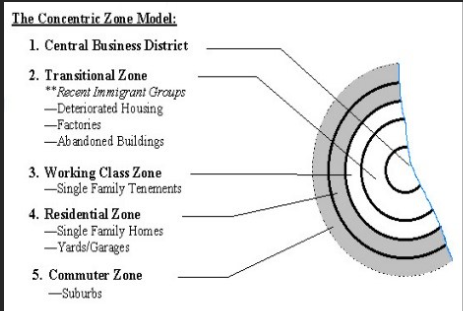
What did Shaw & McKay do?
pioneered some of the earliest work into subcultures
What did the Chicago School Study identify?
identified a distinct delinquent subculture within youth gang
What did they break down the geography of Chicago into?
A number of circular zones
What did they find from these zones?
found that rates of subcultures and criminal activity varied depending on which zone you were in
found that the central zone, the zone of transition, had the highest rate of criminal behaviour and delinquent subcultures
They found that this area had high populations of recent immigrants, families living on low incomes, and a high population turnover.
Despite this rapid change in population, What still occured?
a high crime rate was maintained in the zone of transition over many years, yet they were different offenders.
What did this suggest about the zones?
This suggested there was something about the zones that were linked to criminal behaviour, rather than the particular individuals who lived there.
What became clear that happened when individuals moved out of this zone?
It became clear that when the individuals moved out of this zone and into more permanent homes in the suburbs they left their criminal behaviour behind, as crime rates did not rise in suburban zones.
What was one explanation for the zone of transition?
the zone of transition was temporary for a lot of people
this caused social disorganisation as they did not establish strong bonds to the community as a whole
instead they remained in segregated groups or subcultures that turned to crimes such as theft and drug dealing, in order to subsidise their poor quality of life in the inner city.
What similarities can you identify between Cloward and Ohlin’s theory of Subcultures and the Chicago School?
anomie
locality
What types of subcultures are found in the ‘zone of transition’?
conflict subcultures
What is the theory of ‘locality’?
This theory explains how it is not necessarily the norms and values of the working class that lead them to criminal subcultures
but instead their crime is a response to challenging circumstances
Whose work does the theory of ‘locality’ further develop?
This further develops Merton’s work on strain to anomie and Cloward and Ohlin’s work on locality and neighbourhoods.
Evaluation
1. Right Realists would criticise this point as they feel it is being soft on crime. They do not see social disorganisation as an excuse for criminal behaviour. Right Realists would argue that criminal subcultures are not a result of locality or disruption to circumstances, but are due to poor socialisation and individual choice.
2. Shaw & McKay have been criticised as their work focused solely on Chicago, and does not necessarily apply in other cities around the world. In other places, it is not always the inner city areas that are the ones where crime takes place. For example, in Manchester, suburban Chorlton has a much higher rate of burglary and car theft than the inner city zone. Additionally, their work is outdated.
iv) Focal concerns - Miller
What key differences does Miller have to that of previous subcultural theories?
rejection of the strain to anomie view
secondly, whereas Cohen and Cloward and Ohlin suggest that crime is the result of distinctive subcultures, Miller sees male, working class, delinquent behaviour as a normal part of macho lower class culture, or 'focal concerns', into which they are socialised
Miller argues there are six key focal concerns which determine the behaviour of such subcultures.
What are the six key focal concerns which determine the behaviour of such subcultures? (FATTES)
‘fate’ (what will be will be)
‘autonomy’ (being in control)
‘trouble’ (acceptance of violence)
‘toughness’ (being able to drink, play sport and womanise)
‘excitement’. (synoptic link - Postmodernist Lying Edgework (chp 7)
‘smartness’ (streetwise)
What did Miller identify from his sample?
a disproportionately high number of delinquent boys that came from female-headed lone parent families
What does his work therefore pre-empt?
the New Right 'moral panic' about the detrimental impact of fatherless families on boys that would follow 30 or so years later in the 1990’s.
What did Miller claim about such boys?
such boys sought masculine status through peer group activities such as fighting
How would the following be examples of these ‘masculine values’?
1) Gambling - smartness, autonomy, excitement, fate
2) Joyriding - trouble, exciting
Stretch & Challenge – Synoptic Links
Miller’s work can be supported by Sugarman.
Sugarman highlighted that working-class male’s delinquent behaviour and a failure to achieve mainstream success in education was a result of them being socialised into specific working class values. Examples of these values include fatalism, and immediate gratification.
When considering Miller’s focal concerns, it is clear to see their similarity to Sugarman’s values and how the two may explain working class male subcultures and crime.
Evaluation
1. Marxist Box notes many of the 'focal concerns' Miller describes are distributed throughout society, for example, in a middle class rugby team. Toughness and aggression are evident in these middle class circumstances, suggesting that focal concerns do not explain why crime is considered a more working class activity.
2. As with Cohen’s status frustration theory, this theory is overwhelmingly about male working-class subcultures. How can we apply Messerschmitd’s gender based critique of Cohen, to Miller’s focal concerns? - hegemonic masculinity