Lecture Quiz 10-11
 Call Kai
 Learn
Learn Practice Test
 Spaced Repetition
 Match
Match Flashcards
 Knowt Play
1/39

There's no tags or description
Looks like no tags are added yet.
Name | Mastery | Learn | Test | Matching | Spaced | Call with Kai | Chat |
|---|
No analytics yet
Send a link to your students to track their progress
40 Terms
1865 – Gregor Mendel
• Existence of recessive and dominant genes
• Law of segregation
• Law of independent assortment
1869 – Johann Miescher
• Extracted nuclein from the nuclei of white blood cells
collected from the bandages of patients.
– Contained both protein and DNA
• Purer extracts of DNA from salmon
sperm later.
– Determined its chemical composition:
– C, H, O, N, P
1903 – Walter Sutton
• Proposed what we now know as the Chromosomal Theory of Inheritance
– Observed chromosomes in grasshoppers.
– Recognized there were matched maternal and paternal pairs that segregate during meiosis and suggested they were the source of Mendelian inheritance.
– “I may finally call attention to the probability that the association of paternal and maternal chromosomes in pairs and their subsequent separation during the reducing division … may constitute the physical basis of the Mendelian law of heredity”
1928 – Frederick Griffith
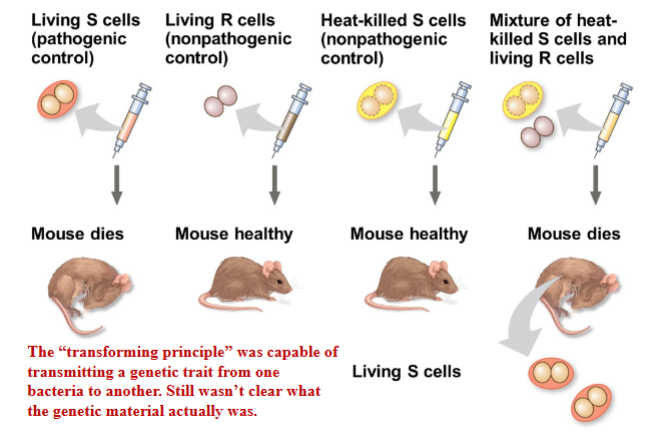
Identified a “transforming principle” that can turn one type of bacteria into another type of bacteria.
Griffith’s Transforming Principle (1928)
The “transforming principle” was capable of transmitting a genetic trait from one bacteria to another. Still wasn’t clear what the genetic material actually was.
Oswald AVERY
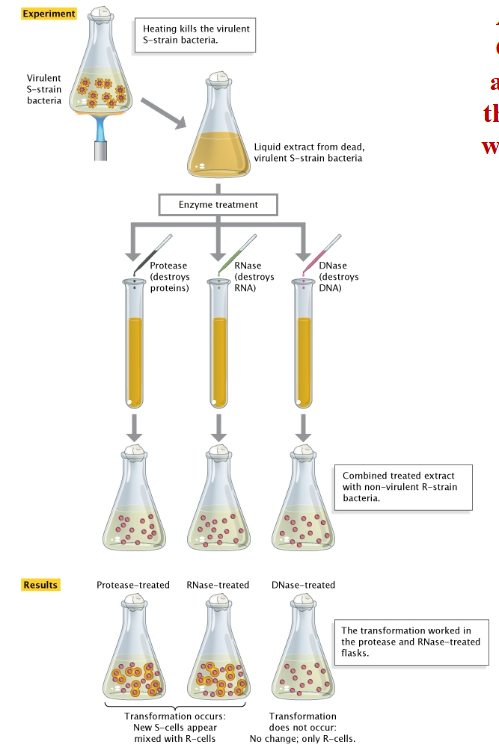
Avery’s work build on Griffith’s experiments and strongly supported the hypothesis that DNA was the genetic material.
Hershey and Chase
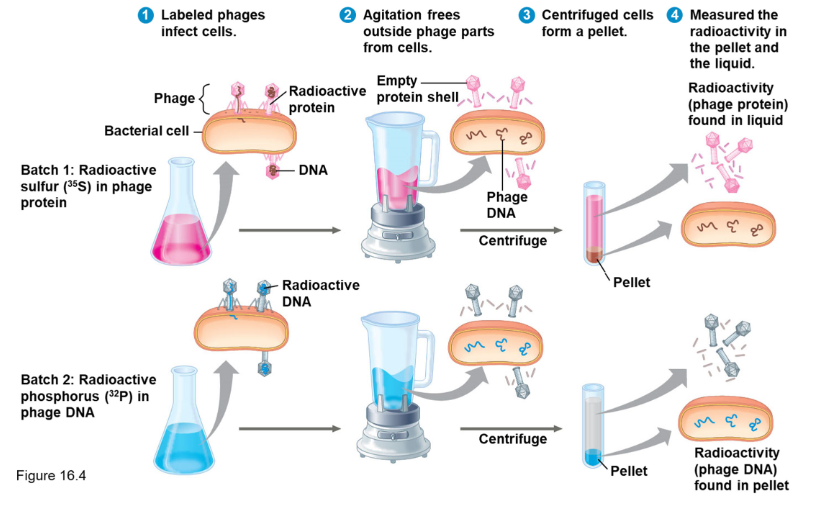
The 1952 Hershey-Chase experiments proved that DNA, not protein, is the genetic material
proved that DNA, not protein, is the genetic material. Using bacteriophages (viruses that infect bacteria), they labeled viral DNA with radioactive phosphorus and viral proteins with radioactive sulfur. They found that only the DNA entered the bacterial cell, carrying the instructions to replicate the virus.
1950 – “Chargaff’s Rule”
– Examined the DNA from multiple species and found:
A = T
C = G
1950’s – X‐ray crystallography by Rosalind Franklin yield’s clues
Produced using well prepared samples of uniformly oriented DNA strands produced by Maurice Wilkins
1953 – James D. Watson and Francis Crick solve the
structure
– Rosalind’s crystallography results suggested DNA is helical
– Other experiments suggested
• DNA consisted of two polynucleotide chains
• The two chains were anti‐parallel (run in opposite orientations)
– Watson and Crick proposed:
Bases run between, sugar‐phosphate backbone on the outside.
Remember Chargaff’s rule? Proposed a purine and
pyrimidine are always paired, one from each strand
The Central Dogma
The proteins expressed by an organism determine most of the phenotype, the observable properties of an organism
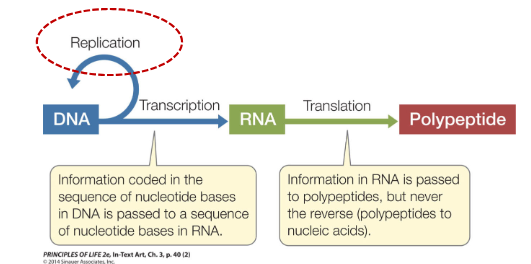
DNA Replication: The super cliff notes
Replication is semi‐conservative.
• Each original strand serves as a template to produce a new complementary strand.
• Each new double‐stranded DNA molecule is half “old” and half “new”
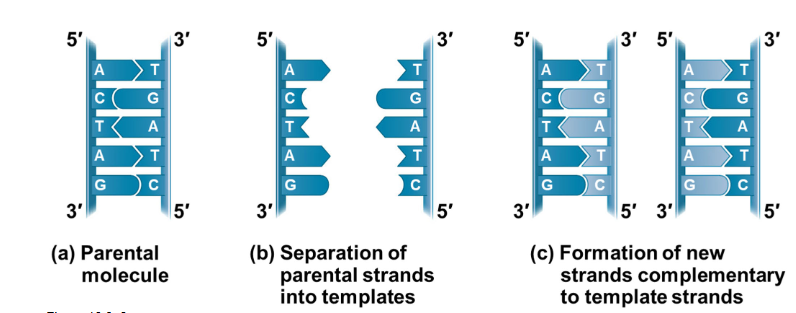
Possible Models for DNA Replication: Conservative Model
Original strands stay together
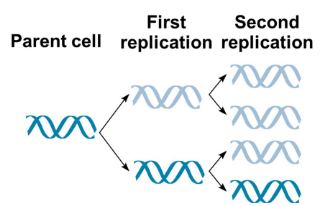
Possible Models for DNA Replication: Dispersive Model
Original DNA molecules remain intact in separate double‐stranded DNA molecules
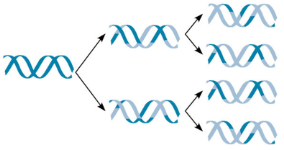
Possible Models for DNA Replication:
Original DNA molecules remain intact in separate
double‐stranded DNA molecules.
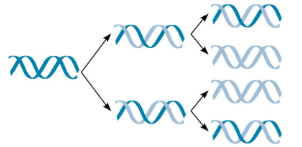
DNA Replication
In order for DNA replication to take place two things
have to happen:
– We have to know which base to add to the growing chain
– Need to catalyze the condensation (polymerization)
reaction creating the phosphodiester bonds
Lets consider the properties of DNA Polymerase
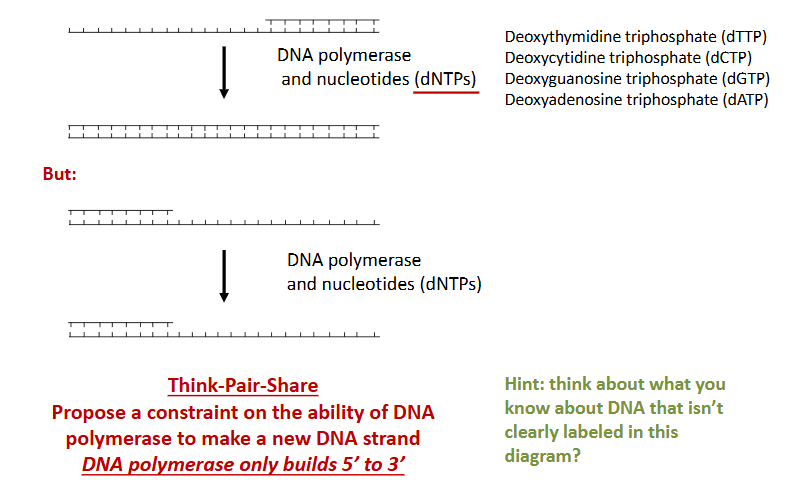
DNA Polymerase Requires a 3’OH to Build
Helicase
Unwinds the DNA double helix.
Topoisomerase (DNA gyrase in bacteria)
Relieves twisting and supercoiling ahead of helicase.
Single-Strand Binding Proteins (SSBs)
Keep DNA strands separated and prevent them from reannealing
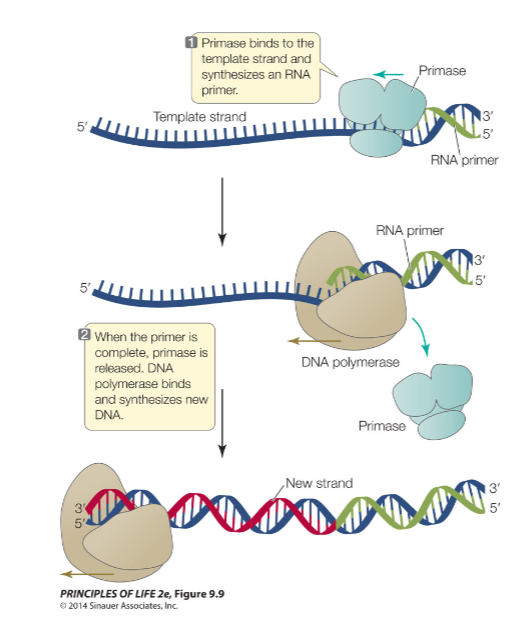
Primase
Synthesizes short RNA primers.
RNA Primer
Provides a free 3' OH group for DNA polymerase.
DNA Polymerase III (prokaryotes)
Main enzyme that synthesizes new DNA.
DNA Polymerase I (prokaryotes)
Removes RNA primers and replaces them with DNA.
Sliding Clamp
Holds DNA polymerase onto DNA to increase speed.
DNA Ligase
Joins Okazaki fragments by sealing phosphodiester bonds.
Okazaki Fragments
Short DNA fragments made on the lagging strand.
Telomerase (eukaryotes)
Extends chromosome ends (telomeres).
DNA polymerase Can Proofread
DNA pol III has 3’ to 5’ exonuclease activity.
What exonuclease activity does DNA pol I have?
DNA pol I has 5’ to 3’ exonuclease activity.
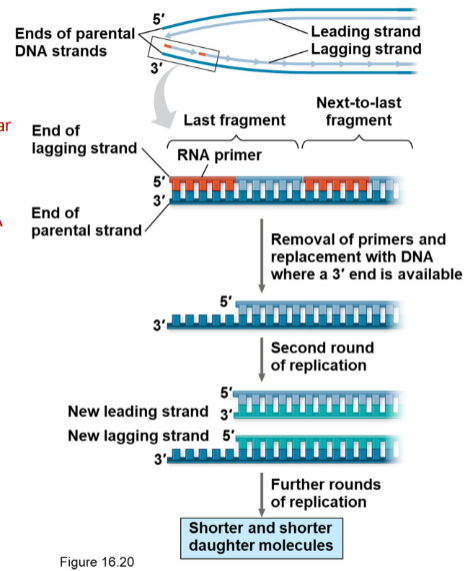
DNA is Check for Mistakes Following Replication
– MismatchRepair (MMR)
These two processes, proofreading and MMR,
reduce the error rate to 1x10
Telomeres
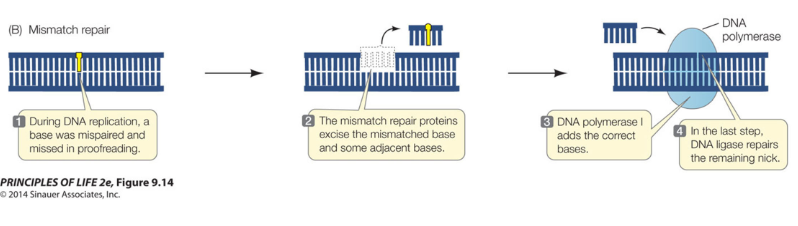
The end of the lagging strand of linear chromosomes can’t be completely copied.
Each time the cell replicates the DNA it will become a little shorter.
Some cells have telomerase, an enzyme that repairs the ends to prevent them from shortening.
DNA Repair
DNA is subject to frequent spontaneous damage and damage from the environment!
Damaged DNA that isn’t fixed before it is replicated leads to mutations.
There are lots of enzymes that recognize different types of DNA damage.
How might they do that?!
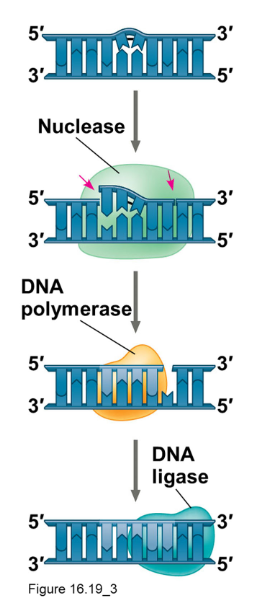
Nucleases cut out damaged DNA.
DNA polymerase fills in the gap.
DNA ligase seals the gap (rejoins the sugar‐ phosphate backbone by creating a phosphodiester bond).
Genes
are segments of DNA that code for a particular protein
or RNA molecule
•Information is encoded in the sequence of the nucleotide bases.
•The human genome contains ~3 billion base pairs (bp)
•There are approximately 20,000 protein coding genes
•Protein coding genes make up <2% of your DNA!
•Most genes encode proteins – we will focus on these
•Some genes are transcribed but not translated – the RNA molecules produced by transcription play a role in the cell.
Transcription- Initiation
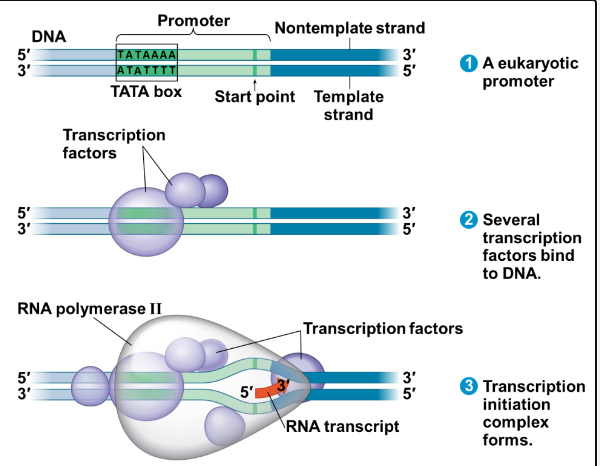
RNA polymerase binds to the promoter and unwinds the DNA
Trxn Elongation
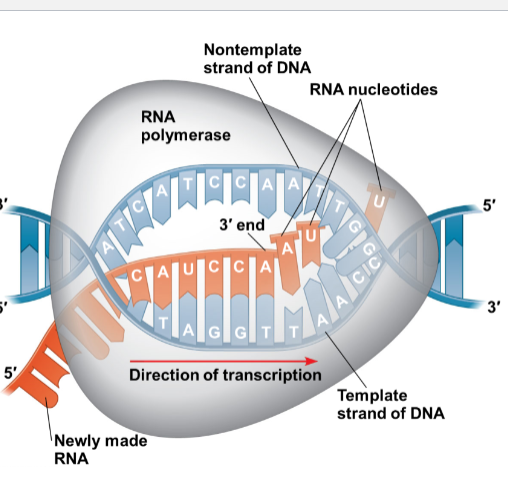
RNA polymerase catalyzes the polymerization of RNA nucleotides generating an RNA transcript complementary to the DNA template strand.
Termination
RNA polymerase ends transcribing when it reaches the termination sequence at the end of a gene
Initiation of Transcription in Eukaryotes
The promoter region is a DNA sequence “upstream” of the coding region:
• Is where RNA polymerase binds
• Dictates which strand is the template strand
• Sets the transcriptional start site (TSS) +1
• Eukaryotic promoters contain a short sequence called a TATA box.
• Transcription factors “recruit” RNA polymerase to the promoter
• In prokaryotes, proteins called sigma factors do this.
Transcriptional Elongation
• As RNA polymerase it untwists the double helix as it goes (10 to 20 bases at a time)
• Transcription progresses at a rate of 40 nucleotides per second in eukaryotes
• A gene can be transcribed simultaneously by several RNA polymerases
• RNA polymerase builds 5’ to 3
A few important notes on transcription:
• tRNA, rRNA, snRNA all arise from transcription (but are not translated)
• Sigma factors and transcription factors are responsible for dictating which genes
are expressed (“turned on”) at any particular time in a cell.
• This is the primary way genes are regulated – more on this soon!
• The strand that is transcribed is fixed for any given gene, but is not the same for all genes.
• Promoter – a DNA sequence. Sets location, strand, and amount of transcription
• Transcription start site (TSS; +1) is distinct from translation start site!
• There is very poor proofreading/error correction of transcripts (1 mutation every 1x10⁴ to 1x10⁵ bases)