(3) Abdominal Pain
 Call Kai
 Learn
Learn Practice Test
 Spaced Repetition
 Match
Match Flashcards
 Knowt Play
1/87

Earn XP
Description and Tags
Lab notes
Name | Mastery | Learn | Test | Matching | Spaced | Call with Kai | Chat |
|---|
No analytics yet
Send a link to your students to track their progress
88 Terms
Right Upper Quadrant
Liver
Stomach
Gallbladder
Duodenum
Right kidney
Pancreas
Transverse colon
Right adrenal gland
Left Upper Quadrant
Liver
Left adrenal gland
Stomach
Left kidney
Pancreas
Spleen
Transverse colon
Small intestine
Right Lower Quadrant
Large intestine
Cecum
Appendix
Right ureter
Right reproductive organs:
ovary, fallopian tube, spermatic cord
Left Lower Quadrant
Small intestine
Large intestine
Left ureter]
Left reproductive organs:
fallopian tube, ovary, spermatic cord
Sigmoid colon
solid organs
organs that bleed when rupture
liver, spleen, pancreas, kidneys
hollow organs
organs that get infections when ruptured
stomach, esophagus, small intestine, large intestine
15s
To listen to bowel sounds, place stethoscope in one quadrant for ____s.
Frequent bowel sounds
Frequent or infrequent bowel sounds?
overactive GI (possible diarrhea)
Infrequent bowel sounds
Frequent or infrequent bowel sounds?
inactive GI (possible constipation)
T
T or F?
Do not start in the quadrant where pt complains of pain.
Hernia
occurs when an organ or fatty tissue squeezes through a weak spot in the surrounding muscle or connective tissue
most commonly appear in the abdomen or groin and often look like a visible bulge that may ache or disappear when lying down.
They may be incarcerated (with feces)
T
T or F?
Hernias are when our intestines slip through the abdominal muscle wall.
Grey Turner’s and Cullen’s sign
Most commonly associated with pancreatitis.
Digestive enzymes get released into the surrounding tissues and can damage blood vessels causing hemorrhaging.
The umbilicus and flanks are areas where blood can pool.
Abdominal aortic aneurysm (AAA)
Pts have a complaint of abdominal pain
tearing sensation to the back and groin might indicate a rupture
Assume if you palpate a pulsating mass
AAA
If you palpate a pulsating mass, assume _____ until proven otherwise.
Aortic dissection
a false lumen develops as the inner lining is peeling off of the middle lining.
affects pulse strengths on both sides and has the potential to rupture
true lumen; Intima; Media; Adventitia
Dissected aorta linings begining from false lumen:
false lumen
____________
____________
____________
____________
Diverticulosis
Small pockets that form within the intestines can make it difficult for bowel movements to pass through
Diverticulitis
Small pockets that form within the intestines that can trap feces and form infections
3
The artery has how many layers?
T
T or F?
A dissection is not the same thing as a rupture.
rebound tenderness
Diverticulosis produces which type of tenderness?
digested; stomach
Coffee ground emesis is (digested/undigested) blood as it makes its way through the _______.
Hematochezia
the passage of fresh, bright red or maroon blood through the rectum
whole red blood
Portal hypertension; Esophageal varices (hematemesis); Hemorrhoids (hematochezia); Ulcers (melena or coffee-ground emesis)
What are the major complications of liver cirrhosis?
Liver cirrhosis
leads to:
Portal hypertension
Esophageal varices → hematemesis
Hemorrhoids → hematochezia
Ulcers → melena or coffee-ground emesis
hematemesis; airway
Why are bleeding esophageal varices dangerous for EMS?
Can cause massive ________
Blood may obstruct the ________
Airway management can be difficult because of profuse bleeding
GI bleeding in liver cirrhosis
Esophageal varices → Hematemesis (vomiting blood)
Hemorrhoids → Hematochezia (bright red blood per rectum)
Ulcers → Melena (black, tarry stool) or coffee-ground emesis
hypertension
occurs from liver failure
ascites
fluid in the peritoneal cavity
tympanic
hollow area in abdominal percussion:
dull
fluid beneath area in abdominal percussion:
Liver
produces bile
gallbladder
stores bile
gallstones (cholelithiasis)
hardened deposits of the digestive fluid bile
Cholecystitis
inflammation of the gallbladder
When bile gets trapped in the gallbladder or when gallstones back up fluid
Pancreatitis
Inflammation of the pancreas typically caused by high fat content in blood (triglycerides).
Mid abdominal pain
Appendicitis
may be caused by various infections such as virus, bacteria, or parasites, in your digestive tract.
Or it may happen when the tube that joins your large intestine and appendix is blocked or trapped by stool.
peritonitis
If the appendix ruptures, the patient is at risk for:
Spleen
Stores and filters about 25% of our blood and produces white blood cells for infections
blunt trauma
The spleen is at risk for rupturing from:
left upper quadrant (LUQ)
Splenic injury would cause pain in which quadrant?
left shoulder
Splenic injury would cause referred pain to the:
kidney stones (renal calculi)
Brought on by history of dehydration and high salt diet
antibiotics
Urinary Tract Infections (UTI) require:
Dysuria; hematuria; unilateral pain
Signs and symptoms of Genitourinary (GU) conditions
Perforated diverticulum; Transport in a position of comfort
You are managing a 37 year old male patient complaining of abdominal pain. He is sitting with his knees flexed. Movement worsens the pain which is described as severe. There is tenderness to palpation in the left lower quadrant. Vital signs are P96, R18, BP 100/60, SpO2 96%
You should suspect
Ruptured appendix
Splenic infarction
Perforated diverticulum
Your management
Transport in a position of comfort
Administer oxygen by non-rebreather mask
Place the patient in a supine position
Endometritis
inflammation of the endometrium
Endometriosis
The lining that grows and sheds during menses is found outside of the uterus
Fibroids
abnormal growth in certain areas
Gravida
total # of pregnancies
Para
# of delivered births including stillbirth
Ectopic pregnancy
pregnancy outside the uterus
Preeclampsia
hypertensive, hypersensitivity to light
Eclampsia
seizures
Gestational Diabetes
uncontrolled blood sugar
Hyperemesis Gravidarum
intractable vomiting leading to volume depletion
Ruptured Uterus
onset of trauma, fetus is in abdominal space (life threatening emergency)
Placenta Previa
Placenta is blocking the cervix (infant will have to be delivered via c-section)
Abruptio Placentae
onset of blunt trauma, placenta has partially or completely torn off from uterus (70% fetal demise)
Miscarriage
possibility if pregnant patient has heavy clots in vaginal bleeding
every 2 min
Threshold for how often contractions occur is:
90 s or more
Threshold for how long contractions last is:
left lateral recumbent
If transporting pt in their third trimester, lay pt in which positon to displace infant off of venous system?
Nuchal cord
umbilical cord is wrapped around the infant’s head
think ‘noose’
Prolapsed cord
Umbilical cord is presenting instead of crowning
present
In prolapsed cord:
If pulse is (present/absent) in prolapsed cord, then cover with moist gauze and reassess in transport
absent
In prolapsed cord:
If pulse is (present/absent), then insert your fingers and attempt to displace infant off of cord to restore pulse
Limb Presentation
One hand or one foot presenting. Unable to deliver vaginally.
F
T or F?
A pt is able to deliver vaginally during limb presentation.
knees to chest
During limb presentation, transport the pt in what position?
Breech presentation
The complication comes when the infant’s head gets stuck upon delivery. We would insert our first two fingers
Shoulder dystocia
Perform McRobert’s Maneuver (knee to chest) and apply suprapubic pressure. Clavicular fracture may be needed as well
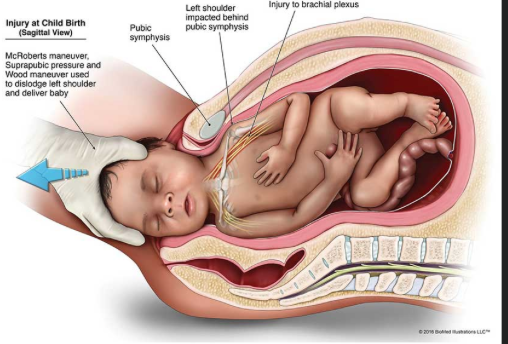
suprapubic area
In the McRoberts Maneuver, apply pressure to what area?
1 minute and 5 minutes after delivery
When should the APGAR assessment be performed after delivery?
dry, warm, stimulate
In order to induce the infants 1st breath:
T
T or F?
Providing a fundal massage and allowing the adult patient to nurse the infant will stimulate hemorrhage control
amniotic fluid embolism (AFE)
one of the catastrophic complications of pregnancy in which amniotic fluid, fetal cells, hair, or other debris enters into the maternal pulmonary circulation
causes cardiovascular collapse
anaphylactic reaction
Fetal blood introduced into maternal circulation may cause an:
Disseminated Intravascular Coagulopathy (DIC)
overactive clotting
Appearance
What does the 1st ‘A’ in APGAR score stand for?
Pulse (Heart rate)
What does the ‘P’ in APGAR score stand for?
Grimace (Reflex irritability)
What does the ‘G’ in APGAR score stand for?
Activity (Tone)
What does the 2nd ‘A’ in APGAR score stand for?
Respiration
What does the ‘R’ in APGAR score stand for?
placenta previa
3rd trimester, vaginal bleeding, NO pain
abruptio placentae
3rd trimester, vaginal bleeding, PAIN