802 Midterm Practice Questions
 Call Kai
 Learn
Learn Practice Test
 Spaced Repetition
 Match
Match Flashcards
 Knowt Play
1/237

There's no tags or description
Looks like no tags are added yet.
Name | Mastery | Learn | Test | Matching | Spaced | Call with Kai | Chat |
|---|
No analytics yet
Send a link to your students to track their progress
238 Terms
Which Brodmann's area forms the unimodal association cortex for understanding what you hear?
A. Wernicke's area, left Brodmann's area 22
B. Wernicke's area, right Brodmann's area 22
C. Broca's area, right Brodmann's area 44 and 55
D. Broca's area, left Brodmann's area 44 and 55
A. Wernicke's area, left Brodmann's area 22
Which cerebral cortex layers contain more pyramidal cells than other interneurons?
A. Layers 1 and 6
B. Layers 2 and 4
C. Layers 3 and 5
D. Layers 3 and 4
C. Layers 3 and 5

Which structure is indicated by E?
A. Globus Pallidus
B. Nucleus accumbens
C. Putamen
A. Globus Pallidus

Which body region is presented by the area C according to the somatotopy/ homunculus?
A. Left lower limb
B. Right lower limb
C. Left upper limb
D. Right upper limb
A. Left lower limb
A student has been diagnosed with alexia. Which brain area is compromised?
A. Frontal eye field
B. Premotor area
C. Wernicke's area
D. Broca's area
C. Wernicke's area
Where is the primary somatosensory cortex, S1, located ?
A. In the occipital lobe
B. In the temporal lobe
C. In the parietal lobe
D. In the frontal lobe
C. In the parietal lobe
Nucleus of which cranial nerve is entirely controlled by the contralateral cerebral cortex?
A. CN 7
B. CN 5
C. CN 10
D. CN 12
D. CN 12
Which structure divides the frontal lobe from the parietal lobe ?
A. Longitudinal Fissure
B. Central Sulcus
C. Lateral Sulcus
D. Transverse fissure
B. Central Sulcus
Which cerebral lobe encodes and stores the explicit/ declarative memories ?
A. Frontal lobe
B. Parietal lobe
C. Insular lobe
D. Temporal lobe
D. Temporal lobe
What is the function of Brodmann's area 17 ?
A. Primary auditory cortex, hearing
B. Primary somatosensory cortex, sensory
C. Primary somatomotor cortex, motor
D. Primary Visual cortex, visual
D. Primary Visual cortex, visual
What basal nuclei component is located in the diencephalon ?
A. Caudate
B. Nucleus accumbens
C. Putamen
D. Subthalamic nucleus
D. Subthalamic nucleus
What are the functions of the reticular formation nuclei ?
A. Both ascending and descending tracts for arousal, alert, motor control, and vital centers
B. Both ascending and descending for somatosensory and motor functions
C. Only descending tracts for vital centers and motor control
D. Only ascending tracts for arousal and alert
A. Both ascending and descending tracts for arousal, alert, motor control, and vital centers
A patient suffers from a stroke with the left frontal eye field injured. Which S&S will the patient present during assessment ?
A. Both eyes cannot shift to the right
B. Both eyes constantly shift to the right
C. Both eyes constantly shift to the left
D. Both eyes cannot shift to the left
A. Both eyes cannot shift to the right
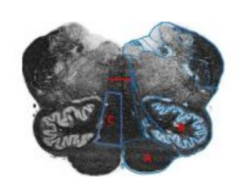
What is B ?
A. Inferior olivary nucleus
B. Caudate nucleus
C. Gracile nucleus
D. Pyramid
A. Inferior olivary nucleus
Where are the 2nd order neurons for the dorsal column ascending sensory tract located ?
A. In the caudal tegmental medulla oblongata
B. In the caudal basilar medulla oblongata
C. In the rostral basilar medulla oblongata
D. In the rostral tegmental medulla oblongata
A. In the caudal tegmental medulla oblongata
Which functions can be compromised generally if the L hemisphere/ telencephalon is injured ?
A. Right body functions and spatial cognition
B. Left body functions and spatial cognition
C. Right body functions and language
D. Left body functions and language
C. Right body functions and language
Where are the superior and inferior colliculi located in the brainstem ?
A. Basilar pons
B. Tegmental pons
C. Tegmental midbrain
D. Tectum of midbrain
D. Tectum of midbrain
Where is the supplementary motor area (SMA) located ?
A. Dorsal to ventral Brodmann's area 4
B. Superior and medial Brodmann's area 4
C. Superior and medial Brodmann's area 6
D. Dorsal to ventral and Brodmann's area 6
C. Superior and medial Brodmann's area 6
Which structure is NOT one part of the diencephalon ?
A. Pineal gland
B. Cranial nerve 2
C. Anterior lobe of pituitary gland
D. Posterior lobe of pituitary gland
C. Anterior lobe of pituitary gland

What is the cause for the patient's copying/ drawing problems ?
A. Injury of the left frontal lobe
B. Injury of the left parietal lobe
C. Injury of the right parietal lobe
D. Injury of the right frontal lobe
C. Injury of the right parietal lobe


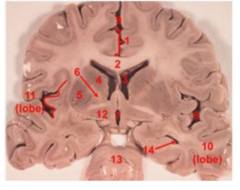
Which cerebral lobe is indicated by 11 ?
A. Temporal
B. Insular
C. Occipital
D. Limbic
B. Insular

Which cerebral cortex layers primarily project to the subcortical structures for their efferent functions ?
A. Layers 1 and 6
B. Layers 5 and 6
C. Layers 2 and 3
D. Layers 4 and 5
B. Layers 5 and 6
Which S&S will a patient present if the vestibulocerebellum is compromised ?
A. Dysarthria and dysmetria
B. Ataxia gait and dysdiadochokinesia
C. Intention tremor and hypotonia
D. Nystagmus, diplopia, truncal ataxia
D. Nystagmus, diplopia, truncal ataxia
Does which artery primarily provide blood to the cerebellar nuclei ?
A. PCA
B. AICA
C. SCA
D. PICA
C. SCA
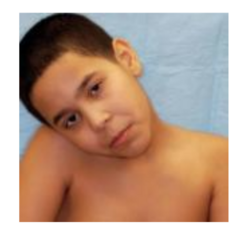
Which cranial nerve injured during birth can result in the abnormal posture ?
A. Right CN 10
B. Right CN 11
C. Left CN 11
D. Left CN 10
C. Left CN 11
What is the cause for Chiari malformation ?
A. Herniation of flocculus and nodulus from lobule 10 through foramen magnum
B. Herniation of uvula and tonsil from lobule 9 through foramen magnum
C. Herniation of uvula and tonsil from lobule 10 through foramen magnum
D. Herniation of flocculus and nodulus from lobule 9 through foramen magnum
B. Herniation of uvula and tonsil from lobule 9 through foramen magnum
A patient suffers from a right thalamic ischemic stroke. Which S&S will the patient MOST likely present ?
A. L hemisphere of body paresthesia/ paresis and R hemineglect
B. R hemisphere of the body paresthesia / paresis and L hemineglect
C. R hemisphere of the body paresthesia / paresis and R hemineglect
D. L hemisphere of the body paresthesia / paresis and L hemineglect
D. L hemisphere of the body paresthesia / paresis and L hemineglect
Which cranial nerve provides somatosensory innervation of the dura mater above the tentorium cerebelli level ?
A. CN V3
B. C2/ C3
C. CN V2
D. CN V1
D. CN V1
Which cranial nerves only innervate one target muscle ?
A. CN 7,9, and 10
B. CN 4, 6, and 9
C. CN 5, 6, and 10
D. CN 6, 9, and 12
B. CN 4, 6, and 9
Where is CN 1 located ?
A. Superior meatus
B. Sphenoethmoid recess
C. Middle meatus
D. Inferior meatus
B. Sphenoethmoid recess
Through which transverse foramen of the cervical vertebrae does the vertebral artery begin its ascent ?
A. C5
B. C4
C. C7
D. C6
D. C6
Axons from which nucleus form the climbing fibers ?
A. Ipsilateral pontine nucleus
B. Contralateral pontine nucleus
C. Contralateral inferior olivary nucleus
D. Ipsilateral inferior olivary nucleus
C. Contralateral inferior olivary nucleus
Which sinus is indicated by E ?
A. Sigmoid sinus
B. Occipital Sinus
C. Transverse sinus
D. Straight sinus
C. Transverse sinus

Which cerebellar cortices can directly project to the lateral vestibular nuclei?
A. Nodulus through the ipsilateral inferior cerebellar peduncle
B. Flocculus through the contralateral inferior cerebellar peduncle
C. Flocculus through the ipsilateral inferior cerebellar peduncle
D. Nodulus through the contralateral inferior cerebellar peduncle
C. Flocculus through the ipsilateral inferior cerebellar peduncle
A patient fractured the jugular foramen during a MVA. Which cranial nerves must be screened to exclude risk of injury ?
A. CN 7 and 8
B. CN 11 and 12
C. CN 9, 10, and 11
D. CN 6, 7, and 8
C. CN 9, 10, and 11
Which afferent fibers/ tracts are contained in the inferior cerebellar peduncle ?
A. Ipsilateral posterior spinocerebellar tract and ipsilateral axons from the inferior olivary nucleus
B. Contralateral posterior spinocerebellar tract and contralateral axons from the inferior olivary nucleus
C. Ipsilateral posterior spinocerebellar tract and axons from the contralateral inferior olivary nucleus
D. Axons from the ipsilateral inferior olivary nucleus and contralateral posterior spinocerebellar tract
C. Ipsilateral posterior spinocerebellar tract and axons from the contralateral inferior olivary nucleus
Which cerebellar area injury can compromise visceral motor functions ?
A. Vermis
B. Cerebrocerebellum
C. Dentate nucleus
D. Interposed nucleus
A. Vermis
Where is the blockage that results in hydrocephalus ?
A. Cerebral aqueduct
B. Left foramen of Monro
C. Right foramen of Monro
D. Foramen of Magendie
A. Cerebral aqueduct
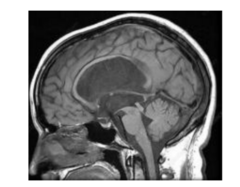
Where do the mossy fibers project to ?
A. Both purkinje and molecular layers
B. Both deep cerebellar nuclei and molecular layer
C. Both deep cerebellar nuclei and granular layer
D. Both granular and molecular layer
C. Both deep cerebellar nuclei and granular layer
Which artery is indicated by D ?
A. Posterior communicating artery
B. Internal carotid artery
C. Superior cerebellar artery
D. Posterior cerebal artery
A. Posterior communicating artery

Does branch from which artery provide blood to the thalamus ?
A. MCA
B. ACA
C. PCA
D. SCA
C. PCA
Which cells play the central functions in the cerebellar cortices and project efferent fibers to other structures ?
A. Purkinje cells
B. Basket cells
C. Granule Cells
D. Pyramidal cells
A. Purkinje cells
Which S&S are most likely presented by a patient with normal pressure hydrocephalus (NPH) in the clinic ?
A. Compromised cognition, truncal ataxia, and rest tremor
B. Incontinence, rest tremor, and magnetic gait
C. Compromised cognition, incontinence, and magnetic gait
D. Magnetic gait, nystagmus, and truncal ataxia
C. Compromised cognition, incontinence, and magnetic gait
Which type of hematoma in the cranium is presented here ?
A. Subarachnoid
B. Subdural
C. Epidural
D. Intraparenchymal
B. Subdural

Which artery does not contribute to forming the circle of willis ?
A. IC
B. MCA
C. ACA
D. PCA
B. MCA
Purkinje cells in the which cerebellar cortices project to the fastigial nucleus ?
A. Vermis and flocculus
B. Vermis and nodulus
C. Flocculus and spinocerebellum
D. Cerebrocerebellum and spinocerebellum
B. Vermis and nodulus
A patient tore off the right occipital condyle during MVA. What will the patient present when asked to protrude the tongue outward ?
A. Tongue will deviate downward
B. Tongue will deviate to the left
C. Tongue will deviate to the right
D. Tongue will deviate upward
C. Tongue will deviate to the right
Which neurons are located in the molecular layer of the cerebellar cortex ?
A. Granule and stellate cells
B. Granule and golgi cells
C. Stellate and basket cells
D. Prukinje cells
C. Stellate and basket cells
A patient was diagnosed with left MCA ischemic stroke, which most prominent S&S will need to be considered before starting assessment ?
A. L trunk/ upper limb paresthesia/ paresis and aphasia
B. L trunk/ upper limb paresthesia/ paresis and hemineglect
C. R trunk/ upper limb paresthesia/ paresis and aphasia
D. C. R trunk/ upper limb paresthesia/ paresis and hemineglect
C. R trunk/ upper limb paresthesia/ paresis and aphasia
What is the structure K ?
A. Cerebral Peduncle
B. Superior cerebellar peduncle
C. Inferior cerebellar peduncle
D. Middle cerebellar peduncle
C. Inferior cerebellar peduncle
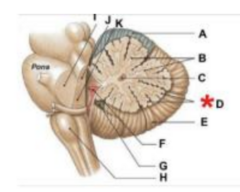
A patient demonstrates areflexia during right knee patellar tendon reflex tendon testing due to injury of the cerebellum. Where is the lesion MOST likely located ?
A. In the right spinocerebellum
B. In the left spinocerebellum
C. In the left vestibulocerebellum
D. In the right vestibulocerebellum
A. In the right spinocerebellum
Where is the lesion pointed by an arrow mainly located ?
A. Right cerebrocerebellum
B. Left vermis
C. Right Vermis
D. Left cerebrocerebellum
D. Left cerebrocerebellum

Which cranial nerves have their visceral motor nuclei located in the tegmental brainstem ?
A. CN 6, 7, 9, 10
B. CN 7, 9, 10, 11
C. CN 3, 7, 9, 10
D. CN 3, 6, 7, 9
C. CN 3, 7, 9, 10
Which neurotransmitters are released by the mossy and climbing fibers and what are the functions ?
A. GABA, inhibitory
B. Glutamate/ aspartate, inhibitory
C. Glutamate/ aspartate, excitatory
D. GABA, excitatory
C. Glutamate/ aspartate, excitatory
Which structure is located between the 2 arrows ?
A. Falx cerebelli
B. Tentorium cerebelli
C. Falx cerebri
D. Diaphragma sellae
C. Falx cerebri
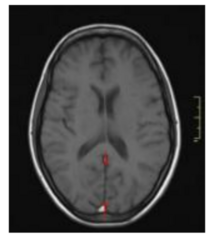
A patient suffers an infection in the scalp. How can the infection be spread to the dural venous system ?
A. The contaminated scalp venous blood drains into the SSS through bridging vein
B. The contaminated scalp venous blood drains into the SSS through emissary vein
C. The contaminated scalp venous blood drains into the ISS through the bridging vein
D. The contaminated scalp venous blood drains into the ISS through emissary vein
B. The contaminated scalp venous blood drains into the SSS through emissary vein
Which artery is the primary one providing blood to the basilar pons ?
A. Superior cerebellar artery
B. Posterior inferior cerebellar artery
C. Anterior inferior cerebellar artery
D. Pontine artery
D. Pontine artery
What are the functions of the paraloops mediated by stellate and basket cells in the cerebellar cortices ?
A. Inhibiting purkinje cells in the same sagittal plane
B. Activating purkinje cells in the same sagittal plane
C. Inhibiting purkinje cells in the neighboring sagittal plane
D. Activating purkinje cells in the neighboring sagittal plane
C. Inhibiting purkinje cells in the neighboring sagittal plane
Where is the lesion pointed by the arrow located ?
A. Left cerebrocerebellum
B. Right cerebrocerebellum
C. Right spinocerebellum
D. Left spinocerebellum
D. Left spinocerebellum

Where are the reticular formation nuclei located ?
A. Tegmental pontomedullary junction
B. Tegmental brainstem
C. Tectum of the midbrain
D. Basilar brainstem
B. Tegmental brainstem
Which cranial nerves have the parasympathetic visceral motor functional component ?
A. CN 3, 6, 8, 9
B. CN 5, 7, 9, 10
C. CN 5, 7, 8, 9
D. CN 3, 7, 9, 10
D. CN 3, 7, 9, 10
Which cerebellar lobule forms the vestibulocerebellum ?
A. Lobule 8
B. Lobule 11
C. Lobule 10
D. Lobule 9
C. Lobule 10
A roofer fell off 12 feet with left face landing on the ground. The patient lost consciousness for minutes and then reported everything OK but suddenly lost consciousness again after several minutes. Which of the following medical emergencies must be screened immediately ?
A. Epidural hematoma due to disruption of meningeal artery
B. Intraventricular hematoma due to disruption of chororidal arteries
C. Subdural hematoma due to disruption of bridging vein
D. Subarachnoid hematoma due to disruption of aneurysm
A. Epidural hematoma due to disruption of meningeal artery
Which cerebellar artery will be compromised DIRECTLY due to vertebral artery stroke as indicated in the attached angiogram ?
A. Right AICA
B. Left PICA
C. Right PICA
D. Left AICA
C. Right PICA

What's the flowing direction of CSF during systole ?
A. CSF flows into the ventricles and superior sagittal sinus
B. CSF flows out of the ventricles to the caudal spinal sac
C. CSF flows out the ventricles and into the superior sagittal sinus
D. CSF flows into the ventricles and the caudal spinal sac
B. CSF flows out of the ventricles to the caudal spinal sac
Which type of medical image is presented here ?
A. T1 MRI, transverse section
B. T2 MRI, transverse section
C. T2 MRI, coronal section
D. T1 MRI, coronal section
A. T1 MRI, transverse section
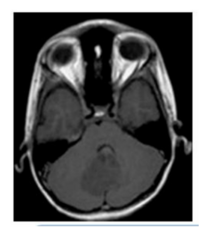
Where does the superior cerebellar peduncle MAINLY decussate ?
A. Rostral midbrain
B. Caudal midbrain
C. Caudal pons
D. Rostral pons
B. Caudal midbrain
A patient has been diagnosed with MS which destroys the myelin sheath in the nervous system. Which of the following supportive cell functions is DIRECTLY impaired ?
A. Schwann cells in the CNS
B. Oligodendrocytes in the PNS
C. Schwann cells in the PNS
D. Oligodendrocytes in CNS
D. Oligodendrocytes in CNS
Which structure is sectioned to control epilepsy as shown in the attached image ?
A. Left occipital lobe
B. Left temporal lobe
C. Right occipital lobe
D. RIght temporal lobe
D. RIght temporal lobe

A patient has a small arterial stroke with inferior olivary nucleus impaired. Which of the following afferent fibers to the cerebellar cortex will be compromised ?
A. Climbing fibers
B. Parallel fibers
C. Multilayered fibers
D. Mossy fibers
A. Climbing fibers
A patient has been diagnosed with a brain tumor as indicated by the attached MRI. Which component of the brain is most likely impaired ?
A. Left parietal lobe
B. Right occipital lobe
C. Left occipital lobe
D. Right parietal lobe
D. Right parietal lobe

Where does the climbing fibers project to ?
A. Contralateral cerebellar nuclei and granular layer of cerebellar cortex
B. Contralateral cerebellar nuclei and molecular layer of cerebellar cortex
C. Ipsilateral cerebellar nuclei and molecular layer of cerebellar cortex
D. Ipsilateral cerebellar nuclei and granular layer of cerebellar cortex
B. Contralateral cerebellar nuclei and molecular layer of cerebellar cortex
A patient can speak fluently but meaningless and could not follow directions. Which Brodmann's area is most likely injured ?
A. Wernicke's area, Brodmann's area 22
B. Frontal eye field, Brodmann's area 8
C. Premotor area, Brodmann's area 8
D. Broca's area, Brodmann's area 44 and 45
A. Wernicke's area, Brodmann's area 22
Which neurotransmitter does purkinje cell release and what is its function ?
A. GABA, inhibitory
B. Glutamate, excitatory
C. Glutamate, inhibitory
D. GABA, excitatory
A. GABA, inhibitory
Which of the following basal nuclei is located in the diencephalon ?
A. Subthalamic nucleus
B. Nucleus accumbens
C. Putamen
D. Substantia nigra
A. Subthalamic nucleus
Cerebral aqueduct is located in which of the following brainstem structures ?
A. Midbrain
B. Cerebellum
C. Medulla Oblongata
D. Pons
A. Midbrain
Where is C located in the brain ?
A. Metencephalon
B. Diencephalon
C. Mesencephalon
D. Telencephalon
B. Diencephalon

A patient with a TBI demonstrated fracture and herniation of the brain as shown in the attached image. Which of the following functions will be most likely impaired according to the herniated brain structure only, not considering other injuries ?
A. Spatial cognition
B. Vision
C. Smell
D. Language
D. Language
How many pairs of cranial nerves have attachments along the brainstem ?
A. 7 pairs
B. 9 pairs
C. 10 pairs
D. 8 pairs
B. 9 pairs
Does which artery ascend through the pointed foramen ?
A. Left vertebral artery
B. Right internal carotid artery
C. Right vertebral artery
D. Left internal carotid artery
A. Left vertebral artery

Meningitis in which part of the dura matter can be presented as cervicalgia ?
A. Anterior cranial fossa
B. Posterior cranial fossa
C. Middle cranial fossa
D. Calvaria part
B. Posterior cranial fossa
What's the name of the axonal bundle connecting corresponding structures of the two hemispheres ?
A. Long association fibers
B. Projection fibers
C. Commissural fibers
D. Short association fibers
C. Commissural fibers
Which neurotransmitter does the parallel fiber release ?
A. Glutamate / aspartate
B. Dopamine
C. Histamine
D. GABA
A. Glutamate / aspartate
What is the structure indicated by the red X?
A. Cerebral peduncle
B. Decussation of superior cerebellar peduncle
C. Red nucleus
D. Substantia nigra
C. Red nucleus

Is the primary motor cortex located in which Brodmann's area ?
A. 4
B. 8
C. 6
D. 3, 1, 2
A. 4
Which structure is indicated by F ?
A. Cerebral peduncle
B. Superior colliculus
C. Superior cerebellar peduncle
D. Inferior colliculus
B. Superior colliculus

Which cranial nerve is the only one attaching to the posterior brainstem ?
A. CN 4, trochlear nerve
B. CN 1, olfactory nerve
C. CN 3, oculomotor nerve
D. CN 2, optic nerve
A. CN 4, trochlear nerve
What is the major function of Brodmann's area 41 ?
A. Vision
B. Smell
C. Taste
D. Hearing
D. Hearing
A patient complains of R upper limb and trunk paresthesia and weakness. Which of the following arteries is most likely impaired ?
A. Right MCA
B. Right ACA
C. Left MCA
D. Left ACA
C. Left MCA
Which cranial nerves have attachments around the brain structure indicated by the X on the attached image?
A. CN 5 and 6
B. CN 3 and 4
C. CN 4 and 5
D. CN 2 and 3
A. CN 5 and 6

Which of the following cerebellar cortical neurons use glutamate as neurotransmitter ?
A. purkinje cell
B. Basket cell
C. Granule cell
D. Golgi cell
C. Granule cell
Which cranial nerve has its nuclei located in the whole brainstem and proximal spinal cord ?
A. CN 8
B. CN 7
C. CN 5
D. CN 10
C. CN 5
Where is the location for motor decussation ?
A. Rostral pons
B. Caudal medulla
C. Rostral medulla
D. Caudal pons
B. Caudal medulla
Does the cerebellar vermis project to which of the following nuclei ?
A. Vestibular nucleus
B. Dentate nucleus
C. Fastigial nucleus
D. Interposed nucleus
C. Fastigial nucleus
Which fissure / sulcus is indicated by 8?
A. Right central sulcus
B. Left lateral sulcus
C. Left central sulcus
D. Right lateral sulcus
B. Left lateral sulcus
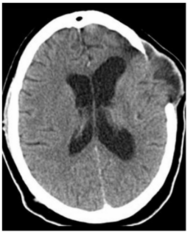
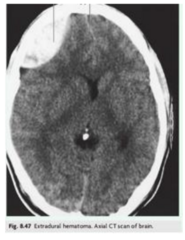
Which type of hematoma in the cranium is shown here ?
A. Epidural hematoma
B. Intraparenchymal hematoma
C. Subdural hematoma
D. Subarachnoid hematoma
A. Epidural hematoma
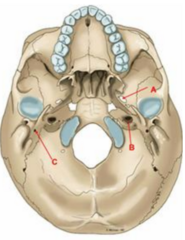
Which cranial nerve courses through the neural foramen as indicated by A ?
A. CN V2, Maxillary
B. CN V1, opthalmis nerve
C. CN V1, abducens nerve
D. CN V3, mandibular nerve
D. CN V3, mandibular nerve
A patient has a CN 7 nucleus injury due to a multiple sclerosis lesion. Where is the lesion located ?
A. Frontal lobe
B. Pons
C. Thalamus
D. Midbrain
B. Pons
Which neuron conveys information from the cerebral cortex to the other subcortical structures ?
A. Bipolar neuron
B. Interneurons
C. Granule cell
D. Pyramidal cell
D. Pyramidal cell
What is the white matter indicated by B ?
A. Posterior limb of the left internal capsule
B. Anterior limb of the right internal capsule
C. Posterior limb of the right internal capsule
D. Anterior limb of the left internal capsule
A. Posterior limb of the left internal capsule
