AP BIOLOGY UNIT-1
 Call Kai
 Learn
Learn Practice Test
 Spaced Repetition
 Match
Match Flashcards
 Knowt Play
1/42

There's no tags or description
Looks like no tags are added yet.
Name | Mastery | Learn | Test | Matching | Spaced | Call with Kai | Chat |
|---|
No analytics yet
Send a link to your students to track their progress
43 Terms
Hydrogen Bond
Weak attraction between water molecules; causes all unique water properties.
Cohesion
Water molecules sticking to each other (creates surface tension).
Adhesion
Water molecules sticking to other surfaces (helps plants pull up water).
High Specific Heat
Water resists temperature changes; stabilizes climates and body temps.
Dehydration Synthesis
Removing water to build a chemical bond between monomers.
Hydrolysis
Adding water to break a chemical bond into monomers (digestion).
Phospholipid
Lipid with a hydrophilic (water-loving) head and hydrophobic (water-fearing) tail; builds cell membranes.
Saturated Fat
Straight fatty acid tails; packs tightly and solid at room temp (butter)
Unsaturated Fat
Kinked/bent fatty acid tails; liquid at room temp (oils).
R-Group
The customizable side part of an amino acid; decides how it folds.
Primary Structure
A straight chain of amino acids linked together.
Secondary Structure
The chain twists into coils or pleats using hydrogen bonds,
Tertiary Structure
The coils fold into a final 3D ball shape.
Quaternary Structure
Multiple 3D protein balls clump together to work.
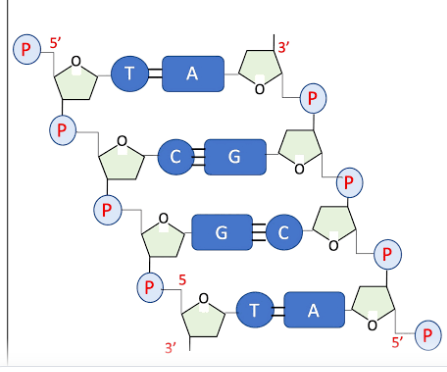
Directionality
New DNA pieces can only attach to the 3' end.
What Sugar Does DNA Use?
DNA uses deoxyribose
What type of sugar does RNA use?
RNA uses Ribose
How many hydrogen bonds hold a G-C pair together?
3 hydrogen bonds.
How many hydrogen bonds hold an A-T pair together?
2 hydrogen bonds.
Which DNA base pair is stronger and harder to break: A-T or G-C?
G-C Because it has 1 more hydrogen bond.
What is a peptide bond and where does it form?
The chemical glue that links amino acids together. It always connects a Carbon (C) to a Nitrogen (N)
What is DNA’s Bonds?
A, T, C, G
What is RNA’s bases?
A U G C
Monosaccharide
A single, simple sugar molecule (like glucose; the building block of carbs).
Disaccharide
Two sugar molecules hooked together (like sucrose or table sugar).
Polysaccharide
A giant chain of many sugars hooked together (a complex carb).
Glycosidic Linkage
The specific name for the chemical bond that holds sugars together.
Starch
A polysaccharide used by plants to store energy (like in potatoes)
Cellulose
A polysaccharide used to build plant cell walls (gives them structure).
Chitin
A polysaccharide used to build the crunchy exoskeletons of insects
Glycerol & Fatty Acids
The two basic building blocks that combine to make a standard fat molecule.
Triglyceride
A standard fat molecule made of one glycerol holding hands with three fatty acid tails.
Cholesterol
A steroid lipid that stays inside the cell membrane to keep it flexible.
DNA
Double-stranded genetic code that uses Deoxyribose sugar and Thymine (T).
RNA
Single-stranded genetic messenger that uses Ribose sugar and Uracil (U).
Pentose Sugar
The 5-carbon sugar "house" that forms the middle of a nucleotide.
Nitrogenous Base
The letter part of DNA/RNA (A, T, C, G, or U) that actually holds the genetic code.
Alpha Helix
A type of secondary structure shaped like a coiled spring or spiral staircase.
Beta Pleated Sheet
A type of secondary structure shaped like a folded paper accordion.
Di-sulfide Bridges
Strong covalent bonds between R-groups that lock the 3D tertiary shape in place.
Covalent Bonds
Strong bonds formed when two atoms share electrons (holds individual water molecules together).
Ionic Bonds
Bonds formed when atoms transfer electrons, creating opposite charges that attract (like salt).
Surface Tension
The tight "elastic skin" on top of water caused by water molecules clinging together tightly using hydrogen bonds. (This is what allows bugs to walk on water!)