Immunology - Midterm ONE
 Call Kai
 Learn
Learn Practice Test
 Spaced Repetition
 Match
Match Flashcards
 Knowt Play
1/105

Earn XP
Description and Tags
HTHSCI 3I03
Name | Mastery | Learn | Test | Matching | Spaced | Call with Kai | Chat |
|---|
No analytics yet
Send a link to your students to track their progress
106 Terms
What are antibodies made by?
B cells
What are antibodies?
Proteins that bind to specific targets
What is immunology?
A complex web of cells and molecules that work together to regulate almost every bodily function AND protect us from disease.
Why do we understand so little about immunology?
It is a very young field! Started in the 60s.
How long does vaccine development usually take?
From concept to federal approval, often it takes 10-15 years.
What is a vaccine?
a substance that builds preventative immune protection against a specific infection
Two main kinds of vaccines
Inactivated (killed) and Attenuated (weakened)
Inactivated (killed) vaccines
uses a version of a germ that has been killed or rendered inactive with heat, chemicals, or radiation so it cannot cause disease
Attenuated (weakened) vaccines
use a live, but weakened, version of a germ to trigger a strong, long-lasting immune response without causing severe disease
Poliovirus
Infects nerve cells and causes paralysis
Eradicated completely thanks to Jonas Salk
Plague of Athens
Athens was at war with Sparta in 430 BC
Spartans were better warriors, but Athens had walls (big ones)
But a plague hit Athens, killis 25-33% of their populations
because of this we got the earliest description of immunity - ‘for no one was every attacked for a second time, or not with a fatal result’
Theory for disease before germs
“bad air” caused disease, if you upset god he would send bad air
John Snow
In 1854 he noticed that all cases of cholera in London were centered around one water pump, and suggested that it was the cause. He also suggested to boil the water to get rid of the disease (he was right!)
Louis Pasteur
1860-1864
really bummed that wine and beer spoils
did a series of experiments and determined that microorganisms were the cause
found out that heating liquids and allowing them to cool stopped spoiling by killing the microorganisms (process called pasteurization)
Robert Koch
Used microscopy and developed culture techniques to generate pure cultures of bacteria and took the first ever published pic of Anthrax.
Giving anthrax bacteria to animals causes symptoms of anthrax… GERM THEORY PROVEN!
Koch’s Postulates
1. A specific microorganism is always associated with a given disease.
2. The microorganism can be isolated from the diseased animal and grown in pure culture in the laboratory.
3. The cultured microbe will cause disease when transferred to a healthy animal.
4. The same type of microorganism can be isolated from the newly infected animal.
Louis Pasteur - chickens
Chickens given weakened bacteria, adn became immune! This led to inactivated vaccines. Salk used this in his Polio vaccine.
Paul Ehrlich
1900, horse suffered infection, take the serum from horse blood and give to humans, ???, cure dyptheria!
Paul Ehrlich thought immunity was…
Adaptive (responds to infection)
Humoral (its in our humours, aka. blood)
He was right, and was talking about (not that he knew) antibodies!
Eli Metchnikoff thought immunity was
Innate (pre-programmed and simple)
Cellular (cells confer protection)
Two major arms of immunity

First vaccine
Reported in 1796, and in widespread use by the 1800s. The smallpox vaccine (we eradicated smallpox)!
Edward Jenner
1796
noticed that local milkmaids who had caught cowpox—a mild, non-fatal disease passed from cows—seemed immune to the devastating smallpox outbreaks sweeping through England
used fluid from cowpox lesions to create immunity against the deadly smallpox virus
put into a little boy, and then gave him smallpox twice (lucky him- the boy was fine)
Variolation
Taking smallpox from one person and giving it to another, hoping for a mild infection.
The practice was brought over to England by Lady Mary Wortley Montagu, who saw the practice while travelling in the Ottoman Empire (Turkey).
Variolation was practiced in China, India, and others in the 16th century.
Who are the immune cells?
White blood cells
Where do immune cells come from?
Bone marrow —> stem cell __> red blood cells, platelets, white blood cells
Differentiation
a cell changing from one type to another
Cell fates
when a cell is choosing how it will differentiate, this is the “end” cell type
What is a cell?
An individual unit of an organism.
Except red blood cells, all cells have a nucleus.
The nucleus contains DNA.
How are immune cells different if they have the same DNA?
When a gene is transcribed and translated into a protein, we say that the gene is expressed.
Gene expression
The “choice” to express different proteins
How do we define cells?
Based on what they make, with a general focus on whats on the surface of the cell (because its easy to study)
How do we denote if a cell expresses a protein?
A plus, and say it is positive for the protein! E.g. Antibody⁺ cell
How do we denote if a cell does NOT expresses a protein?
A minus, and say it is negative for the protein! E.g. Antibody⁻ cell
What does phenotype define?
Function (what the cells make defines what the cells do)
Cell types
(Usually protein) markers that define an entire “lineage” of cells
Cellular program/transcriptional progran
the collection of everything made by the cell
How is immunity achieved?
By cells communicating with one another (exchange of signals)
True or false: Immune cells send and receive signals to non-immune cells in their environment.
TRUE!
How do immune cells communicate?
Molecular interactions that occur through receptors and ligands. “Locks and Keys”.
Direct communication between receptors.
Indirect communication via soluble mediators.
True or false: Cells can only respond to a ligand if they express the appropriate receptor!
TRUE!
Cognate pair
Matching ligand and receptor.
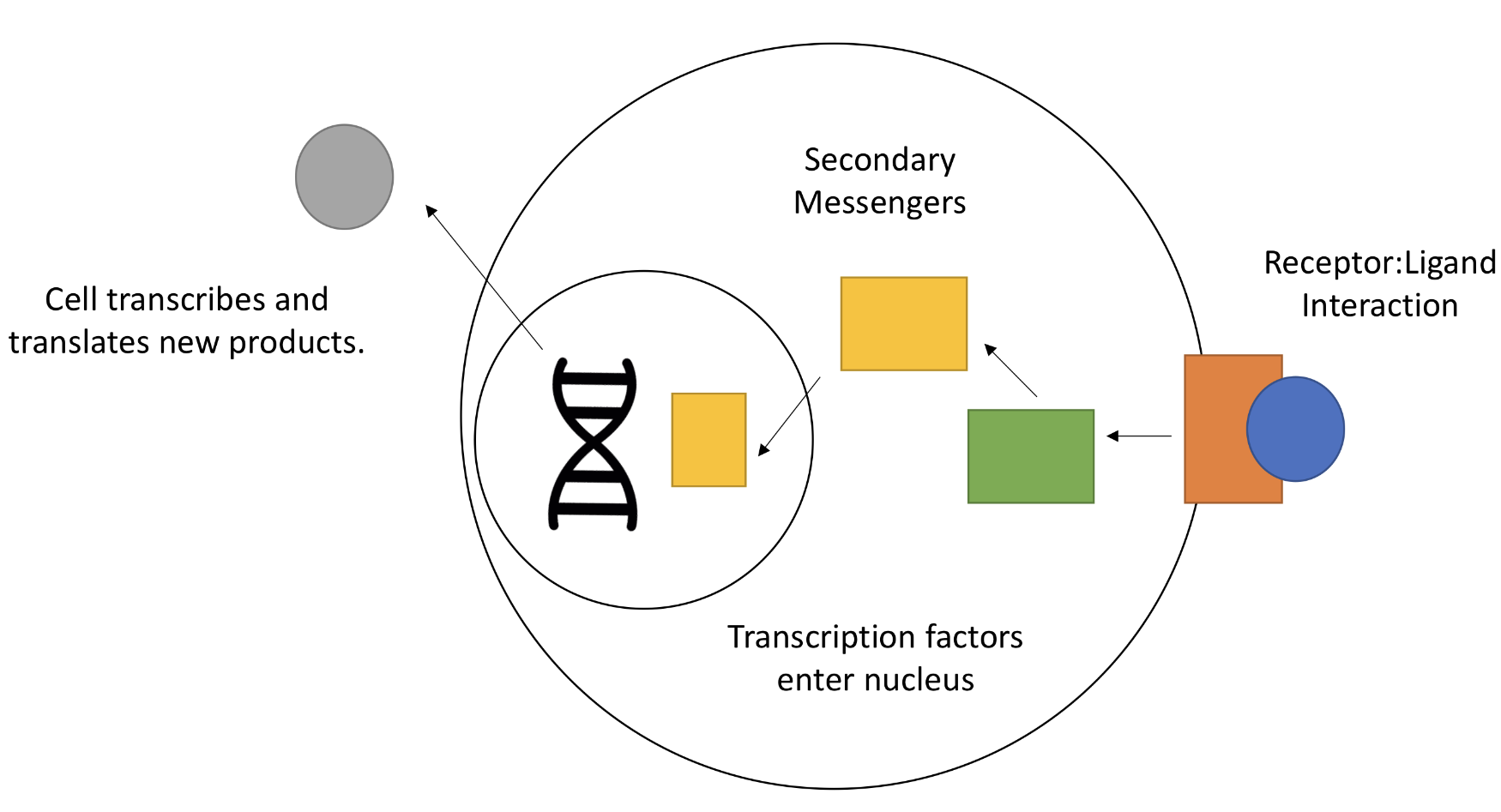
How do receptor interactions change gene expression?
How do we name receptors?
Cluster of Differentiation/Classification Determinant (CD) and then an official designation using numbers… there are now over 370 known CD molecules
Cytokine
Signalling molecule that makes a cell move or change
Interleukins
Molecules that signal between immune cells. Named with ‘IL’ and a number as well.
What are the major differences between innate and adaptive immunity?
Innate: immediate, broad, relatively low energy
macrophages, neutrophils, etc.
Adaptive: delayed, highly specific, relatively high energy
T cells + B cells
Adaptive immunity is induced by innate immunity
Adaptive = potent + systemic
What is the first line of defense?
Intrinsic barriers / epithelial cells
Skin
Mucosal barriers
Prevent pathogens from entering
Skin is difficult to penetrate and consists largely of dead, low-nutrient cells with antimicrobials.
Think: Wall of the castle.
What are the major entry points for pathogens?
Back:
Skin → cuts/broken barriers
Respiratory tract
Digestive tract
Urinary/reproductive tract
Blood
Places where the protective barrier is thinner/wet or can be breached.
What do macrophages do?
Major sentinel cells
Detect pathogens
Eliminate pathogens through phagocytosis
Phagocytosis = essentially “eating” pathogens
Part of the innate immune response.
Think: Castle guards waiting at the wall.
If sentinel cells handle most pathogens, why do we need more immune responses?
Every pathogen has mechanisms for evading the immune system.
If pathogens couldn't evade sentinel cells:
→ sentinel cells would usually be enough
→ infections would often go unnoticed.
What are neutrophils and why are they important?
Part of induced innate immunity
Recruited when local defenses are overwhelmed
Have toxic granules
Very potent at clearing pathogens
BUT their toxicity can also damage our own tissues.
Think: Nearby guards called in to help.
What fundamental problem must the immune system balance?
Protection ↔ Energy cost
The immune system needs to provide enough protection without continuously maintaining massive numbers of highly active immune cells.
What do dendritic cells do?
Sample their surroundings using macropinocytosis
Detect/sample antigens
Travel from infection site → lymph node
Present antigen
Activate T cells
Initiate the adaptive immune response.
Think: Messenger running from the battlefield to the barracks.
What is antigen presentation?
Dendritic cell + MHC + antigen → T cell activation
The dendritic cell presents pathogen-derived antigen to T cells using MHC.
Why are lymph nodes important for adaptive immunity?
Most adaptive immune cells rest in lymph nodes
Lymph nodes are positioned centrally for broad coverage
Lymphatic vessels sample fluid from tissues and bring information to lymph nodes
This allows adaptive immune cells to be activated in response to infection.
What happens to adaptive immune cells after an infection?
Most adaptive immune cells die shortly after infection
Some survive as memory cells
Memory cells continue monitoring and remembering the pathogen
This allows the immune system to respond to future exposure.
Remember: This is the basis for the historian analogy.
What is the long-term antibody response?
Some B cells differentiate into plasma cells
Plasma cells produce antibodies
A small number of plasma cells can produce high antibody titres for decades
Antibodies equip sentinel cells to better kill/clear pathogens.
Walk through the immune response from pathogen entry → adaptive response (maybe even write it out on paper?)
1. Pathogen enters
↓
2. Intrinsic barriers fail
↓
3. Macrophages / dendritic cells detect pathogen
↓
4. Macrophages + sentinel cells respond
↓
5. Cytokines recruit neutrophils
↓
6. Neutrophils attack pathogen
↓
7. Dendritic cells travel to lymph node
↓
8. Dendritic cells activate T cells
↓
9. T cells activate B cells
↓
10. T cells return to infection site
↓
11. B cells → plasma cells
↓
12. Plasma cells produce antibodies
↓
13. Some adaptive cells become memory cells
What is the Lord of the Rings/castle analogy for the immune system?
Castle | Immune system |
|---|
Wall | Intrinsic barriers / skin |
Castle guards | Sentinel cells / macrophages |
Nearby guards | Recruited innate immunity / neutrophils |
Messenger | Dendritic cells |
Barracks | Lymph nodes |
Army | Adaptive immunity / T & B cells |
Why is skin an inhospitable environment?
• No receptors for attachment.
• Very low water content.
• Dead cells do not allow viral replication
Mucous membranes
Interface with the external environment
Ocular mucosa
Gastrointestinal mucosa
Respiratory mucus
Urogenital mucosa
Mucus
Acts as a lubricant
Traps pathogens
Keeps pathogens away from epithelial cells
Provides a niche for commensal microbes
Our intrinsic barriers
Microbiological Barrier
Our microbiome, the “healthy” bacteria that coat most of our surfaces
How does the microbiome protect us?
Competition
Our commensals have evolved
to live in the environment of the
tissue. Pathogens struggle to
compete to live in the pH of our
tissues using the food sources
we create.
Crowding
They cover almost every inch,
leaving very little space for
pathogens to find a niche!
Antimicrobials (Peptides, enzymes, fatty acids)
Bacteria fight each other using
proteins that they evolved to be
competitive. These kill pathogens
while sparing commensals.
How is our relationship with microbes symbiotic?
We give them a home and they digest food we cannot, provide immune defence, create substances that regulate out mood and other functions.
Dysbiosis
improper composition of bacteria or improper diversity, can predispose to infection
What is dybiosis associated with
IBD, IBS, Obesity, Diabetes, Autoimmunity, Cardiovascular Disease, Cancer,
Allergy, Asthma, Mood Disorders, Pregnancy Complications and many many
more
What is the primary overall objective of the immune system?
Homeostasis (balancing external pressures to keep the inside separate from the outside).
Name examples of external pressures that force our body systems to change.
Infection, heat, cold, hunger, toxins, mental stress/studying
How is the mouth (buccal mucosa) structurally adapted to its barrier function?
It features a stratified epithelium (resembling skin) designed to withstand mechanical abrasion during eating.
How is the small intestinal mucosa structurally adapted to its function?
It possesses only a single layer of epithelial cells to maximize nutrient absorption while remaining joined by tight junctions
How is the lung alveolar epithelium specialized for its function?
It consists of a single, extremely thin layer of specialized epithelial cells (Type I and Type II pneumocytes) to maximize gas exchange
What functions does mucosal mucus provide in defense?
It acts as a mechanical lubricant, traps pathogens, physically separates microbes from epithelial surfaces, and provides an ecological niche for commensal flora
What is the defense role of tight junctions between epithelial cells?
They seal intercellular spaces to prevent paracellular entry and migration of pathogens into underlying tissues
How do desquamation and epithelial shedding protect the skin and gut?
By continuously sloughing off attached and infected cells:
Skin: ∼1000 cells/cm2/hour (<spanstyle="line−height:1.15;">\sim 5 \times 10^8\text{ cells/day}</span>)fromthe15–20celllayersofthestratumcorneum.</p></li><li><p><strong>Intestine:</strong>\sim 10\text{--}100\text{ billion cells/day}$$ shed from villus tips as enterocytes migrate from crypt stem cells.
What role do fluid and air flow play in physical defense?
Air flow: Dislodges microbes from the skin surface.
Peristalsis: Drives contents through the gut to prevent adherence and expels them via feces.
Tears / lacrimal flow: Flushes microbes away from the ocular surface into tear ducts and the nasal cavity.
How do active expulsion reflexes protect the respiratory and digestive tracts?
Sneezing & Coughing: Rapidly clear irritants, toxins, and microbes out of the airway.
Vomiting (emesis): Forcefully ejects ingested pathogens and toxins from the stomach.
How does the mucociliary escalator function in the airway?
Coordinated ciliary beating sweeps pathogen-laden mucus upward from the lower airways (or down from nasal passages) into the pharynx, where it is swallowed and degraded by gastric acid
What are the four general mechanisms by which chemical barriers protect us?
Direct membrane disruption and killing
Growth and metabolic inhibition
Enzymatic destruction/denaturation of proteins and toxins
Nurturing and supporting commensal microbiota
What non-immune physiological secretions double as chemical barriers?
Pulmonary Surfactants: Lower surface tension in alveoli; potently disrupt microbial membranes and denature proteins.
Pepsin / Gastric Proteases: Digest dietary protein; enzymatically destroy microbial structural proteins and toxins.
Lysozyme (Tears & Saliva): Cleanses debris and breaks down microbial cell wall/surface components
How do Defensins differ from Cathelicidins in humans?
Defensins: Multiple variants; some are constitutively expressed, while others are induced during inflammation.
Cathelicidins: Only one human variant exists (LL-37), which is constitutively expressed by epithelial cells across all barrier tissues.
What is the step-by-step mechanism of pore formation by antimicrobial peptides?
Electrostatic attraction and the transmembrane electric field pull cationic peptides into the negatively charged lipid bilayer.
Aggregated peptides insert and form transmural pores.
Intracellular contents leak out, destroying membrane polarization and ion gradients (shutting down ATP synthesis), leading to cell lysis.
Aside from membrane lysis, how do antimicrobial peptides (AMPs) neutralize pathogens?
In high concentrations, AMPs disrupt electrostatic charges and folding patterns of bacterial proteins and toxins, denaturing them in a manner analogous to acidic pH.
What are the three primary mechanisms by which commensal bacteria protect against colonization?
Competition: Better adapted to consume available nutrients and thrive at local tissue pH.
Crowding: Cover mucosal niches completely, leaving no adherence space.
Antimicrobial production: Produce bacteriocins, fatty acids, and enzymes that selectively kill competing pathogens.
hat mutual benefits define our symbiotic relationship with commensal bacteria?
Host provides sheltered niches and food; commensals digest indigestible fibers, bolster immune defense, and generate metabolic byproducts/neurotransmitters that regulate host physiology and mood.
How does microbial diversity in the vaginal tract uniquely compare to other mucosal sites?
Most mucosal tissues (oral cavity, gut, skin) thrive on high species diversity, whereas the vaginal tract is dominated almost entirely by a single genus: Lactobacillus.
What is microbial dysbiosis, and what health conditions is it correlated with?
An improper composition or loss of microbial diversity that compromises barrier integrity. It correlates with IBD, IBS, obesity, diabetes, cardiovascular disease, autoimmunity, mood disorders, and cancer (though whether it is causative or symptomatic remains under study).
How do commensal bacteria survive chemical barriers that destroy pathogens?
They have co-evolved specific structural modifications in their membranes and cell walls to resist local enzymes, surfactants, and AMPs, and are metabolically adapted to low pH and fatty acid consumption.
How does Vibrio cholerae breach mucosal barriers?
Secretes mucinase to degrade host mucin polymers, allowing it to swim through the mucus layer instead of becoming trapped.
How does Helicobacter pylori survive the stomach's chemical barrier?
Produces urease to generate basic ammonia, which neutralizes gastric hydrochloric acid in its immediate microenvironment.
How does Pseudomonas aeruginosa neutralize host antimicrobial peptides?
Secretes an elastase enzyme that enzymatically degrades the host cathelicidin peptide LL-37.
How does Shigella flexneri circumvent mechanical epithelial barriers?
Directly targets and disrupts epithelial tight junctions, increasing paracellular permeability to slip past the cell layer.
How does Bordetella pertussis disable respiratory clearance?
Releases a tracheal cytotoxin that paralyzes and destroys ciliated epithelial cells, shutting down the mucociliary escalator.
Where does the complement system sit within the broader immune system?
It is the humoral branch of the innate immune system (evolutionarily conserved, hard-wired, and non-cellular).
Where are complement proteins synthesized, and how do they reach peripheral barriers?
Synthesized constitutively by the liver, secreted continuously into the blood circulation, and distributed from plasma into tissues.
What is a zymogen, and how does C3 exemplify this?
An inactive precursor protein requiring enzymatic cleavage for activation. Native C3 is inert until cleaved into active fragments: C3a and C3b.
What is a complement "convertase"?
An active multi-protein complement complex (such as C4b2a) that acts as an enzyme to cleave downstream complement factors (such as converting C3 into C3a and C3b).