INFORMATICS L3
 Call Kai
 Learn
Learn Practice Test
 Spaced Repetition
 Match
Match Flashcards
 Knowt Play
1/45

There's no tags or description
Looks like no tags are added yet.
Name | Mastery | Learn | Test | Matching | Spaced | Call with Kai | Chat |
|---|
No analytics yet
Send a link to your students to track their progress
46 Terms
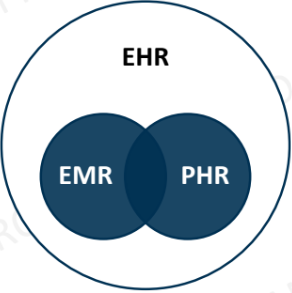
health-related information on an individual that conforms to nationally recognized interoperability standards and that can be created, managed, and consulted by authorized clinicians and staff across more than one health care organization
Electronic health records (EHRs)
health-related information on an individual that can be created, gathered, managed, and consulted by authorized clinicians and staff within one health care organization
Electronic medical records (EMRs)
An electronic record of health-related information on an individual that conforms to nationally recognized interoperability standards and that can be drawn from multiple sources while being managed, shared, and controlled by the individual
Personal health records (PHRs)
Relationship between EHR, EMR, and PHR.
Healthcare today is ___. Patients often:___ Coordination becomes difficult without?
complex, multidisciplinary, and data-intensive
• See multiple physicians
• Use multiple medications
• Receive care from different facilities
electronic systems
Comparing Electronic Health Record (EHR) to paper records.
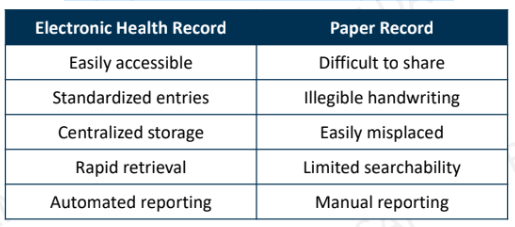
Problems with paper records
• Lost charts
• Missing information
• Delayed access
• Duplicate tests
• Medication errors
• Poor communication
• Limited population health reporting
Pharmacy perspective without an EHR:
• Medication history may be incomplete
• Drug interactions may be missed
• Allergies may not be documented
• Medication reconciliation becomes difficult
For the medical profession to make evidence-based decisions, clinicians need a lot of accurate data
Health information and data
Quick access to lab, imaging, and consult results saves time and money, prevents redundancy, and improves care coordination
Result management
CPOE should reduce order errors from illegibility for medications, lab tests, and ancillary services, and standardize care
Order management
CDS should improve overall medical care quality by providing alerts and reminders
Decision support
Communication among disparate partners is essential and should include all tools such as secure messaging, text messaging, web portals, health information exchange, etc
Electronic communication and connectivity
Recognizes the growing role of the internet for patient education as well as home telemonitoring
Patient support
Sped up by electronic scheduling, electronic claims submission, eligibility verification, automated drug recall messages, automated identification of patients
Administrative processes and reporting
EHR Key Components
• Clinical decision support systems (CDSS)
• Computerized physician order entry (CPOE)
• Electronic prescribing
• Retrieval of lab and imaging reports
• Retrieval of prior encounters and medication history
• Preventive medicine tracking that links to clinical practice guidelines
• Problem summary list
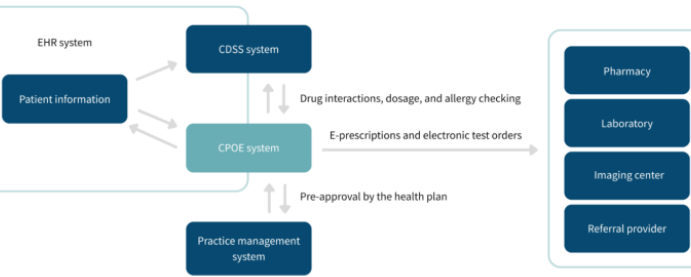
An EHR feature that processes orders for medications, lab tests, imaging, consults, and other diagnostic tests
Computerized Provider Order Entry (CPOE)
Advantages of computerized provider order entry over paper-based systems
• overcomes the issue of illegibility
• fewer errors associated with ordering drugs with similar names
• more easily integrated with decision support systems than paper
• easily linked to drug-drug interaction warning
• more likely to identify the prescribing physician
• able to link to adverse drug event (ADE) reporting systems
• able to avoid medication errors like trailing zeroes
• creates data that is available for analysis
• can point out treatment and drugs of choice
• can reduce under and over-prescribing
• prescriptions reach the pharmacy quicker
potentially introduces new types of errors, including:
• Inexperienced providers and staff may cause slower order entry and person-to-person communication
Computerized Provider Order Entry
A situation in which a provider ignores or overrides CDSS messages without giving appropriate consideration due to their sheer volume
Alert Fatigue
Reasons cited include perceptions that paper methods are faster or more efficient, and that implementation attempts would be costly and unsuccessful
Provider and organization resistance to change
Barriers for wide adoption:
1. Provider and organization resistance to change
2. High cost of CPOE implementation and lack of capital
3. Selection of a specific CPOE product from the many options available
Four key areas to overcome resistance:
• Strong hospital leadership
• Physician champions
• Workflow concerns addressed and users reassured throughout the implementation process
• Organizational expertise should be leveraged
Strategies to overcome high costs:
• Realigning hospital’s priorities to focus on patient safety
• Leveraging external influences such as published literature
• Measuring CPOE’s impact on hospital efficiency
Any software designed to directly aid in clinical decision making in which characteristics of individual patients are matched to a computerized knowledge base for the purpose of generating patient specific assessments or recommendations that are then presented to clinicians for consideration
Clinical Decision Support Systems (CDSS)
Elements of the CDSS:
Knowledge base
Rules engine
Software
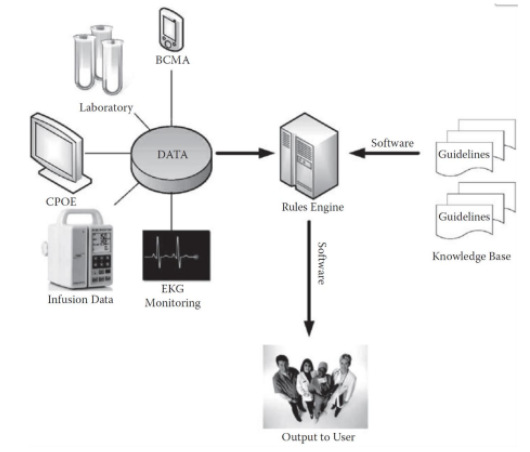
Translates scientific knowledge (e.g., guidelines, treatment protocols) into computer-interpretable decision algorithms (e.g., clinical rules or algorithms)
Knowledge base
Retrieves patient-specific data, often stored in multiple databases, and checks whether the criteria set in the knowledge base are met
Rules engine
Allows the user to create clinical decision algorithms and generates recommendations
Software
Levels of Clinical Decision Support Systems
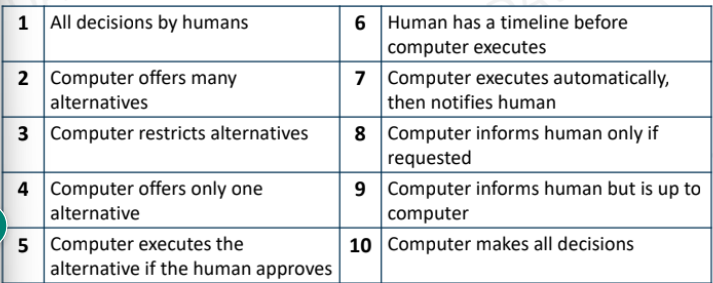
Clinical decision support:
• Knowledge support
• Calculators
• Medication ordering support
• Reminders
• Order sets and protocols
Digital medical resources (such as UpToDate) are being integrated with EHRs
Knowledge support
Particularly helpful in medication and lab ordering sections, such as when prescribing drugs excreted by the kidneys or imaging contrast agents that can be toxic to the kidneys
Calculators
Include rule engines to detect known allergies, drug-drug interactions, drug-condition and drug-food allergies, and excessive dosages
Medication ordering support
Computerized reminders that track yearly preventive health screening measures and vaccination schedules
Reminders
Groups of pre-established inpatient orders that are related to a symptom or diagnosis
• Can reflect best practices, saves keystrokes and time
Order sets and protocols
• Occur as a result of an imbedded rule and typically do not interrupt workflow unless the user chooses to do so
• Can occur based on programmed logic using either data already contained within the CPOE system database resulting from user input
• Can occur based from data sent to the database from ancillary systems
• Asynchronous CDS Alerts
• Pop-up warning screens that interrupt user workflow
• Triggered by specific actions taken by a user of the system
• The user action of submitting the order invokes a check of the dose against defined criteria within the system and interrupts the user with a request to act on the alert notification before proceeding
Synchronous CDS Alerts
Process by which a provider can electronically send an accurate, error-free prescription directly to the pharmacy information system from the point of care. Integrated with CDSS that alert and educate potential medication issues, such as:
• Drug allergies
• Drug-drug, drug-food, and drug-condition interactions
• Teratogenicity
• Under- or overdosages, like in age or BMI extremes
• Duplicate drugs
Electronic Prescribing (E-prescribing)
Electronic Prescribing Functionality includes:
• generating a complete medication list
• supporting prescription ordering, printing, and electronic transmission
• including alerts for unsafe conditions (e.g., allergies)
• providing information on lower cost, therapeutic alternatives
• providing information on formulary and patient eligibility based on the patient’s drug plan
Overall functionality of the e-prescribing software depends on the management of
multiple databases
Includes decision support functions, such as therapeutic categories, drug-drug and drug-disease interactions, dose range checking, and allergy warnings
Drug database
Supports selection of and communication with the patient’s specific pharmacy
Pharmacy database
Consists of a list of prescribers and other users along with their authority to prescribe, and other identifiers
User database
Lists patients and all pertinent patient information to support e-prescribing functions
Patient database
How CPOE, EHR, and CDSS relate to one another.