CHEM 2211 Exam 1 UGA
 Call Kai
 Learn
Learn Practice Test
 Spaced Repetition
 Match
Match Flashcards
 Knowt Play
1/101

There's no tags or description
Looks like no tags are added yet.
Name | Mastery | Learn | Test | Matching | Spaced | Call with Kai | Chat |
|---|
No analytics yet
Send a link to your students to track their progress
102 Terms
Electronegativity trend
increases up and to the right
Ionic bond electronegativity difference
greater than 1.9
Covalent bond electronegativity difference
less than 0.5
Polar covalent bond electronegativity difference
between 0.5 and 1.9
types of covalent bond breakage
homolytic cleavage and heterolytic cleavage
Homolytic cleavage
non-polar covalent bond breaks, each atom keeps one electron(radicals)
Heterolytic cleavage
polar covalent bond breaks, more electronegative atom keeps both electrons (anion)
Nitrogen preferred bonding
3 bonds
1 lone pair
Oxygen preferred bonding
2 bonds
2 lone pairs
Carbon preferred bonding
4 bonds
0 lone pairs
Halogen preferred bonding
1 bond
3 lone pairs
Formal Charge=
# Valence electrons - (# dots + # lines)
Kekule structures
lewis structure without lone pairs
constitutional isomers
have same molecular formula but different connectivity
they will have different physical properties
Condensed formula
organic compounds read then written from left to right in sequential order
how are substituents notated in condensed formulas
in parenthesis after hydrogens
what is the space in between shaded regions called on a p orbital
node
Aufbau Principle
lower orbitals most be filled first
Pauli Exclusion Principle
each orbital can have 2 electrons, they must have opposite spins
Hund's Rule
orbitals of equal energy are each occupied by one electron before any orbital is occupied by a second electron, and all electrons in singly occupied orbitals must have the same spin
molecular orbital theory
when two atomic orbitals combine, two molecular orbitals are produced, a bonding and anti-bonding molecular orbital
The bonding MO is spin-paired and the anti-bonding MO is not
HOMO
highest occupied molecular orbital
LUMO
lowest unoccupied molecular orbital
Sigma bonding
when orbitals overlap head on with the same shading
Sigma anti-bonding
form when valent orbitals overlap head on and out of phase (opposite shading)
Pi bonding
side-to-side overlap that results in double or triple bonds
P orbitals overlap vertically with the same shading
Pi anti-bonding
P orbitals overlap vertically and out of phase (opposite shading)
sp3 hybridization
tetrahedral
109.5 degrees
sp2 hybridization
trigonal planar
120 degrees
sp hybridization
linear
180 degrees
electronic geometry vs molecular
electronic is without counting lone pairs, molecular takes lone pairs into account
sp3 molecular geometry
tetrahedral
trigonal pyramidal
bent
sp2 molecular geometry
trigonal planar
bent
% s character =
s orbitals / (s orbitals+ p orbitals) x 100
the bigger the halogen, the _________ the bond is to the hydrogen. The bigger the bond, the _________ it is
longer
weaker
allylic resonance
when a cation, anion, lone pair, or radical is located adjacent to a bond
lone pair resonance
lone pair on an atom, N or O, shares a lone pair with an adjacent electron deficient, positively charged, atom
rules of resonance
1. Net charge MUST remain constant
2. NEVER break sigma-bonds when trying to create new resonance structures, only pi-bonds can move
3. Do not violate the octet rule
Alkane

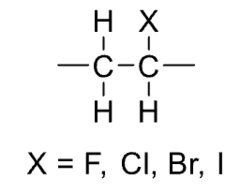
alkyl halide
Alkene

Alkyne

Arene
Alcohol
Ether

Epoxide

Thiol

Thioether

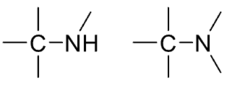
Amine

Amine 2*, Amine 3*
Aldehyde

Ketone

Carboxylic acid

Ester

Acyl halide

Anhydride

Amide

Nitrile

What are 11 and 12 hydrocarbon chains called
Undecane
Dodecane
Primary Carbon
a carbon bonded to only one other carbon
Secondary Carbon
carbon bonded to two other carbons
Tertiary Carbon
carbon bonded to three other carbons
Quaternary Carbon
carbon bonded to four other carbons
Primary alcohol
an alcohol in which the hydroxyl (-OH) group is attached to a carbon that is attached to no more than one other carbon.
Secondary alcohol
An alcohol in which the hydroxyl (-OH) group is attached a carbon that is attached to two other carbons.
Tertiary alcohol
An alcohol in which the hydroxyl (-OH) group is attached to a carbon that is in turn attached to three other carbons.
Primary amine
Nitrogen has one or zero carbons attached to it
Secondary amine
nitrogen has two carbons attached to it
Tertiary amine
nitrogen has three carbons attached to it
Quaternary amine
nitrogen has four carbons attached to it
IUPAC name breakdown
Sub, Par, Sat, PG
isopropyl

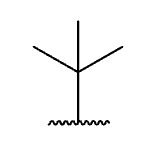
Tert-butyl
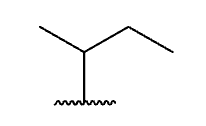
sec-butyl
isobutyl
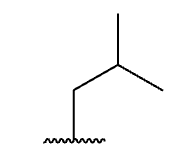
double bond saturation
_____ - # - ene
triple bond saturation
_____ - # - yne
who is given priority in the direction of the parent chain
priority groups, OH
pi bonds if not OH
If alkene and alkyne are tied in position on the parent chain
prioritize the alkene
vinyl
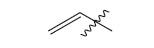
allyl
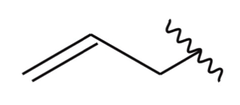
What is an alkene substituent directly attached to a parent chain called?
alkyl-idene
exception, methylene
Common names for simple molecules
Alkyl Halide
Alkyl Ether
Alkyl Alcohol
Alkylamine
Methyl Group
CH3
Methylene Group
CH2
Methine Group
CH
like dissolves like
polar dissolves polar, nonpolar dissolves nonpolar
Anti-staggered conformation
the two largest groups are 180° apart, and strain is minimized
gauche interactions
when nonhydrogen atoms are next to each other in a staggered projection
conformational isomers
compounds that share the same molecular formula and connectivity due to single-bond rotation
eclipsed interactions
strain caused by overlapping molecules in eclipsed formations
which formation has the highest energy
eclipsed with the largest atoms overlapping
What does an eclipsed line bond look like

What does a sawhorse projection look like

steric strain
repulsion of neighboring electron clouds of substituents
examples of steric strain
gauche interactions
also occurs in eclipse interactions
torsional strain
arises from stored potential energy within bonds and unfavorable orbital overlap
examples of torsional strain
eclipse interactions
when bonds form how does energy change
energy is released
which type of cleavage is more common?
heterolytic