OCR A Level Chemistry Unit 2
 Call Kai
 Learn
Learn Practice Test
 Spaced Repetition
 Match
Match Flashcards
 Knowt Play
1/11

There's no tags or description
Looks like no tags are added yet.
Name | Mastery | Learn | Test | Matching | Spaced | Call with Kai | Chat |
|---|
No analytics yet
Send a link to your students to track their progress
12 Terms
Composite ions + their charges
OH-
NO2-
NO3-
CO32-
SO42-
Cr2O72-
PO43-
NH4+ (ammonium)
What is an isotope?
Atoms of the same element with different numbers of neutrons + different masses
How does a mass spectrometer work?
Vaporisation - the sample is converted into a gas
Ionisation - the gas is bombarded with high energy electrons, knocking an electron off the molecules, forming positive ions
Positive ions are accelerated using an electric field + are all given the same kinetic energy
Deflection - ions pass through a magnetic field, heavier ions deflect less, whilst lighter ions deflect more depending on the m/z ratio
What are 3 functions of a mass spectrometer?
Determine relative formula mass by the M+ ion
Identify elements/isotopes present → isotopic patterns e.g. 3:1 ratio for Cl35 and Cl37, helps to identify elements
Identify unknown compounds (structural info) → fragment peaks provide clues about how the molecule breaks apart, indicating its structure
What is M+? Equation to show its formation?
The molecular ion which has the highest m/z ratio

What is M+1? Why does it exist?
Caused by molecules containing one heavier isotope (e.g. C13 over C12), giving a slightly higher m/z peak than the molecular ion peak.
It exists because 1.1% of carbon is present as the carbon-13 isotope - so a small proportion of the molecules of a hydrocarbon will contain an atom of C13 - higher molecular mass
What is fragmentation?
When the molecular ion breaks down into smaller pieces, producing smaller peaks on a mass spectrum known as fragment ions
What does the simplest fragmentation produce? Example equation?
Positively charged ion (detected by mass spec)+ a radical (uncharged + not detected)
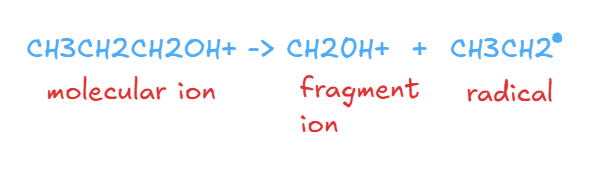
What is the base peak?
The tallest peak aka the most abundant ion
What are some common fragment ions + their values?
CH3+ = 15
C2H5+ = 29
C3H7+ = 43
C4H9+ = 57
What is relative atomic mass + its formula?
Ar = (relative isotopic mass of isotope 1 x percent abundance of isotope 1) + (relative isotopic mass of isotope 2 x percent abundance of isotope 2)/100