DSM-5
 Call Kai
 Learn
Learn Practice Test
 Spaced Repetition
 Match
Match Flashcards
 Knowt Play
1/11

There's no tags or description
Looks like no tags are added yet.
Name | Mastery | Learn | Test | Matching | Spaced | Call with Kai |
|---|
No analytics yet
Send a link to your students to track their progress
12 Terms
What are the four primary purposes of the Mental Status Examination (MSE)?
To assess cognitive/emotional/behavioral functioning, formulate a diagnosis, monitor changes over time, and guide treatment planning
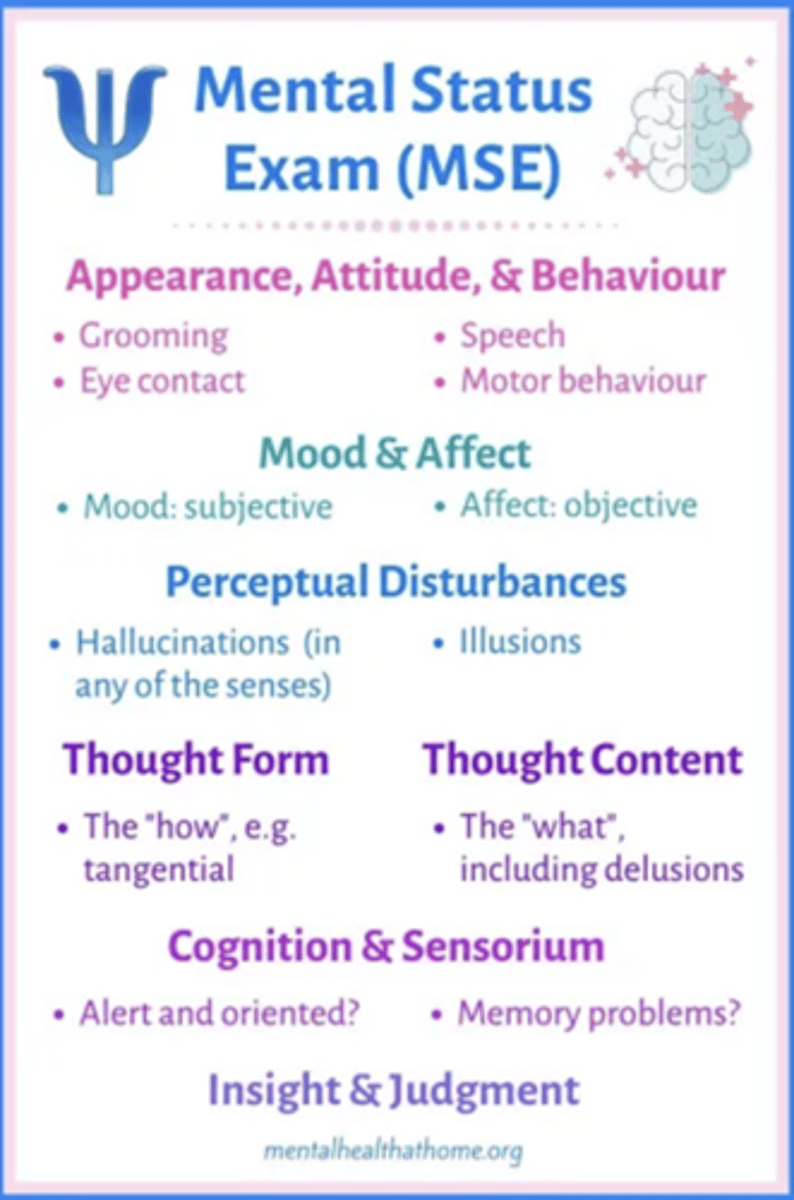
What are the domains assessed during a Mental Status Examination (MSE)?
Appearance, behavior, speech, mood, affect, motor activity, thought process, thought content, perception, cognition, insight, and judgment.
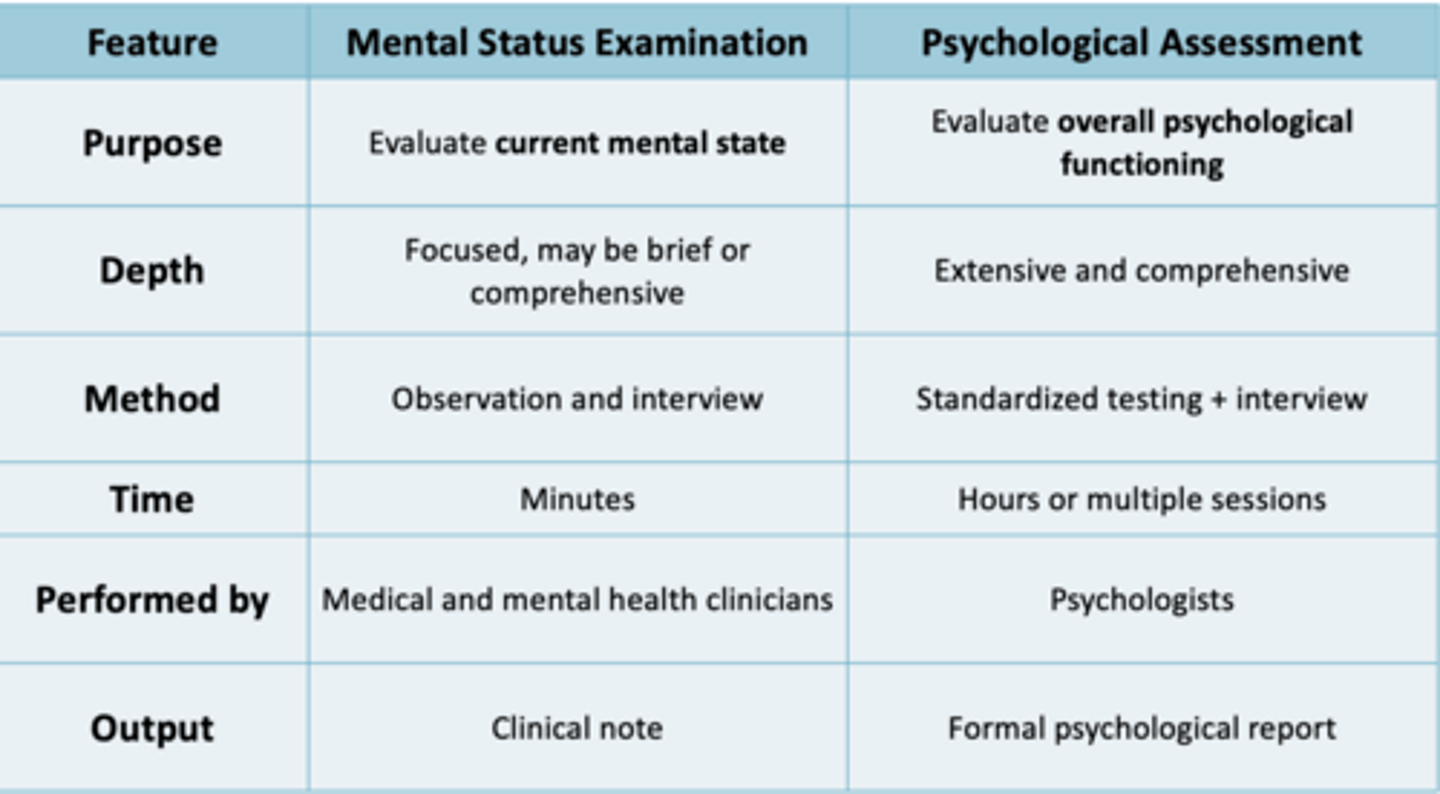
What are the characteristics of a brief MSE?
Performed in 1-3 minutes, usually for outpatient screening without a formal template.
How does a comprehensive MSE differ from a brief MSE?
More thorough, lasts 10-30 minutes, and includes a detailed exploration of memory, attention, and executive function.
What is a psychological assessment?
a comprehensive evaluation of psychological functioning, personality, and cognitive abilities utilizing standardized testing and multiple sources of information
What are the four main purposes of the DSM-5?
Standardization of diagnosis, aiding clinical treatment, providing a research framework, and serving as a training tool for clinicians.
What was the primary change of the DSM-5?
replaced the multiaxial system with a single diagnostic list and incorporates cross-cutting measures that identify symptom overlap across diagnoses
What assessment measures are present in the DSM-5?
Tools and scales for assessing symptom severity, cross-cutting symptoms, and disability.
What is cultural formulation in DSM-5?
Guidelines for conducting cultural assessments and understanding the cultural context of mental disorders
What is the general work up for pyschiatric diagnosis?
conduct a mental status exam, identify patterns of symptoms that align with specific disorders, and rule out medical conditions
What are some common criticisms or limitations of the DSM-5?
Over-diagnosis, reliability and validity, pathologizing normal behavior, cultural bias, and a lack of biological markers.
What is the main purpose of the Cultural Formulation Interview (CFI)?
To enhance diagnostic accuracy, improve patient-clinician communication, reduce misdiagnosis, and guide culturally appropriate treatment planning.