Year 10 Physics
 Call Kai
 Learn
Learn Practice Test
 Spaced Repetition
 Match
Match Flashcards
 Knowt Play
1/45

There's no tags or description
Looks like no tags are added yet.
Name | Mastery | Learn | Test | Matching | Spaced | Call with Kai | Chat |
|---|
No analytics yet
Send a link to your students to track their progress
46 Terms
How is distance different to displacement?
Distance: The actual length of path covered EG 300m
Displacement: The change in position and direction of an object EG 300m North/from home to school
Include the angle of displacement using true bearings EG N 067 E
What is a vector vs scalar quantity?
Vector quantities: Have magnitude and direction
Represented by arrows that can be added or subtracted
Scalar quantities: Have only magnitude (size)
What are examples of vector and scalar quantities?
Vector: Displacement, velocity, acceleration, force, momentum, gravity, weight
Scalar: Time, distance, speed, mass, temperature, time, density
What is speed?
A measure of the distance travelled per unit of time
Measured in km/h or m/s
To convert from km/h to m/s, divide by 3.6 (larger to smaller unit = divide)
How is average speed different to instantaneous speed?
Average speed: A measure of how fast an object moves overall whilst ignoring all stops and changes in speed during the journey
• Average speed = total distance/total time
Instantaneous Speed: A measure of how fast an object moves at a particular moment during travel
Can be seen in a speedometer
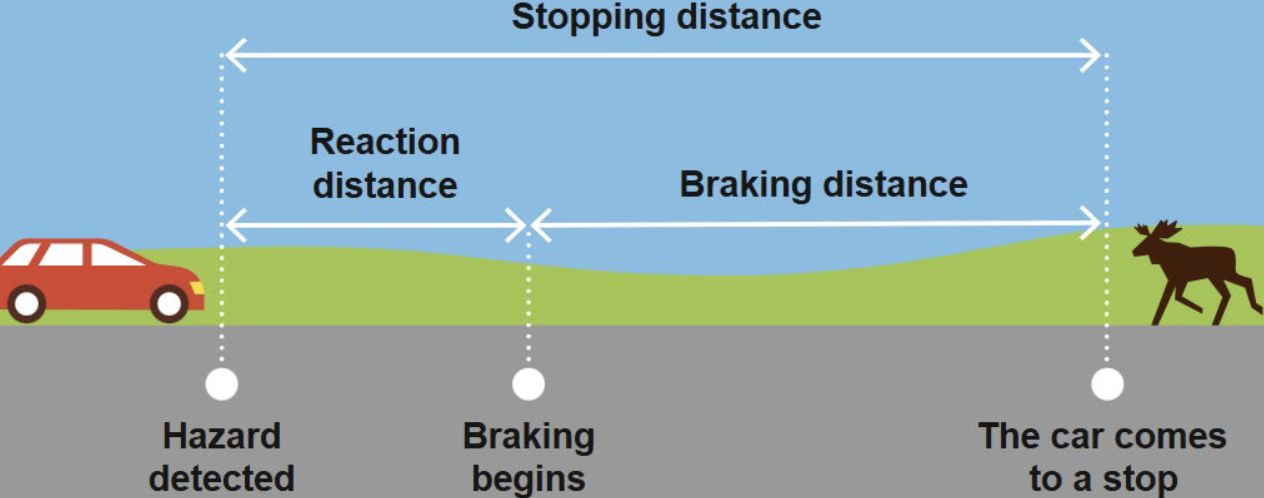
Why is reaction distance different to breaking distance? What is stopping distance?
Reaction distance: The distance the car travels from the point at which a hazard is detected until it begins braking or swerving
Braking distance: The distance the car travels from the point at which it begins braking until it comes to a stop
Stopping distance = Reaction distance + braking distance
What are the factors that affect stopping distance in terms of reaction distance?
Level of tiredness
Whether driver is under the influence of alcohol
The drivers’ awareness/hazard detection
The effect of medication
Psychological reaction time
What are the factors that affect stopping distance in terms of braking distance?
The vehicles speed (quadratically increases each time by a power of 2)
EG 2 x higher speed = 2², 4x longer braking distance, 3x higher speed = 3², 9x longer braking distance
The road’s gradient and conditions
The vehicle load EG Trucks have long braking distances
The brakes (condition, braking technique and number of wheels braking)
How is velocity different to speed?
Speed: The distance travelled per unit time (in km/h or m/s) EG 5m/s
Velocity: The rate of change of displacement over time 5m/s East
The direction of an object’s velocity is the same as its displacement
Velocity = Displacement (s)/time
What does the gradient of displacement/position-time graph vs velocity-time graph give you?
Displacement/position-time graph: Gives you velocity EG m/s North
A negative gradient gives you movement in the opposite direction
Velocity-time graph: Gives you acceleration EG m/s squared North
How do you calculate displacement using a velocity-time graph?
By calculating the total area between the plotted line (velocity) and x-axis (time) when velocity is constant
If velocity is different, you multiply time by each velocity and add to make final displacement
Areas above the axis are positive (forward displacement) and areas below are negative (displacement in the opposite direction)
How is acceleration different to velocity?
Velocity: The rate of change of displacement over time
Acceleration: The rate at which velocity changes over time
How do you calculate acceleration?
Acceleration is the rate at which velocity changes over time = Change in velocity/change in time
A = final velocity (v) - initial velocity 9 (u)/time (t)
Measured in m/s or km/h squared
What is the acceleration of gravity?
The acceleration of gravity (g) is 9.81m/s2 (when the effects of friction are not considered)
All objects experience the same acceleration
‘g’ can vary slightly on different points on the Earth’s surface EG Decrease in high altitudes
What are some of the types of forces classifed as contact and non-contact?
Contact:
Driving force
Frictional force
Drag/air resistance force
Normal force
Compression force
Tension force
Non-contact:
Magnetic force
Gravitational force
Electrostratic force
What is a force?
A push or a pull that acts upon an object as a result of its interaction with another object
Vector quantity, can cause an object to accelerate, change velocity, or change shape.
Unit for force is newtons ‘N’
What is normal force?
The force applied by a surface at right angles to the surface in response to a push on it by an object
What are resistance forces?
Forces that oppose motion, including drag and frictional forces such as air resistance
Drag is the force that opposes an object moving through a fluid (a liquid or a gas)
EG Force of water against you as you swim
What are thrust or driving forces?
Forces that cause an object to move or accelerate forward
EG Force of cars/planes engines or the force of a person pushing on the pedals of a bike
How are resistive forces different to thrust/driving forces?
Resistive forces oppose the motion of an object, while thrust/driving forces promote motion and move the object forward
What are tension and compression forces?
The forces caused by pulling on an object to stretch it or pushing on an object to compress it
Tension force commonly exists in ropes and wires used to move objects or hold them stationary
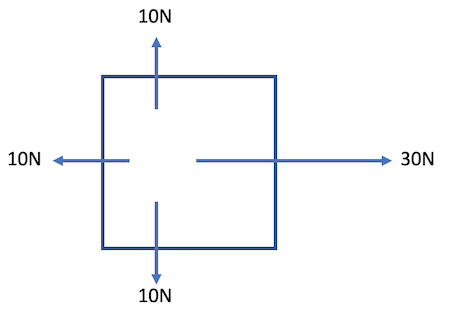
What does an object having net force acting upon it indicate?
It indicates that the object will accelerate in the direction of the net force
This means that the overall forces acting on the object are unbalanced
EG Net force, Fnet = 30N east + (-10N west) = 20N east (vector quantity)
How are balanced forces different to unbalanced forces?
Balanced forces occur when result in no change in motion, while unbalanced forces cause an object to accelerate or change its direction.
What is the force of friction?
A resistance force created whenever two surfaces move or try to move across each other
Friction always opposes the motion of one surface across another surface
Friction is dependent on the texture of the two surfaces
What is the force of air resistance?
The force of air particles that oppose the motion of an object through the air
It acts in the opposite direction to the object's velocity
Air resistance increases with the speed of the object and its surface area.
A type of drag force (since air acts as a fluid (a gas))
What is Newton’s first law of motion?
A body will either remain at rest or continue with constant speed in a straight line (constant velocity) unless it is acted upon by an unbalanced force
What does it mean forces acting on an object are balanced?
The object is at rest
The object is moving at constant velocity
What is inertia and how is it involved in car safety?
The property of an objecct to resist changes in its motion
A property of matter (not a force) affected by friction
EG Inertia is evident during a sudden stops or collisions, where passengers continue moving at the same speed, requiring the seatbelts and airbags to prevent injury
What is Newton’s second law of motion?
States that when a net force acts on a constant mass, it accelerates in the direction of a net force
The greater the net force, the greater the acceleration of the constant mass
Formula: Fnet = ma
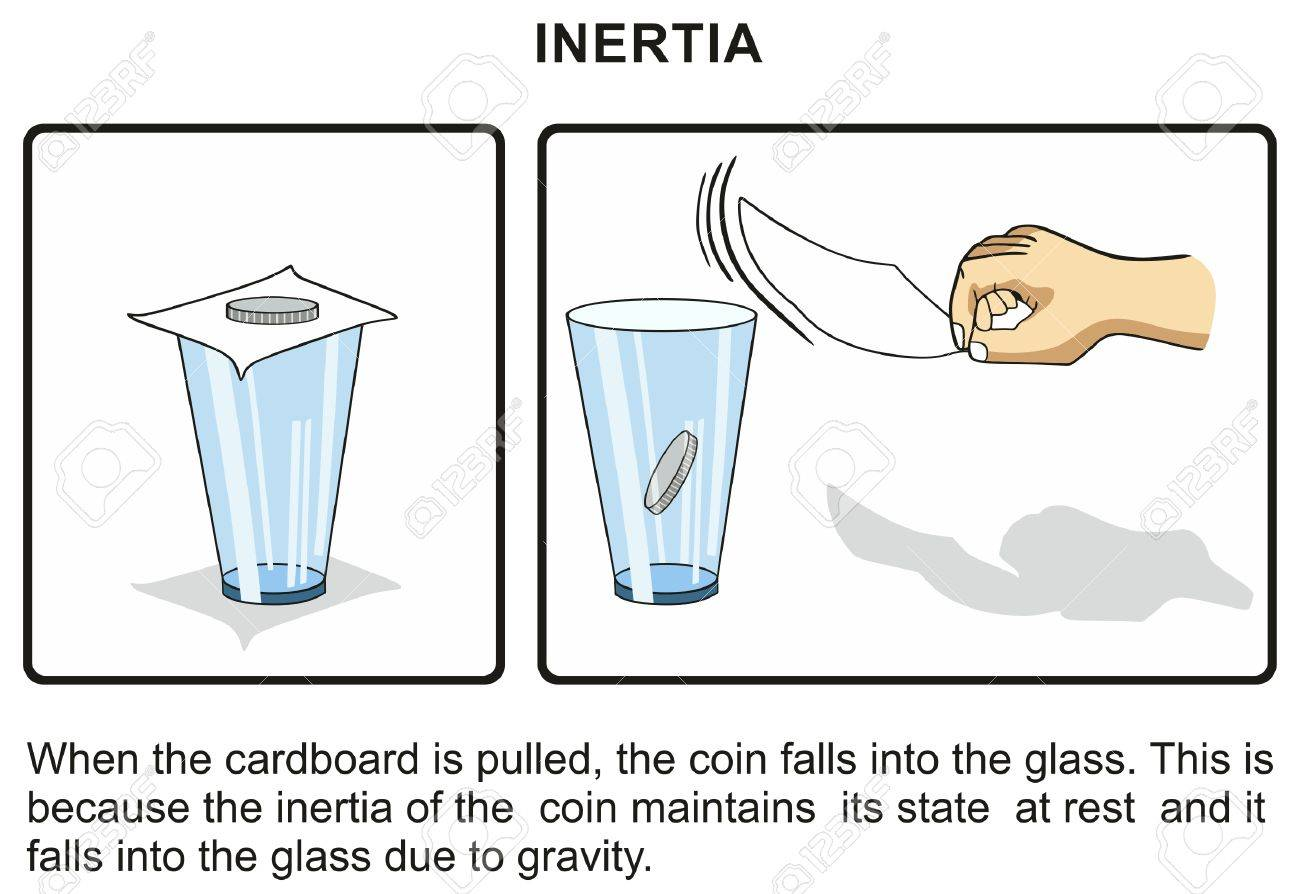
Why does the coin drop into the cup when the card is flicked away? (3 mark)
1 mark (definition): Newton’s first law states that an object will continue at rest unless acted on by an unbalanced force
1 mark (why? application): The coin is at rest and has inertia which resists the force imposed on it by the moving card
1 mark (what happens? application): The card moves away and the coin tries to maintain it’s rest position. It falls into the cup under the action of gravity
What does Newton’s second law of motion describe?
Acceleration is directly proportional to the net force
A particular mass will accelerate faster when acted upon by a greater net force
Mass is inversely proportional to the net force
If the same net force acts on a large and small mass, the smaller mass accelerates faster
When forces are balanced (net force = 0) the object will not accelerate
How is mass different to weight?
Mass is a measure of the amount of matter in an object (kg), and is constant regardless of location
Weight is a force (measured in Newtons)
It is a measure of the force exerted on an object due to gravity (the force with which the Earth attracts you to it’s centre)
How is weight different to gravitational force?
Weight is the gravitational force acting on an object whereas gravitational force refers to the attractive force between two masses, not just the force acting on an object near a planet
Weight is dependent on the object’s mass and the acceleration due to gravity (therefore Fnet = ma, W=mg)
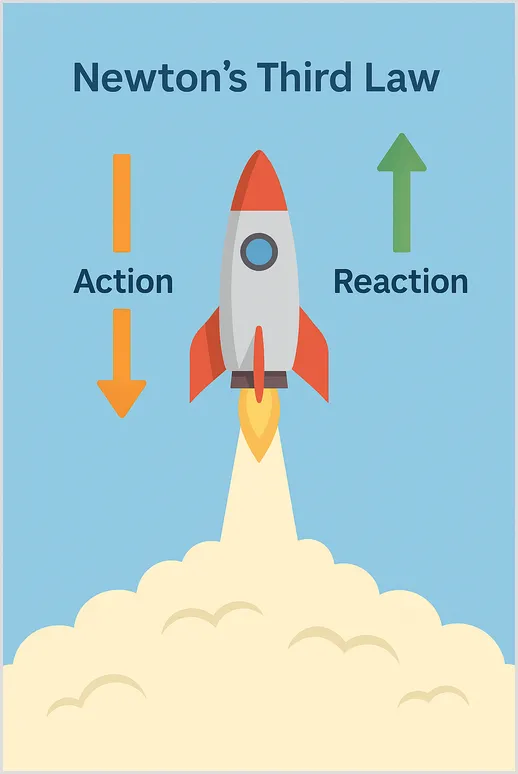
What does Newton’s third law of motion state?
When one object exerts a force on a second object, the second object exerts an equal but opposite force on the first
Every action has an equal and opposite reaction on different objects
How do objects accelerate if Newton’s Third law of motion says forces have equal and opposite reactions?
Although action and reaction forces are equal, they act on different objects and can produce movement when unbalanced
How do the earth and a rock form an action-reaction pair?
Action force: The Earth exerts a force on the rock downwards
Reaction force: The rock exerts a force on the Earth upwards
As the gravitational force of the Earth is much larger (unbalanced force) the rock accelerates at 9.81m/s2 (object accelerates in the direction of that net force)
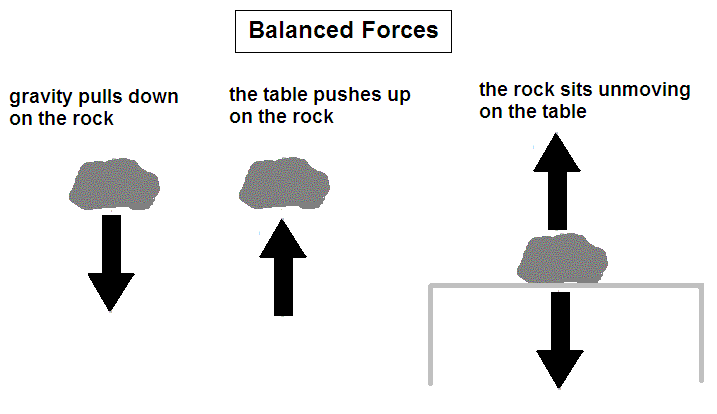
How do you get full marks for action-reaction pairs?
Clearly state both the action and reaction forces
Check they are on different objects
Demonstrate their effect on direction, such as acceleration or movement
EG Upwards/downwards, east/west, left/right, forward/backward
When is work done and what is it’s formula?
When a force is applied and movement occurs in the direction of that force
Energy and work have the same unit = Joules
W = force (N) x distance (m) = Joules
What is energy?
The ability to do work, measured in Joules
How is energy different to work?
Energy is a broader concept that is the ability to perform work, whereas work is the transfer of energy when a force causes displacement
Energy can exist in various forms, such as kinetic or potential, whereas work is done only when a force leads to movement in the direction of that force
What is kinetic energy (Ek)?
The energy an object possesses due to its state of motion
The faster an object movesm the more kinetic energy it has
EG An athlete running converts stored chemical potential energy into kinetic energy
Formula: 𝐾𝐸=21mv2 (mass = kg, velocity = m/s)
What is stored/potential energy?
The energy held by an object due to its position or condition
It can be converted into kinetic energy when the object is set in motion
What are some forms of stored/potential energy?
Chemical potential: Converted to other forms when reactions occur
Elastic potential: In objects that can be compressed or stretched
Gravitational potential: In objects where they have a position to fall under the force of gravity
Electrical potential
Nuclear potenial
What is gravitational potential energy (GPE)?
The energy stored in an object by virtue of it’s position above the Earth’s surface
It has the potential to do work asit can be converted into kinetic energy when the object falls
Formula: GPE = mgh (mass = kg, height above Earth’s surface (the displacement) = m, gravitational acceleration = 9.81m/s2 )
Therefore same as weight x height (as W=mg)
What does the law of conservation of energy state?
Energy cannot be created or destroyed, it can only be transferred or transformed into other forms of energy
How do you find velocity using the kinetic energy formula?
v=m2K from 𝐾𝐸=21mv2 (mass = kg, velocity = m/s, KE = J)
This calculates the speed of an object based on its kinetic energy